


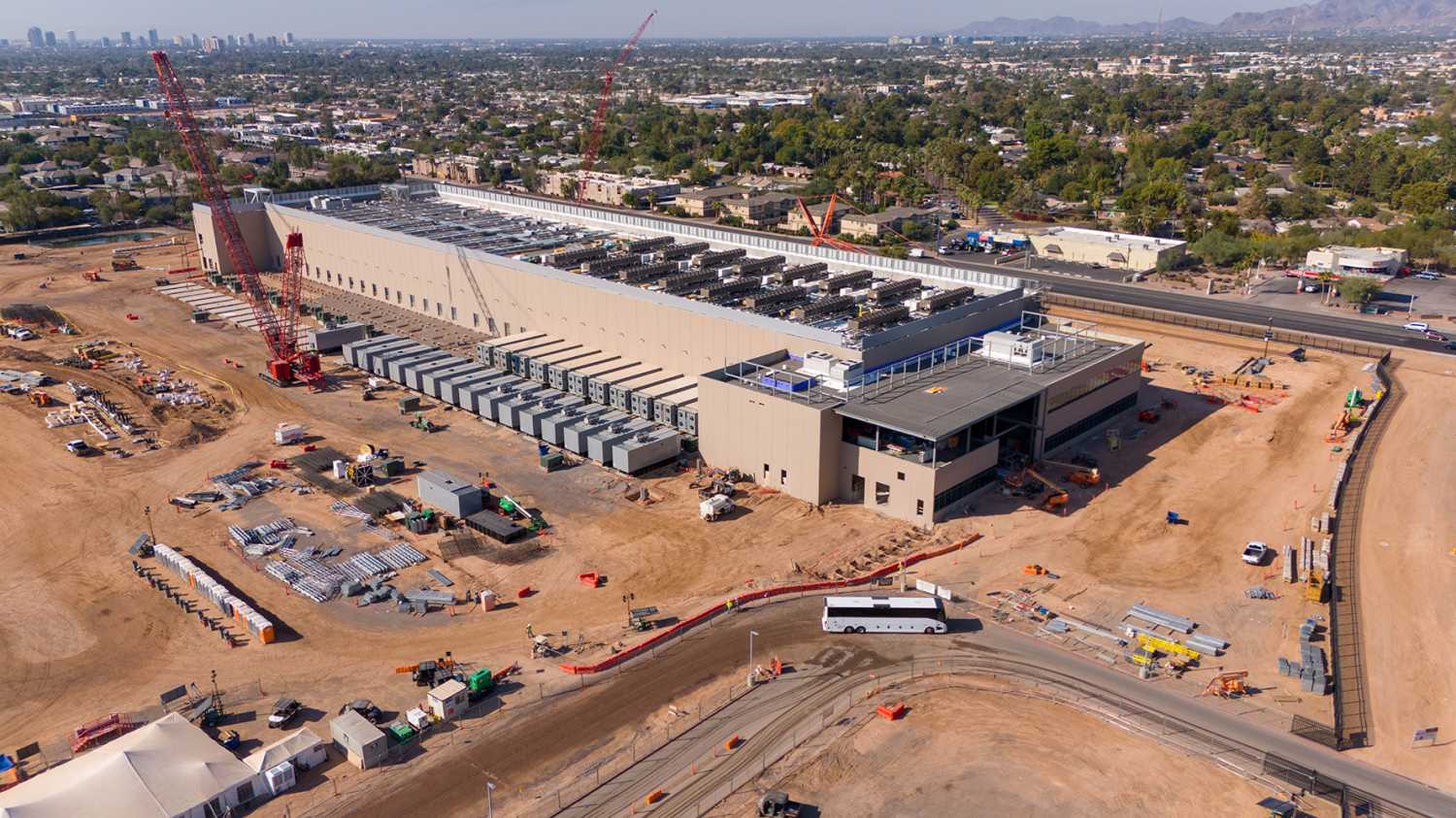
The AI goldrush roars on. Hyperscalers like Google and artificial intelligence (AI) upstarts like OpenAI continue to pour massive sums into building gargantuan data centers, often in small- and medium-sized communities.
As the deals proliferate, concerns are rising about the huge amounts of electricity and water required to keep the centers running. At the same time, pitched battles over zoning and permitting rules are pitting tech-firm developers against local land-use managers, especially in rural and exurban America.
Yet beyond such infrastructure and resource concerns, sharp debates are also engulfing the facilities’ core economic proposition for communities. Local leaders are questioning the credibility of Big Tech’s promises of spillover effects that will produce high-quality economic development beyond near-term construction. What’s more, skeptics are wondering about the veracity of the developers’ assurances of a thrilling new era of “reindustrialization” across Main Street America.
These debates raise fundamental questions: To what extent are the data center builders’ promises of economic development more than hype? And if these promises are more than hype, how can communities make sure these pledges translate into a durable local economic advantage?
As to the historical answers to those questions, they are mixed. Yes, data centers can contribute to local economic development, including by generating meaningful tax revenues. But for all that, the current, often-secretive site selection game tends to pit states and localities against each other, creating a fear-of-missing-out (FOMO) dynamic that limits creativity and leverage.
Given that, local elected officials are frequently rushed into hasty sprints to negotiate complicated power, permitting, and financial incentives with community benefits often tacked on at the end of the discussions only as a supposed sweetener or to counter community unease. As a result, few negotiations explore how siting for data centers can be leveraged into truly win-win partnerships for economic development—ones that unlock high-value tech opportunities in host regions while preserving hyperscalers’ and data center developers’ core business models and timelines.
All these issues suggest that the standard model for economic development involving siting deals for data centers needs rethinking, especially as the deals get bigger and the opposition to them grows more fraught. Governors, commissioners, and other elected officials across the country, in short, should insist on a more creative ecosystem-like view of the economic benefits that AI-related centers can deliver alongside the cloud services they provide. And for its part, the AI sector should truly engage with local communities because getting this model right can transform isolated data center projects into community-supported AI ecosystems that deliver with the speed and scale that the AI sector has promised—but not yet fully delivered.
The rest of this analysis contains two parts, then. First, it features a look at the current AI-supported data center opportunities that regions are facing. Second, it includes a playbook or set of scenarios for regional leaders who are negotiating with a range of data center developers and end users—including developers like Equinix and Digital Realty; newcomers like OpenAI, Anthropic, and CoreWeave; and established hyperscalers like Google, Amazon, and Oracle. Ultimately, the hope is to suggest routes toward truly mutualistic siting deals that truly benefit U.S. communities.
Moving beyond the standard calculus on data centers
The opportunities at hand reflect the urgency of today’s AI scale-up moment. Traditionally, data centers have been built as standalone industrial facilities designed to securely store, manage, process, and share large amounts of data for various digital services. Accordingly, the facilities have required major upfront infrastructure investments—including in large tracts of land, expensive server hardware, and reliable utility-scale power—while generating relatively few local benefits.
Accordingly, both developers and communities have treated data centers like warehouses—routine projects that produce a surge in short-term construction jobs followed by a steady stream of tax revenue without offering many direct contributions to or interactions with the local economy. In that sense, an out-of-sight, out-of-mind approach has been the preferred state for data center management.
As to their specific local impacts, the centers’ contributions have been mostly modest in the last decade. Data from the U.S. Chamber of Commerce’s Technology Engagement Center documented this trend. Using data from 2017, the chamber showed that economic benefits of a typical large data center decline substantially after the construction phase. Similarly, Table 1 below, which was reproduced from research in November 2025 by Michael J. Hicks, summarizes input-output model estimates from multiple studies and shows that long-term, operational employment is small relative to job creation during the construction phase.

In short, the standard model of data center development has produced mostly short-term construction jobs in recent years and relatively little long-term, high-value tech activity or large-scale employment. That is true, at least beyond a limited number of dense clusters in places like Northern Virginia and, more recently, Texas, where workers can easily and quickly move between multiple sites that are coming online.
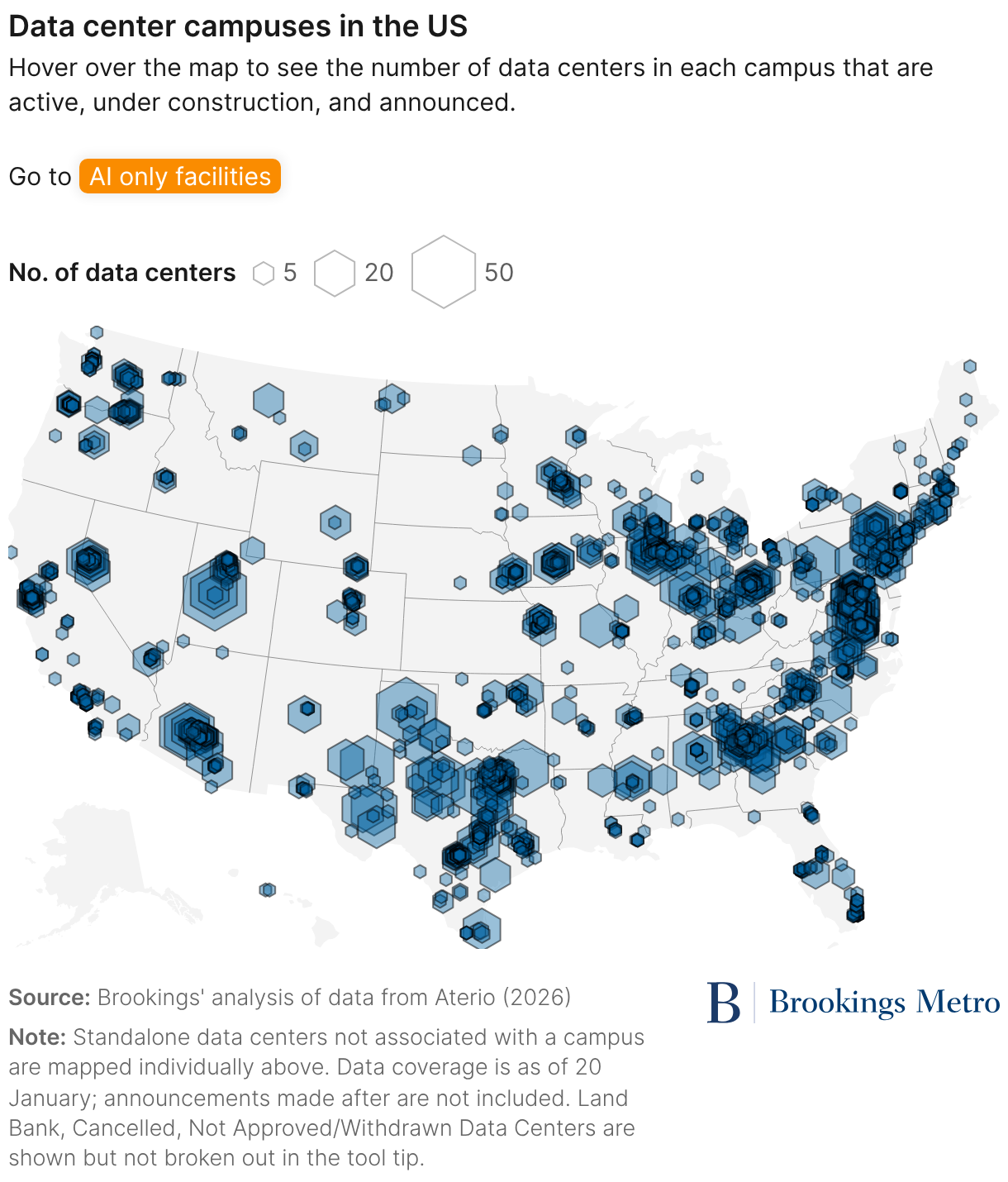
Yet now the ChatGPT era is disrupting the standard model. From the moment the AI titans committed to super-scaling their models to unprecedented sizes, they began to require unprecedented amounts of computing infrastructure to train and operate their datasets. What’s more, the faster the firms have sought to scale, the faster they have needed to strike deals with communities to build massive computing facilities, often in the face of increased local concerns about electricity use, noise issues, and other side effects (see Map 1).
These industry changes are shifting the balance of power. For years, data center development has pitted community against community in races to attract data centers and their perceived jobs. Now, the new frenzy of competition between the hyperscalers themselves (and other actors) for the biggest sites with the best power connections has given communities at least a sliver of their own leverage to shape AI-focused data center deals into more forward-looking, mutually beneficial development projects.
In that vein, more regions have a chance now to wield their leverage over siting-game rights in ways that engage data center developers to become partners in a given region’s own AI readiness strategies. These areas for engagement with Big Tech might involve advancing a local agenda for enhancing high-tech talent initiatives at local institutions and schools. Alternatively, they might involve securing abundant computing resources for local academic work from an incoming hyperscaler, or they could entail enlisting partnerships in other forms of R&D at local universities, startup companies, or entrepreneurial energy companies.
In any event, regions have a legitimate opportunity now to leverage the data center gold rush in support of building up true local tech clusters. With AI centers spreading across the country and with more being announced daily, more regions should weigh their opportunities to leverage these data centers to attain true local benefits.
Exploring new avenues for economic development driven by data centers
Delving deeper into the current AI moment, it is possible to see the first outlines of a more valuable buildout of data centers coming into focus on its own—in a way that helps regions gain benefits that meaningfully support the development of local tech ecosystems.
Even allowing for a degree of hype, the hyperscalers’ urgency to close deals has already driven several announcements in the last year in ways that suggest how data center agreements could—with greater levels of intentionality—more meaningfully benefit local communities’ economic development.
As a matter of high-level rhetoric, for instance, OpenAI’s update last year to its “AI in America” economic “blueprint” statement set out a useful high-level vision of community gains. It proposed the creation of “AI Economic Zones”—government-industry development areas where permitting is expedited in exchange for substantive commitments to local high-tech development. As part of that proposal, the firm floated the idea of creating as part of siting commitments local “AI research labs” and workforce pipelines “aligned with key local industries.” To that end, the firm spoke about making available “meaningful amounts of compute to public universities” and “equitably scal[ing] the training of a homegrown AI-skilled workforce.”
For its part, the U.S. Department of Energy (DOE) is promoting opportunities to accelerate the development of data centers on lands belonging to national laboratories while prioritizing public-private partnerships to enable the development and use of such infrastructure by local institutions and the sharing of compute resources back with the national lab research teams. Sixteen locations have been nominated for such collaboration by the DOE.
At the same time, several real-world data center operators are demonstrating elements of a more symbiotic development stance. Notably, Microsoft’s launch of a major AI data center in Mount Pleasant, Wis., is bringing about meaningful investments in the state’s broader tech ecosystem (see Map 2).
Simultaneous to the data center project, Microsoft is partnering with the University of Wisconsin-Madison to accelerate scientific discovery through its AI-driven Microsoft Discovery platform, an agentic AI tool for R&D. Likewise, Microsoft has helped to open a manufacturing-focused AI Co-Innovation Lab on the campus of the University of Wisconsin-Milwaukee to leverage AI adoption in the manufacturing sector. As of the fall of 2025, the lab had helped several dozen Wisconsin companies—including Regal Rexnord, Renaissant, and BW Converting— practically adopt AI development ideas. In addition, Microsoft is partnering in Racine, Wis., with Gateway Technical College to launch Wisconsin’s first Datacenter Academy to train more than 1,000 students in five years for high-demand data center roles. Across the state, the firm and more than 40 partners like the United Way, the University of Wisconsin, and the Wisconsin Technical College System have worked together with Gener8tor to train 114,000 Wisconsinites in AI. Complementing this work, the hyperscaler recently launched a national agenda to build “Community-First AI Infrastructure,” which includes investments in local training, job creation, and nonprofits along with commitments to cap electricity and water demands.
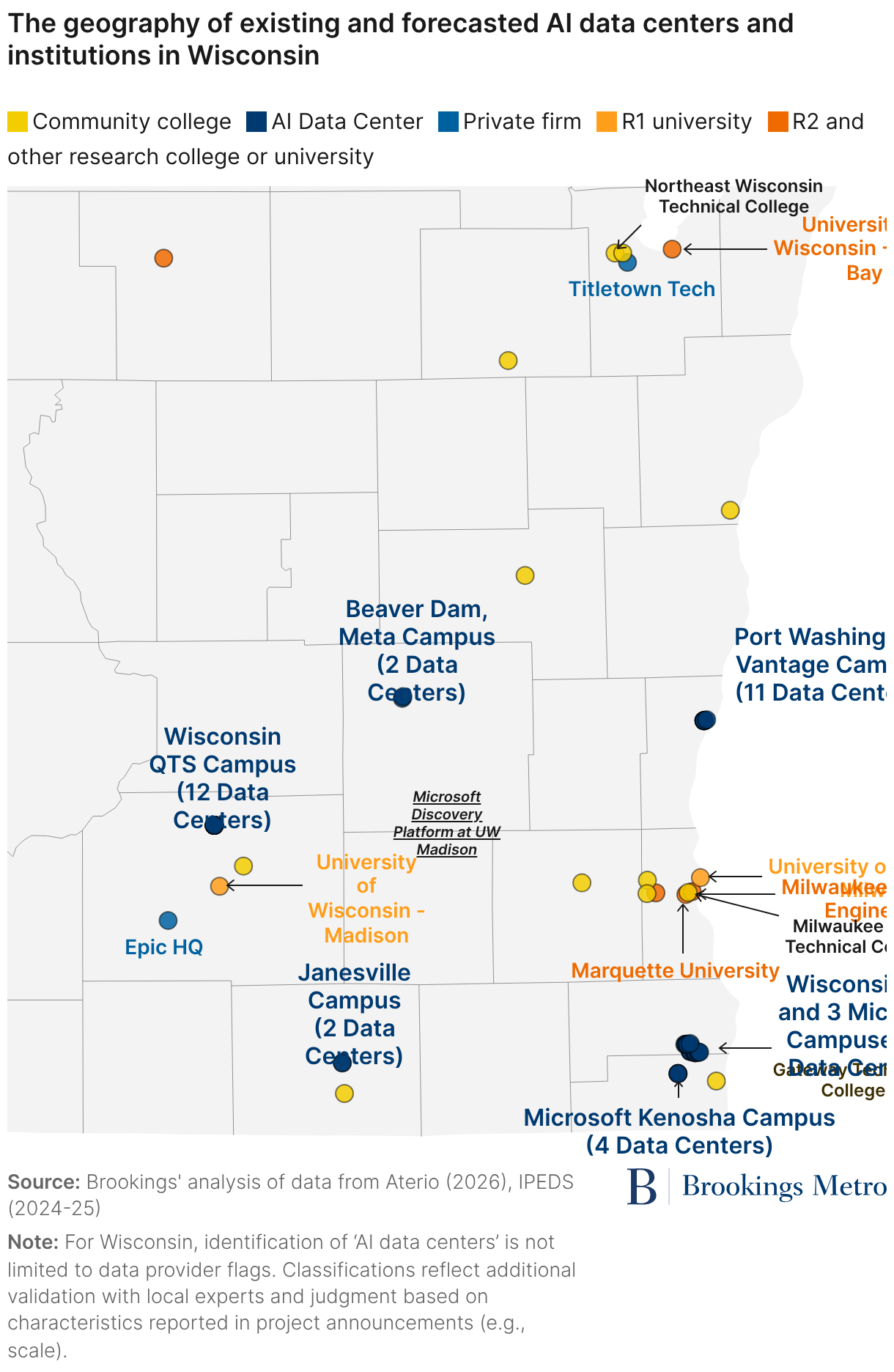
And other actors are following suit in Wisconsin, seeking to link the construction of data centers at least somewhat to higher-value economic benefits. OpenAI’s Stargate campus in Port Washington, Wis., for example, will generate more than 1,000 long-term jobs according to Open AI, and the campus will “be water-positive, using closed-loop cooling that requires minimal water, and supporting local projects that restore more water than the campus uses.” This seems to be a starting point for delivering on the firm’s larger reindustralization mission.
And so, without fully reorienting the data center game, OpenAI’s words in its blueprint document and its early actions in Wisconsin as well as Microsoft’s decade-plus of activities in the Badger State (home of the firm’s Vice Chair and President Brad Smith) point in a needed direction. This new approach to the development of data centers does not yet comprise explicitly negotiated alignments or a new standard framework, but a new approach has begun to emerge organically.
Reimagining success: Leveraging data centers to scale up regional tech hubs
The problem is that the Open AI and Microsoft announcements, while encouraging, aren’t yet translating into widespread change on the ground. Most data center deals continue to reflect the standard model of one-to-one, highly asymmetric face-offs between Big Tech and local governments. For the most part, elected officials (cowed by a sense of FOMO) take the first deal offered or only negotiate around the edges rather than treating data center negotiations as a core opportunity for higher-value development. The result is more of the standard dealmaking that’s been around for years.
So, what would it take for regions to enlist the development of data centers in their most ambitious aspirations of building high-value local economies? To start with, regions need to marshal the high levels of focus and alignment that Joseph Parilla and Mayu Takeuchi show have characterized the shift of leading-edge communities from “traditional” to “transformational” approaches to economic development. In this vein, Parilla and Takeuchi document how the Syracuse, N.Y., region’s clear set of high-level strategic priorities has helped it obtain stellar local outcomes from a recent $100 billion semiconductor siting by Micron Technology.
At the same time, states and regions need to ask for more, recognizing that they have more clout today than they did five years ago. Most notably, data center developers—faced with too few mega-sites, too much backlash, and sharpening battles with their competitors to secure previous land and approvals—are finding they need to give a little to get deals done. For their part, more communities and states are remembering that their land, infrastructure, approvals, education systems, and worker training organizations are precious. In doing so, they should be and increasingly are elevating their aspirations for siting deals that remain at base asymmetric face-offs with huge tech firms and hard-driving developers. Given that, county executives, local and regional development officials, and governors need to have some game-changing scenarios in mind.
What follows, then, are some initial tenets for such a playbook aimed at enlisting AI data center investments into higher-order economic agendas.
Structure negotiations as opportunities to unlock regional economic development rather than merely as chances to deliver narrow data center deals.
Challenge: Too often, data center deals play out as single-project siting games that pit giant developers in narrow negotiations with local governments. This mindset results in deals that focus on an important but circumscribed set of issues (electricity, water, and zoning) but leave out larger questions of regional advantage such as higher-value tech benefits and gains for the broader technology ecosystem.
Opportunities: In contrast, the controversy and competitiveness of new data center sitings mean that regions and states have a chance to negotiate harder for a broader set of benefits aimed at supporting their boldest economic aspirations in sectors where a given region has a competitive advantage. In that vein, more communities have the leverage to trade expedited permitting and approvals for substantive gains that truly advance the region’s goals, whether that involves donations of compute to local universities, R&D partnerships, support of local talent programs, or investments in AI startup intermediaries. Nor do these gains need to be broached as mere deal sweeteners or appended community benefits. Instead, communities can now argue for strategic benefits like these as core elements of any deal, given the increasingly challenging atmosphere surrounding such deals and the overstretched, specialized workforce needed to build these sites. Regions should therefore broaden their agendas.
The focus, meanwhile, should be on sectors where a given state or region has the right to win. For example, shouldn’t Michigan’s self-driving car companies be an attraction and point of collaboration for the hyperscalers and regions in that state? Or can OpenAI develop custom models (and provide technical support) that meet the needs of manufacturers in Wisconsin as part of a grand bargain there? Striking these types of partnerships can benefit both hyperscalers and regions by advancing key AI use cases from the theoretical to the actionable in the eyes of community members. An additional benefit is that such corporate partnerships can be leveraged in applications for future federal, state, or regional competitions such as the U.S. Economic Development Administration’s Tech Hubs Program or the National Science Foundation’s Regional Innovation Engines awards.
Examples: What might this look like, results-wise? In many respects, the tech ecosystem emerging in southeastern Wisconsin provides an aerial view of the kind of regional benefits creative management of data center negotiations could help yield. There, Microsoft’s recent announcement of 15 more data centers in Mount Pleasant follows on the heels of the firm’s multiple continued investments in workforce development, R&D, manufacturing, and tech startups. While not negotiated in overarching grand bargains, the coinciding of data centers and new tech ecosystem developments points in the right direction.
For its part, CoreWeave is taking a similar approach in its home state of New Jersey, where it is building multiple data centers while serving as a founding partner of the NJ AI Hub with Princeton University, N.J.; Microsoft; and the New Jersey Economic Development Authority (NJEDA). CoreWeave worked together with the NJEDA to invest $20 million into emerging startups as a part of this effort. While not directly tied to the NJ AI Hub, former Governor Phil Murphy and his economic development team intentionally structured carrots that made it attractive for CoreWeave and other AI companies to make similar bets in New Jersey. The former governor pushed new state legislation that offered AI companies up to $250 million in tradeable tax incentives built around mega deals in return for making similarly sized investments back into New Jersey’s tech ecosystem with a focus on collaborative partnerships. These prospective partnerships could, according to the statute, be “between an eligible business… and a (1) New Jersey-based public or private research university or universities; (2) [New Jersey-based] technology startup company or companies; or (3) [New Jersey-based] incubator(s), accelerator(s), [or] studio(s).” In practice, the governor receives a pool of flexible economic development funds that he or she can redirect to high-priority areas (without a new piece of legislation), while the AI company secures an invaluable tax credit and public relations benefits, making them feel like winners in the process too.
Neighboring Michigan has a similar opportunity to add to this new style of playbook, in light of OpenAI’s new Stargate data center down the street from Ann Arbor, Mich.; the University of Michigan’s partnership with the Los Alamos National Laboratory on a joint AI research center in the state, and the university’s inclusion in OpenAI’s NextGenAI research partnership.
Convert AI investment into local wealth creation, moving from a community-benefit model to a shared-prosperity model.
Challenge: Large, complex sums of private capital are surging into data center projects, enlarging unicorn AI companies, supporting infrastructure, and leading to multi-billion-dollar announcements. On the infrastructure side, investors capture most of the upside once project buildouts are completed and stabilized. For their part, by contrast, communities typically receive limited community-benefits agreements at the outset, while over the long-term, tax payments from data centers are largely invisible to residents—both in terms of how much is paid and how local governments ultimately spend the funds. These dynamics are creating an infrastructure wealth gap.
Concurrently, in-state university endowments, community foundations, and state pension funds have deep financial pockets and are looking for impactful opportunities for double-bottom-line investments. However, it is very difficult for universities (and states) to secure access to compute, toolsets, and the world-class large-language models that are largely being built in for-profit labs. Meanwhile, these same for-profit labs, backed by significant venture capital investments, are often poaching top talent from compute-constrained academic labs.
Opportunities: Given these deficits of local financial participation, a two-fold opportunity for local wealth participation exists here: Communities should become participants in real estate deals for data centers, and universities and states should participate in large and small funding rounds for AI startups. On the real estate side, communities or community-designated entities should seek to co-invest in AI-related real estate deals alongside developers of data centers. Both parties (impact investors and data center developers) would commit to transferring a portion of their illiquid equity shares into a separate fund called a community equity endowment (CEE). If (and only if) a given project is successful, then a portion of any windfall financial returns would be distributed to community members via the CEE, with direct community oversight on the uses of funds. The community shareholders could collectively decide if they wanted to use their CEE allocation to introduce universal basic income programs, develop a fund for one-time emergency expenses, provide micro-grants to small businesses, or even develop programs like local baby bonds. Citizens in the surrounding community could receive their shares as cash or compute, with the ability to use their personal compute allocation on their own projects at nearby OpenAI Academies (like the ones proposed by OpenAI in their Stargate Community plan) and at local small business hubs. As outlined in the aforementioned CEE white paper, the benefit of this model is that community members get the advantage of an “inheritance… linking their personal financial opportunity to a project’s success, without their needing to have the means to invest in the project.”
In a parallel fashion, universities and states should seek to participate in AI players’ super-sized fundraising rounds, perhaps by asking for early access to cutting-edge models for their researchers in exchange for their investment. Using this approach, AI companies (at the scale of Anthropic and OpenAI), or smaller, high-growth companies, receive an inflow of much-needed capital and the ability to train their models on university datasets. Universities, meanwhile, receive near-term access to compute, which is critically important to their faculty recruitment and retention and broader R&D efforts. In the long run, universities can hold equity stakes in increasingly valuable companies, hoping to replicate Stanford’s windfall from its early equity stake in Google. OpenAI even suggested pursuing this partnership approach in their June 2025 paper entitled “Ideas to Power Democratic AI.”
Examples: These investment models may seem ambitious, but they are already happening in the wild. For decades, the citizens of oil-, mineral-, and gas-rich states like Alaska and North Dakota have received direct payments from oil revenues, through state-operated entities like the Alaska Permanent Fund and the North Dakota Legacy Fund. More recently, New Mexico created a $7 billion fund for universal childcare, using endowment revenues from the oil and gas industry. More sophisticated investment models are starting to take shape in the data center and venture capital spaces. The O.H.I.O Fund is actively investing in growth-stage startups and real estate projects for data centers in the state. The fund’s general partners have proactively committed to donating 25% of the general partnership’s profits to a newly formed Ohio Fund Foundation, focused on supporting community and economic development efforts. Emerson Collective, whose chief operating officer is a co-author of the CEE paper, is building a community hub in Southeast Washington, D.C., adjacent to the new WNBA basketball arena, aiming to bring this innovative real estate product to life.
On the direct private investment front, several foundations and innovative pension funds are already investors in AI companies. These arrangements range from the Emerson Collective’s investment in OpenAI to the Ford, Kapor, and Cummings Foundations’ positions in Anthropic to Ontario’s Teacher Pension Plan and its investment in Anthropic. It is also rumored that several university endowments are direct investors in these companies, building upon Washington University in St. Louis’s strategy of direct investing in the most promising startups from their endowment’s venture capital portfolios. Tying such investments to useful regional ecosystem development commitments looks like a very real strategy for communities.
Develop regional testbeds for collaboration between local academia, startups, and data center operators.
Challenge: Data center operators and AI companies tend to operate clandestinely. As discussed earlier, data center operators negotiate these deals quietly through site selectors, and then, once projects are up and running, they oversee and manage massive amounts of confidential data. As such, they severely limit access into and out of their data center campuses. This model makes it very hard for university researchers and startup companies to forge partnerships in a live data center environment. States and municipalities are subsidizing large projects to the tune of billions of dollars without unlocking any of the R&D innovation occurring within these AI factories.
Concurrently, AI companies are deploying increasingly large sales teams to sell products and give away software to universities, state and local governments, teachers, journalists, and even startup companies, who might become the next big thing. AI and chip companies, like Nvidia and OpenAI, want startups to build on their proprietary AI rails. The current approach is that these companies provide heavily discounted or free tools (such as ChatGPT or Claude) and API calls in the early days to encourage tech lock-in.
Overall, piecemeal approaches are complicating cohesive adoption. For example, universities are regularly involved in negotiating data center deals for their on-campus computing needs while concurrently negotiating research agreements with Microsoft and OpenAI for cloud credits and research collaboration, yet communication is not necessarily occurring between the teams involved in those efforts. Additionally, pilot projects are often narrowly structured and miss out on opportunities to build broader, replicable forms of collaboration that unlock meaningful ecosystem value. For example, Maryland has partnered with Anthropic and the Rockefeller Foundation to deploy proprietary AI tools inside state agencies—focused on improving service delivery and eligibility navigation for programs like the Supplemental Nutrition Assistance Program; Medicaid; the Special Supplemental Nutrition Program for Women, Infants, and Children; and temporary cash assistance. However, the state’s collaboration with Anthropic is disconnected from its efforts to attract data centers. It is also missing an opportunity to intersect with the research and educational work of its largest anchor institution, Johns Hopkins University, which is investing significant funds into a Data Science and AI Institute, which will drive an infusion of AI talent into the region and require large amounts of compute.
Opportunities: Yet there are opportunities here, too—if mindsets shift. States working with universities and other actors can and should develop the negotiating muscles, infrastructure, and whole-of-government approaches needed to ask AI negotiating partners to commit to organizing AI-related pilot programs and testbeds as a condition of incentives for data center buildouts. By incorporating phased asks into these negotiations (such as calls for tech pilots, shared compute, and other benefits), states and regions can transform their interactions with the AI sector from a series of disconnected, isolated data center projects into AI hubs.
What could this look like? Regions could launch R&D testbeds—co-financed by builders of data centers in partnership with universities, states, or nearby national labs. Likewise, communities could build on and expand on the largely proprietary collaboration models employed by Open AI, Anthropic, and Nvidia—which are not readily accessible to most academic and startup partners. In this way, new facilities would allow local startups to validate technologies before deployment in live AI factories, while encouraging more applied university research and attracting startups to participating regions. Successful pilots—in partnerships with tech giants like Microsoft, Nvidia, and OpenAI—would help hyperscalers adopt new technologies faster, let startups scale up their operations, and lead to advanced market commitments. States could use innovation vouchers and compute vouchers to incentivize the large companies and startups participating in such programs to do some of this R&D work at nearby campuses, creating a self-sustaining flywheel effect.
Along these lines, testbeds supported by data centers could:
- Develop and deploy of next-generation liquid cooling systems and advanced materials hardware to materially reduce the energy intensity, operating costs, and national security risks of large-scale data centers;
- Engage local universities and labs in the design and commercialization of novel semiconductor chips and chiplet architectures; and
- Link local quantum-enabled computing clusters with data center environments.
Examples: The testbed model is gaining significant traction in Europe, including in the United Kingdom (UK), through the creation of supercomputing campuses, which facilitate cross-sector partnerships and often provide free or discounted computing to the most promising startups. In addition to creating AI Growth Zones, the UK developed the National Quantum Computing Centre (NQCC), an effort to bring quantum into data center environments, investing 30 million pounds to establish seven quantum computing testbeds, all built by quantum hardware companies at NQCC facilities. Meanwhile, European Union (EU) officials are working closely with Europe’s most promising AI startups like Mistral AI on startup support programs within state- sponsored computing facilities and on commercial deployments that bring together AI-native firms like Nvidia and homegrown companies, with financing from the French national investment bank. In conjunction with a recent announcement about a large-scale data center campus in Greece, OpenAI structured an agreement with the Greek government to develop a Greek AI accelerator program with Endeavor Greece providing OpenAI credits and technical support. The memorandum of understanding between the government and OpenAI also included a third signatory, the president of the Onassis Foundation, who is co-investing in efforts to introduce AI education and tools into Greek schools.
Finally, promising efforts are getting off the ground in the U.S. with the creation of the Massachusetts AI Hub, through the Mass Leads Act. The act commits $100 million to a new nonprofit called the Massachusetts Green High-Performance Computing Center, which is a testbed data center built in partnership between the AI industry (including Dell Technologies, VAST, and Nvidia) and academic institutions. Six universities from Massachusetts and Connecticut already have signed on, including Boston University, Harvard, the Massachusetts Institute of Technology, Northeastern, the University of Massachusetts system, and Yale. Notably, the center is based in Holyoke, Mass., rather than the tech epicenter of the Boston and Cambridge area, which shows how these innovations can spur activity outside of core urban centers. This was an intentional effort by Massachusetts Governor Maura Healey’s team to stay competitive with Silicon Valley in the AI talent agglomeration race while distributing the benefits of such innovation across the state.
Turn AI firms’ demand for energy into a regional R&D driver using new energy procurement tools and grid stabilization policies to develop a future-leaning energy economy.
Challenge: Companies operating large-scale AI models have significant and growing energy needs to power their computing infrastructure. There are mounting, legitimate concerns about how these energy requirements will stress the grid, increase households’ energy bills, and lock communities into an energy stack that is heavily reliant on gas turbines and non-renewable energy sources (at least in the short term).
At the same time, governors must make tough choices about what technology, energy, or other sectors they should prioritize and how to double down on their investments in those areas. When negotiating with emerging and large AI companies, states should focus on making asks in critical sectors where they have a competitive advantage, including opportunities to become emerging hubs for energy innovation.
Opportunities: By thoughtfully partnering with energy companies, utilities, and regulators, governors can reduce the risks of data center projects and the environmental and financial costs to their states’ citizens while simultaneously establishing their states as hubs for energy innovation. In that vein, novel partnerships designed to address data centers’ energy demand could vary widely and include the following aspects.
- Models where energy companies, hyperscalers, and utilities jointly share the cost and risk of new projects;
- Activities undertaken by governors, legislators, and local leaders to minimize rate payer risk, including opportunities for energy companies to support these efforts (financially or through other innovative capital stack models);
- Forward-looking research and development (R&D) and partnership strategies to pilot emerging technologies (including nuclear, geothermal, and other forms of energy) and grid stabilization platforms.
To bring this kind of cooperation to life in a win-win manner, a state could offer a hyperscaler expedited approvals and permitting on a project in exchange for commitments to areas like the following examples:
- Reduced energy usage during periods of peak usage;
- Jointly funded pilots of AI-driven technologies that shift loads and energy mix during peaks and lulls in data center activities, while giving opportunities to locally sited data centers and proposed testbeds to incubate and stress-test these models;
- Economic development commitments that expand beyond traditional short-term construction jobs;
- Market commitments and conditional purchase agreements with geothermal and nuclear companies that are building projects within a given state, as a way to allow states to invest in new technologies and finance pilot projects without sticking ratepayers with the future bill; and
- Commitments and investments that replicate at the state scale the arrangements emerging AI companies are making with federal agencies and national labs, such as Anthropic’s commitment to the Department of Energy’s Project Genesis or OpenAI’s and Nvidia’s agreements for sharing supercomputer and model resources with national laboratories.
Examples: Innovative pilots of new technologies, financing, and approval models are already taking shape in a growing number of states as the demand for new solutions grows. On grid stabilization models and pilots, Nvidia has already announced a new data center project with the developer Digital Realty and the startup Emerald AI in Virginia. The project is a testbed for the new approach. Emerald AI’s software focuses on quickly and temporarily shifting AI workloads downward during high-stress moments for the energy grid. The Federal Energy Regulatory Commission is taking notice too, calling for large grid operators like PJM to incorporate “enhanced load forecasting and demand flexibility measures.”
On emerging technologies and creative financing models, Google is partnering with a startup called Fervo Energy in Nevada, which has developed new technology for harnessing geothermal power. The project has the capacity to generate 3.5 megawatts of power and will feed electricity into the local grid, which serves two of Google’s data centers outside of Las Vegas and Reno. This in turn makes Nevada a new testbed for energy innovation and financing, given the use of a Clean Transition Tariff, a first-of-its-kind rate structure. To execute the pilot, Fervo is bringing skilled scientific talent into the state and developing apprenticeship programs with neighboring Southern Utah University (home to a second Fervo project), which leads to knowledge spillovers and a stronger research ecosystem.
Relatedly, regional actors are working to leverage fast-track approvals for data centers as incentives for stronger economic development benefits. ComEd, a utility in Illinois, for example, is working with the state, its economic development agency, and regulators to create a new tariff model where data center projects with an outsized economic development impact can get a fast pass for approval if that project has been formally designated by the Illinois Department of Commerce and Economic Opportunity or another unit of Illinois’s state government. To participate, ComEd is requiring data centers to make higher deposits and to post collateral in case “loads and revenues do not materialize as planned.” This approach creates a meaningful incentive for utilities, data centers, developers, and companies to develop activities that promote the emergence of regional AI hubs rather than isolated data center islands. For its part, Pennsylvania last year announced major data center deals and grid modernization efforts totaling $90 billion. However, the deals also enshrined the development of an AI-oriented regional cluster as a goal and sought concessions from the AI industry to support it. Quietly tucked into the announcement with President Donald Trump hosted by Carnegie Mellon University (CMU) were $2 million in commitments from Anthropic to provide cybersecurity education to middle and high school students in Pennsylvania and funding for energy research at CMU, which is increasingly becoming a nexus of AI, energy, and industrial innovation.
Conclusion: Summing up the shift
The standard model of data center siting—based on asymmetric face-offs, fraught battles over electricity, and questionable long-term economic benefits—may be giving way to an alternative model of at least partially shared gains for host regions.
Deals that have for years seen powerful tech firms set the terms almost unilaterally show signs of shifting. Stiffer competition among developers for limited land and harder-to-win approvals may be giving regions more leverage. Recognizing that, Big Tech and AI upstarts have dialed up their stories of corporate citizenship and a future world where AI is a “force multiplier” for local transformation and shared prosperity.
At the same time, more regions have been lifting their aspirations on economic development in recent years. They are focusing more on their own high-value industrial and technology development goals. They are seeking to build their own regional tech ecosystems on their own strengths and local industry specializations. As they do, more of them may be emboldened to ask the developers of data centers for more: more electricity and water assurances, more engagement locally, much more high-value, high-tech economic development, and more workforce development.
In that vein, states and regions are beginning to remember that their land, approvals, infrastructure, water, and electricity are invaluable. As they do, they—and in time, industry actors—may well soon come to believe those important AI resources should be shared only as part of grand bargains that deliver true, high-value economic development to the regions that provide them.
Authors
-
Acknowledgements and disclosures
Daniel Goetzel is a fellow at the Reimagining the Economy Project at Harvard and the President of Chalant Strategies. He previously served as a program director in the National Science Foundation’s Technology, Innovation and Partnerships Directorate, where he developed and launched the NSF’s Regional Innovation Engines program. He also spent time at the U.S. Department of Commerce where he was a senior advisor for investments working across the Economic Development Administration and CHIPS R&D portfolios. Since leaving government, he has advised a mix of universities, venture funds, and regional ecosystems. In his post-government life, he has worked with the University of Wisconsin-Madison, the venture capital fund Maverick Silicon, Johns Hopkins University, and an emerging hyperscaler—all of which are referenced directly or indirectly in this piece.
Amazon, Google, and Microsoft are general, unrestricted donors to the Brookings Institution. Nvidia previously funded the institution but was not a current donor at the time of publishing. The findings, interpretations, and conclusions posted in this piece are solely those of the authors and are not influenced by any donation.
The Brookings Institution is committed to quality, independence, and impact.
We are supported by a diverse array of funders. In line with our values and policies, each Brookings publication represents the sole views of its author(s).