
This report is one of three case studies produced as part of the Strengthening Pedagogical Approaches for Relevant Knowledge and Skills (SPARKS) project.
Executive summary
This report describes a comparative case study that investigated how culture, education ecosystems, and preferred learning theories, collectively referred to as Invisible Pedagogical Mindsets (IPMs), impact the implementation of Education 2.0 reform in Arabic-language classrooms within a government public school and an autonomous community school in Egypt.
The study’s findings reveal that the IPMs serve as a filter for how teachers experience Education 2.0 in their daily classroom practice.
- Culture. In both schools, Arabic-language teachers viewed their work as a moral and relational responsibility. They saw themselves as custodians of language and culture, responsible for shaping students’ character and sense of belonging while meeting exam pressures and curricular demands. This dual role generated tension between fostering creativity and fulfilling performance targets. Teachers’ commitment to their students and communities was strong, but the curricular framework and incentives systems rarely acknowledged or supported this ethical and emotional labor.
- Education ecosystem. Teachers’ ability to apply Education 2.0 principles depended heavily on school conditions and management structures. In the public school, overcrowded classrooms, rigid inspection systems, and seniority-based promotion discouraged innovation. In contrast, teachers in the community school benefited from smaller classes, collegial mentoring, and locally driven decisionmaking, fostering greater autonomy. In both schools, short-term contracts and compliance-oriented accountability systems undermined teachers’ motivation.
- Learning theories. Most teachers supported Education 2.0’s vision for student-centered, competency-based teaching, but found that Teacher Professional Development (TPD) did not model the approaches it promoted. Training remained largely theoretical, detached from classroom realities, and focused on procedural compliance rather than reflective practice. TPD workshops rarely included opportunities for follow-up, coaching, or classroom experimentation. As a result, teachers struggled to translate the pedagogical approaches outlined in Education 2.0 into classroom practices.
The study’s findings point to a central challenge: translating reform vision into practice requires rethinking how teachers are prepared, supported, and trusted to implement pedagogical changes in classroom practice. Based on the findings, the report provides three recommendations for policymakers and other education ecosystem actors:
- Reframe TPD to emphasize reflection and ongoing growth. To enhance the impact of TPD, tie program completion to promotions, recognition, and financial rewards. Ensure teachers have a voice in shaping and evaluating TPD, foster peer-led communities of practice that promote collaboration and professional trust, and introduce an Arabic-focused TPD program that integrates literacy, identity, and culture through immersive, hands-on learning and is reinforced by extracurricular reading and writing initiatives that build foundational skills.
- Strengthen institutional support and autonomy. To promote coherence and sustainability in TPD, establish a dedicated coordinating body within the Ministry of Education (MoE) to align all initiatives—domestic and donor-supported— under a unified strategic framework, guided by a representative policy committee that includes teachers and regularly reviews progress. In parallel, align curriculum and staffing structures through a comprehensive mapping study to identify gaps between vision and practice, adjust teacher allocations for multidisciplinary subjects, encourage collaborative teaching, and streamline assessments to create space for reflection and innovation.
- Align curriculum and assessment with competency-based learning. Reorient evaluation for learning by redesigning student and teacher assessments to reflect the principles of competency- based learning. Redefine the inspector’s role to emphasize pedagogical coaching, providing mentorship and formative feedback while maintaining accountability. Build feedback and trust mechanisms by establishing channels for anonymous teacher input on inspection practices and introducing peer evaluation systems that encourage continuous improvement and shared responsibility.
Authors


Related Content

-
Acknowledgements and disclosures
First, we would like to acknowledge the support, participation, and contributions of the Egypt Research Policy Collaborative, formed as part of the SPARKS project. We extend our sincere gratitude to the members of the SPARKS Global Network for their invaluable support and feedback over the past two years.
We offer our heartfelt thanks to Nehal ElSouheimy and Nehal Omar for facilitating an inspiring arts-based workshop and exhibition with teachers, and to Mona Abdelmoneim for her outstanding communications leadership. Our appreciation also goes to the Foundation for Self-Discovery and Development (FSDD) Board of Trustees, especially Hussein ElHajj, for supporting this partnership from its inception, and to Ebtehal ElGhamrawy for her openness and belief in this work.
We are also grateful to our reviewer Dr. Linda Herrera and colleagues at the Center for Universal Education, Dr. Emily Morris and Dr. Rebecca Winthrop, for their thoughtful work as reviewer and editor, respectively. We also thank Dr. Rachael Graham Tin and The Other Design Studio for their contributions to editing and design.
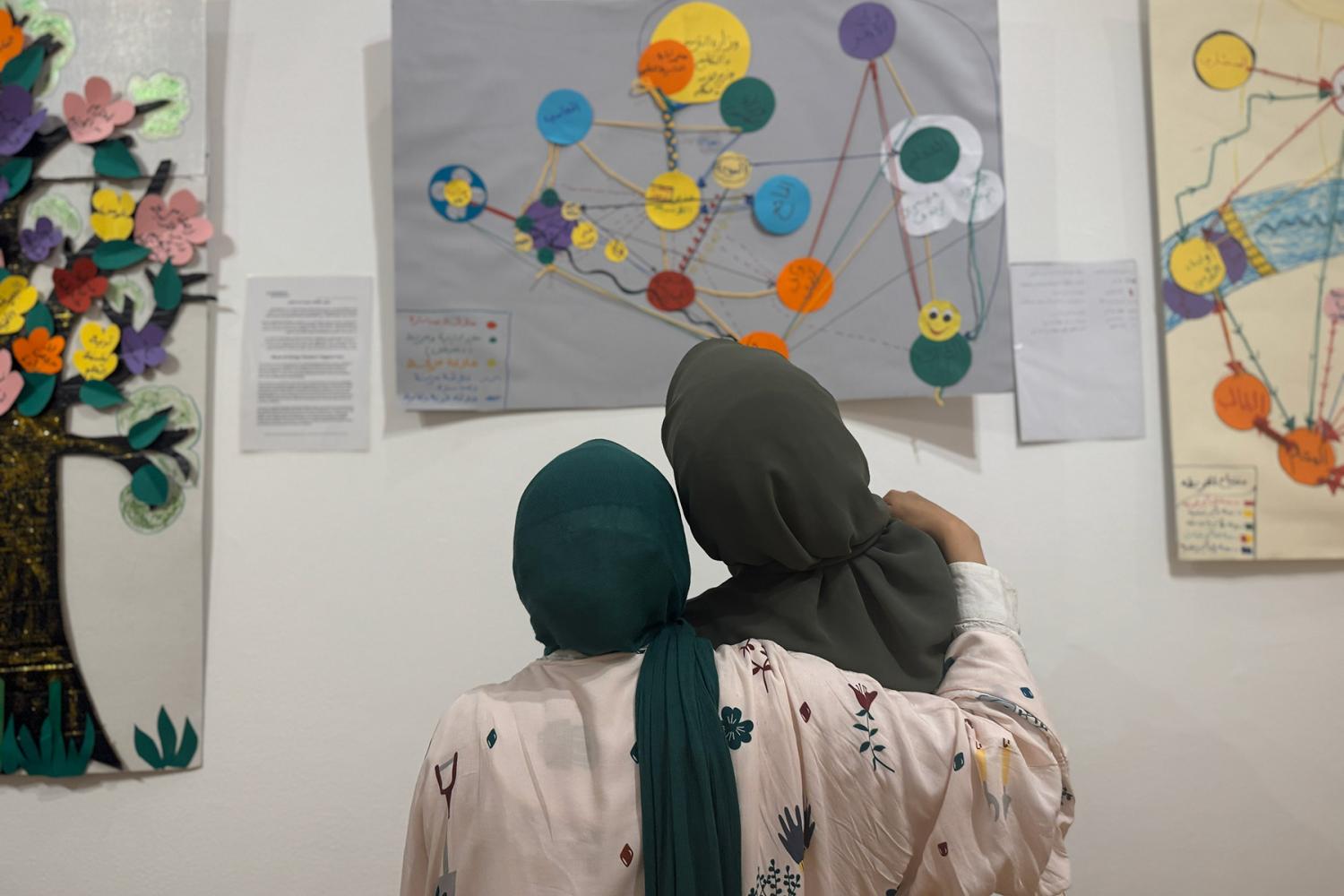
Photos from the arts-based workshop with community and public school teachers, conducted by the SPARKS Egypt team for data collection purposes, courtesy of SPARKS Egypt (2025). Cover Photo from the “Teachers’ Voices Beyond Curricula, Strategies and Tools” exhibition at the American University in Cairo, courtesy of SPARKS Egypt (2025).
Brookings gratefully acknowledges the support provided by the LEGO Foundation.
Brookings recognizes that the value it provides is in its commitment to quality, independence, and impact. Activities supported by its donors reflect this commitment.
The Brookings Institution is committed to quality, independence, and impact.
We are supported by a diverse array of funders. In line with our values and policies, each Brookings publication represents the sole views of its author(s).