
Current debates about AI and the labor market overwhelmingly focus on job losses. If you’re a student of history, this might seem counterintuitive: You’ve likely heard the argument that new technologies historically create more new jobs on net than they destroy.
One reason why today’s discourse revolves around job displacement rather than creation is that we have far less clarity about what those “new jobs” are going to be.
Over the past year, as part of my upcoming book, “The New American Frontier: Job Training for the Next Technological Age,” I have been researching the jobs being created in what I call “frontier regions”—places that have been early to develop and deploy critical and emerging technologies. In doing this work, I came to appreciate more fully that the traditional labor market data sources many policymakers rely on were not really designed to shed light on this question, especially not in real time.
Some of this is by intention. Government statistics are meant to prioritize consistency and reliability, not to change with every new trend. For many purposes, this is a strength. But it also has downsides: If new or changing job categories do not show up clearly in official data, that makes it harder for people to see where new opportunities will be or what skills they should start building.
This analysis shows why traditional public data sources often struggle to capture the extent of the “frontier economy,” or the jobs critical and emerging technologies create. Drawing on our experience analyzing jobs data in frontier industries, we highlight several recurring challenges and blind spots for policymakers relying on traditional labor market data. We conclude with five ready-to-deploy strategies that can help practitioners keep better pace with the workforce development needs of new industries, even in the absence of perfect data.
A note on data
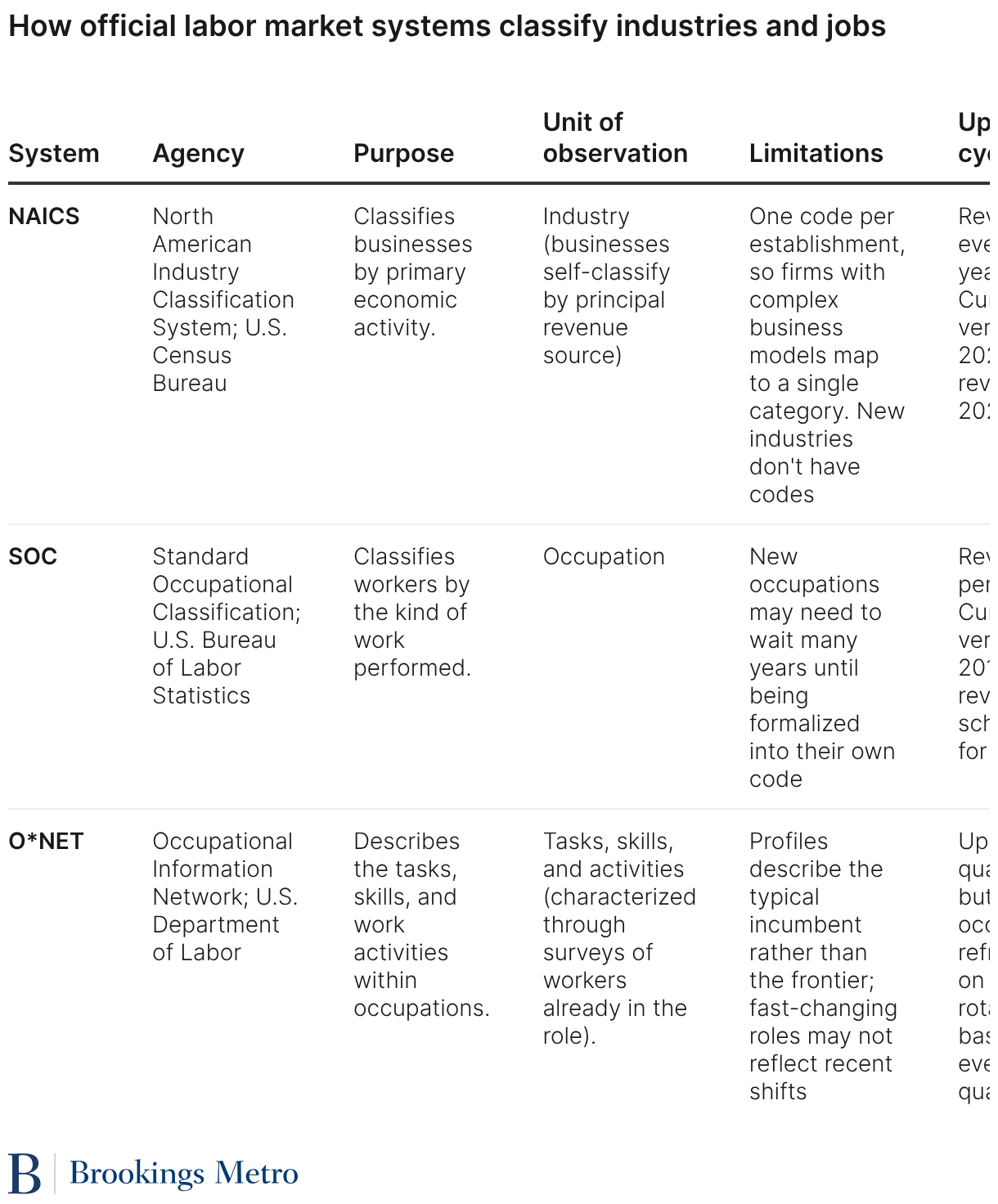
The examples in this piece reference several data sources and classification systems that policymakers and educators commonly use to analyze the labor market, summarized in Table 1.
A common way state and local policymakers project workforce needs is to start with an industry using North American Industry Classification System (NAICS) codes, and then use Bureau of Labor Statistics (BLS) industry-occupation tables to estimate the composition of workers across different Standard Occupational Classification (SOC) occupations. They may then use O*NET to help them translate the SOC occupations into tasks and skills workers will need.
To go beyond these official classifications in this analysis, we use individual-level resume data and job postings from Revelio Labs. Revelio compiles data from more than 1 billion worker profiles, including work and education histories, along with data from job posting aggregators and company websites.
Challenge #1: Frontier industries are hard to classify
One of the first problems in understanding jobs in frontier industries is definitional: It’s hard to identify the right industry codes to use.
Take data centers as one example. In the Census Bureau’s NAICS system, companies self-classify in tax forms and surveys based on their primary business activity, or the activity that generates the most revenue. However, data center companies vary widely in their business models, and could reasonably be classified under several different codes. For example:
- CyrusOne leases data center facilities to AI “hyperscalers” such as Meta and Amazon. A company focused on leasing real estate might be classified under NAICS 531120 (“Lessors of Nonresidential Buildings”).
- CoreWeave provides AI compute infrastructure through a software platform. A company selling computing services primarily through software could fall under NAICS 513210 (“Software Publishers”).
- Meta, Google, and Amazon build and operate some of the largest data centers in the country. These hyperscalers are classified under their parent company codes, such as social networking, software publishing, and retail—not as data center operators.
This matters because different codes produce very different pictures of the jobs available. The real estate code (531120) would show property managers and leasing agent jobs. The software publishing code (513210) would emphasize software engineers and sales roles. Meanwhile, the most common code for data centers, “Computing Infrastructure Providers, Data Processing, Web Hosting, and Related Services” (518210), would largely capture computer occupations and office support roles, but not the construction and maintenance jobs needed to build and operate data center facilities over time.
There is a similar challenge when you try to analyze quantum technology jobs. Today, there is no single standardized NAICS code for the quantum industry. Table 2 below shows how 10 quantum companies could be plausibly classified into roughly 10 different NAICS codes. Meanwhile, tech giants such as IBM and Google have their own quantum research divisions, but are classified under the parent company’s main code. Quantum startups might also appear under scientific research and development or, depending on their business model, under the industries they serve. All of this makes it challenging for someone designing a new quantum education program to use government data to visualize a landscape of quantum jobs.

Challenge #2: The supply chain plays an outsized early role in job creation, but gets overlooked
When regions plan for workforce development around new technologies, most attention usually goes to the headline industry. But much of the earliest hiring actually happens in the supply chain. If those jobs are invisible in the data, they may be missing from education and training plans too.
As one example, consider semiconductor manufacturing. Many prior analyses of workforce needs under the CHIPS Act focus on the primary NAICS code for semiconductor and other electronic component manufacturing (3344).
But making chips in the United States also depends on specialty chemical manufacturers, industrial equipment manufacturers, and the construction firms that build and maintain the factories, or “fabs.” And in reality, supplier jobs often show up first: Factories must be built and equipment must be installed before a fab can go online and start producing chips.
In our analysis of semiconductor job postings from 2023 onward, the inclusion of supply chain jobs nearly tripled the number of postings compared with using only the core manufacturing code (see Figure 1).

Click to view NAICS codes included as supply-chain input sectors
| NAICS code | NAICS description |
|---|---|
| 331410 | Nonferrous Metal (except Aluminum) Smelting and Refining |
| 334418 | Printed Circuit Assembly (Electronic Assembly) Manufacturing |
| 334412 | Bare Printed Circuit Board Manufacturing |
| 334416 | Capacitor, Resistor, Coil, Transformer, and Other Inductor Manufacturing |
| 334417 | Electronic Connector Manufacturing |
| 334419 | Other Electronic Component Manufacturing |
| 326112 | Plastics Packaging Film and Sheet (including Laminated) Manufacturing |
| 326113 | Unlaminated Plastics Film and Sheet (except Packaging) Manufacturing |
| 334515 | Instrument Manufacturing for Measuring and Testing Electricity and Electrical Signals |
| 811310 | Commercial and Industrial Machinery and Equipment (except Automotive and Electronic) Repair and Maintenance |
| 333242 | Semiconductor Machinery Manufacturing |
| 325120 | Industrial Gas Manufacturing |
| 325180 | Other Basic Inorganic Chemical Manufacturing |
This aligns with findings from a recent Brookings Paper on Economic Activity by Bilge Erten, Joseph E. Stiglitz, and Eric Verhoogen, which found that when upstream suppliers and construction are included, the estimated job impacts of the CHIPS Act roughly double.
In interviews with industry experts, we’ve heard about similar challenges in other frontier technologies. Consider microreactors and small modular reactors, which represent key next-generation nuclear energy technologies. Because they are designed to be assembled in factories rather than built on construction sites, much of the earliest job growth is likely to appear in the fabrication shops that produce components, including jobs for welders, machinists, and operators.
But these firms typically serve multiple industries. Their jobs may never appear in an analysis of the main nuclear NAICS code (221113: “Nuclear Electric Power Generation”), even if nuclear projects are the primary driver of their new hiring.
Challenge #3: ‘Frontier jobs’ are missing from traditional data sources
Emerging technologies also create new jobs that didn’t exist before the technology’s emergence. Inspired by a paper by David Autor and colleagues, we call these roles “frontier jobs.” And just as frontier industries don’t appear neatly in NAICS industry classifications, frontier jobs don’t appear yet in the BLS Standard Occupational Classification (SOC) system.
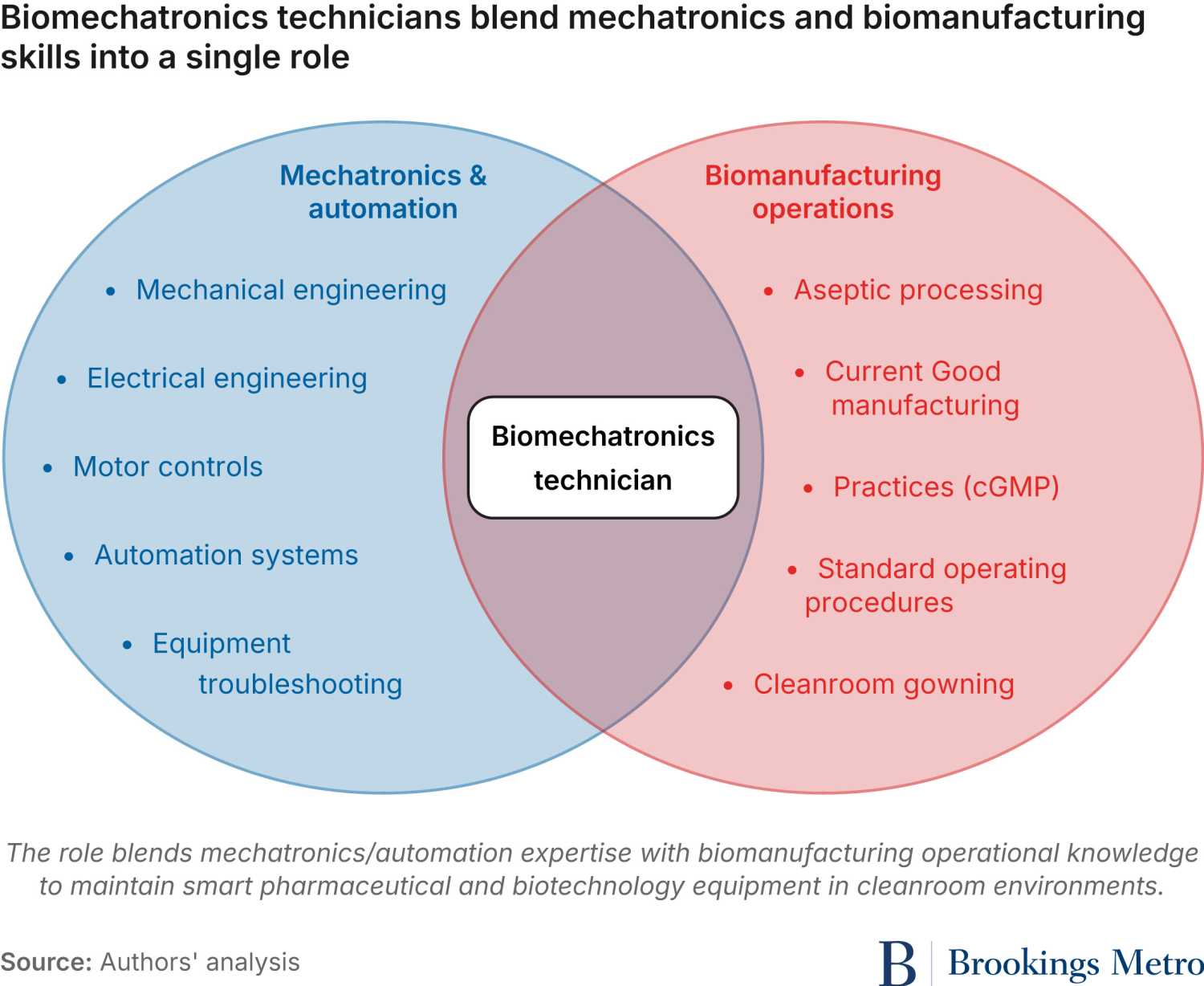
One example to consider is the emerging role of a “biomechatronics technician.” As modern biomanufacturing facilities become more automated, firms increasingly need workers who can understand the specific processes involved in biomanufacturing while also applying mechanical and electrical skills to troubleshoot new advanced equipment, from robotic liquid handlers to automated cell culture bioreactors. That role is more specialized than general maintenance work and can help facilities reduce downtime.
“Biomechatronics technician” does not have its own SOC code. In government data, the job would be lumped into roles such as industrial machinery mechanics, mechanical engineers, or bioengineers. But if you relied only on those existing categories, you would have a hard time understanding the job’s distinct needs.
Revelio’s profiles data, however, allows us to identify workers based on the specific experience and skills listed in their resumes and job postings. Using this clustered approach, we can see that the number of workers focused on maintenance of machines within pharmaceutical and biopharmaceutical manufacturing more than doubled between 2008 and 2025, from roughly 26,000 to 57,000.
In North Carolina, a biomanufacturing hub, employers and educators are already treating this combination of skills as a distinct occupational need. Job postings from companies such as Eli Lilly, bioMérieux, and Fujifilm show they are asking for workers who combine knowledge of regulated pharmaceutical manufacturing with advanced skills in automation and industrial controls. Most list a high school diploma as the minimum educational requirement, with many preferring an associate degree. North Carolina’s Wake Technical Community College is already partnering with life sciences companies to launch a training program specifically for biomechatronics technicians. The job appears to have real demand, but it is not yet showing up clearly in traditional sources.
Challenge #4: Jobs are changing, but titles don’t reflect new skills
The challenges so far have been about understanding changes in occupations. But even if we could track the mix of occupations perfectly, the content of occupations is changing too.
Economists conceive of jobs as a bundle of tasks. When tasks change, the skills required to do the job change as well. We call these “retooled jobs”—roles that use an existing occupational title but require new skills related to emerging technologies.
Consider a job posting for a “journeyman electrician” at Base Power, a Texas company that provides home battery systems and has raised $2 billion in venture funding over the past year. Base Power electricians still need the foundational skills and licensing of a traditional electrician. But they also require new skills. For instance, the company’s home batteries require systems that let power flow both ways—between the grid and the batteries—rather than in a single direction from the grid into the home. That changes the skills the electrician needs and may also shift how educators should think about training for this job. As Table 3 shows, the company is using the traditional “journeyman electrician” job title, but the standard government data (O*NET) doesn’t fully capture what the retooled version of the job actually demands.

Challenge #5: Traditional labor market sources can be slow to pick up on real-time shifts
The final challenge is about timing, and about what the main public labor market tools are actually built to measure. The federal government does publish official forward-looking occupation-by-occupation employment projections, but those are 10-year forecasts, not real-time indicators of hiring demand.
The monthly jobs numbers, by contrast, are designed to track changes in payroll employment by industry. They can tell you whether employment rose in construction or manufacturing last month, but not whether employers are looking for more nuclear technicians, data center technicians, or biomechatronics technicians. (The government does publish a separate series on job openings, called JOLTS, but it also reports by industry rather than occupation, so it runs into the same classification problems described above.)
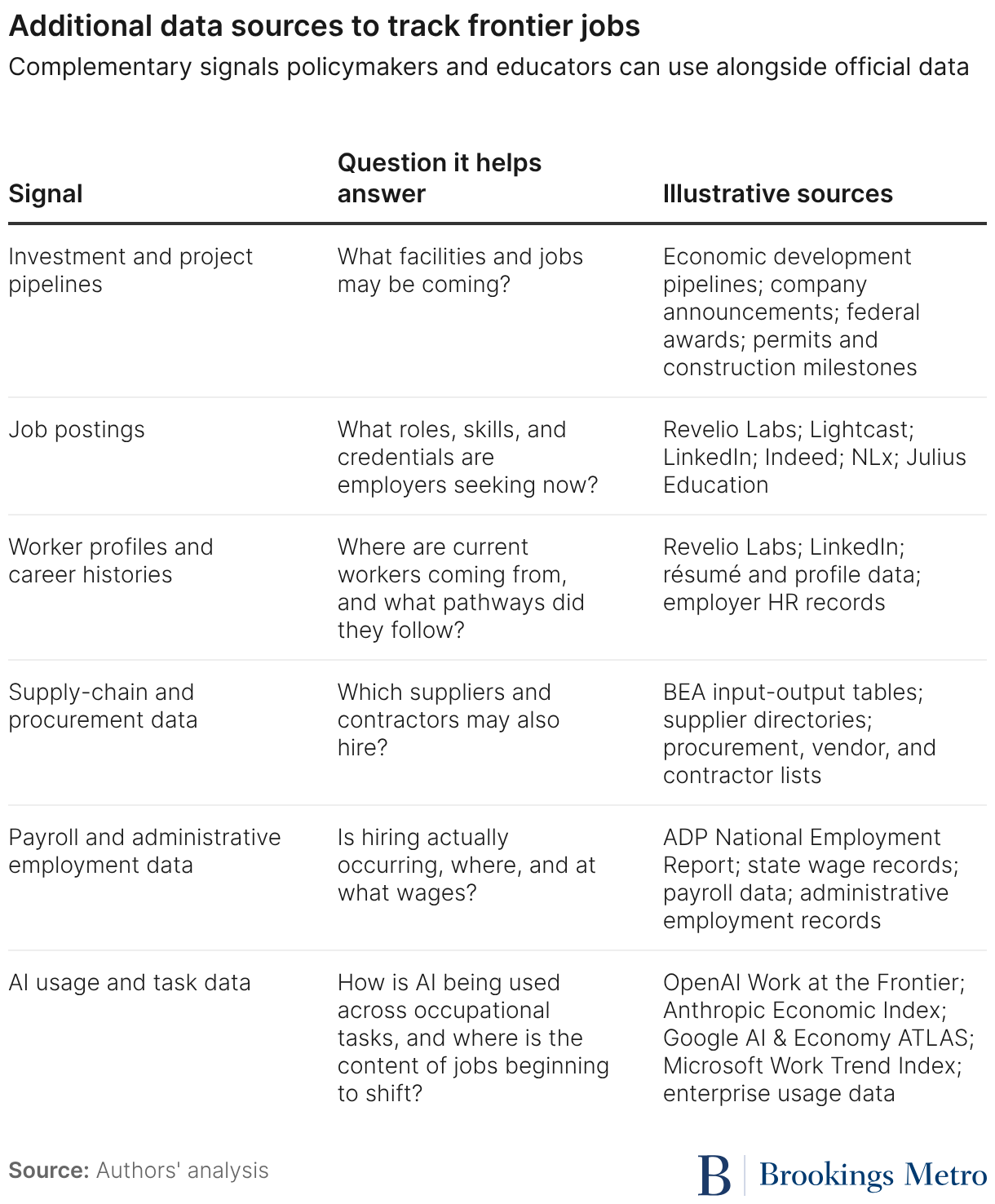
That is where private sources such as job postings and online worker profiles can help. Because they pull from company job ads and worker resumes or profiles, they can show what employers are calling jobs right now, what skills they are asking for, and whether hiring appears to be picking up—before that shift is visible in official forecasts.
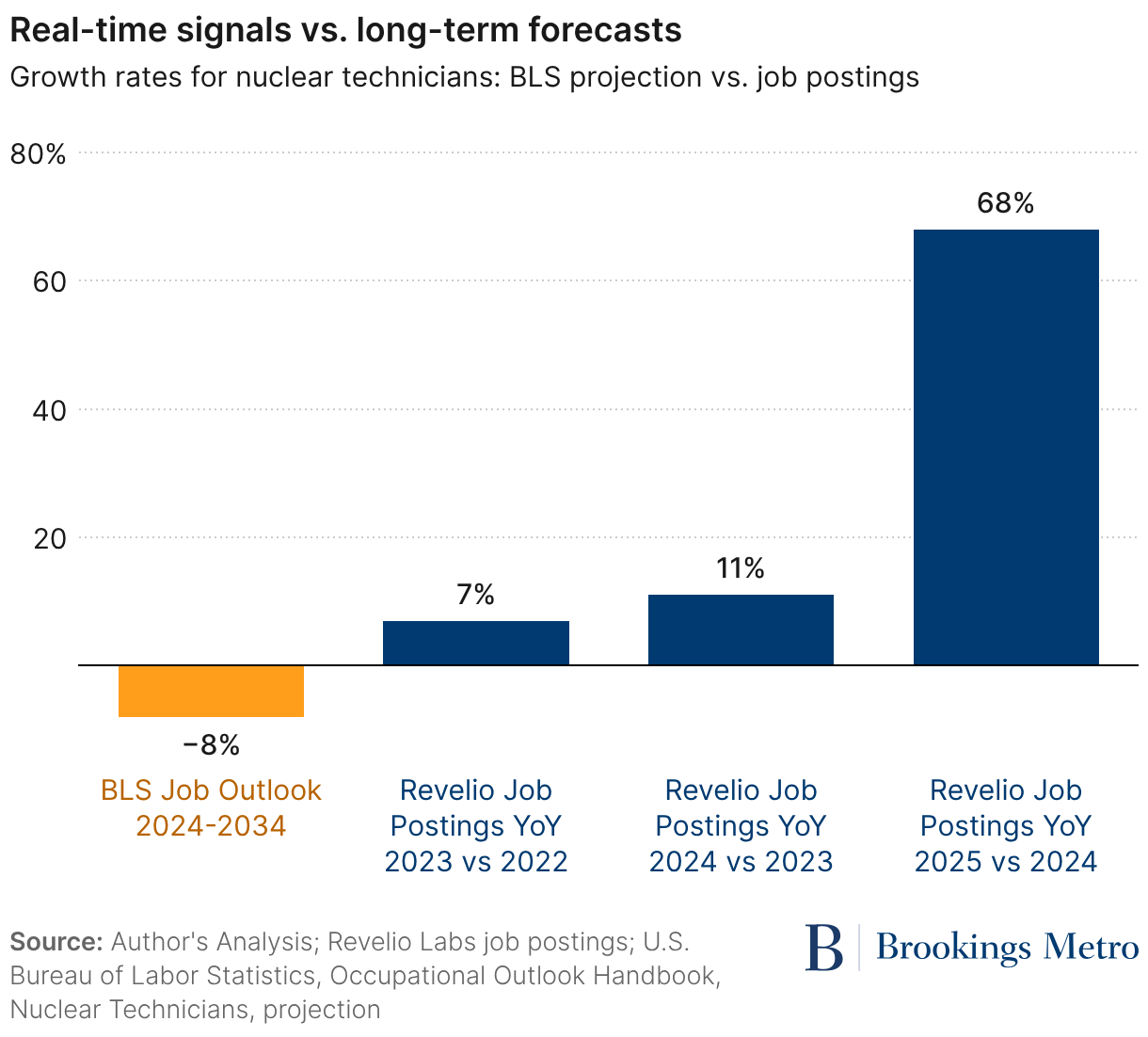
Consider the nuclear industry as one illustrative example. In projections released in August 2025, the BLS estimated that employment of nuclear technicians would decline 8% from 2024 to 2034. Yet someone looking at more current market signals would have seen a different picture: Private investment in advanced reactors hit record levels in 2025, major tech companies such as Google and Amazon signed deals to power AI data centers with small modular reactors, and the federal government made nuclear a priority.
Nuclear employers and industry leaders we spoke with expect significant hiring growth ahead, and Revelio job postings data suggest the same. Postings for nuclear technicians were up about 68% in 2025 compared with 2024. The job postings therefore offered an earlier and likely more accurate signal for the outlook ahead. (In fact, in its next annual update, the BLS reversed course, projecting 1% growth in nuclear technician employment from 2025 to 2035.) This pattern illustrates why private labor market data can be a useful complement to official data, especially when policy priorities are shifting and a technology may be moving toward commercialization.
Implications for education and training policy
For decades, educators and economic developers have been told repeatedly they should “align” workforce training to the needs of their current local labor market. But if you only align to the economy of today, you risk missing the opportunities of tomorrow.
Of course, predicting jobs has been notoriously challenging. Consider a 2017 Organisation for Economic Co-operation and Development (OECD) report projecting a loss of more than 4 million truck driver jobs across the United States and Europe by 2030, premised on driverless trucks being deployed quickly—a forecast that so far has not materialized.
Doing better doesn’t require perfect foresight. It means using the right tools for the right decisions, and recognizing where data have limits. Below are three risks policymakers should keep in mind.
Risk #1: Emerging roles get neglected
If we undercount the potential in emerging industries, we may lag behind in standing up programs for high-growth opportunities.
In recent years, states and the federal government have increasingly moved to tie workforce funding to “high-growth” or “in-demand” jobs—most recently, through the new federal Workforce Pell expansion, which is a positive step toward ensuring education delivers a return on investment. But if eligibility is defined exclusively from historical data, these funding streams can end up excluding the emerging fields that matter most for national competitiveness.
Consider advanced photonics manufacturing in western Massachusetts—an industry with potential in a region the state has identified as a priority for growth and investment. Much of Massachusetts’ job training dollars are tied by statute to job placement rates. This policy makes sense, but it makes it hard for a new photonics program to qualify, since it won’t have the placement track record to compete with established programs such as nursing assistant training.
Risk #2: Programs get ahead of real demand
The opposite problem can also occur. Training programs get built for jobs that don’t materialize.
Some institutions recently stood up programs to train electric vehicle fleet technicians in anticipation of coming jobs, but had to shut down or shift focus when local job openings ultimately didn’t appear. One university leader told us about an earlier version of this problem during the Obama-era push on wind and solar. Federal funding was available and the market was quickly saturated with new programs, but some universities had to close their programs or refocus their offerings when the funding ran out or graduates couldn’t find work.
We have to be comfortable with some level of risk to keep up with emerging technologies. Demand may be expected, but outside factors such as policy changes and technology shifts can derail those expectations. What we need is a way to validate demand and make bets with some confidence upfront, but also to keep iterating and adapting as new information emerges.
Risk #3: The curriculum falls behind the job
This may be the most important version of the problem in a frontier economy. Many job titles are staying the same, but their tasks are changing. If we don’t have good information about those new tasks, the training is likely to fall behind in relevance too.
AI is likely to accelerate this dynamic. Using work-related ChatGPT conversations mapped to O*NET data, researchers at OpenAI found significant evidence of “task crossover,” meaning that workers are using AI at work to do tasks outside the traditional boundaries of their stated occupations.
But AI is not the only source of change. Think about electrical training: Many programs still focus heavily on traditional topics such as lighting and outlets, but neglect emerging fundamentals needed for solar and batteries. That might be in part because the official O*NET tasks still reflect what a “typical” electrician does, which isn’t necessarily what the job looks like on the technological frontier and in the highest-tech companies and settings.
Of course, outdated programs can’t be fully blamed on the data. There are still automotive service technician programs out there focused on carburetors (a part that hasn’t been in a new car for 30 years), while ignoring the computer-based diagnostic systems standard in virtually all of today’s cars. That’s not O*NET’s fault; in fact, those tasks are up to date.
In either case, educators no longer have the luxury of treating occupations as static. As jobs quickly evolve, better signals from both official data and real-time sources will be key to keeping training current.
Momentum for federal data modernization
We don’t have any perfect fixes to these challenges, though it is important that AI is forcing policymakers to start taking data limitations more seriously. For instance, the Department of Labor is standing up a new dedicated AI Workforce Research Hub under the White House’s 2025 America’s AI Action Plan. The department also recently issued a request for information to explore ways to modernize O*NET, including how AI can enable faster updating of tasks and skills. The Census Bureau is updating tools such as its Annual Business Survey and the Business Trends and Outlook Survey with questions about whether firms use AI and how that adoption affects their demand for workers and skills. Some states are starting to add occupational codes to unemployment insurance wage records, which can enable more real-time information about hiring.
Meanwhile, as AI labs and other private firms are producing all kinds of rapid, new information about which tasks workers perform and what skills employers need, formal data-sharing agreements with public agencies could make these private signals more consistent and accessible to the public.
Five steps education and workforce leaders can take now
Still, systemic federal data updates will take time, and local communities cannot afford to wait. While national efforts catch up, education and workforce practitioners need to make bets with imperfect information in the meantime. Below are five tactical strategies leaders can use to help them spot emerging hiring shifts and validate demand on the ground.
Track announced investments
BLS projections won’t include new companies coming to town or new startups. Education and workforce leaders can work with their economic development agencies to get information about new attraction or expansion projects, including firms’ own workforce projections. This may require signing nondisclosure agreements or interagency data-sharing agreements. Of course, not every announced project will ultimately materialize, and projections can change, but this data can provide a helpful complement to existing information.
Incorporate private data
Real-time job postings and worker profile data can complement public data in several ways. Most importantly, they show the real titles companies are actually using, the career paths of workers in the industry, and the real-time changes in demand for emerging skills.
Looking ahead, policymakers should be looking for ways to incorporate these signals at the federal level. For instance, statistical agencies such as the BLS and the Census Bureau could consider launching an experimental series for “frontier jobs” that leverages the postings data they already collect, similar to how they have successfully started publishing experimental inflation measures using private sector data.
Map the supply chain
To capture early hiring around a new industry, workforce analyses must look beyond the headline sector to its vendors and construction contractors. Practitioners can use tools such as the Bureau of Economic Analysis’ input-output tables as a baseline to map supply chain relationships. By expanding data tracking to include upstream suppliers, leaders can better capture the full ecosystem of jobs.
Build in qualitative inputs from employers
Quantitative data is important, but it won’t capture everything perfectly. There’s no substitute for company relationships and feedback, which can surface new roles, clarify where skills are changing, and validate the assumptions educators are working from. Beyond understanding job demands, companies’ perspectives should also be critical inputs to building the curriculum itself. In many cases, employers will also be best positioned to lead training themselves.
Don’t let ‘in-demand’ lock out emerging fields
As states increasingly tie training funds to lists of “in-demand” occupations, emerging industries may need special consideration, because backward-looking data is not well suited to capture their potential.
Education and workforce leaders should advocate for alternative metrics or exceptions for emerging fields when employer demand can be validated. Utah, for example, builds industry prioritization into its methodology for identifying which occupations to target with workforce funding. The state’s Top Jobs tool includes “regional economic importance” as one of the filters, weighting occupations by their concentration in priority industries. Texas’ recent community college reform also includes a process to petition to add “essential” or “emerging” occupations to its high-demand list.
Conclusion
It’s always tempting to wait for better data. But at this moment, if government doesn’t provide clearer signals on frontier industries, someone else will fill the gap. Advocacy organizations and industry groups will write reports with their own agenda, showing huge shortages, or exponential growth rates, or lack of any jobs at all. Education providers will pay for ads on buses and trains. Some of those claims will be real—others won’t be. Policymakers need ways to check them against reality.
When a worker walks into a job center inquiring about training to be a biomechatronics technician, a quantum technician, or any role they may never have heard of, what they want to know is whether the opportunity is real and will lead to a job. Especially at a moment of rising public anxiety about technology, we owe them a real answer. It will never be a sure bet, but collectively, our goal should be to give learners and job seekers information they can trust.
Authors


-
Acknowledgements and disclosures
The authors thank Mark Muro, Ben Zweig, Lisa Simon, and Luke Pardue for their helpful comments.
This publication was generated with support from Arnold Ventures. The views expressed in this report are those of its authors and do not represent the views of Arnold Ventures, their officers, or employees.
The Brookings Institution is committed to quality, independence, and impact. We are supported by a diverse array of funders. In line with our values and policies, each Brookings publication represents the sole views of its author(s).
The Brookings Institution is committed to quality, independence, and impact.
We are supported by a diverse array of funders. In line with our values and policies, each Brookings publication represents the sole views of its author(s).