The AI buildout is shaping up to be one of the largest investment booms in U.S. history, and borrowed money is covering a growing share of it. Amazon, Alphabet, Microsoft, Meta, and Oracle, often called “hyperscalers” because they operate massive computing networks and data centers, expect to spend more than $800 billion on data centers, computing equipment, and other capital in 2026.
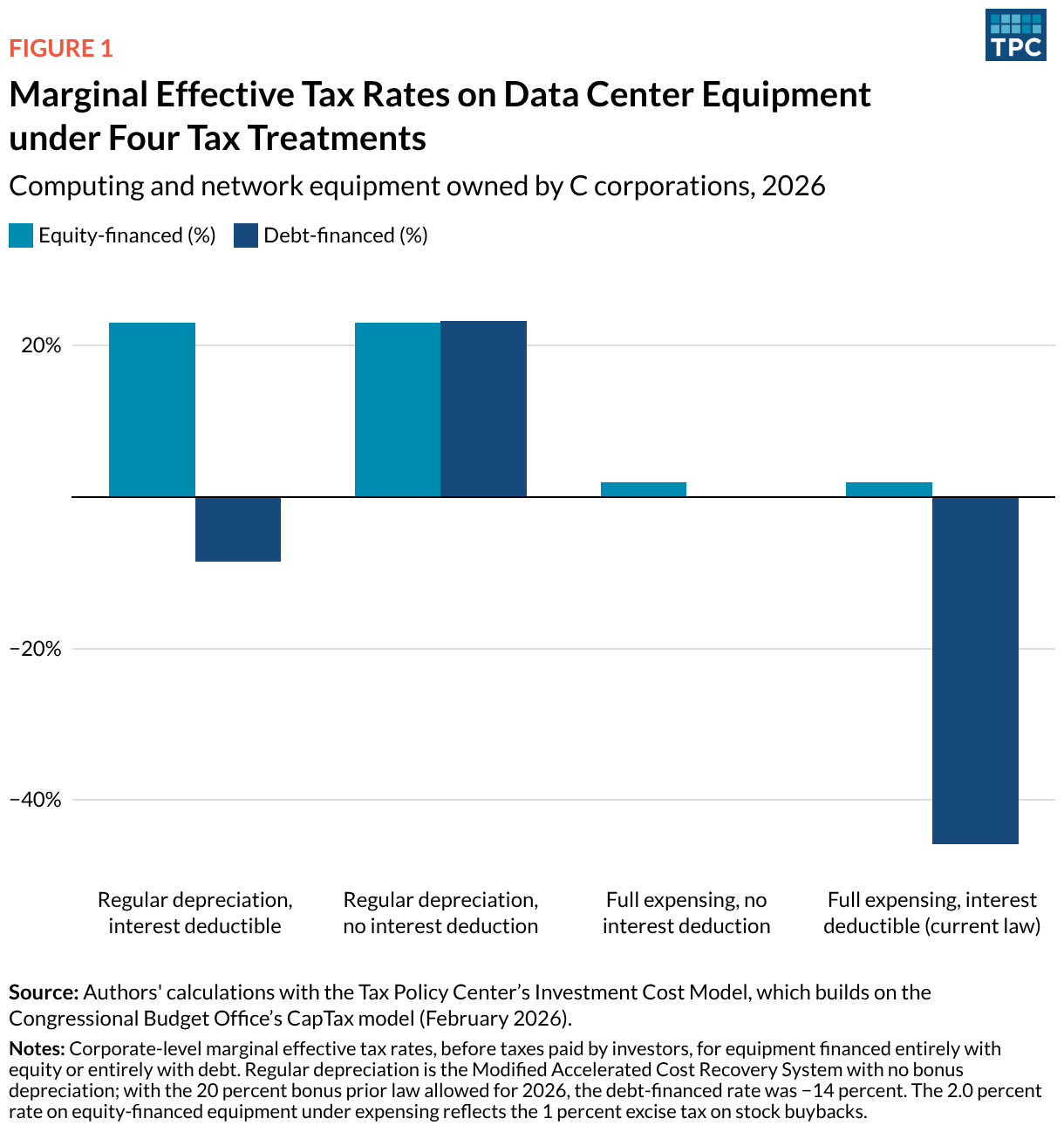
The federal tax code is helping pay for that borrowing. When these companies borrow to buy computing equipment, the tax rate on that investment is -46%. Instead of taxing the profits from this investment, the tax code effectively adds 46 cents to every dollar it earns. A new Brookings paper by Stijn Van Nieuwerburgh warns that if AI doesn’t pay off as expected, losses on that debt could spread well beyond those companies.
Removing the tax incentive for companies to borrow could reduce the risks that excessive debt creates for taxpayers and the economy as a whole.
Two federal deductions can add up to a generous subsidy
Computing equipment accounts for about two-thirds of the cost of an AI data center, according to Van Nieuwerburgh. When a company invests in computing equipment, it can deduct the entire cost that same year by “expensing” it, a provision made permanently available by last year’s One Big Beautiful Bill Act (OBBBA).
Many economists favor expensing because it removes the tax penalty on investment without subsidizing it. Under a traditional income tax, a company deducts investment costs over a number of years. A tax deduction is worth less the longer a company waits for it, so this delay raises the cost of investing. That could change a company’s decision to invest.
With expensing, a company faces a marginal effective tax rate of zero on new investment financed with its own cash, allowing it to make an investment decision as if there were no corporate tax at all.
But current law also allows a company to deduct the net interest it pays on its debt (subject to certain limits). Combined with expensing, this can push the marginal effective tax rate on debt-financed equipment investment below zero. In effect, the government is paying the company to borrow in order to invest. As a result, some projects that wouldn’t be worth doing without tax benefits become worthwhile because of them.
Figure 1 shows the tax rate on computing equipment as roughly zero if paid for with cash (full expensing, no interest deduction) but -46% if financed with debt (full expensing, interest deductible). For 2026, OBBBA more than tripled the subsidy—from 14% to 46%—by making full expensing permanent, just as AI borrowing took off.
The AI buildout increasingly relies on debt
Hyperscalers are borrowing more as their capital spending consumes a growing share of the cash their businesses generate. From 2024 to the first half of 2026, their long-term debt more than doubled from $232 billion to $486 billion (Figure 2). That debt is widely expected to continue growing at an even faster pace.
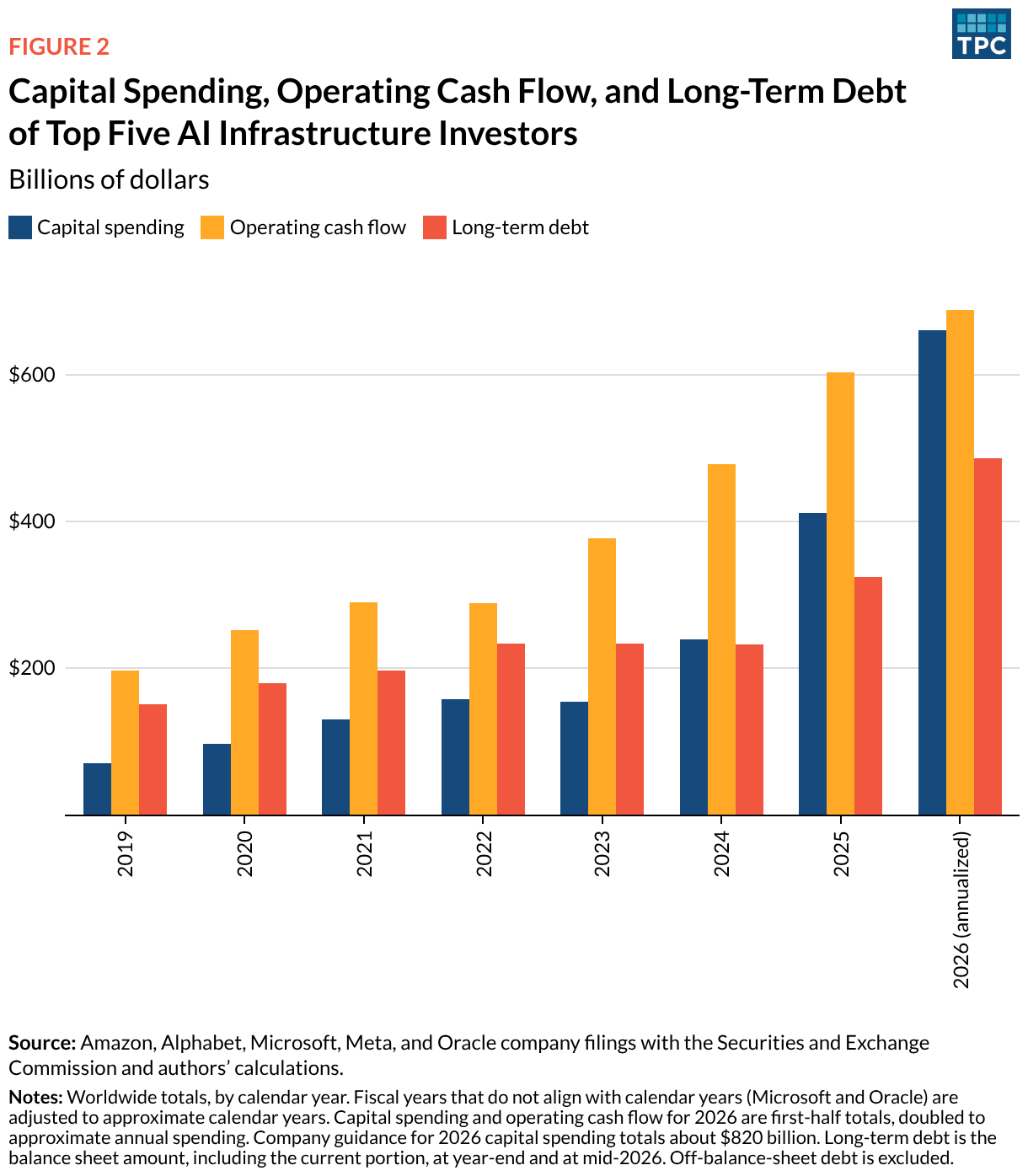
The growth in hyperscalers’ reported debt tells only part of the story. Companies are also financing AI infrastructure projects through leases, joint ventures, and private lenders, keeping some borrowing off their balance sheets.
Meta’s Hyperion data center campus in Louisiana is a central example. A joint venture between Meta and the investment firm Blue Owl raised $27 billion in debt, financing about 90% of the cost of the campus’s buildings and power infrastructure. That debt does not appear on Meta’s balance sheet.
By encouraging these hyperscalers to borrow more, the tax code increases the debt riding on the AI bet. And because a growing share of that debt sits off companies’ balance sheets, losses from an AI bust could spread beyond these companies to their lenders and the wider financial system, and in ways that are hard to see coming.
Congress can stop subsidizing AI debt
The AI buildout is one of the biggest economic bets in U.S. history, and the tax code is encouraging companies to make it with borrowed money.
The cost of investment can be deducted right away, and interest on debt used to pay for that investment can also be deducted. This combination essentially pays hyperscalers to borrow more, even for bets that would not be profitable without the tax benefit. Current law does cap interest deductions, but the cap applies only certain interest paid beyond what a company earns in interest income. In their most recent annual reports, four of the five hyperscalers reported substantial interest income compared to interest expenses, raising concerns that the limit is unlikely to apply to them.
The federal incentive to borrow could be removed. Most directly, interest could be excluded entirely from corporate tax considerations, so companies would not deduct interest payments or include interest income. Investment, whether financed with debt or equity, would then be taxed the same way. Many economists and some policymakers support this approach, which effectively transforms the current corporate income tax into a corporate cash-flow tax.
Alternatively, companies could be allowed to deduct interest payments only if they deduct the costs of investment over time, rather than expensing immediately. Real estate businesses and regulated utilities already face this requirement. Either way, the tax code could stop encouraging a risky and expensive debt buildup.
The nation cannot afford this bet. Every dollar the hyperscalers save in taxes is a dollar the federal government doesn’t collect, at a time when federal debt is near an all-time high.
Authors


Related Content


The Brookings Institution is committed to quality, independence, and impact.
We are supported by a diverse array of funders. In line with our values and policies, each Brookings publication represents the sole views of its author(s).



Commentary
The tax code already has an AI policy: It pays companies to borrow
November 17, 2026