In the aftermath of U.S. and Israeli strikes on Iran that killed the country’s supreme leader, Ayatollah Ali Khamenei, on Saturday, Ambassador Jeffrey Feltman reflects on his experience while serving as United Nations under-secretary-general for political affairs, as one of the only Americans to meet with Khamenei.
Meeting Iranian Supreme Leader Ali Khamenei in August 2012 was as close to an out-of-body experience as I’ve experienced. After all, I had spent years attempting to understand Khamenei and Iran. As U.S. ambassador to Lebanon (2004-2008), I daily walked past an embassy memorial to the Marines, diplomats, and Lebanese butchered by the Islamic Republic’s crown jewel proxy, Hezbollah. I oversaw the evacuation of over 15,000 American citizens when Hezbollah, in an operation surely green-lighted by Tehran and Damascus, provoked war with Israel in July 2006. As U.S. assistant secretary of state for Near Eastern affairs (2009-2012), I joined an inner circle of senior U.S. officials focused on both preventing Iran from building nuclear weapons and on mitigating Iran’s malevolent regional role and domestic repression. Khamenei, I understood, was the tyrannical heart of everything foul, vile, and dangerous about the Islamic Republic of Iran.
And yet, only three months after retiring from the U.S. foreign service, there I was, in Khamenei’s modest inner office in his Tehran compound. Surreal. My new boss, United Nations Secretary-General Ban Ki-moon, was in Iran to attend that year’s Non-Aligned Summit. As under-secretary-general for political affairs and Ban’s chief foreign policy adviser, I was his “plus one” and notetaker in the closed-door Khamenei meeting, which followed an introductory protocol welcome with larger delegations on both sides of the table in a nondescript conference room in Khamenei’s now-destroyed headquarters.
After perfunctory greetings, including a polite nod to me as we sat down, Khamenei, via an interpreter, invited Ban to speak first. Ban—never a strong communicator, but whose gut instincts and sense of responsibility were solid—nervously shuffled his notecards, as he plodded through mostly innocuous points. Eventually, as he always did with tough messages, Ban hesitantly pulled out the ace at the bottom of his deck: It is unacceptable, Ban said (flitting his eyes back and forth between his card, Khamenei, and the interpreter), for one U.N. member state to call for the destruction of another U.N. member state. Condemning people for their religion or nationality violates U.N. conventions signed by Iran. The Holocaust happened, and denial is offensive and delegitimizing to its victims. Using military proxies to threaten states or interfere in the internal affairs of others is destabilizing and unacceptable. Human rights comprise a core pillar of the United Nations, and Iran’s record is discouraging. With an incongruous “thank you for your leadership”—the phrase he used to close most interventions with leaders—Ban looked at Khamenei, while the interpreter finished.
Khamenei stared for what seemed an eternity. Finally, in a soft, raspy voice, he said that he never expected the U.N. secretary-general to come to Tehran carrying American talking points. He said that Ban and the U.N. made a serious error in aligning so closely with Washington, the capital of an aggressive country on the verge of collapse. Never taking his eyes off of Ban, he launched into a monologue alternating between grievances and fantasies about the United States: American sanctions harming the Iranian people are illegal under the U.N. charter, and the Americans maliciously manipulated the U.N. Security Council into following suit. U.S. leaders intentionally sow havoc globally in order to distract the American people from their country’s declining power. The Americans prop up illegitimate regimes in the Middle East and then just toss them aside when inconvenient, leaving chaos and violence. Look at Iraq. Look at Libya. Look at Afghanistan. Trusting the United States always leads to disaster. U.S. democracy is in meltdown, as witnessed by the Occupy Wall Street protests (which had concluded nine months earlier, an eternity in American political life). On and on, for well over an hour.
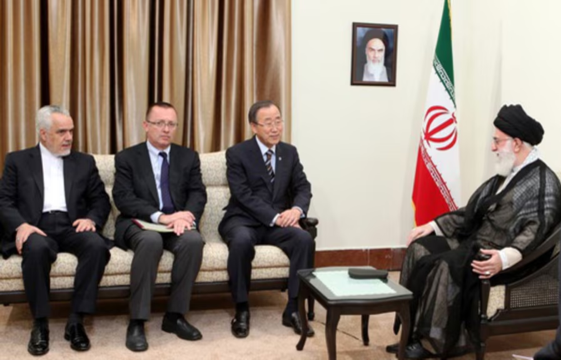
At one point, Ban interrupted the supreme leader, noting the May 2009 letter from then-U.S. President Barack Obama to Khamenei and Obama’s 2010 Cairo speech. He explained that conversations with U.S. officials convinced him that the U.S. administration was sincere in wanting a less antagonistic relationship. (Unknown to Ban at the time, Obama had also sent a second letter in 2009.) Khamenei was dismissive; Ban was naïve. One should never trust the Americans, he said, with their uncompromising hostility toward the Islamic Republic and unrelenting commitment to overturn the Islamic revolution. In his view, Obama’s letter was a ruse, and Iran was wise enough not to fall for it.
Khamenei could have talked about economic development, the Non-Aligned Summit opening the following day, or any number of noncontroversial issues related to the U.N. He might have tried to persuade Ban that Iran’s controversial nuclear program was peaceful. Instead, he used the entirety of a rare meeting with the top U.N. official to indict the United States. This did not seem to be for my benefit. In addition to his only cursory acknowledgement of my presence, I believe Khamenei learned only later that Ban picked, of all the U.N. officials in the introductory meeting, the infamous, onetime Hezbollah-bashing U.S. ambassador to Lebanon to accompany him to the restricted meeting. Two days later, my past official life had sunk in: Rent-a-crowd protesters showed up at Ban’s meeting with university students to demand my departure.
As I jotted down Khamenei’s catalogue of American sins, bewildered to be experiencing Khamenei’s diatribe in person, I found three aspects particularly noteworthy. First, Khamenei’s failure to condemn or even mention Israel, which in his mind must have been an insignificant sideshow compared to this opportunity to highlight the nefarious role of the “Great Satan,” as official Iranian rhetoric describes the United States.
Second, his utter lack of charisma, the contrast between harsh rhetoric and flat delivery. Accustomed to my time in Lebanon, with Hezbollah Secretary General Hassan Nasrallah’s gravitational force and versatile use of humor in front of televised, spellbound audiences, I found Khamenei’s delivery curiously lifeless, accentuated by his utterly still, straight-back posture while speaking at length, without notes.
The third aspect almost prompted me to nod: while undoubtedly Washington officials had gaps in their understanding of Khamenei, the Americans in those meetings I once attended in Washington grasped precisely what was essential. I realized from listening to Khamenei that we got it right: his paranoia; his singular, hostile focus on the United States; how he was consumed with, and identified by, enmity toward Washington. By contrast, I thought, Khamenei gets us wrong. If he truly wanted to understand us, Khamenei could have queried Iranians who had studied in the United States or who had served at the Iranian mission to the U.N. But his obsession with U.S. enmity and decline led him to board flights of his preferred fancy: an imploding country of race riots, collapse of faith in democratic institutions, predatory economic mayhem, and falsified elections, all of which he outlined as if true. (What seemed preposterous in 2012 may now sound to many almost prescient, although prompted by Khamenei’s loathing rather than an informed read of America’s future.)
His monologue concluded, Khamenei stood, precluding further debate. In what was and wasn’t a handshake, he lifted his left arm (with the right arm immobilized by a 1981 bomb) for us to touch hands. In comparison to Khamenei’s bizarre rantings, Iranian President Mahmoud Ahmedinejad, in a subsequent meeting, came across as surprisingly lucid and rational compared to his offensive public theatrics. His “Death to Israel, death to America” was apparently for public consumption, not something to raise with the U.N. secretary-general.
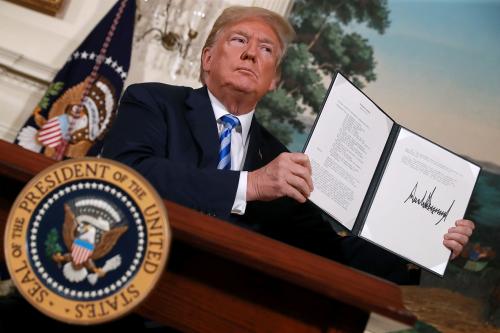
The meeting I’m describing occurred over 13 years ago. Nothing that has happened since then has shaken my belief that Khamenei, with his hatred of the United States, directed a system that violently brutalized Iranians, murdered Americans and others, and threatened the region. Likewise, U.S. policies in the intervening years may well have reinforced Khamenei’s unshakeable conviction that the United States was a malevolent, untrustworthy force: U.S. President Donald Trump’s 2018 withdrawal from the Iran nuclear deal, the 2020 assassination of Qassem Soleimani, and U.S. participation in the June 2025 war despite ongoing negotiations. It’s safe to assume, given his wariness, that Khamenei authorized Foreign Minister Abbas Araghchi’s participation in the most recent nuclear talks primarily in order to buy time. Khamenei’s own time ran out before he could document the latest in what he would see as proof of America’s enmity and perfidy.
Author

Related Content

The Brookings Institution is committed to quality, independence, and impact.
We are supported by a diverse array of funders. In line with our values and policies, each Brookings publication represents the sole views of its author(s).
Commentary
VideoThe surreal experience of meeting Khamenei
March 2, 2026