Charlie Kirk’s assassination in September and the ensuing backlash have reignited public debates on free speech. The conflict has impacted schools, forcing resignations of multiple educators who celebrated Kirk’s death. These educators’ reactions appear to confirm the longtime conservative critique of public schools as institutions of indoctrination, politically captured by the left.
But are these claims of education indoctrination valid? In this piece, we argue no: They rely heavily on cherry-picked data and simplified narratives. Rather, the available evidence suggests a complex school ecosystem shaped by many influences. The educator workforce solidly leans Democratic but is hardly monolithic. And schools must balance viewpoint diversity against countervailing interests, namely the duty to prioritize learning.
This post draws on available research considering both the complexities of the school system and its objectives. Because both K-12 and higher education have faced similar scrutiny in recent years, we discuss evidence across both sectors.
Claims of 'indoctrination' are ascendant, with policy consequences
Liberal indoctrination was a trope advanced by ‘old guard’ conservatives. David Horowitz criticized the “liberal totalitarian regime” in the early 2000s, urging universities to adopt an Academic Bill of Rights to curb professors’ political expressions. Former House Speaker Newt Gingrich wrote in his 2006 book, “In the classroom …Western values and American history are ignored or ridiculed.” And conservative radio host Rush Limbaugh frequently criticized what he viewed as educators’ attempts to sway students’ politics. Naturally, not all Republicans of that era were critical of education—President George W. Bush built a legacy around education reform, signing No Child Left Behind.
Criticisms of education, however, have been amplified since President Trump began leading the Republican Party in 2016. His first administration began amid what one scholar labels a “manufactured moral panic” on free expression, following college student protests against provocateur Milo Yiannopoulos. Trump then installed Betsy DeVos as Education Secretary, on her record of public school opposition. And in 2019, Trump countered public fanfare of the New York Times’ 1619 Project, which highlighted the role of slavery in the nation’s founding, by convening the 1776 Commission to promote a more patriotic history. Conflict continued after Trump left the White House, when worries about critical race theory in schools triggered new state laws banning teaching certain concepts about race.
Claims of “woke” education also appear to be more commonly accepted as established fact in recent years, frequently cited in editorials in prominent media outlets. And it’s not just partisan MAGA voices; more politically moderate commentators like David Brooks have joined in. Comedian Bill Maher earned rare praise from Fox News for discouraging youth from attending college and pleading, “if you absolutely have to go, don’t go to an elite college, because … it just makes you stupid.”
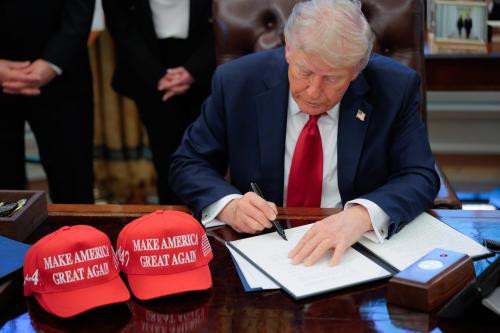
Now, rhetoric has become action in Trump’s second term. A week after inauguration, Trump issued an executive order outlining plans to redefine certain “radical” terms and to end “discriminatory equity ideology.” Since then, those plans have been substantiated through cutting funds for diversity, equity, and inclusion programs in both K-12 and higher education, imposing conditions for access to unrelated federal funds, and relaunching efforts for a patriotic civics curriculum. The administration also continues to dismantle the U.S. Department of Education.
Schools are complex institutions with many disparate components
If liberal indoctrination is real, we should expect some things to be true: The educator workforce would be dominated by liberals; and educators would be infusing liberal content into teaching. Here, we look at the data and find a more complex reality. Further, while there are opportunities for goal misalignment between the various stakeholders in the school system, the reality is a somewhat banal picture of people performing their jobs and balancing multiple competing priorities—not indoctrinating kids.
Is the educator workforce dominated by liberals?
A close inspection of teachers’ and professors’ political views paints a nuanced story: They favor Democrats, with a stronger lean among professors than K-12 teachers. But there is variety in their views—and good reasons for them to differ from the voting public.
Looking first at K-12 teachers, 58% identify with or lean toward the Democratic Party, compared to 35% of Republicans (based on a 2024 Pew Research survey). That skews more liberal than the broader population, with 45% of adults leaning Democrat and 46% leaning Republican. Yet, over a third of K-12 teachers (a plurality) on the Pew survey said they “trust neither party to do a better job” resolving issues around school safety, funding, or curriculum. Notably, too, a recent EdNext poll finds that K-12 teachers hold more patriotic views than the American public. Even analysis from the Heritage Foundation in 2021 concluded that teachers tend to the left on social issues but are not the “radical activists” commonly feared among conservatives. In fact, the majority of students from all ideological backgrounds report their schools are politically neutral.
College professors skew modestly more to the left. Recent studies examine professors’ Wikipedia pages and Twitter feeds to discern political leanings. They estimate Democratic support around 70% and Republicans around 25% or less, though neither source can be considered nationally representative of professors. More importantly, a focus on liberal-conservative ratios (as many critics reference) misses the large and rising share of moderates. A nationally representative 2006 survey identified 46% of professors as moderates. Two more recent studies find an increase in the ranks of moderate professors, primarily due to fewer professors identifying with Republicans (these shifts coincide with a national trend in which educational attainment has become a significant predictor of Democratic vote shares). Importantly, the politics of professors also vary across multiple dimensions including academic departments (humanities and social sciences are more liberal; business and the natural sciences are more conservative) and institutions (elite and Ph.D. granting institutions are more liberal; less-selective and religious institutions are more conservative). These nuances reveal far greater variety in professors’ political views than is acknowledged in claims of indoctrination.
There’s also an occupational selection effect at work in shaping who decides to teach. Educators are often driven by prosocial values, which correlate with liberal political views. And personality traits associated with student rapport (e.g., extraversion, openness, and agreeableness) also correlate with Democratic support. And educators choose these careers despite low pay, relative to similar occupations. If teachers and professors were paid more, perhaps these intrinsic motivations (and their associated partisan leanings) would exert less influence in shaping educators’ political views.
Is a liberal curriculum being taught?
Educators are given considerable autonomy over the content they teach and the teaching practices they employ. Schools generally hire teachers who demonstrate competence and meet licensing standards, and they expect teachers to ensure students meet state K-12 standards. However, schools leave much of the day-to-day instruction to teachers’ discretion. Studies show that teachers’ perceptions of professional autonomy and self-efficacy are positively associated with their job satisfaction and student achievement. Thus, some variation in teachers’ curriculum and instruction is expected, even desirable.
Teachers, however, are hesitant to use that discretion to wade into controversial topics and typically approach these topics with deliberation, separating their personal views from learning goals. Stepping outside their lanes opens teachers up for unwanted scrutiny, and many report now being more cautious in their instruction. Teachers are more likely to deviate from standard curriculum to tailor instruction based on students’ achievement levels, language proficiency, or racial and ethnic backgrounds.
Select examples of K-12 curricula developed by external organizations, such as those from Black Lives Matter, have garnered criticism for being politically motivated. Due to the decentralized process of curriculum adoption and teachers’ autonomy, gauging how, and how widely, these resources are used is difficult. A 2024 American Historical Association survey of U.S. history teachers concluded that a strong majority prioritized authorized resources like textbooks or online resources from government agencies. A small minority (19%) used resources from The 1619 Project, while 18% used those from the Ashbrook Center (a right-leaning source). Critics’ selective worries about one but not the other reveal their partisan motivations.
Criticisms of higher education curricula center on those of a liberal academic monoculture. In contrast to K-12, higher education does not have clear public standards for content instruction; rather, professors’ instruction is held in check by their faculty colleagues and the norms of academic disciplines. This governing structure, combined with professors’ left leanings, is believed to produce groupthink.
This criticism is central in a recent, widely publicized study by Shields and coauthors drawing from the syllabi of college courses that engage with contentious topics. Analyzing assigned reading lists, they found American professors favor works that feature influential liberal views, while only infrequently assigning conservative authors offering a counter perspective. Yet these conclusions are drawn from the small sliver of college syllabi that touch on these topics. For example, Edward Said’s “Orientalism” was one of the more frequently assigned works in their analysis of syllabi discussing the Israel-Palestine conflict, assigned to 7,673 courses worldwide (out of more than 1 million syllabi of History and Political Science courses in the database). Even taking the findings at face value to conclude that most professors assigning this book do not offer a balanced perspective, this still tells us nothing about all the other courses that do not touch on this content. Extrapolating these very narrow findings to generalize across college instruction would be cherry-picking. Further, much college instruction prioritizes students’ specific skill development, not political identity formation; there are few opportunities to introduce politics into, say, a biochemistry class even if the professor holds radical views.
Studies directly assessing the evolution of college students’ political views, rather than curriculum inputs, provide a more direct assessment of whether they are “indoctrinated.” Two recent studies find students simultaneously move both right (on economic issues) and left (on social issues) during college. Political attitudes also shift differently based on students’ chosen majors. These symmetrical associations are overlooked in the political rhetoric disparaging universities.
What other forces are shaping schools’ actions around speech?
Schools’ foremost priority is to further students’ learning and they therefore occupy a constitutional liminal space for speech. Multiple Supreme Court cases use balancing various interests as a theme when ruling on free speech in schools, including landmark decisions like Tinker v. Des Moines School District (1969), Bethel v. Fraser (1986), and Hazelwood School District v. Kuhlmeier (1988). These rulings differentiate schools from other settings, along with individuals’ First Amendment protections. When the free expression of diverse opinions contributes to student learning, schools should encourage and protect it. Yet, when unfettered speech detracts from learning objectives, schools should curb speech that may be allowed elsewhere.
Critics also frequently overlook the role of students in shaping their school experience. By bringing students together into the same space, schools create interactions among students. While often beneficial, these interactions lead to inevitable conflicts and occasional violence. Though schools are not responsible for students’ choices, they bear responsibility for maintaining a safe and orderly learning environment. Threats to student safety, whether in the form of physical harm or persistent bullying, harassment, or verbal threats create unsafe learning environments. This dynamic sets up a clash between the rights of targeted students to a safe learning environment versus the civil rights of other students for expressing their views. This tension was central to the pro-Palestinian protests following the Oct. 7 attacks on Israel, forcing universities to improvise compromises between student factions.
Students also sort across schools. In fact, recent evidence shows that students are increasingly choosing universities based on political dimensions; for example, liberal (or conservative) students avoiding states with restrictive abortion (or gun) policies. This sorting dynamic contributes to politically homogeneous college campuses where students are less likely to encounter classmates with opposing viewpoints. Indeed, a recent analysis suggests many students are willing to pay more to avoid contrary views. Though outside partisans may revile at the idea of ideological bubbles on college campuses, it’s apparently something students value and are willing to vote with their feet (and wallets) to secure.
The role of technology, especially social media, in shaping how young people interact is difficult to overstate. Young people’s in-person and online social lives are heavily intertwined. And while schools can monitor students’ experience on campus, they have virtually no control over online spaces where students may gather. Online spaces are also where many students learn about the world and are the most likely reason that even a majority of K-12 students outside public schools are also aware of “woke” ideas about race and sexuality, despite conservative parents’ preferences to the contrary. Claims of education indoctrination too often fail to identify the real source of students’ forbidden knowledge.
Finally, students weigh heavily in the well-known College Free Speech Rankings, published by the Foundation for Individual Rights and Expression (FIRE). The annual report’s publication predictably triggers headlines lamenting the worst campuses for free expression. But readers may not realize that students’ views collectively account for 100 of the 111 possible index points (excluding controversies). And controversial campus incidents involving students lose more points than a scholar being officially punished or investigated over free speech. In other words, these rankings weight students’ perceptions of free expression more heavily than actions taken by the college itself to support free speech.
To their credit, colleges have made earnest efforts to respond to criticisms that they censor conservative views. Establishing free speech zones, pledging political neutrality, hosting lecture series promoting diverse viewpoints, and advisory boards comprised of conservative academics are among the many reforms universities have made in recent decades. Charlie Kirk himself was a beneficiary of these policies by openly debating and championing his views on college campuses to fuel Turning Point USA’s expansion, despite his history of criticizing universities as intolerant liberal havens.
Why setting the record straight matters
Ultimately, most arguments about the state of free speech in schools miss the complexity of our school system. Because of its many moving parts and an online media ecosystem that thrives on conflict and controversy, actions of some students, teachers, or schools can quickly go viral, creating an impression that many partisans seize on and extrapolate to the entire system. Yet, jumping to that conclusion assumes cohesion across the system that rarely exists in practice.
The intention of this piece is not to offer a one-dimensional defense of schools. We make no claim that schools or educators have always made the right choices about free expression. Rather, we argue that schools are inherently liminal spaces where educators face conflicting duties to multiple stakeholders, a context that creates circumstances where schools’ decisions can frequently be contested.
However, pointing out the faulty logic and harmful political rhetoric permeating the “indoctrination” narrative matters because the public’s trust in education is a foundational element of a healthy democracy and a thriving economy.
Related Content

Authors
The Brookings Institution is committed to quality, independence, and impact.
We are supported by a diverse array of funders. In line with our values and policies, each Brookings publication represents the sole views of its author(s).
Commentary
The politics of free speech in US schools today
January 7, 2026