Driven largely by public discontent over persistently high prices, approval of Donald Trump’s performance as president declined substantially in 2025. What the public saw as the president’s inadequate focus on the economy made things worse. At the same time, many of Trump’s disappointed 2024 supporters could shift back toward him if the economy improves.
The issues that matter—and where Trump falls short
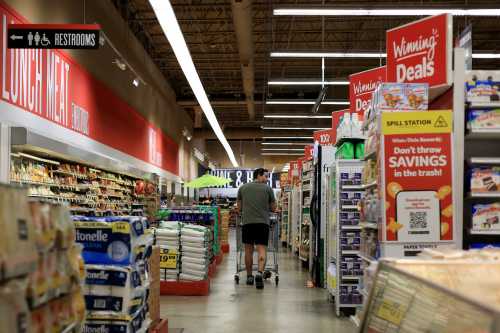
At year’s end, the president’s overall job approval averaged about 43%. He does reasonably well on immigration, crime, and foreign affairs—the issues that dominated his first year in office. He does much worse on the economy (41%), inflation (36%), and health care (32%).1 Unfortunately for him, the people care more about the latter list than the former: 66% of Americans identify either the economy, inflation, or health care as the top issue facing the country, while 24% pick one of the issues to which the president has devoted most attention.
Economic concerns remain dominant, and the public’s assessment offers the president little encouragement. Only 27% rate the state of the economy as excellent or good, compared to 72% who evaluate it as fair or poor. Eighteen percent say that they are better off, but 36% say the reverse. Twenty-three percent think the economy is improving, but 53% say that it is getting worse.
This helps explain why almost six in 10 Americans say that President Trump is focusing on the wrong things. Only 16% think that he is spending most of his time on domestic issues, and the invasion and possible occupation of Venezuela won’t help those numbers. Seventy-three percent say that he is not spending enough time working to lower prices.
The public’s perception of misplaced priorities has consequences. Only 38% believe that Trump cares about “people like you,” while 62% think that he does not.
What the president has been saying about the economy in response to these perceptions seems to be making matters worse for him. His effort to shift blame to his predecessor is falling flat. Only 22% blame Joe Biden for the state of the economy, compared to 47% who place responsibility on the current occupant of the Oval Office. And when Trump talks about prices, 61% say that he makes the situation sound better than it really is.
Finally, the public believes that when the president has turned his attention to the economy, his policies have made things worse. Only 29% believe that his policies have helped create jobs, compared to 50% who think they have contributed to job losses. Sixty-one percent believe that his policies have raised premiums for health insurance. As for tariffs, his signature economic policy, 75% of Americans, including 56% of Republicans, believe that they are raising prices. Not surprisingly, only 14% support imposing additional tariffs.
Economic expectations for 2026 are not bright. Most Americans think that tariffs will continue to push up prices, and only one-third believe that their family’s finances will improve, down from 48% last June. Twenty-three percent think that the economy is getting better, compared to 53% who think that it is getting worse.
The president’s job approval typically influences midterm elections, and 2026 looks to be no different. Congressional Republicans moved in lockstep with Trump during 2025, which helps explain why Democrats are now favored over Republicans, 40% to 35%, to handle the economy. Among independents, Democrats lead by 11 points; among Hispanics, by 15 points. At the end of the 2024 election, by contrast, Donald Trump enjoyed a substantial edge over Kamala Harris on managing the economy and inflation.
Increased public confidence in Democrats’ ability to manage the economy has contributed to the 4.5-point edge Democrats now enjoy in the midterm vote for the House of Representatives. Still, 40% of the electorate is willing to change its mind about Trump’s job performance, and they overwhelmingly cite the economy as the issue that could move them. If this happens, Republicans’ prospects in the midterm elections would brighten.
Implications for party coalitions
There is some evidence that the first year of Trump’s second term could have longer-term consequences for the American party system. After the 2024 election, analysts speculated about a realignment that would transform Republicans into a multi-ethnic, populist, working-class party. Now this prospect seems remote. Many of the groups that moved strongly toward the Republicans in 2024—independents, Hispanics, young adults—have moved away and should be regarded as swing voters.
Republicans’ populist credentials have been tarnished. Sixty-five percent of the people think that the Trump administration’s policies favor the wealthy, compared to just 12% who think they are oriented toward the middle class. Not surprisingly, populist sentiments remain strong. Eighty-one percent of Americans, including 66% of Republicans, believe that the rich in the U.S. have too much power. Sixty-two percent say that taxes on billionaires are too low. Fifty-seven percent believe that the government should try to reduce the wealth gap between the rich and the poor.
Important elements of the American creed are being challenged. If you work hard and play by the rules, goes the familiar mantra, you can get ahead. But when asked about the most important source of success in today’s America, just 21% cite hard work, compared to 40% who believe that coming from a privileged background is the key.
Progress is another core element of the creed. Each generation is supposed to do better than the last. But now, only 15% of Americans believe that today’s children will grow up to be better off than their parents, while 51% think that they will be worse off. Republicans and conservatives share this pessimism.
Donald Trump returned to the White House with a familiar promise to “Make America Great Again.” But for most Americans, greatness as they understand it remains elusive, and they do not believe that we are moving toward it. As long as this sentiment persists, neither party will enjoy a stable majority, and control of national political institutions will continue to oscillate.
Related Content

Author

-
Footnotes
- These data are drawn from RealClearPolitics polling averages. The health care approval estimate reflects an average of surveys conducted by Fox News, “Trump’s economy approval hits 39% as voters worry about prices”; the AP-NORC Center for Public Affairs Research, “Trump’s approval rating slips on the economy and immigration”; and Gallup, “Trump’s Approval Rating Drops to 36%, New Second-Term Low.”
The Brookings Institution is committed to quality, independence, and impact.
We are supported by a diverse array of funders. In line with our values and policies, each Brookings publication represents the sole views of its author(s).


Commentary
The economy weakened support for President Trump in 2025 and may do so again in 2026
January 15, 2026