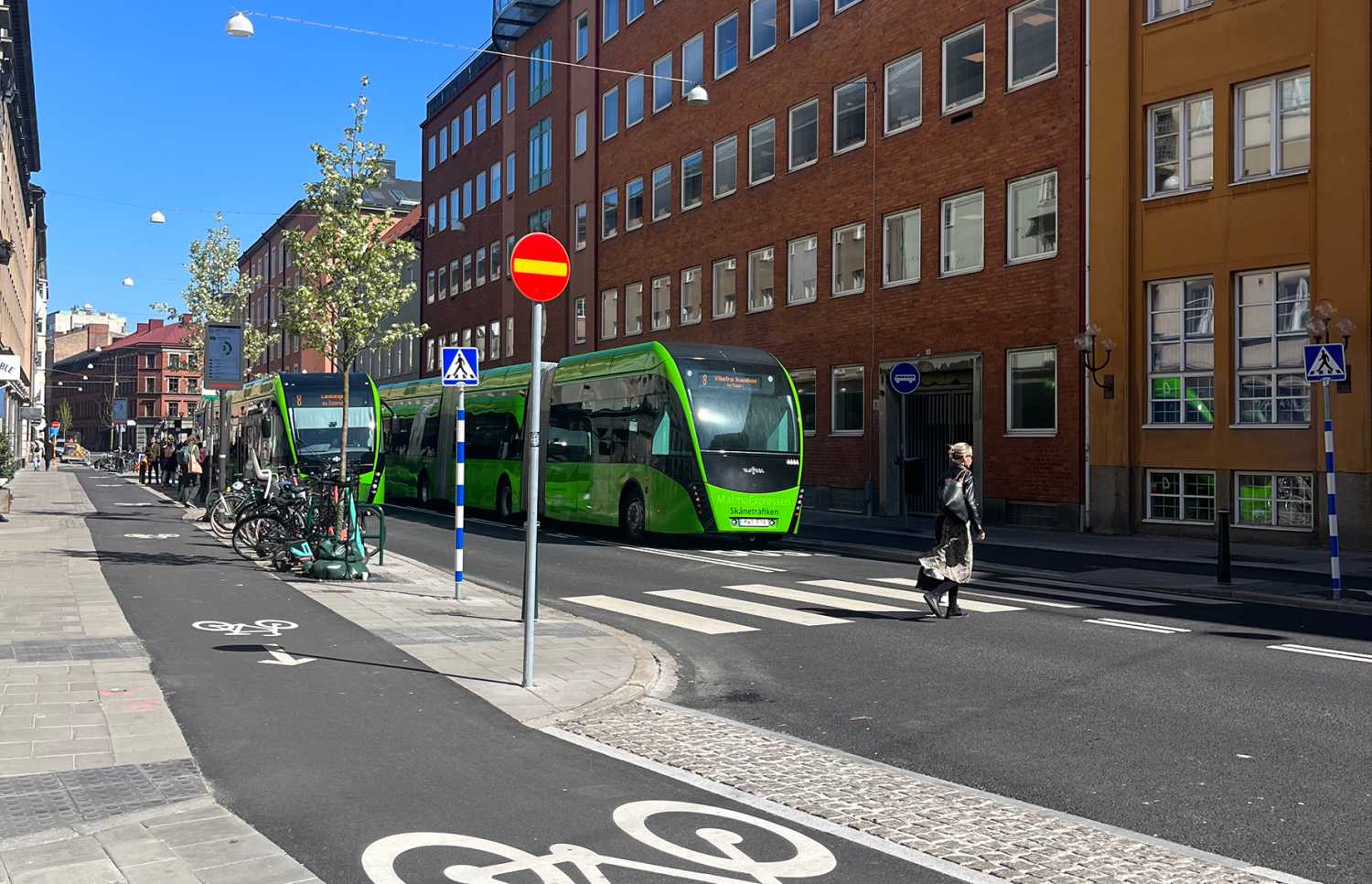
Across the United States, local governments are struggling to manage the dual challenges of providing enough housing and maintaining high-quality infrastructure. While the extent of housing underproduction is the subject of debate, the presence of a housing shortage is generally accepted. Meanwhile, limitations on federal funding and locally constrained revenues have made it especially hard to pay for new transit and active transportation infrastructure. Cities and regions can potentially solve both problems at once by building more housing adjacent to transportation investments.
A national policy in Sweden provides some inspiration for U.S. metropolitan areas. In 2014, Sweden adopted the National Negotiation on Housing and Infrastructure (or Sverigeförhandlingen) policy framework. The Swedish approach provides an innovative method of co-financing between the national and local government to invest in transportation, all while holding local governments accountable for reaching housing targets.
Despite their many contrasts across government and policy, the U.S. and Sweden are more similar than different in key aspects of housing, land use, and transportation revenues than one may think. This report draws on four months of research on the National Negotiation in Sweden during 2022 through document analysis, site visits, and stakeholder interviews, and shares replicable takeaways for U.S. policymakers.
How Sweden develops land, finances transportation, and builds housing
Even though Sweden has a coalition-based, multiparty political system, its approach to governing and financing housing, transportation, and other land uses closely mirrors approaches in the United States. Table 1 compares Sweden and the U.S. to describe key similarities and some important differences, outlining aspects of how housing, transportation, and land use planning and financing work in the U.S. generally and in the state of Oregon specifically, as many aspects of planning and financing are determined at a state rather than federal level. (For sake of comparison, Sweden’s 2025 population was 10.6 million and Oregon’s was 4.3 million.)
In Sweden, land use is governed at the municipal scale. The national government sets certain standards for buildings, but does not intervene in local land use planning. The landscape for comprehensive planning varies across U.S. states; in Oregon, the state sets standards for local comprehensive plans, which are reviewed for compliance with statewide goals by a state agency and commission (the Land Conservation and Development Commission). Oregon has a higher level of state authority over land use than most states. However, like most states, regulations that affect land use are controlled at the municipal level through local development codes.
Unlike some other European countries that play a strong role in social housing, Sweden relies on the private sector to provide housing, much like the U.S. A key difference is the role of Swedish “municipal housing corporations,” which own roughly 20% of all units and 50% of rentals, and rent on an “income-qualified” basis. These municipal housing corporations function similarly to nonprofit property managers in the U.S., but serve a broader income spectrum. Another key difference is in how rent subsidies are provided: While the U.S. limits the supply of housing assistance, the Swedish government provides a housing allowance based on income and housing costs to certain groups, including families, young people, and the elderly. The Swedish government has not directly invested in housing since the Million Dwellings Programme in the 1960s and 1970s. Similar to the United States, tax policies tend to favor homeownership via mortgage interest deductions; the Swedish homeownership rate is around 65%, including attached and detached housing.
For transportation infrastructure, Sweden relies on multilevel governance to fund capital improvements and operations. Cities are responsible for roads and bicycle infrastructure within their own boundaries, while transit functions at a regional level (similar to counties in the U.S.). Revenues are simple to track in Sweden: City and regional governments only have access to income taxes. There are no local property taxes in Sweden, and value-added taxes (VAT) and user charges (such as registration fees) are pooled at the national level. Oregon also relies on multilevel governing responsibilities, although there is a different variety of revenue sources funding the system.

Creating a co-financing structure for housing and transportation in Sweden
Sweden is experiencing a housing shortage. When Sweden enacted the National Negotiation in 2014, it set a goal of constructing 700,000 units over the following decade. According to a 2025 Organisation for Economic Co-operation and Development (OECD) report, Sweden’s housing need is 50,000 units per year over the next decade (to match population and household growth), but it only averaged 31,000 new units per year in 2023 and 2024, in no small part due to higher interest rates.
At the same time, Sweden’s local revenue options for transportation infrastructure are limited. Swedish cities are revenue-constrained; the only revenue source they can access is municipal income taxes, which do not provide enough capital funding for large-scale investment. Local income tax rates are set by city councils and range from 29% to 35%. Only higher earners (those making roughly double the median income) pay a progressive national income tax, starting at 20%.
The National Negotiation was a purposeful effort to respond to those dual challenges, looking to leverage the best features of both the national and local governments. It began in 2014 under a center-right national government coalition led by the Moderate Party. The directive asked for negotiators to look at multiple reform areas, including metropolitan agreements to expand public transportation and increase housing construction in the nation’s three largest cities (Stockholm, Gothenburg, and Malmö). The process was informed by lessons drawn from prior national programs that provided special funding for large transportation projects in Stockholm (Stockholmsforhandlingen in 2013) and Gothenburg (Västsvenska paketet in 2009).
Over three years, the national government’s negotiators worked with the cities and transit agencies on how to co-finance transit investments in exchange for achieving housing construction targets by 2035. The eventual agreements saw each city commit to a housing target, while the national government would co-finance transport assets. (Table 2 shows a summary of the targets and investments.) The national government co-finances the infrastructure at a rate of 50% for transit and 25% for bicycle infrastructure. The local government pays for the balance of the cost of providing infrastructure.
These agreements are motivating to local governments; if jurisdictions do not reach housing targets by 2035, the central government will withhold 25% of their promised investment.

As of the last reporting period in 2025, the three cities are in various stages of planning and construction for transportation infrastructure. Malmö has completed 80% of the 2035 housing target; Gothenburg has completed 40%; and the Stockholm region has completed 35%. Housing production is tracked via a method that links it to individual infrastructure projects (e.g., bus lines), as Figure 1 shows. And Map 1 illustrates the clear geographic connection between housing and transportation in Malmö.

Key lessons from Sweden’s approach
Sweden’s approach provides some key lessons for investing in sustainable transportation while encouraging housing production. The following examples are derived from document analysis, interviews, and site visits.
- Rely on co-financing (or match funding): The key element of the National Negotiation is that the cities commit to providing the conditions to ensure housing can be built; each region committed to a specific number of housing units alongside transit investments.
- Offer carrots, but hold some back: If jurisdictions do not reach their housing targets by 2035, the national government will withhold 25% of its promised investment—and jurisdictions will have to pay for that share of transit investment themselves.
- Fund the infrastructure, not the planning: Interviewees from all regions agree that national investment was monumental, and transit investments could not have happened without the promise of co-financing due to limited taxing authority.
- Implement existing plans: Projects were part of long-standing city plans; cities did not create new plans in this process, and instead implemented existing ones.
- Focus on the outcome, not the process: Having a single, straightforward metric of housing units constructed streamlined the negotiations compared to a complex, multi-criteria analysis including other metrics such as modal split and greenhouse gas emissions.
Takeaways for the United States
There is no shortage of American cities and regions struggling with housing shortages and underfunded transportation. Leaders in those places—regardless of partisan affiliation—are looking for ways to accelerate housing construction while finding the means to pay for transportation investments.
But there is also no shortage of creative ideas to inspire local governments to take action on housing supply. Several U.S. policy proposals seek to increase housing supply, primarily by linking federal funding to housing production targets. Common mechanisms include withholding discretionary transportation or affordable housing dollars from jurisdictions that miss targets, and rewarding communities that take action with direct payments or infrastructure grants (as described in proposals from the Center for American Progress, the Searchlight Institute, the Biden administration’s Pathways to Removing Obstacles to Housing (PRO) grants, and the 2023 Yes in My Backyard Act.
Local governments in the U.S. exert tremendous capital to apply for competitive federal grants that fund one piece of the puzzle—e.g., a single corridor, a regulatory barriers study, or a feasibility study. Sweden gives us something else to consider: How can we solve the dual crises of housing production and transportation funding simultaneously? One answer lies in focusing on the outcomes: thinking big and systemically about building out a transportation system adjacent to housing development while simplifying the process of accessing large-scale funding. Instead of local governments in the U.S. applying for grants to remove regulatory barriers while separately applying for individual transportation projects, they could receive large-scale block grants to invest in infrastructure provision.
Sweden and the U.S. are more similar than different when considering land use, housing, and transportation. Sweden is quickly building infrastructure and leveraging that expansion to build housing in areas adjacent to carbon-efficient transportation options.
U.S. policymakers can apply the Swedish lessons as they continue to craft policy solutions. It’s especially important to think about tapping the unique capabilities of localities due to their greater land use authorities, and then the capabilities of states and the federal government, which have larger borrowing capacities and the ability to influence places at scale. Five core principles stand out.
- Focus on the outcome: Give local governments a measurable target to reach and the carrot to get there, but let them innovate to figure out how to reach the outcome. Instead of requiring implementation of specific policies or adoption of certain plans, require that local governments meet a goal of units produced.
- Catalyze local investment: Provide funding that encourages local governments to use match funding and align development toward areas where federal and state governments are investing in carbon-efficient transportation infrastructure.
- Think systematically and strategically: Instead of funding incremental projects, invest a much larger amount of funding to allow local governments to build out expansive, multi-model infrastructure in systems instead of segments.
- Reduce administrative burdens: By shifting from small, competitive, and discretionary grants to systemic investments, cities will spend less time applying for grants and more time implementing and building projects.
- Shift from planning to doing: When we require local governments to adopt new plans or update plans to receive funding, we risk creating more “plans sitting on a shelf” and extending the timeframes for building the needed infrastructure.
Conclusion
Limited supplies of housing and transportation infrastructure are two of the most impactful problems societies face. Solving them requires a diverse array of actors at all scales—including government officials, developers, construction companies, and financiers—to both coordinate their actions and then maintain that coordination over years to steadily increase supply.
The Swedish model offers a promising pathway for aligning local and higher-level government officials using a mix of outcome-oriented thinking and goal-setting to motivate direct transportation investment and related land-use reforms. Just as importantly, aligning public sector commitments can then catalyze greater private sector investment in housing construction, as it provides a clear market signal that government will do its part in specific corridors.
With many American regions failing to deliver enough housing, Sweden’s model marries philosophy and achievement. U.S. policymakers would be wise to look across the Atlantic and apply those lessons in their own backyards.
Author

-
Acknowledgements and disclosures
The author would like to thank Nick Meltzer, Magnus Andersson, and Adie Tomer for useful comments on earlier drafts of this piece.
The Brookings Institution is committed to quality, independence, and impact.
We are supported by a diverse array of funders. In line with our values and policies, each Brookings publication represents the sole views of its author(s).