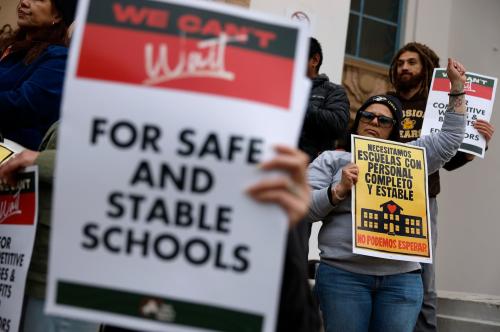
State finance reforms since the 1970s have changed school funding formulas to improve socioeconomic equity by providing more funds for districts in lower-income communities and with lower property values. The goal was to make school funding more equitable by reducing the connection between local property values and school resources. State approaches vary, but often they achieve this by allocating additional funds for each low-income student and in some cases additional funds for districts with a high concentration of low-income students. The finance reforms did not generally aim to address racial equity of school funding, but because of the correlation between income and race in the U.S., we expected to find that the reforms would also improve racial equity of school funding.
These state finance reforms were successful in increasing the equality of school funding by household income. High-poverty districts now receive more funding than they used to, and funding levels are now much more equal between high- and low-poverty districts. But, contrary to expectations, our recent study finds that the same reforms did not make funding more equal by race or ethnicity. In fact, in some cases, the same reforms that improved equality by income made funding less equal by race and ethnicity.
Decades of reforms improved equality by income but not by race
To learn how school finance reforms impacted inequality of school funding by race and ethnicity, we built on a landmark 2018 study by Lafortune, Rothstein, and Schanzenbach that found that school finance reforms from 1990 to 2012 increased equality of spending by district income. We included more recent data, allowing us to include reforms enacted between 1990 and 2017 and to examine state outcomes through 2022. This extended timeframe enabled us to assess changes at least five years after each reform, which is important given that reform effects may be delayed or unfold gradually. We also applied recently developed difference-in-differences techniques that better address state differences in the timing of the finance reforms.
We built a database of school finance reforms in 40 states from 1990 to 2017 and identified the most economically progressive reforms. These reforms could be court mandates, legislative changes, or voter-approved reforms. For example, in 2012 the state of Washington’s Supreme Court ruled the existing funding formula unconstitutional for failing to provide enough funds for districts and for forcing heavy reliance on local taxes, prompting reform. By focusing on the most economically progressive reforms, we set up an “upper bound” test of whether the strongest income-based reforms could improve racial equality.
We measure racial funding disparities as per-pupil state and local revenue received in districts with low shares of Black or Hispanic students (3% on average) minus revenue in districts with high shares of Black or Hispanic students (40% and 20% on average, respectively). Positive values indicate higher funding for districts with low shares of Black or Hispanic students. We use a similar approach to measure income-based gaps, calculating per-pupil state and local revenue in low-income districts minus revenue in high-income districts.
Finance reforms increased equality by income
The good news is that the finance reforms achieved their goal: The reforms reduced school funding gaps between low- and high-income districts. After the reforms, funding increased by over $500 per pupil more in low-income districts than in high-income districts, on average looking across all states. When including more recent reforms through 2017, funding increased by over $1,300 per pupil more in low-income than in high-income districts. In short, whether we look only at the early reforms or include more recent reforms, we find that the economically progressive school finance reforms made school funding more equal by income. When including the longer time period, the reforms eliminated or even slightly reversed the initial funding gap in 1990 based on household incomes.
Reforms did not improve—and in some cases reduced—funding equality by race
The picture changed when we examined funding gaps by race and ethnicity instead of income, keeping all the other details of the analysis the same. In other words, the same finance reforms that improved equality by income either did not change or widened funding gaps between districts with the lowest and highest shares of Black or Hispanic students.
Economically progressive school finance reforms passed through 2017 increased the funding advantage of districts with low shares of Black and Hispanic students. Specifically, funding increased by $740 more per pupil in districts with low compared to high shares of Black students. The funding advantage of low-Hispanic districts increased even more, by $1,100 per pupil, compared to high-Hispanic districts.
The surprising takeaway is that even well-intentioned and effective reforms to improve economic equality can fail to improve, and may even exacerbate, racial inequality.
Why such limited progress by race and ethnicity?
Our surprising findings raised questions about why equality-enhancing reforms based on income widened funding inequalities based on race. To try to understand the findings, we compared the effects of the finance reforms by the extent of funding inequality and segregation before the reforms. These were the three factors that we identified to explain our surprising result.
Segregation and the geography of inequality: Racial funding disparities exist between districts and between states, not just within states. State school finance reforms can only change the allocation of funding within states, meaning they cannot address between-state disparities, which account for much of the remaining gaps in school spending when looking across the country. Further, our analysis shows that reforms’ impact differed based on a state’s baseline level of segregation. In states with high racial-economic segregation—where Black and Hispanic students disproportionately attended more poorly funded districts prior to the reforms—the reforms did not improve economic progressivity and amplified ethnic inequality of funding. In states with low race-by-income segregation, reforms improved funding equality by income, and increased spending in high-Black and high-Hispanic districts (though similar increases in spending in low-Black and low-Hispanic districts meant overall racial equality did not change).
The limits of “colorblind” or race-neutral policy: Another issue is the politics of redistribution. Income-based reforms are generally more politically feasible than race-based reforms. Income-based reforms may avoid political backlash that often accompanies race-conscious policies. But race-neutral policies come with a major tradeoff: School finance reforms can only mitigate racial funding inequality to the extent that race and class overlap. If poverty and race are not strongly correlated in districts, then policies based only on income may overlook racially segregated districts that are not the lowest income, but are still underfunded compared to districts with more racially advantaged student demographics and greater economic resources. They may not improve racial inequality and could even make it worse.
Adaptive behavior and policy dilution: Reforms can also have different effects than intended if legislators include “hold harmless” provisions or other clauses that weaken the reforms and protect wealthy districts from losing funds. Well-resourced districts can also adapt to state finance reforms by increasing local taxes to offset declines in state funding.
Together, segregation and geography, the limits of race-neutral policies, and adaptive behaviors help in understanding why finance reforms can increase equality of funding by income but not by race.
Contexts where the reforms did improve racial equality
Results are more promising when we look at specific states that had low racial inequality of funding to begin with and low race-by-income segregation, meaning weak overlap between race and income segregation. In those states, the finance reforms did not make racial inequality worse and, in some cases, improved equality of funding by race. States that had already demonstrated a commitment to funding equality by race seemed to retain that commitment as they improved equality by income.
Takeaways for policymakers
Our findings offer some notable implications for state policymakers interested in improving school funding equality.
- Income-based reforms are important, but not sufficient, if policymakers have a dual goal of improving racial and income equality. On average, states have successfully reduced inequality of school funding by income. But state lawmakers should pay attention to how the reforms interact with funding disparities by race. This could mean noting how funding formulas overlap with district racial composition as well as income composition.
- Targeted desegregation efforts may indirectly reduce racial funding inequality. Rather than only addressing income-based gaps, states could also allocate funds to help integrate racially isolated or marginalized districts. Desegregation efforts, including affordable housing and housing vouchers, could help address racial funding inequality from another direction.
Income-based school finance reforms since the early 1990s have enhanced school funding equality by income, but not by race or ethnicity. The reforms had, at best, neutral to small positive impacts on racial and ethnic funding equality in select states. For most states, race-based spending gaps widened after the reforms. These findings highlight the inability of income-based reforms to address racial disparities in education. The two problems are not interchangeable and policymakers who wish to address both need to attend to both dimensions of inequality.
Authors


The Brookings Institution is committed to quality, independence, and impact.
We are supported by a diverse array of funders. In line with our values and policies, each Brookings publication represents the sole views of its author(s).