To be American is to embrace the narratives and experiences of freedom and unfreedom. It is to know there were enslaved people and those who enslaved them. It is to learn that some could vote and others could not. And it is to learn that states’ boundaries were formed by removing their indigenous inhabitants. These are the realities of American history, and ignoring them means denying mechanisms that might transfigure our country into a more perfect union.
The act of suppressing information, knowledge, and data about Americans dishonors the past and those who fought for equality and justice. Acts of suppression often fuel counterrevolutions that seek to reverse social, racial, economic, and political progress for unrepresented groups. Recent examples include the federal government’s removal of an exhibit on the realities of slavery in America from the President’s House in Philadelphia. There have also been thousands of attempts since 2020 to ban books that focus on racial, ethnic, LGBTQ+, and religious minority communities from public libraries and schools.
To preserve the legacy, vision, and transformative influence of these communities in constructing American democracy, then and now, scholars at the Race, Prosperity, and Inclusion Initiative (RPII) are launching a series titled “Uprooted: Rediscovering American History.“
Uprooted examines the histories and contributions of marginalized groups that have shaped our nation. This series provides evidence-based analysis and concrete policy recommendations to reinforce civil rights, address economic inequality, and promote mutual understanding in a landscape increasingly shaped by misinformation, partisan rhetoric, and political infighting. Our work highlights the voices, leadership, and impact of these groups, emphasizing their role in advancing policies that foster a more inclusive democracy. In doing so, we seek to prevent them from being forgotten, erased, or uprooted.
Research consistently demonstrates that systemic disparities—embedded within institutions, policies, and social norms—have historically marginalized certain communities and perpetuated gaps in education, economic opportunity, health care, and the criminal justice system. These structures continue to guide decisions about access and opportunity, often in tension with the idealized narrative of a meritocratic society. Ongoing debates over resource distribution have heightened political tensions, strained civic cohesion, and contributed to regressive policy actions. Amid these challenges, communities have responded through various forms of activism, policy advocacy, and legislative changes. Examples include immigration policy, the Black Lives Matter movement, marriage equality, technology justice, and national health care access movements.
Uprooted highlights innovative policies and community-led solutions to these problems. Drawing on social science research showing that fairness and strong civic networks drive economic prosperity and collective well-being, the series creates a platform for nuanced, evidence-based discussion of racial and economic injustice—and aims to catalyze action by bridging political divides, championing policy innovation, and inspiring civic engagement in the ongoing work of building a healthier democracy.
Over the next year, Brookings scholars and external contributors will examine five key themes from both historical and modern perspectives.
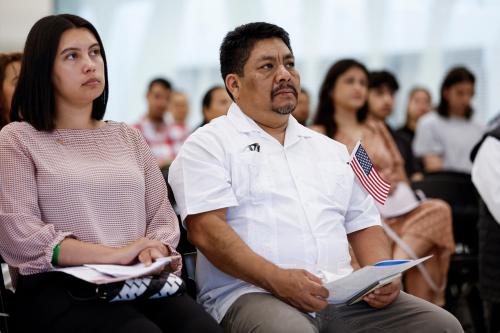
- Migration and immigration: Across America, the demographic changes caused by the movement of people within and into the country have shaped cities, the workforce, culture, and public policies. These movement patterns impact the democratic process and have deep implications for housing, health care, and workforce development.
- Civic engagement and community power: At the heart of the American promise are free speech and collective action. Social movements have long embodied these values, giving individuals the autonomy to define their own freedom and the capacity to resist oppressive power, pursue equality, and promote practices that mature our democracy and create pathways for equitable access, resources, and the opportunity to thrive.
- Inclusion and cultural politics: Storytelling and art allow Americans to express their identities and political views, and in doing so, strengthen democratic participation. Preserving that democracy means documenting and centering the historical and modern-day perspectives of diverse communities to build a more inclusive future and uphold our shared democratic principles.
- Community health and well-being: Health and well-being are shaped by social networks, neighborhood environments, and opportunities for social mobility. Access to high-quality health care and robust public health prevention is essential, yet policy also determines the physical and social landscapes that either hinder or support healthy living.
- Technology and innovation: Technology can accelerate the spread of mis- and disinformation targeting people of color, while also enabling the extraction of data from vulnerable populations without regard for the human consequences. Addressing these harms requires human-centered policy, as well as leaders who understand the experiences of affected online communities. These efforts have the potential to mitigate online bias and labor force disruptions, helping to prevent wider wealth gaps when individuals and groups are excluded from mainstream technology conversations.
The collective scope of Uprooted centers the voices of communities across America, revealing that the promise of the American dream is most equitably achieved when we move toward collective action that builds resilience. “Uprooted: Rediscovering American History” contributes bold and uplifting dialogue to the national debate on racial equity, shining a light on narratives and people that are lost but not forgotten.
Uprooted’s first cycle of publications, focusing on migration and immigration, launches at the end of March 2026.
Authors





The Brookings Institution is committed to quality, independence, and impact.
We are supported by a diverse array of funders. In line with our values and policies, each Brookings publication represents the sole views of its author(s).

Commentary
Restoring the voices that transformed American history and democracy
March 5, 2026