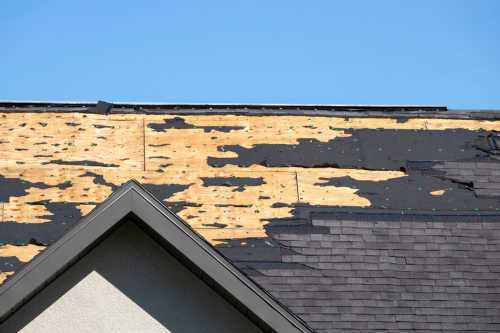
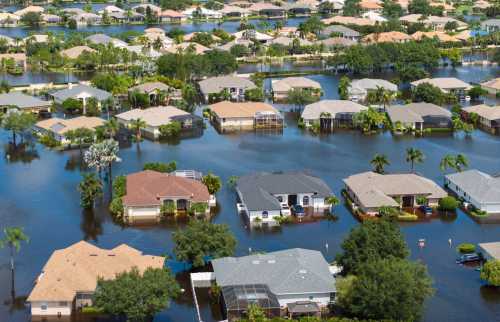
Largely due to the growing frequency and severity of extreme weather, homeowners and businesses face rising premiums on property insurance, limits to coverage, or outright unavailability. On the morning of March 18, the Hutchins Center and the Hamilton Project at Brookings hosted a discussion of the challenges to the insurance market. The Hamilton Project also published a proposal that the U.S. government create a reinsurance entity to relieve strains on the insurance market.
Adam Solomon of New York University’s Stern School of Business, who joined the March 18 panel, draws lessons from foreign governments’ intervention in their insurance markets in a new paper, “Designing Public Reinsurance: Global Lessons for the U.S.” He identifies two fundamental market failures that occur in insurance for natural catastrophes: (1) underpriced insurance that distorts property owners’ location and mitigation decisions, and (2) financial frictions due to correlated risks. (Insurance spreads the risk of loss across many policyholders; natural disasters are concentrated—correlated—in a single place, which requires insurers to hold enough capital in case of a major catastrophe, increasing premiums.)
In response to that second issue, reinsurance—insurance for insurance companies—allows primary insurers like Allstate, State Farm, and Liberty Mutual to reduce their exposure to catastrophes. When risks are too big or too costly for private reinsurers (such as Swiss Re and Munich Re), governments may offer public reinsurance.
“Public reinsurance typically covers a defined slice of catastrophic risk, for example, hurricane or flood losses or officially declared disaster events, while leaving the pricing, underwriting, claims management and idiosyncratic risk to private insurers,” Solomon writes. “The rationale is to leverage the size and diversification of the public balance sheet to add to the supply of capital available in private markets where it is most strained: correlated tail risks. Public reinsurance has become standard for terrorism since the 1990s, and analogous programs to cover natural catastrophe risk have emerged in many countries around the world, and are being actively discussed by academics and politicians in the U.S.”
The U.S. government, for instance, created the Terrorism Risk Insurance Program after 9/11 for commercial properties because most private insurers wouldn’t offer it. The state of Florida created the Florida Hurricane Catastrophe Fund in 1993 after Hurricane Andrew; all residential property insurers in the state are required to participate and pay premiums. Governments can and do provide insurance directly, as with the National Flood Insurance Program in the U.S., but political pressures often lead them to keep premiums below risk-justified levels, Solomon notes.
Programs such as the Australian Cyclone Reinsurance Pool, Flood Re in the U.K., and Spain’s Consorcio de Compensación de Seguros “aim to supply cheap and stable capital to absorb shocks…while maintaining risk-based pricing and encouraging mitigation,” Solomon writes. (For more on the Australian pool, see this Solomon paper.)
Solomon identifies several design decisions for architects of public reinsurance. Among them are the following.
Pricing
The most consequential design decision is how the program prices risk.
Risk-based pricing means premiums are set actuarially to cover expected losses and, in some cases, cost of capital. Programs such as Florida’s Hurricane Catastrophe Fund, the California Earthquake Authority (CEA), and recent reforms to U.S. flood insurance aim in this direction. Risk-based pricing strengthens fiscal sustainability and preserves price signals that influence location and mitigation decisions.
Alternatively, cross-subsidized pricing redistributes the burden among policyholders, but the program still covers its costs. In the U.K., for instance, private insurers turn high-risk policies to the pool at below-risk prices, financed by a uniform levy across all homeowners. Government reinsurers in France, New Zealand, Norway, and Spain have similar cross subsidies. “Although not ideal in the long-term due to the blunted risk signals,” Solomon writes, “this might be a politically feasible short-term solution that allows for gradual movements towards risk-rated pricing for existing residents.”
A third alternative is for the government to subsidize the reinsurer. France’s Caisse Centrale de Réassurance (CCR), recently rebranded as Arundo Re, has set premiums that are lower than total claims for several years.
Mitigation incentives
Public reinsurance can provide incentives for risk reduction through premium discounts, direct payments, or conditions on eligibility.
Australia’s cyclone pool offers standardized premium discounts for verified mitigation measures, such as roof retrofits and window protection. Japan’s earthquake system embeds premium discounts for earthquake-resistant construction. The UK’s Flood Re, in addition to reimbursing for actual losses, offers up to £10,000 per claim for approved resilience upgrades. France’s CCR indirectly incentivizes municipal mitigation by potentially charging higher deductibles in municipalities that haven’t adopted risk-prevention plans.
Mandatory vs. voluntary participation
Mandatory participation is a feature of many of the most stable programs—those in Australia, Florida, Norway, and Spain. Mandatory participation broadens risk pools, reduces adverse selection, and stabilizes funding. Voluntary participation at the portfolio level allows insurers to opt in with their full book of business. The UK’s Pool Re (terrorism) and France’s CCR operate this way. Voluntary models can preserve private market competition, but they risk adverse selection if insurers with safer portfolios decline to participate. Policy-level opt-in, as in the U.K.’s Flood Re, allows insurers to cede only selected policies. This design deliberately concentrates high-risk properties in the pool but adds administrative complexity and increases adverse selection risk. International experience suggests that adverse selection is a real threat to voluntary programs, particularly if pricing deviates from actuarial norms.
Funding shortfalls
Even well-priced programs face volatility. Countries use several backstops: industry levies (Spain, Florida), central government guarantees (Japan, Australia), and pre- and post-event bonds (Florida, Mexico). The strongest programs combine bonding authority with credible levy powers, supporting high credit ratings while rarely invoking taxpayer transfers.
Solomon concludes that the most durable systems share several features: risk-based pricing, broad participation to prevent adverse selection, carefully defined hazard coverage, indemnity-based triggers for domestic insurers, and credible funding backstops. International experience suggests that design choices determine whether public reinsurance stabilizes markets or reinforces the distortions of subsidized public insurance. By concentrating public capital in the catastrophic tail while preserving private-sector underwriting and mitigation signals, well-designed public reinsurance can address capital constraints without sacrificing long-run resilience, he says.
Author

Related Content
The Brookings Institution is committed to quality, independence, and impact.
We are supported by a diverse array of funders. In line with our values and policies, each Brookings publication represents the sole views of its author(s).


Commentary
Public natural catastrophe reinsurance: What other countries do
March 18, 2026