Families are a critical ingredient to student success and well-being but are often left out of education policies and agendas. What will it take to make sure family engagement is seen as a must-have in schools and education systems?
The Center for Universal Education (CUE)’s Global Family Engagement in Education Network (FEEN), a cross-continental collaborative, has been grappling with how to create family-centered education systems that position families and communities as essential partners in delivering a shared vision of education. For the last four years, schools and civil society organizations from six countries of the FEEN have been testing strategies to create family-centered education systems in Brazil, Bangladesh, Colombia, South Africa, Sierra Leone, and Zanzibar.
On November 18 and 19, CUE and collaborators hosted the second Global Family, School, and Community Engagement symposium to explore findings from this policy and systems research. Participants from around the world discussed how to create opportunities for teachers and families to learn from each other, leverage community organizations to support home-school partnerships, and draw on lived experiences in building family-centered education systems.
What is a family-centered education system?
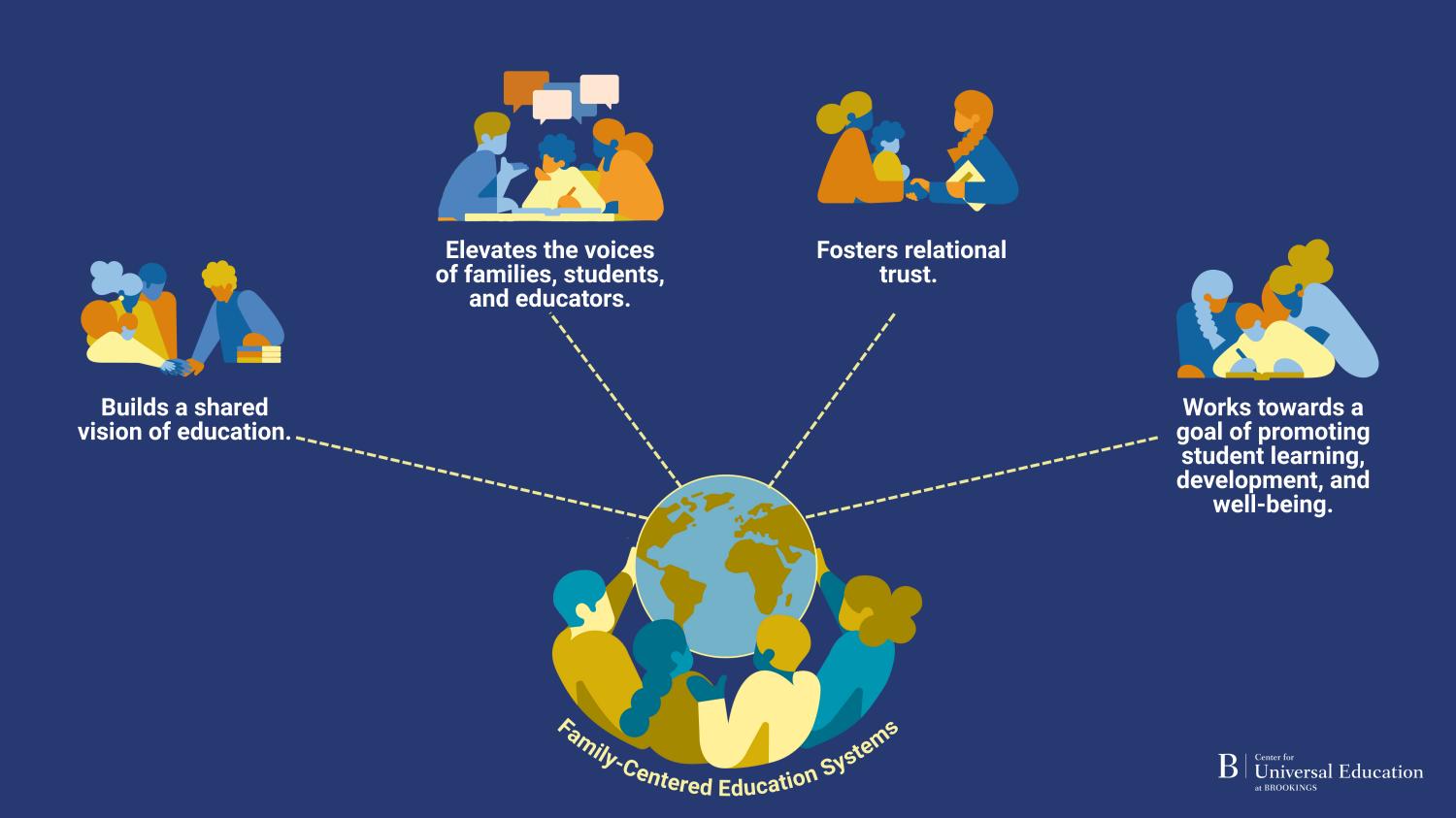
CUE defines family-centered education systems as those that position students, families, and communities as essential partners and assets—along with educators—in supporting young people to thrive and flourish. In family-centered education systems, families and schools work together to:
- Build a shared vision of education.
- Elevate the voices of families, students, and educators.
- Foster relational trust.
- Work towards a goal of promoting student learning, development, and well-being.
How can schools and communities champion family-centered education systems?
Championing family-centered education systems requires opening doors for not only family involvement, but also engagement. Involving families in events, committees, and activities is important, but often focuses on telling families how to be involved and sharing information. In these cases, while families are present, they are rarely really heard or part of designing the school’s vision of family involvement and engagement.
Family-centered education systems strive for meaningful family engagement. CUE developed the below image with Kidsburgh and the Global FEEN to highlight some of the distinctions between these two concepts, drawing on the research from “Building parent engagement in schools.” 1

Meaningful engagement is based on listening to families, creating opportunities for two-way communication, and responding to the needs, lived experiences, and hopes of diverse families. It is ensuring that families contribute to decisionmaking and serve in leadership roles through formal committees and governance bodies, but also that they act as partners in the everyday learning and development of their children. Meaningful engagement ensures that families across all education levels, demographics, and languages are seen as assets and allies in learning.
Key takeaways
Family engagement looks different around the world. Colombia is one of the few countries in the network with a national policy on family partnerships, but like in Brazil and in the U.S., educators rarely have any training on how to actually collaborate with families. In Bangladesh and Zanzibar, while a handful of parents serve as representatives on school management committees, there is no widespread parental involvement in school activities or decisionmaking through parent teacher associations. In Sierra Leone and South Africa, families described trust as being passive: they leave their kids at the doors of the school for the experts to take over.
Yet despite all these challenges in building partnerships, schools and communities are trying out new approaches to engage families in change. The full policy recommendations can be found here, but below, we provide a snapshot of the few takeaways—coupled with insights from the speakers at our symposium.
- Equip schools and educators to partner meaningfully and inclusively with families. Few education systems include family engagement as a core component of teacher preparation programs. Educators rarely receive in-service training and support on how to partner effectively with families. As Ana Ligia Scachetti noted, “In Brazil, the teachers are not prepared and do not have the support to deal with family engagement. Many teachers tell us that the day that they have a meeting with the families is a day that they fear a lot. They don’t know how to do it. They don’t know where to start.”
Promising practice: Nova Escola (Brazil) and Red PaPaz (Colombia) are facilitating communities of practices and developing training materials to support educators, school counsellors, pedagogical coordinators, and families on effective ways to partner with one another. - Elevate family voices in school planning and decisionmaking. Families can serve as important allies in developing impactful and responsive school plans and policies. Many national education systems provide limited opportunities for families to participate in school committees and counsels. But in most parts of the world, only a few more-privileged families are typically involved in these decisionmaking activities. As Nasrin Siddiqa noted about schools in Bangladesh, “Families have never lacked commitment. They have only lacked a seat at the table.”
Promising practice: The Education and Cultural Society (Bangladesh) is working in collaboration with rural and urban schools to develop a shared vision of education in partnership with families using CUE’s Global Rubrics Tool. Likewise, the Milele Zanzibar Foundation (Tanzania) is leveraging parent champions as trusted leaders in school communities who can act as models and resources for other families.
- Build engagement responsive to the lived experiences of families and students. Recognizing families’ cultures and contexts, as well as the barriers they face in engagement, helps build cohesion and collaboration. Miriam Mason-Sesay said of Sierra Leone, “Families often feel unsure about how to help their children because they lack guidance and may be facing challenges such as poverty, time constraints, and their limited schooling experiences. When we shifted our mindset from hard-to-reach families to hard-to-reach schools, we reached those who are often left out of the conversation.”
Promising practice: EducAid (Sierra Leone) is collaborating with youth researchers to investigate the root causes of high rates of chronic absenteeism and develop solutions and strategies that consider the different barriers in schools and communities. - Ensure partnerships are built on trust. Relational trust is a process of beliefs, decisions, and actions fostered through consistent and reciprocal interactions and mutual respect. Trust is built over time through intentional efforts, dedicated spaces, and clear mechanisms for collaboration. In South Africa, Karen Ross observes, “Partnership doesn’t require grand interventions. It requires simple, repeated relational actions.”
Promising practice: The Mikhulu Child Development Trust (South Africa) is supporting early childhood centers in facilitating listening circles with families to understand diverse perspectives and develop appropriate family engagement and support communications strategies.
Family-centered education systems position families as a critical resource in educational transformation. Although national education policies and global visions of education, such as Sustainable Development Goal 4, do not clearly lay out a role for families in their ambitious aspirations for education, the research and demand is growing. Without families, students cannot thrive. Without partnerships, schools cannot achieve their goals. Looking ahead, families need to be a part of the global vision of education. Schools and communities around the world are showing us how to do the hard work of bringing families into the center of education systems transformation.
Authors


Related Content



-
Footnotes
- The first version of this graphic was developed by CUE and Kidsburgh and was cited in “Everybody wins! The evidence of family-school partnerships & implications for practice”).
The Brookings Institution is committed to quality, independence, and impact.
We are supported by a diverse array of funders. In line with our values and policies, each Brookings publication represents the sole views of its author(s).


Commentary
Moving from family involvement to engagement in education
February 10, 2026