With Venezuela’s President Nicolás Maduro and his wife captured by the U.S. military and exfiltrated to New York to face drug trafficking charges, there is stunningly little clarity as to what kind of governance lies ahead in Venezuela and how U.S. objectives will be met. During a January 3 press conference, U.S. President Donald Trump broke with his administration’s own national security strategy of doing no more “nation-building,” and declared that his administration would now run Venezuela until its oil production is significantly boosted. He designated several of his cabinet officials to work through Delcy Rodríguez, Maduro’s vice president, now sworn in as the president of Venezuela, instead of the widely popular opposition leader María Corina Machado and her associate Edmundo Gonzalez, who likely won the 2024 presidential elections. A day later, U.S. Secretary of State Marco Rubio provided a radically different vision for Venezuela’s governance, with the United States only shaping the policies of Venezuela on a limited set of issues through its blockade of sanctioned Venezuelan oil. On Monday, Trump doubled down on his vision, while also adding that elections in Venezuela would not be held soon.
Why the attack of Venezuela and the snatch of Maduro
Just as it sought, but failed to do in its first term, the Trump administration was gunning for months to overthrow the Maduro regime. It highlighted Maduro’s brutal authoritarianism and theft of the 2024 and 2018 elections and his alleged role as the leader of the Cartel de los Soles, the regime elements complicit in permitting cocaine traffic through Venezuela, a claim from which it backtracked in a revised indictment of Maduro. Despite complex questions about the legality of the military action, the Trump administration has framed the Maduros’ capture and U.S. lethal strikes on alleged drug trafficking boats as efforts to protect Americans from drug overdose deaths. Yet without the addition of fentanyl or methamphetamine, both produced in Mexico and not present in Venezuela, cocaine is not a significant cause of lethal overdoses. And despite a U.S. intelligence assessment to the contrary, Trump has also claimed that Maduro is purposely sending members of the Tren de Aragua criminal group to the United States to terrorize U.S. citizens.
Trump has also focused on increasing access to Venezuelan oil for U.S. companies, and in recent weeks began speaking of the Hugo Chávez-Nicolás Maduro regime as having stolen U.S. oil and owing the United States vast sums of money.
Various top Trump administration officials have had their own reasons for toppling the Maduro regime. A key objective of Rubio has been to sever the economic life support that Caracas extends to Cuba, to further economically squeeze the Castroite regime and bring it down. Stephen Miller, Trump’s homeland security advisor, has sought to enable the deportation of numbers of Venezuelans who have received temporary protection status in the United States. During the January 3 conference, Trump made repeated references to Venezuelans returning back to their home country, though he acknowledged that some may not wish to do so.
A U.S. protectorate?
Trump provided almost no details to back his assertation that the United States is now in charge of Venezuela and will be running the country until it can safely hand governance over to local authorities when oil production has been significantly increased and benefits the United States. But he did suggest that U.S. officials would be giving instructions to Rodríguez, or perhaps co-running Venezuela with her for a while. He also threatened further U.S. military against her and other Venezuelan officials who do not toe the line that the U.S. dictates.
With Venezuela’s top military establishment behind her, Rodríguez rapidly distanced herself from Trump’s claims and denounced U.S. actions as an illegal invasion. Balancing U.S. pressure and threats with her domestic political imperatives of not alienating the still-powerful Maduro regime, she softened her stance toward the Trump administration some hours later, only to backpedal and once again issue hard anti-Trump administration rhetoric later. For her and any Venezuelan official, even eventually elected ones, it will be hard to act merely as U.S. proxies.
The colonial overrule that Trump sketched resembles, and even surpasses, the Coalition Provisional Authority (CPA) rule the United States established in Iraq in 2003 after overthrowing the country’s dictator Saddam Hussein. The CPA made legions of grave errors that ushered in a corrupt, defective, and sectarian rule. But at least nominally, Iraqi officials within the CPA had a substantial say over governance.
A protectorate-like vision leaves many questions unanswered: How much power will the remaining heads of the Maduro regime hydra have to run Venezuela and will democratic actors be brought into the government? Will the United States seek only to dictate decisions over oil production and counternarcotics efforts or other domestic issues as well? How will the United States even know whether Venezuelan authorities are actually obeying the U.S. dictates and not subverting orders to and promote their cliques? The CPA had thousands of U.S. and Western administrators and advisors, yet they failed to prevent immense malfeasance. With U.S. administrative expertise within the State Department eviscerated by the Trump administration, will any such technocratic advisors deploy from Washington, perhaps hired as ad hoc contractors?
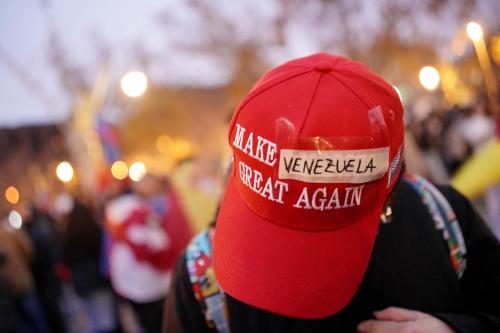
The CPA was underpinned by 160,000 U.S. soldiers on the ground (and later more) whereas, according to Trump’s press statements and the promises to his MAGA base, there are currently no (or only minimal numbers of) U.S. soldiers in Venezuela.
Rubio’s radically different portrayal of U.S. overrule in Venezuela also assumes that the United States would structure the policies of Venezuelan officials on oil policies, Cuba, and counternarcotics, but only through the continuation of the U.S. off-shore naval blockade. If Venezuelan officials displease Washington, oil exports would be prevented.
Is there a regime change in Venezuela?
Where both visions meet is that they leave—for some undefined period—the Maduro regime in place, essentially in its entirety. Yet restructuring governance in Venezuela is fundamental.
A critical mistake of the post-Saddam rule in Iraq was the de-Baathification process that purged vast numbers of civil servants and technocrats. It led to a loss of administrative experience, heightened sectarianism, and governance dysfunction and paralysis.
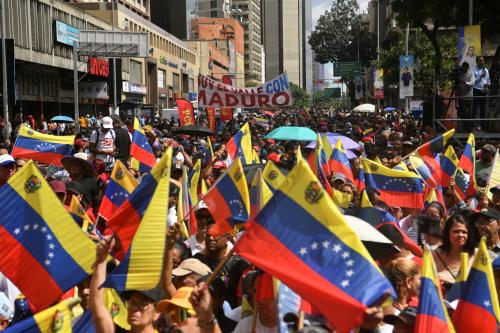
The Venezuelan security forces and civilian structures down to the local level are permeated by the Maduristas. Firing them en masse would reproduce the Iraq errors. Such purges could even lead to conflict, with the regime militias known as colectivos possibly resorting to street violence and fired soldiers to more organized armed resistance.
But leaving the Maduristas in power is problematic. Many are corrupt, clientelist, ideological, incompetent, and unaccountable administrators. Many will be tempted to continue prioritizing their own corrupt personal gain, particularly if the Trump promise of enlarged oil revenues, in fact, materializes. In Iraq too, oil was the mother of corruption.
Many Maduro regime officials are deeply implicated in forced disappearances, extrajudicial killings, arbitrary arrests, torture, and slaughter of protesters. Many others, including throughout the ranks of the Venezuelan military, are far more directly involved in drug trafficking than Maduro. How many will be removed from office by the U.S. military or Venezuelan authorities to stand trial in the United States or face some justice in Venezuela or told to go into exile?
Or will Washington leave just about everyone alone, as long as they now do U.S. bidding? Leaving 99% of the regime still in power, as is currently the case, would make a mockery of U.S. justifications for its military action, including countering drug trafficking. And it would leave the post-Maduro regime deeply illegitimate.
Already, Trump’s de facto anointment of Delcy Rodríguez as the United States’ preferred official, and his dismissal of Machado’s credentials deeply undermines the legitimacy of the post-Maduro regime. Brave, determined, and popular, Machado is the legitimate leader of the anti-Maduro opposition. If allowed to run in the 2024 elections, she would have likely won, despite Trump’s claims that she’s not respected in Venezuela.
Machado has been buttering Trump up since his election. Emphasizing her conservative credentials, she has not opposed the renditions of Venezuelans to the torture chambers of El Salvador’s CECOT prison nor the expected U.S. mass deportations of Venezuelans, despite human rights concerns and the loss of remittances, an important lifeline for many Venezuelan families. She was a staunch proponent of Trump’s military invasion to depose Maduro, and even dedicated her 2025 Nobel peace prize in part to Trump, knowing how much he covets the award.
While Rodríguez has gathered praise for her effective management of Venezuela’s dilapidated oil industry, apparently why Trump likes her, she has been a ruthless operator within the Maduro regime. Summarily handing power over to her would expose U.S. justifications for the invasion as nothing more than an oil grab and crush the aspirations of millions of Venezuelan people.
Author
Related Content
The Brookings Institution is committed to quality, independence, and impact.
We are supported by a diverse array of funders. In line with our values and policies, each Brookings publication represents the sole views of its author(s).
Commentary
Just one head of the hydra? Regime change in Venezuela
January 6, 2026