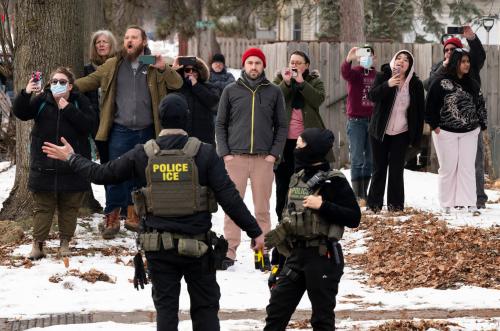
In the wake of this week’s killing of Alex Pretti by federal agents, Minneapolis has again become a lightning rod in the struggle for racial justice. The multicultural city was transformed by the 2020 uprising following the murder of George Floyd, and its Somali community has lately become a target of the Trump administration—prompting a federal crackdown and local pushback that led to Pretti’s death on January 24.
As the political and social fallout from that killing continue, we should not lose sight of the fact that Minneapolis’ circumstances present an opportunity to convert pluralism into a truly inclusive democracy—part and parcel of the civic work of building a more perfect union. The response in Minneapolis will signal how other cities will contribute toward this American idea.
The fraud case that sparked the federal enforcement surge and subsequent protests has raised legitimate concerns about the integrity of Minnesota’s social safety net as it applies to a narrow segment of the Somali community accused of wrongdoing. But this scrutiny did not emerge in a vacuum: Long before the allegations surfaced, Donald Trump, as a candidate and president, had already weaponized racial resentment to paint immigrant and Black communities with a broad and derogatory brush, referring to African nations and others as “shithole countries” while using similar language to describe majority-Black U.S. cities.
Yet the story of Minneapolis illustrates something far different. The city’s rich diversity is yielding notably positive outcomes for its minority-Black population, who are achieving significant strides in health, entrepreneurship, and community vitality.
In 2022, Brookings’ Black Progress Index identified a community’s share of Black immigrants as the single strongest predictor of life expectancy for Black residents. The Minneapolis-Saint Paul area, which ranks in the 96th percentile for its share of Black immigrants, exemplifies this trend, boasting one of the highest life expectancies in the nation (78th percentile) for Black residents: 76.5, compared to 74.4 nationally.
This positive outcome is reinforced by another powerful predictor: Black business ownership, where Minneapolis also scores highly (86th percentile). The city’s number of Black-owned employer firms (those with at least one employee) has increased by over 200% since 2017—a rise undoubtedly influenced by immigrant populations, who demonstrate a strong propensity for entrepreneurship and further contribute to communities’ health and vitality. These encouraging numbers exist in spite of continued racial disparities in housing, policing and education.
We must learn from the successes of Minneapolis’ Black and immigrant communities to craft policies that replicate their thriving models. Their achievements stand as a direct rebuttal to the harmful myth that Black and immigrant communities hinder progress—they are, in fact, foundational to it.
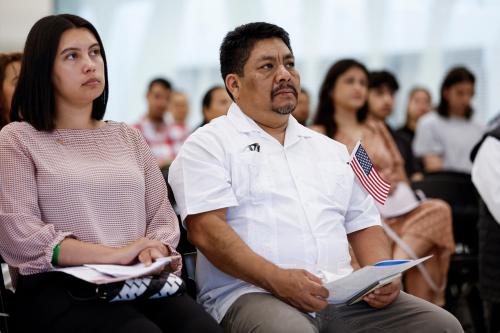
Minneapolis offers a striking reflection of present-day America. Its population is 78.4% white, 12.3% Black or African American, 8.7% Asian American, and 2% American Indian or Alaskan Native. The Somali community represents a significant share of the Black community, with approximately 84,000 people across the region. To be clear, most Somalis in Minnesota (58%) were born in the United States, and of those born abroad, 87% have obtained citizenship. Most of the city’s non-citizens arrived as refugees escaping decades of conflict in Somalia, often settling in Minnesota due to its strong public support systems and established diaspora.
Crackdowns targeting these groups not only harm neighbors, friends, and colleagues—they also undermine productivity and fracture community cohesion. And history reminds us that even citizenship has often failed to protect marginalized groups such as Black Americans, women, and Native peoples, who have routinely been treated as second-class members of society. Though citizenship offers fragile protections, it has never been a guarantee of dignity or equality—a truth that underscores the profound cost of exclusionary policies for everyone.
That fragility for citizens and non-citizens alike has never been more apparent. In December 2025, the Trump administration significantly expanded its travel and immigration restrictions to bar or limit entry for nationals from 75 nations—nearly 20% of the world. The measure effectively blocks roughly 1 in 5 prospective legal immigrants and imposes severe constraints on non-immigrant visas, deepening the policy’s demographic and geopolitical impact. The expanded policy primarily targets Muslim-majority, African, and Southeast Asian nations, while the president himself has made appeals for more immigrants from majority-white countries in Europe.
On the ground and in legislative halls, many are fighting for an anti-immigrant agenda based on a distorted image of America—one that misrepresents its communities of color and stands in stark contrast to the reality of who Black, brown, and immigrant people are, how they contribute to community well-being, and how they uphold the vision of a pluralistic American democracy.
There are also those fighting for our noble democratic ideals and a more accurate representation of our fellow citizens and potential citizens. However, their fight must be focused on legislation and policy, not just yielding symbolic victories.
As I wrote last year to mark the five-year anniversary of George Floyd’s murder, “the Black Lives Matter movement has led to a barrage of performative gestures while failing to deliver any meaningful results for Black communities. The rate of police killings of Black people is unchanged, according to data compiled by the police reform organization Campaign Zero. And in a Pew Research Center survey, 72% of respondents said the increased focus on race and racial inequality after Floyd’s killing did not lead to meaningful changes that improved the lives of Black people.” To be clear: Authoritarianism by any name didn’t begin in 2024 or 2016.
Yet this moment of reckoning in Minneapolis and beyond presents another critical opportunity to move past performative solidarity and enact policies that truly reflect the strengths, growth, and contributions of our diverse communities. Rather than repeating cycles of reaction and retrenchment, we must advance reforms that honor the role of immigrants and communities of color as vital architects of our nation’s social and economic fabric. Real change lies not in statements, but in structures—and it is past time we built them together.
Author

The Brookings Institution is committed to quality, independence, and impact.
We are supported by a diverse array of funders. In line with our values and policies, each Brookings publication represents the sole views of its author(s).

Commentary
Immigrant communities have helped Minneapolis prosper. The federal crackdown threatens to undermine that.
January 30, 2026