




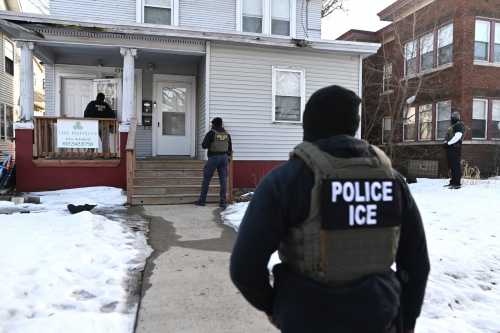
The violence in Minneapolis has become a flashpoint for a national debate regarding ICE and immigration enforcement. In this episode of The Current, Gabriel Sanchez and Rashawn Ray, senior fellows in Governance Studies at Brookings, analyze the structural breaks behind the headlines, from hiring 18-year-olds in “six-minute” windows to slashing training academies from 22 weeks to just 47 days. They offer a roadmap for reform with specific policy remedies, including vetting reforms, virtual reality training, and ending absolute immunity, aimed at restoring public accountability and reversing the trend of violence.
Related Content
Transcript
SANCHEZ: The training academy for these officers I understand has been slashed from what used to be 22 weeks, which we might argue might not even be enough, just down to 47 days. What does this reduction in training mean on the ground?
RAY: The lack of training leads to mistakes, and in law enforcement mistakes get people killed. The watering down of standards for training is extremely troubling and problematic.
[music]
SANCHEZ: Hello, you’re listening to The Current, part of the Brookings Podcast Network. My name is Gabe Sanchez and I’m a senior fellow in Governance Studies here at Brookings. My work focuses on immigration, politics, and policy. And I’m pleased to be joined today by Dr. Rashawn Ray, also a senior fellow in Governance Studies, and a leading expert in community policing and criminal justice policy.
We’re here to talk a little bit about the crisis in Minneapolis, and I’m pleased to be able to have my colleague who’s a national expert to inform some of this discussion. So, Dr. Ray, we’re seeing, unfortunately, a dramatic surge in violence in Minneapolis. Beyond the headlines, how do you feel about this? Is this isolated incidents or is this a predictable pattern?
[1:08]
RAY: When I think about what’s happening in Minneapolis and elsewhere around the country, it’s very predictable, unfortunately. When use of force increases, it is inevitably something that ends up being highly problematic where the more use of force we have, it’s going to end up being where someone ends up getting killed. And that’s what we’re seeing with ICE.
And in many respects, it’s emblematic of the Civil Rights movement in some ways, where at that particular time, as you know, the National Guard was being mobilized. We now have ICE, which really popped up after 9/11. I think it’s something that people don’t always recognize that is is relatively new as an agency. And we’re seeing Trump utilize ICE and Border Patrol in ways that we have not for previous presidential administrations.
[1:55]
SANCHEZ: And some of the work that you’ve released recently through Brookings, I think emphasizes a piece of this puzzle not that many people are aware of, and that’s just how massive the hiring surge has been for a lot of these officers. I know that the administration has set a goal of hiring more than 12,000 agents, right? But I know your work has shed some light on the fact that the quality of hiring is a concern in and of itself.
[2:17]
RAY: Yeah, I mean, it’s extremely troubling. I really don’t think people understand that the drop in age, which previously has been 21 for most federal agencies, and there are also a lot of just local law enforcement that have 21 as well. ICE and Border Patrol dropped their age requirements down to 18. They also waived the upper limit for those of us who are getting up in age like us, right, that we wouldn’t have qualified in the past either. We now do. And I think people have to think about those age limits. As a person who has two teenagers– Dr. Sanchez, I know you have children as well– thinking about in in three years my oldest being able to be an ICE agent and go on the streets, I mean, are things that we really need to think about.
But the reason why it’s happening is because with the funding that’s been given to DHS, there’s this hiring surge as you mentioned. There’s also a huge signing bonus of $50,000. People have to think about that incentive. For any job, a $50,000 signing bonus will get a lot of people coming out the woodworks.
And potentially even more problematic then lowering and increasing the age limits, it’s also the fact of how they are actually going about the hiring at that time a person interviews. There was an investigative reporter who went to one of these open houses, if you will, to get hired for ICE. And what she reported was that in six minutes she was hired, that there was not a background check, which we know takes time. So we don’t know who these individuals are.
One thing I know from studying law enforcement is that when you don’t do a background check there are a lot of individuals who might have worked in law enforcement in other areas, and they might have gotten fired, they might have resigned before they had a chance to be fired. And they might also be under investigation somewhere else in the country.
These are officers and agents who even most law enforcement would not want to work alongside. And I know that because I’ve interviewed hundreds of law enforcement officers and agents who report on the difficulties of of bringing on new staff and the pressures they have to actually fill requirements for hiring.
[4:29]
SANCHEZ: Wow. Alarming. Eighteen-year-olds being recruited with the $50,000 signing bonus in this economy where we think about how much $50,000 is to a lot of Americans out there. That’s scary in and of itself in terms of how we’re thinking about the hiring, and in the numbers of how many people are being brought on.
That I think emphasizes the fact of the necessity to have high quality training. Unfortunately, that’s not a positive sign either as we see this play across the the country. The training academy for these officers I understand has been slashed from what used to be 22 weeks, which we might argue might not even be enough, but think about from 22 weeks just down to 47 days. Just from a policing standpoint, what do you lose when you cut that much time? Twenty-two weeks down to 47 days. What does this reduction in training mean on the ground?
[5:16]
RAY: The lack of training leads to mistakes. And in law enforcement mistakes get people killed. And I think that that is the bottom line. I mean, the watering down of standards for training is extremely troubling and problematic. There are a lot of people who think 22 weeks still isn’t enough time, including law enforcement because one thing they will tell you is they have to make decisions very quickly. I think that they are oftentimes put in situations that most people, not just in the United States, but around the world, have no idea how stressful those interactions can be.
So now you take an 18-year-old with 47 days of training, you put them in a situation where they also remove the five weeks of Spanish language training that they would also receive. So now you might have a language barrier when interacting with people.
And more importantly, not just the fact that these watering down of training standards are endangering the public, it’s also endangering the agents by putting them in situations where they aren’t fully trained to be able to do the things that they need to do.
And and accordingly, I think when we, when we think about this, Gabe, the protections that that these agents are also receiving is something that’s been given a lot of attention. The administration is pushing for absolute immunity, which we know is different from qualified immunity, which a lot of people might have heard about over the past few years with local law enforcement. How does that that legal shield of absolute immunity embolden the aggressive tactics we’re seeing on the streets?
[6:48]
SANCHEZ: Well, I appreciate you you flagging that question for me, because as you know, accountability is essentially the foundation for successful community law enforcement relations, whether we’re talking about local police, federal officers. Without a semblance of accountability, right? we don’t have any mechanism to ensure that these officers are being responsive to the voters, the public, anybody essentially. So this is a very scary proposition that we should all be very concerned about.
In essence, and if we just think about this, this is very unprecedented policy, right? This is new territory. Just think about if we were talking about giving absolute immunity to our local police forces across the country, I think there’d be immediate, right, negative reaction. I don’t even think we’d even broach that conversation. So it’s important to just note how unprecedented this is.
In my opinion, these agents are already operating under a culture of immunity. You know, we think about one of the things that’s changed symbolically is the fact that these folks are wearing masks to hide their identities. I think that’s a powerful symbolic shift in operations. Right? We don’t know often what agency, if any agency, these folks are from when they’re interacting with the public, obviously in some contexts, violent situation.
Whether it’s been messaging coming from the top, the president and the vice president suggesting that these folks should be completely immune from any of their activities, or the fact that we really have not seen the administration look deeply into trying to investigate the officers involved in in just this month’s shootings in Minnesota, despite increased pressure to do so, I think it’s pretty obvious to the public and to those of us that track these things as experts that this is leading already to more aggressive behavior.
In essence, if you just think about it very plainly, we are painting a picture today of many young people being recruited to become officers without adequate training, and they’re being socialized, unfortunately, into a culture of immunity. I think this is a very dangerous environment that potentially could lead to increasingly aggressive and violent behavior among officers well beyond what we’re seeing uh today across the United States.
[8:39]
RAY: Yeah, I mean, absolute immunity, people just have to recognize that means there could be violations of not just civil and human rights, but even due process of following the law. And there’s no accountability for it. And as you highlighted, it’s problematic.
Now, we’ve seen over the past several days, the Trump administration seemed to to roll back, in a sense, soften its stance, I think after people have seen a lot of video evidence of of the recent killing. And in particular the Trump administration has made some moves, including the removal of the senior Border Patrol commander that was in Minneapolis. I think it’s important to note that he was simply removed. He he hasn’t been relieved of his entire duties. And instead what Trump is doing is bringing in the the “border czar,” quote unquote, as he’s called. And there’s also been some withdrawal of some agents.
What do you think is driving this shift and this change? And do you think it’s an indicator of potentially a larger shift in tactics that might lead to a lower use of force?
[9:41]
SANCHEZ: Yeah. Important question because I think it it provides some insights into what the public can do if they they feel outraged or they feel like there’s something that they need to do to take action. And one of the mechanisms for that is public opinion, as as we know, has shifted sharply. I think as Americans see images of of officers attacking unarmed immigrants, throwing senior citizens to the ground, obviously the shooting of U.S. citizens, I think as Americans see more and more of these images, it’s a big wake up call. And we’re seeing this tracked in the data.
As you know, I’m a professional pollster, have been tracking immigration attitudes since the campaign season as well as all the way up to today. And the long story short of this is going back to the campaign season where the Trump administration was signaling to the public, we’re only going to focus on violent criminals, right? That was the messaging coming from the campaign. Public support was pretty high among most subgroups of the population.
But as we’re seeing that shift, as you noted, a large segment of folks that have no violent backgrounds being deported, American citizens being detained, unfortunately some American citizens being deported, et cetera, I think you’re seeing a significant shift in public opinion. In fact, like, all reputable surveys have found that the majority of Americans think the Trump administration has gone way too far in their enforcement of deportation policy.
[10:58]
RAY: Look, one out of three people who are arrested or detained by ICE do not have a criminal record, including a relatively high percentage of people who are actually either citizens or residents. And I think sometime people don’t recognize that, that people are citizens, but people also have work visas and student visas and reasons why they are legally in this country.
And I think when we started seeing what’s happened, say, with five-year-olds, it makes me think about the the broader social psychological literature on on some of the policing and profiling that happens for kids at that age like we see in schools. And we’re starting to see the way that ICE is not only coming into into homes and in communities, but also schools where kids are learning, including preschoolers.
[11:44]
SANCHEZ: The thing that I really want to do is start to transition a little bit into any potential solutions or remedies. I know both of us are trained social scientists, we’re very good at being able to identify problems and challenges. I think what separates Brookings from the rest of our active academic community is we try to stress solutions. I know you’ve already done some great work outlining some immediate steps to somewhat reverse this trend.
I’m hoping, and I know this is a tough task to ask you to do this, but if you could walk us through some of these recommendations, I think that would be very enlightening for a lot of our viewership out there that’s probably alarmed at a lot of these statistics and are hoping to be able to see that there’s some mechanisms to do something about it.
[12:25]
RAY: Yeah, I mean, look what, what could be done? What we aim to do is to lay out five recommendations. First is dealing with hiring. It would be very simple to do a cross-checking with state misconduct files. In fact, the state of Texas passed legislation, which some of my research helped to inform, called the Wandering Officer Law, which actually prevents officers who are under investigation or who have been fired for misconduct to go to another department. We need to be doing that federally as well. And that helps us to to actually remove some of the most problematic actors who might be ICE agents.
The second thing is around training. I mean, we we talked about the training. I think that there are ways with even advances in technology with the virtual reality training that that I helped to develop, that this can be put in place in real time to simulate deescalation tactics, to to increase communication. And these sort of training tools can be mobile. They can be put in all of these different cities where these surges are happening, but it’s allowing for agents to continue their training even beyond that watered down eight weeks. And of course, a lot of people think that that should obviously be changed and increased.
And I think third is dealing with duty to intervene. That we need to scale local accountability to the federal level. That when we start talking about, and this speaks to accountability as well, which is the fourth one, when we start talking about immunity standards, there are a lot of people across the board, Republicans, independents, and Democrats, who think that creating a culture of absolute immunity is problematic because when people are above the law, then sometimes there are people who will act above the law, and we’ve obviously seen that.
And then the fifth is around transparency. Body-worn cameras have to be a must. That should be just a given in this day and age in the U.S. And then also unmasking requirements in dealing with signage. That part of what’s happening is that when ICE officers are able to go in and not show their face, not only does it decrease the ability for people to connect just as humans and have a conversation, but it also allows for that lack of transparency, that lack of accountability.
And then when it comes to signage, no matter if you are in the suburbs or whether you’re in an urban area or rural area, most people are going to be alarmed if a vehicle rolls up on them not not having any signage. People don’t know that it’s law enforcement. People might run, people might be alarmed, people might react back. All of those scenarios create problematic situations for the individuals in their interactions. Not only the person who’s being approached, but also the ICE agents.
So I think those five things can go really far.
And I, and I want to ask you one more question, Gabe. I want to be clear and help people recognize this, that changes in personnel is not the same thing as changes in policy, and that’s what we’re talking about. It’s real easy to change people, and people are like, oh yeah, they got them outta there. Yeah, but it hasn’t changed the policies that actually led to the behavior. So we’re talking about policies. If these policies and these reforms aren’t implemented or altered, what do you see happening in the next six months to the future in places like Minneapolis and other places around the United States?
[15:41]
SANCHEZ: I like the way you frame the question because in essence, right, our worry is you might see some Band-Aid immediate reactions, which is really about symbolic rhetoric. Right? Moving some folks, as you noted, not necessarily even removing anybody from their duties, just removing them from Minneapolis. Right? If that’s all we see, unfortunately, I think the next six months looks pretty scary for not only Minneapolis but a lot of other cities across the country.
And I think one of the things we really haven’t touched on is this whole entire mechanism, right? of lack of training, violence, all these things that the American public is seeing, I think the unfortunate reality, as social scientists we know there’s counter mobilization. Right? What I’m really worried about is if these tactics continue and they escalate, right?– and I think that’s the unfortunate picture that we’re painting is things could possibly get a lot worse, believe it or not, than they already are– I think the public out there, their frustration, right, starts to boil over in and of itself, and you’ve got two forces, right, that are escalating in dangerous places. I think that’s going to be very scary.
The other thing that I think the next six months might look like is essentially challenging what the motivation is in the first place around this. And the fact that Minnesota, Los Angeles, a lot of these other cities across the country, Chicago, that have been targeted by by some of the federal encroachment have all been defined or at least argued to be sanctuary locations. So I think a lot of folks are wondering, you know, who’s next? What other cities across the country are next on the list that have been friendly to immigrants in the past?
And so I think the next six months might unfortunately look a lot like it does now, but spread out to other cities across the country. And obviously that’s a very dangerous proposition.
[17:22]
RAY: Yeah, I, I could, I couldn’t agree I couldn’t agree more. I mean, what could happen in the street …
SANCHEZ: I was hoping you might be able to have a little bit more optimistic take than I do, but I’d love to hear your thoughts if there’s anything in there that you’re seeing in the tea leaves that might lead to a more positive situation.
RAY: No, I mean, I, I don’t. I think we’ll see a an increase in protest, partly because unfortunately we’re going to see a a continued increase in use of force and and ultimately killings. And we see the way that that the killings in Minneapolis have actually escalated tensions.
And we have to recognize that right now in the United States, Minneapolis is probably one of the coldest places in the United States, and there are still thousands of people in the streets. And as it gets warmer throughout the year, gets to the spring and the summer, it’s going to be even more people out in the streets protesting as these particular incidents might not wane. Yeah, I mean, not not too much optimism on my end either.
[18:17]
SANCHEZ: I appreciate you Dr. Ray. This has been a wonderful conversation. I will close on one important point that you made, and that’s just to recognize that despite the weather, by dire cold conditions in Minnesota, and something I’ve been tracking in survey data, the public’s fear of protesting because of ramifications of a whole lot of potential of negative things that can happen to you, including being arrested, being pepper sprayed, you’re still seeing thousands of Americans across the country, and particularly in Minnesota, doing their part to practice democracy and stand up to what they perceive as as just not good policy and not democratic approaches to trying to adjudicate immigration policy.
So I thank all of you for listening to The Current here at Brookings. For those of you interested in digging in and learning more, I will point out that a lot of the data points that we stressed in our conversation today are available in a blog post that has come out on FixGov here at Brookings. So please go to that, Dr. Ray and myself are co-authors of that piece.
And pay close attention to Brookings. We are both members of the How We Rise team. I know we’ll be putting out additional content, particularly on this topic. So for those of you that want more information, stay tuned to Brookings.
[music]
We would like to continue pushing some of the efforts to utilize data to inform public policy as we talk about deportation across the country.
Thank you very much.
Participants

More information:
- Listen to The Current on Apple, Spotify, YouTube, or wherever you like to get podcasts.
- Learn about other Brookings podcasts from the Brookings Podcast Network.
- Sign up for the podcasts newsletter for occasional updates on featured episodes and new shows.
- Send feedback email to [email protected].
The Brookings Institution is committed to quality, independence, and impact.
We are supported by a diverse array of funders. In line with our values and policies, each Brookings publication represents the sole views of its author(s).


Commentary
PodcastICE: A predictable pattern of tragedy in Minneapolis
Listen on
The Brookings Current
January 29, 2026