After Donald Trump won the presidency in 2016, the New York Times reported the story simply: Black Christians left white evangelical congregations, exhausted by pastors who prayed for Paris and Brussels, but went silent on police shootings of Black Americans. This exodus narrative seems to echo Martin Luther King Jr.’s observation that 11 a.m. Sunday is the most segregated hour in America.
The data tells a different story. Six in 10 religiously active Black adults worship in a Black congregation, while one in four worships in a multiracial congregation. Another 13% worship in white or other congregations. And while 84% of Black adults identify as Democrat or lean Democratic, that number hides what congregational diversity costs Black politics. Among Black nondenominational Protestants, that figure drops to nearly 60%, with one in three calling themselves independents.
Political scientist Maruice Mangum first argued that congregational context shapes Black partisan attachment, but the measures needed to test that idea did not yet exist. They do now, in the study “Diversity and Dealignment: Congregational Context and the Weakening of Black Partisan Attachment.” Where Black Americans worship shapes their politics, and the data show the cost. The losses run in two directions: White congregations convert Black members to Republicanism, while multiracial congregations pull them out of partisan politics altogether. The mechanism is not diversity itself—it is who holds power inside those congregations.
White congregations convert
Black members shift Republican inside congregations that fuse conservative politics and Christian faith. As Perry and Whitehead show, white Christian nationalism drives these congregations. Sociologist Gerardo Martí finds the pattern extends across denominations: the more white a congregation, the more Republican its members.
As Figure 1 shows, Black adults in white congregations identify as Republican at more than twice the rate of those in Black congregations. Ryan Burge, drawing on separate national data, confirms it: Black Protestants in white congregations show higher Republican identification rates than those in Black congregations.
Sociologist Jason Shelton finds the same pattern in nondenominational spaces: Black Protestants in nondenominational congregations are twice as likely as Black Baptists and Methodists to vote Republican.
A 2025 NPR report describes a mostly white congregation at Myers Park Baptist in Charlotte, North Carolina, whose board voted 17 to 3 to remove pastor Benjamin Boswell after years of friction over his focus on racial justice. These congregations welcome racial justice as an abstraction. They remove it as practice.
Multiracial congregations depoliticize
Look at who is disengaging, and by how much.
The number that matters is not in the Republican column—it is in the disengagement column. Among religiously active Black adults, nearly 9% of those in multiracial congregations claim no partisan identity—nearly three times the rate in Black congregations. This is not independence, which is an active political stance. These adults have disengaged from partisan politics altogether. One objection remains: Maybe already disengaged people self-select into multiracial congregations. Black-led multiracial congregations do not show this effect. That is what matters.
Same upbringing, different Sunday, different politics
The sharpest test fixes upbringing: same childhood congregation, different adult Sunday.
The childhood baseline is fixed. Only the congregation changes. Those who remain in Black congregations are more than 90% Democratic. Those now in multiracial congregations lean 80% Democratic, while nearly 8% are nonidentifiers. This doesn’t prove causation, but it rules out the most obvious alternative. The same upbringing but a different Sunday produces different politics. Black-majority congregations forge political identity through sermons, shared experience, and collective action. When people exit those spaces, the politics go with them. Not all multiracial congregations depoliticize equally. Leadership is the variable.
Two ways to lose a voter
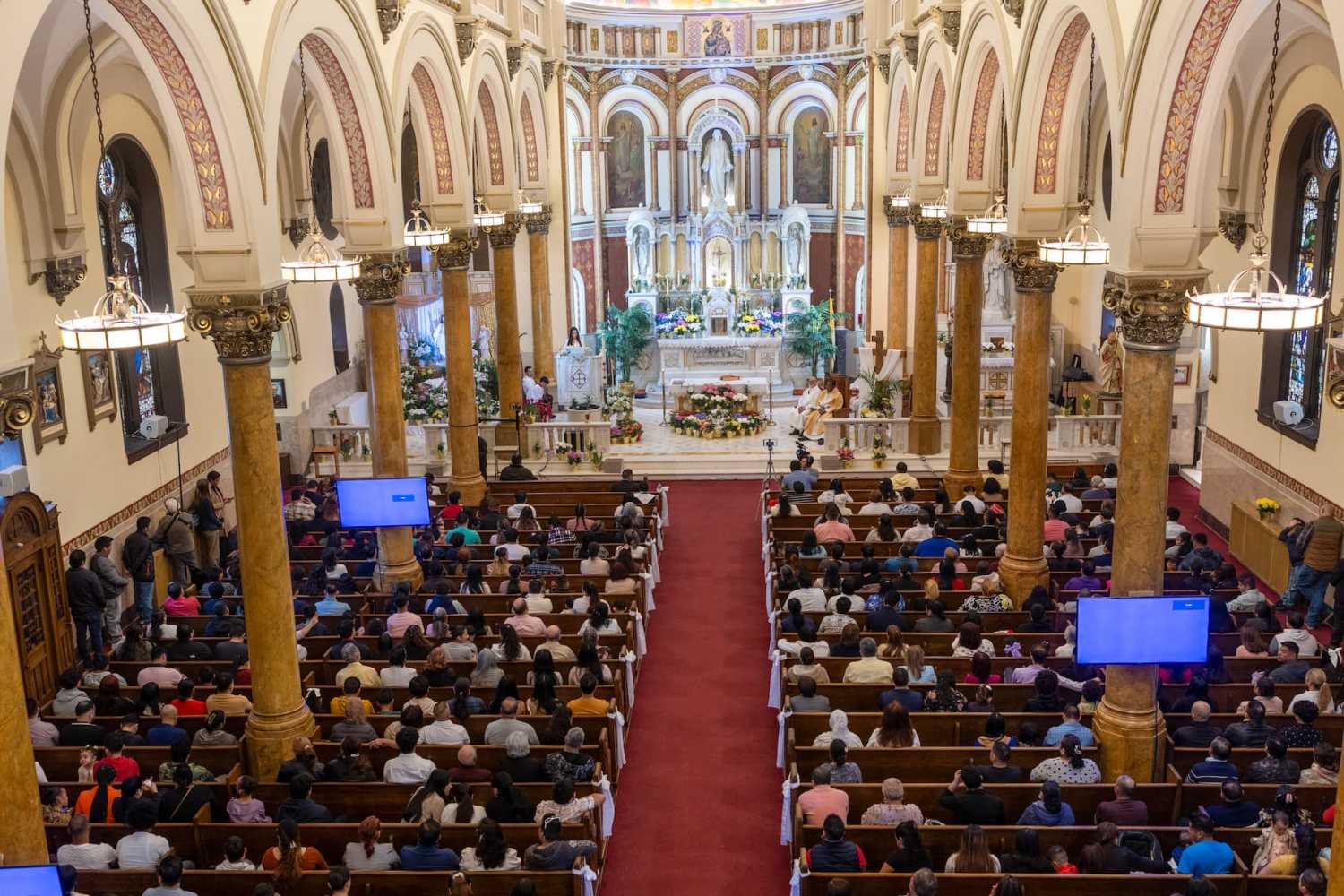
The multiracial pathway is quieter. Multiracial congregations don’t convert—they drain Black members of the political identity Black-majority congregations build. They hold together not by centering integration but by defaulting to white cultural norms. In practice, Black members absorb the congregation’s culture rather than reshape it, a pattern documented across multiple congregations.
No one had more to lose from that conclusion than Michael O. Emerson—a leading sociologist of race and religion in America, who spent two decades building the case for multiracial congregations. His 2006 book “People of the Dream” argued that multiracial attendees were forging a new American identity—what he called “the sixth Americans.” By 2022, he conceded that the movement had failed. Congregations grew more diverse. The culture did not. Leaders of color, in Emerson’s own account, felt “defeated.”
Researchers call this racial filtering: clergy of color accepted as symbols, sidelined as agents. Korie Little Edwards and Rebecca Y. Kim’s book “Estranged Pioneers” documents that real relationships form across racial lines, but Black members bear the cost. They set aside racial justice and conform to white organizational norms. Keeping white members comfortable becomes the price of belonging.
W.E.B. Du Bois saw this coming. In “The Negro Church,” he named the Black church as the original space of Black self-governance. The organizations structuring Black political life serve other purposes—sustaining Black political power was never among them. As sociologist Victor Ray shows, white-led institutions reproduce racial hierarchy through routine operations—not through overt hostility but through the everyday rules that determine who belongs and who leads.
Jessica Barron calls it “managed diversity,” racial differences deployed as a selling point while the structure preserves white authority. The congregation appears diverse. The power does not move. Political identity follows power. The electoral numbers confirm it, which raises the question: What happens when power moves?
It’s not diversity. It’s power.
One finding changes everything—and the effect extends beyond Black members. Black-led multiracial congregations generate far less political disengagement than white-led ones, which post the highest rates of any group in this study. Korie Little Edwards and Rebecca Y. Kim find that when the leader is Black, all members—including white and non-Black congregants—exhibit higher levels of civic and racial justice engagement. The difference is who sets the culture.
Multiracial congregations show it: Clergy of color who join them find that white colleagues sideline them. Institutions welcome them as symbols and block them as agents. The issue is not diversity. It is who holds power.
A congregation can be 40% Black and politically corrosive, or majority white and civically generative. The difference is governance: who controls the budget, who sets the agenda, and who decides what gets preached. Denominations that care about Black political power need to ask who holds the keys, not who stands at the pulpit.
Sunday morning is integrating, but not the coalition
Black Americans are among the Democratic Party’s most dependable voters, and their turnout decided presidential elections and Senate races for decades. Nonidentifiers are not Republican converts. The other side did not persuade them; the party lost them through neglect. That distinction matters. Demobilized voters can be retrieved but only through sustained institutional presence, not election-cycle outreach. Even modest disengagement could flip Georgia, Pennsylvania, and Wisconsin, states this coalition won on Black turnout margins.
The damage goes further. Partisan nonidentification drives civic withdrawal, including lower rates of contacting elected officials, attending public meetings, and organizing community life.
Black congregations sustain the advocacy infrastructure for public health, housing, criminal justice reform, and civic engagement powers it. When that engagement erodes in the pew, it erodes in the hearing room.
The Supreme Court accelerated the threat from outside. Shelby County v. Holder gutted preclearance in 2013. Brnovich v. DNC weakened Section 2 of the Voting Rights Act in 2021. Louisiana v. Callais struck down the mechanism for challenging discriminatory maps in 2026, and hours later, Florida redrew its congressional districts to dilute Black representation. In the states where Black turnout is decisive, the legal infrastructure that once protected that turnout is gone.
Faith leaders argue that Black churches know exactly what to do in response, and many Black members in those congregations are asking the same question: “Black members sit in your pews, worship on your stages, serve and give in your churches,” wrote pastor Demetrius Davis in May 2026. “Will you be silent while we suffer?”
These data show that the institutions capable of answering that call are being hollowed out from within. Demobilization from the pew and suppression from the courthouse are not separate problems. They compound. Rashawn Ray and Mark Whitlock put it directly: When the party ignores Black voters, staying home is structural protest, not apathy. In 2024, Black voter turnout declined, and Kamala Harris underperformed Joe Biden among Black men—the clearest sign yet that political disengagement is now electoral.
No one understood the architecture better than Rev. Jesse L. Jackson. The Rainbow Coalition was multiracial in its reach but Black in its roots. That coalition carried the Democratic Party for decades, built under a Voting Rights Act that had teeth. Now, that legal protection is gone. The party ignored longstanding Black concerns during the Obama years, despite record Black turnout. The data show exactly what that erosion looks like. When Black Americans worship in congregations where no single race holds a majority, they gain inclusion but surrender the infrastructure that made collective action possible. Black political power does not begin on Election Day. It is built Sunday by Sunday, in the pew.
What faith leaders can do
The diagnosis demands a response. Three practitioners are already providing one. At First Baptist Church of Gary on New Year’s Day 2026, Rev. Nicole P. Guns preached to a congregation that had heard the story of emancipation, but had not inherited its testimony. That is the transmission failure the data measure. Multiracial congregations that wish to retain Black civic engagement must refuse the managed diversity bargain, the pretense that unity requires setting racial justice aside. That means teaching the history of the Black church alongside scripture, naming injustice from the pulpit, and protecting the testimonial practices through which Black political identity has always been formed.
- Leadership is the variable. F. Willis Johnson’s book “Holding Up Your Corner” gives pastors a method for what the data confirm: Multiracial congregations led by Black clergy do not show the same disengagement. Denominations investing in multiracial ministry must invest in Black pastoral authority within those institutions—governance, budget control, hiring decisions, and preaching calendar—not only diversity in attendance. A diverse pew under white institutional authority produces the numbers this study documents. A diverse pew under Black institutional authority does not.
- Use the infrastructure that already exists. Apostle Kelly Williams and Greater Destiny Bible Church run a food pantry and a back-to-school drive and already know the principals and the caseworkers by name. That is civic infrastructure. It becomes political infrastructure when someone walks it from the food bank to the school board meeting to the council hearing.
- Hold the coalition accountable, not just together. Ivan Douglas Hicks and the Ministerium have sustained the Jackson model: a denomination-spanning advocacy infrastructure that is explicitly nonpartisan and rooted in Black institutional authority. Denominations and funders who care about Black civic voice should treat Black-led multiracial congregations as strategic assets—not diversity statistics—and invest in the denominational coalitions that keep civic engagement alive between elections. The threat is structural. The response must be too.
Integration and political power are not the same force, and right now they move in opposite directions. The question is not whether to integrate. The question is who gets to lead when you do, and whose vote still counts when you get there.
Related Content
Author
-
Acknowledgements and disclosures
Portions of this commentary were generated using Microsoft Word’s AI-assisted editing features, Grammarly, and Anthropic’s Claude, which are generative AI tools, to refine language and arguments and tighten prose. The output was reviewed and revised for factual accuracy and checked for plagiarism by the author prior to publication. The AI tool did not contribute any original ideas to the commentary.
The Brookings Institution is committed to quality, independence, and impact.
We are supported by a diverse array of funders. In line with our values and policies, each Brookings publication represents the sole views of its author(s).