A recent assessment of 2025 in this blog noted that while the year felt like a litany of woes marked by trade disruptions, debt, and climate disasters, several silver linings emerged for emerging markets and developing economies (EMDEs), from the record-breaking expansion of the global middle class (adding 108 million people) to the unprecedented pace of digital public infrastructure (DPI) deployment. In a similar vein, this commentary looks at how growth and development have fared in this century compared to the previous one.
We first present the basic facts about growth and examine whether growth is still translating to reduction in poverty as it did in the 20th century. Beyond these bare facts, we also tackle bigger questions about the drivers of growth in this century. Specifically, we provide some preliminary evidence on whether the era of export-led development is yielding to a new paradigm where institutional quality (proxied by indices of “rule of law,” following the common practice in the literature) is the key driver of the next generation of growth miracles.
To answer the first question, we first compute the global growth rate of per-capita GDP for this century (2000-22). We find the annual average growth to be 2.4%, which is lower than the average during the first quarter of the previous century (2.8%). This slowdown is also shown in Figures 1a and 1b.
Despite this slowdown in global growth since 2015, the 21st century has still delivered remarkable progress in poverty alleviation. The long‑run decline that began in the late 20th century continued into the new millennium, helped substantially by the near‑eradication of extreme poverty in India and China.
This happened despite these countries embarking on different development paths. China focused on rapid industrialization, while India specialized in services. The progress in poverty alleviation is a fact acknowledged both in the media and by international organizations such as the World Bank. At the $3.00‑PPP poverty line, poverty fell by about 5.9% per year in the early 2000s, easing only slightly to 5.2% in the 2010s. At the higher $4.05‑PPP line, however, the pattern flips: Annual poverty reduction was roughly 4% in the early 2000s and strengthened to 4.6% in the 2010s. The faster fall at the $4.05 line is not mysterious: There are simply more people near that threshold. Once the pool of extreme poor thins out, the biggest gains naturally shift to the next rung up. Progress in poverty alleviation is a fact; efforts to make growth more pro-poor have yielded dividends. Electronic transfers, especially during the pandemic likely helped too, as they did in India. And looking over the full 2011-24 period, the annualized decline remains solid: 4.34% at the $3.00 line and 4.15% at the $4.05 line. These gains provide modest evidence that the momentum of development has not vanished, even as economic growth may have slowed in recent decades. While poverty reduction is only one of many Sustainable Development Goals, this blog by Kharas and McArthur demonstrates that this momentum has translated into measurable progress across the broader SDG spectrum.
Figure 1a. Average annual per capita GDP growth
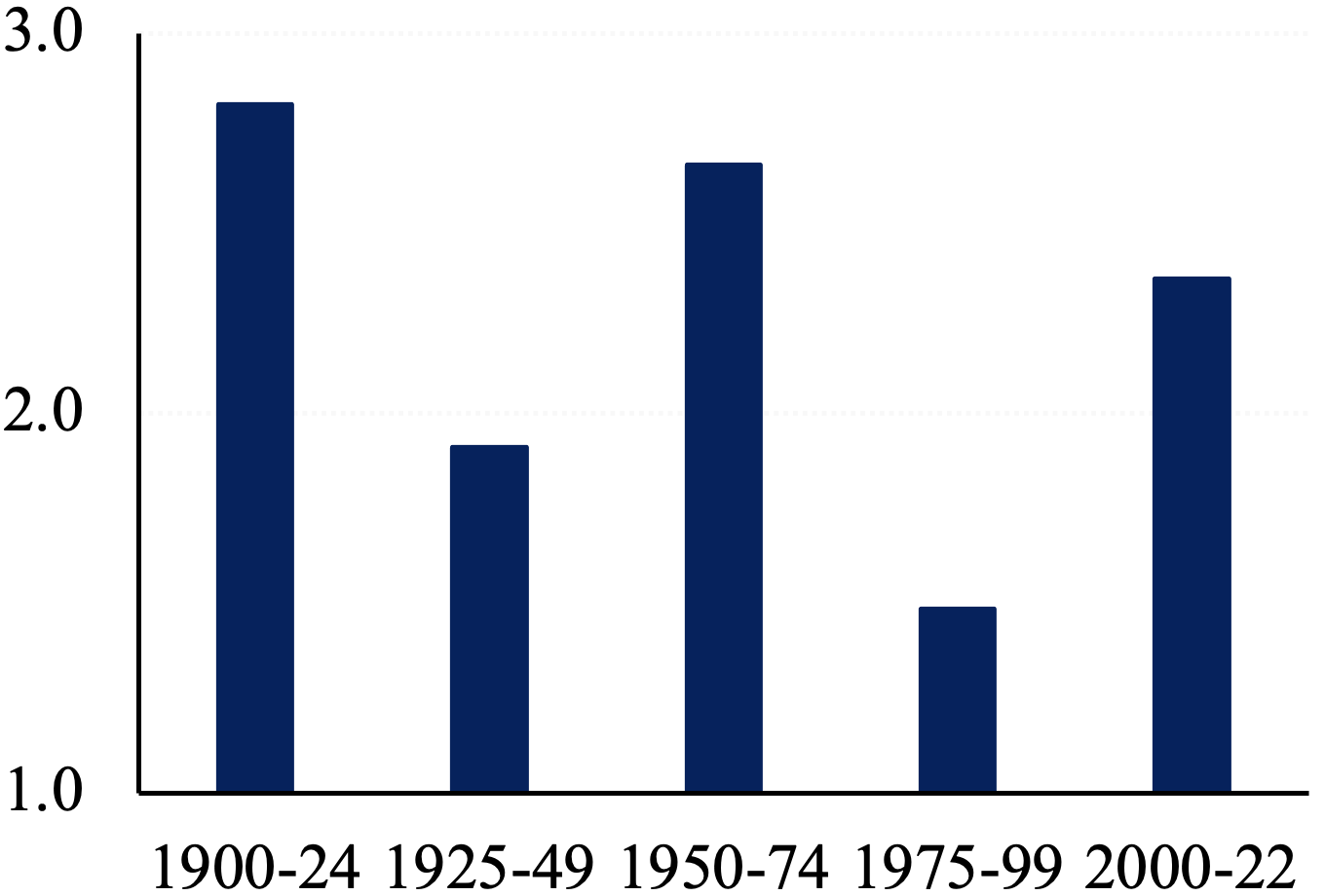
Figure 1b. Poverty headcount ratio and GDP growth rate, 1980-2024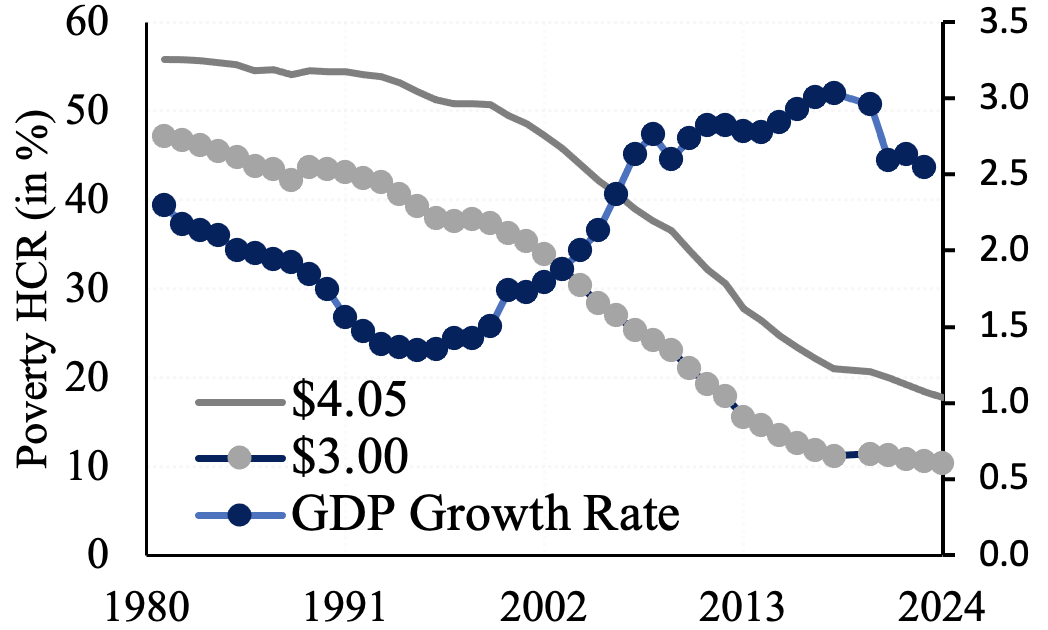
Source: Authors’ computation using data from the World Bank.
Having examined the bare facts about growth and development, we now turn to the bigger question of what this century tells us about drivers of growth. To do so, it is useful to recall the lens through which earlier analysts have sought to identify the ingredients of sustained high growth. The Spence Commission’s landmark report on growth tried to identify drivers of growth in the 20th century. It also provided a benchmark for identifying when a country’s growth was strong enough to be classified as a “miracle.” Using the same benchmark, the table below provides a list of eight growth miracles; these are countries that experienced an annual average per-capita growth rate of 7% or more over the last 25 years. However, because average growth itself fell, we also relaxed the definition of growth miracles to show 15 growth champions, defined as countries with an annual average per-capita growth rate between 5 and 7 over the last 25 years.
Table 1. Growth miracles and champions
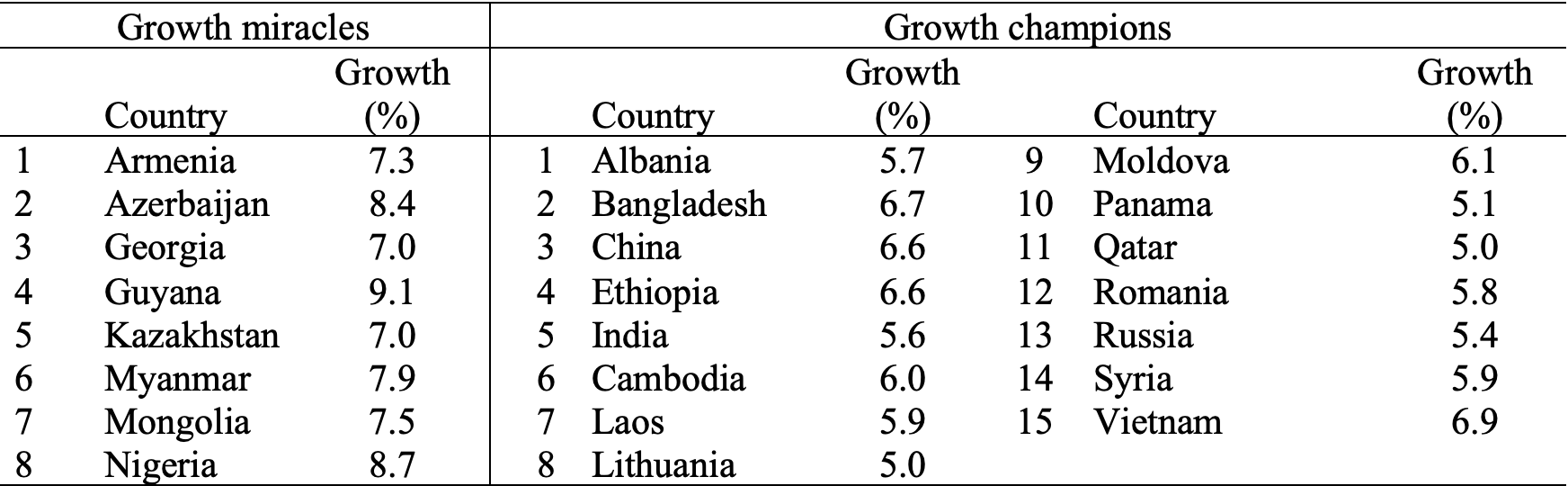
Notes: 1) Growth Miracles are defined as countries that experienced a growth rate in excess of 7% over the last 25 years. 2) Growth Champions are defined as countries that experienced a growth rate between 5 and 7% over the last 25 years. 3) Countries are listed alphabetically. 4) Data from Penn World Tables 11.0.
What secret sauce allowed these modern “growth miracles” to thrive while the rest of the global economy cooled? The traditional blueprint suggests they should have ridden a wave of surging exports, as the Tigers of the 20th century did. But as the era of hyper-globalization waned, a surprising trend emerged: These champions did not just climb the old export-led ladder. In our ongoing work with Songyan Ni, we found essentially no relationship between exports as a share of GDP and GDP growth rates for these countries, suggesting that, unlike their predecessors, this century’s success stories achieved their miracle status with surprisingly little help from the export sector.
If exports are not the common factor among these successes, what other factor might explain their performance? Rodrik, Subramanian, and Trebbi (RST, 2004), in an article titled “Institutions Rule,” argued that institutions were more important than geography or exports (which they labeled “integration”) in explaining growth outcomes in the 20th century. Yet, a critical nuance remains: Teasing out the statistical causality between whether institutions lead growth, or whether higher incomes create the conditions for citizens to demand better institutions, remains tricky.
Following the RST framework, we revisit the issue by looking at the impact over time of institutions (measured, as in the RST paper, by indices capturing the rule of law) on GDP per capita. The results are shown in Figure 2. We find that while the impact of institutions on GDP has moderated in the 21st century, they continue to have a statistically significant and positive effect on per-capita incomes. We interpret this finding as follows: while the ascent to high-income status has grown increasingly steep in the 21st century, the strengthening of institutions ensures that the summit remains within reach.
Figure 2. Impact of the rule of law and trade on GDP per capita over time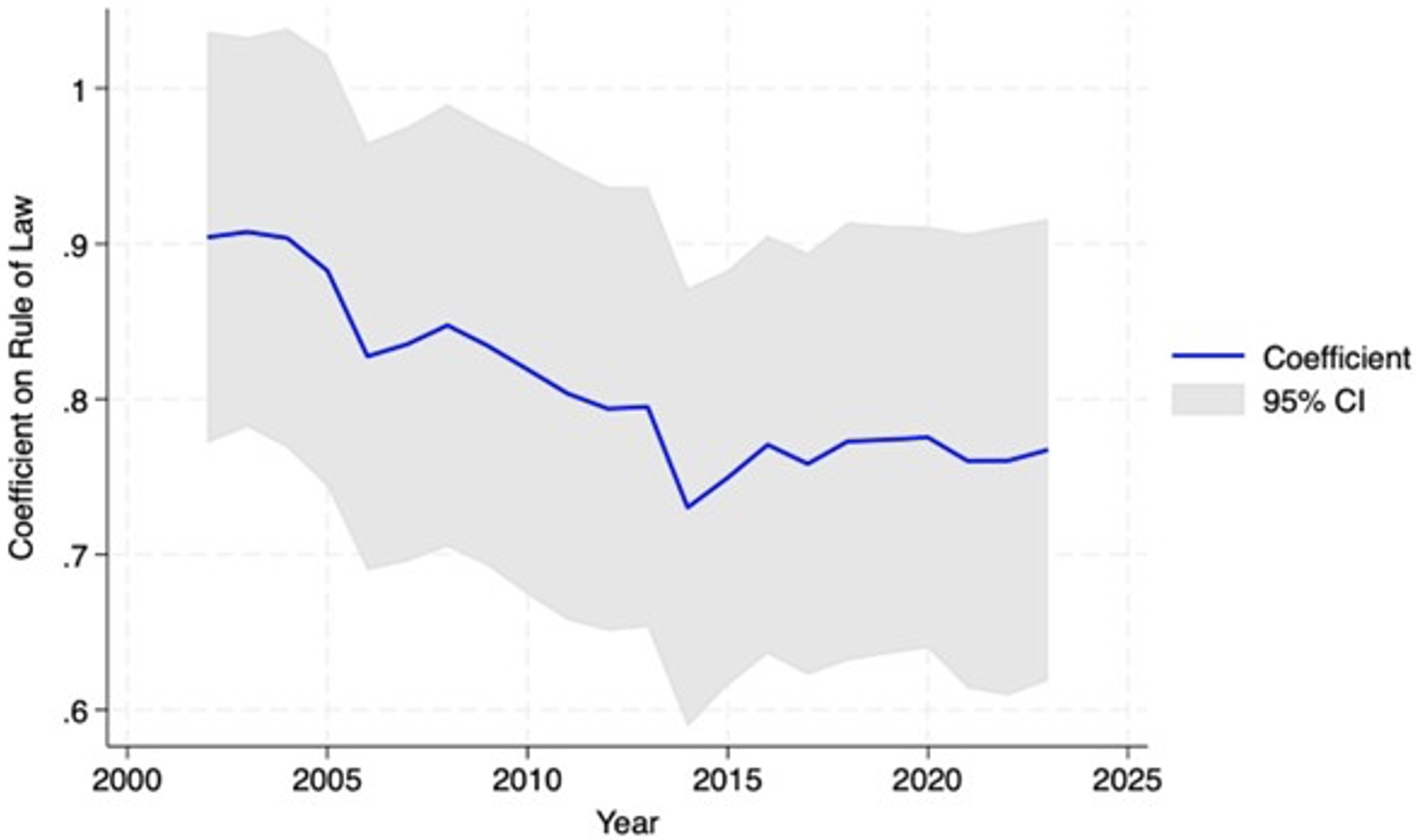
Source: Authors’ computation using data from the World Bank.
So, how is growth and development doing in this century? To us, our findings suggest that we are entering a more complex chapter of development, where globalization (growth through increased exports and integration) is no longer a guaranteed tailwind. However, a silver lining is that growth continues to liberate people from destitution; this poverty reduction is driven in part by more sophisticated, tech-enabled social protection. Moreover, despite the world turning away from globalization in this century, growth miracles and champions have continued to emerge. And building institutions remains a viable route to growth. Development has become more challenging, but there is cause for optimism: Because institutional quality, the key driver of growth in this century, lies within a country’s own hands, the path to prosperity is not hostage to the vagaries of global trade or the turbulence of trade wars. Countries can still climb the developmental ladder, and there is still hope for growth.
Authors


The Brookings Institution is committed to quality, independence, and impact.
We are supported by a diverse array of funders. In line with our values and policies, each Brookings publication represents the sole views of its author(s).


Commentary
Has the developmental ladder become steeper?
April 3, 2026