

This report is the final piece in a series on Latino business entrepreneurship during a time of federal policy volatility. The first report focused on local solutions for small business stabilization; the second report detailed disruptions in “business-friendly” states; and the third report explored access to capital and contracts.
Latino entrepreneurs have been among the fastest-growing segments of the U.S. small business landscape. According to the Census Bureau’s Annual Business Survey, there were over 495,000 Latino-owned employer firms (those with more than one employee) in 2023, generating more than $730 billion in annual revenue and employing more than 3.8 million workers. This growth reflects both demographic change and entrepreneurial dynamism, as Latino business owners continue to play a growing role in new business formation.
Yet in recent years, many of these businesses have faced an uncertain economic environment shaped by heightened federal policy volatility. Tariffs, intensified immigration enforcement, and shifts in small business policy affecting capital, procurement, and technical assistance have introduced new and compounding risks. These changes have increased input costs, disrupted labor supply, and made demand less predictable for small firms across the country.
Latino entrepreneurs are not an outlier in this story, but a bellwether. Many Latino-owned businesses are concentrated in sectors such as construction, accommodation and food services, retail, and transportation—industries in which firms rely on stable labor supply, predictable input costs, and consistent local demand. As a result, these businesses are often among the first to feel the effects of policy shifts, from rising material costs due to tariffs to workforce disruptions tied to immigration enforcement and changes in access to capital and contracts. The pressures facing these businesses—and how they are responding—offer an early signal of how policy volatility is reshaping competition, opportunity, and survival for small businesses more broadly.
To understand what is at stake, this report combines existing research with scenario-based estimates of how policy-driven disruptions could scale across the small business economy. While these scenarios are not predictions, they illustrate how even modest changes in business activity can translate into broader economic consequences. Three findings stand out:
- Even small disruptions can scale quickly. A 3% decline in the number of Latino-owned employer firms nationwide would correspond to a loss of nearly 15,000 businesses, more than 100,000 lost jobs, and billions of dollars in lost revenue.
- Local impacts are already visible. In Los Angeles, more than 80% of businesses reported disruptions tied to immigration enforcement, with 44% losing over half their revenue; in Chicago, 95% of businesses in key corridors reported declining sales.
- At scale, these effects could translate into thousands of lost businesses and jobs. A 3% decline would mean over 1,200 businesses and roughly 9,000 jobs would be lost in Los Angeles alone, and more than 2,000 businesses and over 20,000 jobs in Texas, where coordination with federal immigration enforcement is more extensive.
However, this moment also highlights a broader challenge. The question is not only how to help Latino entrepreneurs withstand disruption, but how to rebuild and reimagine the conditions that allow small businesses to plan, invest, and grow. A stronger economy for small businesses will require a more affirmative policy vision that restores predictability, lowers structural barriers, and supports long-term growth for entrepreneurs and the communities they serve. The analysis that follows pairs these findings with a set of policy recommendations aimed at reducing policy volatility, leveling the competitive landscape, and making the systems small businesses rely on more accessible and reliable.
Policy volatility is compounding long-standing structural barriers, making the small business system more fragile
Federal policy has become a direct and immediate source of disruption for small businesses (see Table 1). Immigration enforcement can produce simultaneous labor and demand shocks, as businesses lose workers while customers reduce their presence in public spaces due to fear and uncertainty. As other Brookings scholars have noted, policies that sharply reduce immigration could shrink the nation’s workforce by more than 2.4 million people and reduce national gross domestic product (GDP) by more than 7% by 2028.
These effects are not theoretical—they have material impacts. Immigrants are workers, business owners, and consumers who play a central role in local economies. Policies that restrict their participation do not just affect individuals—they reshape the markets that small businesses rely on to hire, sell, and grow.
Meanwhile, tariffs introduce cost volatility, forcing firms to absorb higher input prices or adjust pricing and investment decisions. Broader geopolitical developments, including those affecting energy markets, further increase operating costs and supply chain uncertainty.
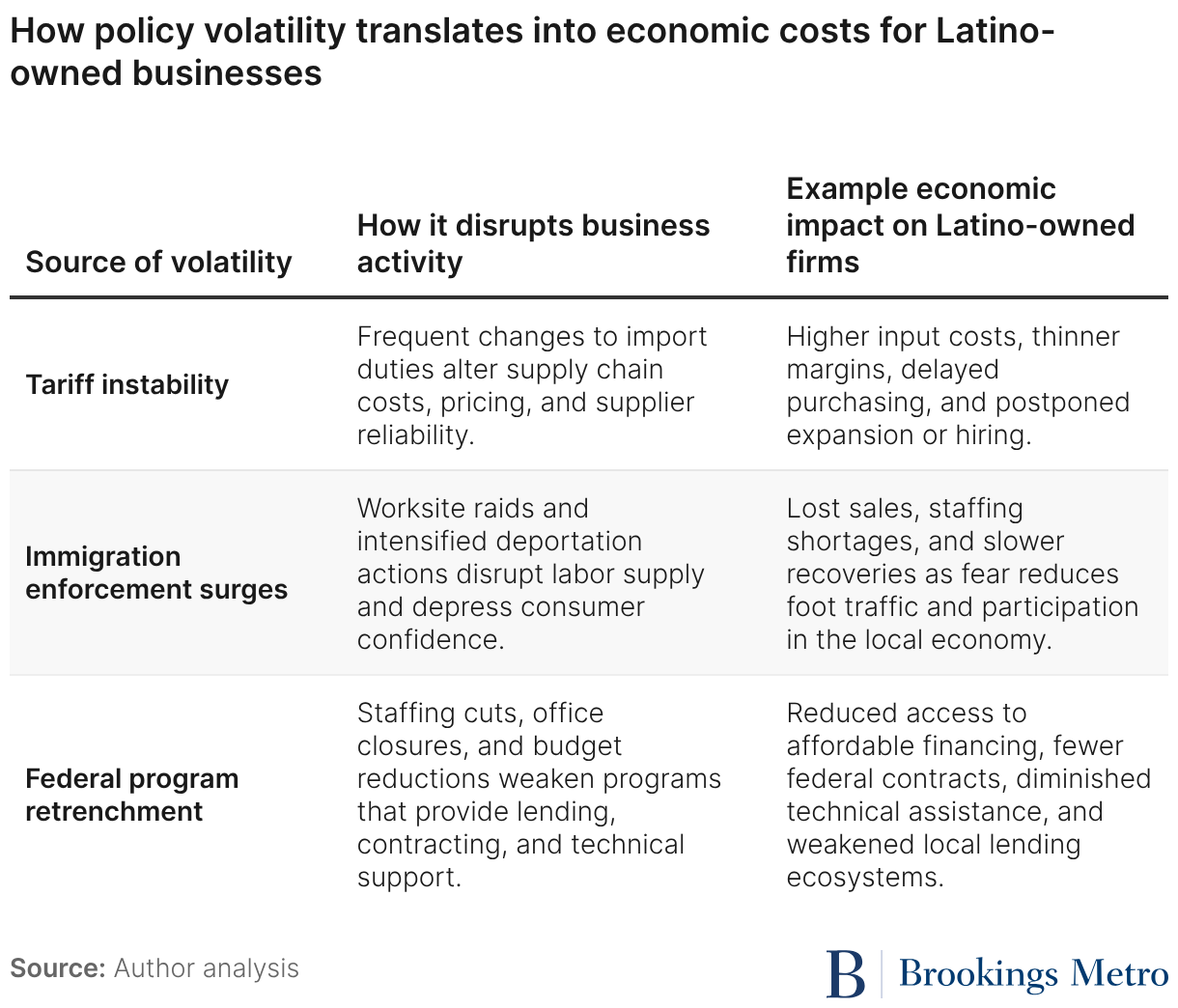
What distinguishes the current moment is not simply the presence of shocks, but their frequency and unpredictability. For small businesses operating on thin margins, the inability to anticipate costs or demand can be as damaging as the shocks themselves.
These pressures are unfolding within a system that already unfairly disadvantaged Latino- and other minority-owned businesses. Access to capital, contracts, and business infrastructure has long varied by firm size, resources, and ownership. As volatility increases, these underlying disparities become more consequential, shaping which businesses are able to adapt and which are forced to scale back or exit.
At the same time, the systems intended to support small businesses are becoming more difficult to access. Changes to lending rules and increased scrutiny around eligibility have added friction to already constrained capital markets. Strain on mission-driven lenders, including community development financial institutions (CDFIs), has impacted the availability of flexible capital at precisely the moment it is most needed.
Federal procurement—long viewed as a pathway for small business growth—is also becoming less predictable. Shifting program priorities and heightened scrutiny have made participation more uncertain. In response, contracting officers and prime contractors may default to established firms, thus reinforcing existing advantages.
These dynamics are compounded by the erosion of business support infrastructure. Reductions in staffing and resources across technical assistance networks will likely make it more difficult for entrepreneurs to navigate loan applications, certifications, and compliance requirements. For many firms, this translates into higher transaction costs and increased reliance on informal networks.
The result is a system in which instability amplifies existing inequities. Businesses that were already operating with fewer resources face greater exposure to shocks, while larger and more established firms are better positioned to absorb uncertainty. Over time, this dynamic risks accelerating market concentration and reducing the diversity of the business ecosystem.
Even modest disruptions can scale into significant economic losses for small businesses, workers, and local economies
The effects of policy volatility are often discussed abstractly. But for small businesses, they are anything but theoretical. Latino-owned employer firms alone support millions of jobs nationwide, meaning that even modest disruptions in business activity can carry broader economic consequences when applied at scale.
To illustrate what is at stake, Table 2 presents a range of plausible disruption scenarios, including 3%, 6%, and 9% declines in the number of Latino-owned employer firms. Because official data on firm closures and formation are not yet available, and Annual Business Survey data for 2024 will not be released until next year, we use these scenarios in the interim to illustrate how changes that may appear incremental at the firm level can translate into meaningful economic effects across hundreds of thousands of businesses. These scenarios reflect net changes in the number of operating firms, which in practice could result from a combination of business closures and reduced rates of new business formation. Given that the number of Latino-owned employer businesses has been growing at roughly 7.7% annually in recent years, sustained disruption may not only lead to closures, but also slow or reverse this growth trajectory. Table 2 also includes a “business-as-usual” continuation of recent growth trends, providing context for how disruption may not only lead to losses, but also reduce or reverse expected gains.
These scenarios are intentionally conservative. During the early months of the COVID-19 pandemic, business closures and exits rapidly surged, with hundreds of thousands of establishments closing in a single quarter and permanent exits alone destroying nearly 1.2 million jobs. That recent experience shows how quickly disruptions can escalate under sustained uncertainty, suggesting that even modest declines can carry significant economic consequences.
A 3% decline alone would correspond to thousands of business closures and well over 100,000 lost jobs. At higher levels, the number of lost jobs rises into the hundreds of thousands. The point is not the precise number, but the scale: Small percentage changes, when spread across a large and interconnected sector, can have significant implications for workers, local economies, and public revenues.


While the scenarios presented here are intentionally conservative, recent history suggests that small business disruptions can escalate quickly under conditions of sustained uncertainty. During the COVID-19 pandemic, many small businesses experienced sharp declines in revenue and foot traffic, particularly in sectors such as accommodation and food services—an industry in which Latino entrepreneurs are heavily represented. These disruptions were often immediate and severe, forcing businesses to reduce hours, cut staff, or close temporarily.
At the same time, overall business counts and revenue ultimately recovered and continued to grow in the years that followed the pandemic. This reflects a key difference between that period and the current environment. The federal response to COVID-19 included large-scale support programs, such as the Paycheck Protection Program (PPP), that helped stabilize small businesses, sustain payrolls, and support new business formation. Access to these programs was not uniform: Latino-owned businesses reported greater challenges in navigating the PPP, particularly in its early stages, resulting in lower approval rates and limited guidance from lenders. Subsequent changes in 2021 expanded access by prioritizing smaller and minority-owned businesses, addressing some of these disparities over time. More broadly, federal policy during the Biden-Harris administration continued to support small business recovery through expanded access to capital and contracting opportunities for disadvantaged business owners. Together, these efforts cushioned the broader economic impact even as many firms experienced acute, short-term losses.
Current conditions differ in both source and response, but still point to how policy-driven disruptions can shape local economies. Data from Brookings Metro’s DMV Monitor show that in the Washington, D.C.-Maryland-Virginia region, total employment declined by 1.7% in 2025 compared to the previous year—the largest drop among major metropolitan areas. This period coincides with federal workforce reductions and increased immigration enforcement and National Guard presence in parts of the region. Over the same period, commercial occupancy contracted and visitor spending fell by 7.7%. These shifts are consistent with weakening demand in sectors that rely on in-person activity and illustrate how policy changes can translate into real-time shifts in business conditions. For small businesses, those changes show up most clearly in revenue.
Revenue loss, in this context, reflects more than an accounting change—it represents a contraction in day-to-day economic activity. For small businesses, revenue supports payroll, rent, inventory purchases, and payments to local suppliers. When revenue declines, these expenditures are often among the first to be reduced. As Jaime di Paulo, president and CEO of the Illinois Hispanic Chamber of Commerce, explained in a piece for Crain’s Chicago Business:
When a family decides not to dine out due to concerns about being targeted by U.S. Immigration and Customs Enforcement, the impact extends beyond the loss of $100 for the restaurant. It also means approximately $10 in local sales tax won’t reach the city and state. A server misses out on a tip. A distributor may receive smaller orders for bakery and produce items. The delivery driver will work fewer hours, the fuel supplier will sell less diesel, and the laundry service will have less work.
Jaime di Paulo, President and CEO, Illinois Hispanic Chamber of Commerce
The scenarios presented above capture changes in business activity and employment through business closures. They do not reflect the broader spillover dynamics di Paulo described, in which shifts in revenue and payroll affect suppliers, neighboring businesses, and local public finances. As a result, our scenarios should be understood as a partial view of how policy volatility moves through local economies.
These effects are often concentrated at the neighborhood level. In areas with high concentrations of immigrant-owned businesses, changes in foot traffic and consumer activity are shaped by fear, uncertainty, and shifts in daily routines. In these settings, economic impacts can be more pronounced along commercial corridors where businesses are closely interconnected. The scenarios presented here should be read in that context, as illustrations of how even modest changes can take on greater significance in specific places.
In major cities where local policies limit cooperation with federal immigration enforcement, disruptions are already reshaping local business activity
Small business disruptions and associated spillover effects are especially visible in large metropolitan areas where these firms are densely clustered and closely tied to neighborhood economies. Chicago and Los Angeles provide clear examples. In both cities, Latino-owned businesses anchor commercial corridors and play a central role in local economic activity.
Both cities also have adopted sanctuary city policies that limit cooperation with federal immigration enforcement. Even so, recent enforcement activity has affected business conditions, contributing to shifts in foot traffic, workforce stability, and day-to-day operations in affected neighborhoods.
Evidence from Los Angeles illustrates how these dynamics are playing out in practice. Analysis from the Los Angeles County Department of Economic Opportunity and the Los Angeles County Economic Development Corporation finds that a majority of businesses are reporting disruptions tied to immigration enforcement. In one survey, 82% of businesses reported negative impacts from immigration enforcement, and 44% reported losing over half of their revenue. Meanwhile, 52% reported reduced daily sales and revenue, and 51% reported declines in customer traffic. Workforce effects were similarly pronounced, with 70% of businesses reporting staffing shortages and 33% indicating that workers were afraid to report to work.
In Chicago, similar patterns are visible at the neighborhood level. In the Little Village neighborhood and its surrounding Latino business corridors, local organizations report sustained declines in commercial activity following federal immigration enforcement actions. A survey of businesses in majority-Mexican neighborhoods found that 95% reported lower daily sales, with 75% experiencing revenue declines of at least 30%. Vacancy rates have also increased along key corridors, reflecting ongoing challenges for small businesses operating in these environments.
Table 3 translates these neighborhood-level effects into their potential scale at the metro area level. In Los Angeles, a 3% decline in the number of Latino-owned employer businesses would correspond to more than 1,200 lost businesses and over 9,000 lost jobs. In Chicago, similar percentage changes correspond to thousands of lost jobs and measurable reductions in revenue and local tax collections.

Across both cities, the pattern is consistent: Changes in consumer activity and workforce participation are already shaping business conditions at the local level, particularly in neighborhoods where small businesses are closely interconnected. And when viewed at scale, even modest shifts can translate into meaningful changes in employment, business activity, and public revenues across an entire metro area. These dynamics are not limited to any one place; as the next section details, similar pressures are emerging beneath the surface in states experiencing continued business growth.
In high-growth states, underlying instability is increasing exposure for small businesses
In states such as Texas and Florida, where policymakers have taken a more cooperative approach to federal immigration enforcement, small business dynamics take a different form. These states continue to experience business growth, but recent reporting suggests that small businesses are also navigating increased strain in day-to-day operations.
Both states are among the nation’s leading participants in the federal 287(g) program, which allows state and local law enforcement agencies to partner with U.S. Immigration and Customs Enforcement (ICE) to carry out certain immigration enforcement functions (see Map 1). When this Brookings report series began in October 2025, there were 1,033 active 287(g) agreements in place. As of the end of April 2026, that number has grown to over 1,700 across 39 states and two U.S. territories (a 64% increase), with Texas and Florida accounting for roughly 40% of the total. This level of coordination can expand the reach and day-to-day presence of immigration enforcement, shaping business conditions in ways that extend beyond individual enforcement actions.

In Texas, business owners across sectors report less foot traffic, more workforce instability, and rising costs tied to immigration-enforcement-related disruptions. Restaurant operators and trade groups note that worker fear has affected both staffing and customer activity, contributing to declining profitability and reduced demand.
These pressures are also visible in the construction sector, particularly in South Texas and the Rio Grande Valley. Builders report delayed projects, difficulty recruiting workers, and reduced activity at job sites following repeated enforcement actions. In some areas, construction activity has declined significantly, with suppliers reporting falling demand and stalled projects.
At the same time, enforcement activity has remained elevated across parts of Texas and Florida. Federal data show that areas such as Miami, Dallas, and San Antonio have recorded some of the highest levels of immigration arrests in the country, even in places without high-profile enforcement operations. This suggests that business conditions can be shaped not only by visible enforcement actions, but also by broader patterns of enforcement and the uncertainty they create.
The figures presented in Table 4 illustrate what similar changes in business conditions look like at the state level. As in previous sections, these scenarios are estimates intended to show how even small decreases in business activity in local economies can scale across large and growing small business ecosystems to result in decreased revenue, jobs, and even state taxes.

Even in high-growth states, relatively small changes can translate into meaningful economic effects when applied at scale. In Texas, a 3% closure scenario corresponds to more than 2,000 lost businesses and over 20,000 lost jobs. In Florida, similar changes correspond to more than 3,000 lost businesses and over 16,000 lost jobs. These figures capture direct changes in business activity and employment and do not reflect the broader ripple effects described earlier, which can extend further through local and regional economies.
Small business policy must shift from reactive support to building stability, competition, and system-level access
The patterns documented throughout this report point to a core challenge: Latino-owned businesses, which have been among the fastest-growing segments of the small business landscape, are navigating not only long-standing barriers such as access to capital and contracts, but also a broader environment shaped by policy volatility. Because these businesses are deeply embedded in local economies and concentrated in sectors sensitive to changes in labor supply and consumer demand, they provide an early signal of how these dynamics are reshaping small business conditions more broadly.
Yet the current policy environment remains largely reactive; it is designed to help firms respond to disruptions after they occur rather than shape the conditions that determine whether those disruptions arise in the first place. A more effective approach requires moving beyond program expansion and toward system design—building a more stable, competitive, and navigable economic environment (see Table 5).

Federal policy is driving instability and must be redesigned to support stability, access, and competition
Much of the instability facing small businesses today is policy-driven. Unpredictable tariffs, intensified immigration enforcement, geopolitical volatility, and the erosion of federal support systems are interacting in ways that raise input costs, disrupt labor supply, suppress consumer demand, and make capital and contracts harder to access.
The first federal priority should be to stop creating avoidable policy volatility. That means avoiding sudden tariff shifts, ending enforcement strategies that destabilize workers and local economies, preventing unnecessary conflicts (such as the U.S.-Israel war with Iran) that raise energy and supply chain costs for small businesses, and maintaining the federal programs that small businesses rely on to access capital, technical assistance, and contracting opportunities.
But reducing instability is not enough. The status quo was already falling short; federal lending, procurement, and technical assistance systems have long been difficult to navigate, especially for smaller firms and entrepreneurs with fewer reserves. Recent changes have made those systems even more restrictive by tightening eligibility, increasing documentation requirements, weakening procurement pathways, and reducing support infrastructure. The task is not simply to restore what existed before, but to build a better system.
That should include a more affirmative federal small business agenda. Congress could develop a package that treats small business growth as a cross-cutting economic priority, not just a Small Business Administration (SBA) issue. That means connecting capital, procurement, competition, health care, payments, energy, and workforce policy into a coherent strategy for helping small businesses start, operate, compete, and grow.
This broader approach matters because many policies that are not usually labeled “small business policy” directly shape entrepreneurship. Health care policy affects whether people can leave traditional employment to start a business or whether they can expand an existing one. Payments policy affects how quickly businesses receive revenue and how much they lose to card processing fees. Clean energy policy affects operating costs and investment opportunities, yet recent federal rollbacks have targeted programs that helped small firms lower energy costs, finance clean energy upgrades, and participate in the clean energy economy.
Small businesses are central to economic opportunity, local job creation, and the overall dynamism of the U.S. economy. The conditions under which small businesses operate are also conditions that shape competition. Federal policy therefore plays a central role in determining how firms compete and who is able to remain in the market. Under conditions of policy volatility, these dynamics can become a competitive filter, allowing larger firms with more capital and compliance capacity to absorb shocks while smaller firms face a rising risk of contraction or exit. A stronger small business agenda should therefore treat stability as a condition for competition, not just a form of relief. These priorities differ between immediate policy conditions and longer-term structural reforms.
In the short term:
- Avoid sudden tariff shifts that raise input costs without clear timelines or transition periods.
- End immigration enforcement strategies that destabilize workers, consumers, employers, and local economies.
- Avoid geopolitical escalation that raises energy, transportation, and supply chain costs for small firms.
- Maintain continuity in federal lending, contracting, and technical assistance programs.
- Pause or phase in major changes to eligibility rules, underwriting standards, and procurement requirements that could disrupt access to capital and contracts.
Over the medium to longer term (structural reforms):
- Develop a coordinated federal small business agenda that connects capital, procurement, competition, health care, payments, energy, and workforce policy.
- Support policies that enable immigrants to work, start businesses, and participate fully in local economies, recognizing their role as workers, entrepreneurs, and consumers in sustaining small business ecosystems.
- Expand capital access by incorporating grants and more flexible financing alongside loans through programs such as the State Small Business Credit Initiative (SSBCI), CDFIs, and other federal-state tools.
- Redesign procurement rules to expand competition, reduce reliance on large incumbent firms, preserve meaningful small business participation targets, and make prime contracting more realistic for smaller firms.
- Centralize or better coordinate small business supports across agencies so firms are not forced to navigate fragmented federal systems on their own.
- Reduce payment costs and delays by advancing instant payments, increasing transparency around swipe fees, and supporting competition in payment networks.
- Protect and expand programs that help small businesses lower energy costs and invest in clean energy, including rural energy, SBA green lending, and energy-efficiency financing tools
State and local governments play a central role in stabilizing businesses, expanding opportunity, and connecting systems
While federal policy shapes the broader environment, responses to these conditions have varied across states and regions, offering a clearer picture of what different approaches look like in practice.
In Los Angeles, local officials used an emergency declaration to deploy grants to businesses affected by immigration enforcement. Comparable responses are emerging in smaller cities: In Charlotte, N.C., the city committed $100,000 in emergency assistance to households facing income loss from business disruptions, reflecting how local governments are adapting crisis-response tools to stabilize economic activity.
These responses stand in contrast to states such as Texas and Florida, where state leadership has taken a more active role in coordinating with federal immigration enforcement, including through the 287(g) program. In Texas, recent tensions between state leadership and major cities highlight how enforcement policy is extending beyond direct economic effects and into the governance of local systems. State officials have threatened to withdraw more than $150 million in public safety funding from cities such as Houston, Dallas, and Austin over local policies governing cooperation with federal immigration authorities.
This type of pressure can constrain the ability of local governments to respond to economic disruptions, particularly when funding tied to public services and local stability is used as leverage. As a result, policy choices at the state level do not only shape enforcement itself, but also the capacity of local actors to support small businesses and stabilize their economies.
These examples point to a clear takeaway: State and local governments play a central role not only in responding to disruption, but in shaping opportunity and building the systems that small businesses rely on over time. State and local governments play distinct roles during disruption and in more stable periods.
In the short term:
- Establish rapid-response funds that can be deployed quickly to businesses and households facing sudden income loss.
- Use emergency authorities to expedite grants, fee relief, or short-term financial support.
- Work through community-based organizations to identify needs and deliver support quickly.
- Target support to commercial corridors where business activity is concentrated and disruptions are most visible.
Over the medium to longer term (structural reforms):
- Expand local procurement and contracting pathways to create more consistent demand for small businesses.
- Invest in corridor-level economic development strategies in neighborhoods where businesses are interconnected.
- Fund business navigators and technical assistance networks to help firms access capital, contracts, and public programs.
- Institutionalize coordination across agencies to simplify processes and reduce fragmentation in how support is delivered.
- Reduce barriers to starting and expanding a business, including streamlining licensing requirements, lowering or waiving fees for small firms, and simplifying permitting processes.
- Build and maintain cross-sector partnerships in advance so that capital, technical assistance, and outreach systems are already in place before disruption occurs.
Private, nonprofit, and philanthropic actors can mobilize capital and demand, but need stronger coordination to sustain impact
Government alone cannot stabilize small business ecosystems. The private sector, nonprofits, and philanthropy play a critical role in mobilizing capital, creating demand, and coordinating responses, particularly when public systems are slow to respond or constrained.
Across the country, these actors have already stepped in where federal policy change has created funding gaps. In Chicago, civic leaders and community-based organizations supported small businesses in key corridors, with groups such as Latinos Progresando and the Little Village Chamber of Commerce helping secure and deploy $250,000 along the Cermak and 26th Street corridors, as these were economically impacted by ICE’s Operation Midway Blitz. In Los Angeles, philanthropic actors such as the California Community Foundation mobilized funding to support communities affected by enforcement-related disruptions.
The experience in Minneapolis illustrates how these systems can operate at scale. Following a surge in immigration enforcement, community organizations, philanthropic institutions, and corporate leaders mobilized rapidly to meet immediate needs. The Minneapolis Foundation activated an Economic Response Fund with an initial $3.5 million in grants to support small businesses, including assistance for payroll, rent, and inventory, with funding drawn from a coalition of 28 major companies. Resources were directed through community-based organizations with deep experience supporting small businesses, while groups such as the Latino Economic Development Center played a key role in delivering capital and assistance to affected businesses. These efforts were not centrally coordinated at the outset, but evolved into more structured partnerships as the scale of need became clearer.
These examples highlight both the strengths and limitations of current approaches. Private and philanthropic actors can move quickly, deploy flexible capital, and respond to needs in real time. At the same time, these efforts are often episodic, fragmented, and dependent on existing relationships and institutional capacity.
A more durable approach would focus on building coordinated systems in advance, so that capital, demand, and delivery mechanisms can be activated quickly when disruptions occur. The role of private, nonprofit, and philanthropic actors also differs across moments of disruption and stability.
In the short term:
- Philanthropy and corporate partners: Provide fast, short-term funding to businesses experiencing sudden revenue loss, with simple applications and minimal paperwork so funds can be delivered within days, not months.
- Private sector (large firms, hospitals, universities): Avoid canceling or delaying contracts with small businesses; large companies, hospitals, and universities can continue or accelerate payments to vendors to help stabilize cash flow.
- Philanthropy and corporate coalitions: Set up emergency funds in advance so money can be released immediately when disruptions occur, rather than raising funds after the fact.
- Private sector (buyers and anchor institutions): Use purchasing power to keep demand steady; for example, by placing advance orders or committing to buy from small businesses in affected sectors.
Over the medium to longer term (structural reforms):
- Philanthropy: Create dedicated funds that are ready to deploy during a crisis, so communities are not relying on last-minute fundraising.
- Private sector (corporate buyers): Build long-term supplier relationships with small businesses, including multi-year contracts, rather than one-time or symbolic supplier diversity efforts.
- Financial Institutions and lenders: Expand access to financing that better reflects small business cash flow, including underwriting approaches that account for revenue variability and limited collateral.
- Nonprofits and community-based organizations, supported by philanthropy: Invest in the organizations that connect businesses to capital, contracts, and support, so these systems are already in place before disruptions occur.
- Cross-sector coalitions (private, philanthropic, nonprofit): Develop clear coordination plans across businesses, philanthropies, and local partners so roles and responsibilities are defined in advance, rather than improvised during a crisis.
Conclusion
Latino entrepreneurs are not peripheral to the U.S. economy—they are central to its present and future growth. The recent expansion of these businesses reflects both entrepreneurial dynamism and the increasing role they play across key sectors of the economy. Yet the conditions in which they operate are becoming more unstable, shaped not only by long-standing structural barriers, but also by an unstable federal policy environment that introduces new and compounding risks. The disruptions to Latino-owned businesses offer an early signal of how policy volatility is reshaping the small business landscape more broadly.
The evidence presented in this report points to a clear conclusion: The current set of small business policies at the federal level is not designed for stability, nor is it structured to support competition. These gaps extend beyond the federal level, intersecting with similarly fragmented policies at the state and local levels and with the actions of private sector, nonprofit, and philanthropic actors who often step in to fill gaps but operate with limited coordination. As a result, the broader system remains reactive, fragmented, and often difficult to navigate. Addressing this challenge requires more than expanding the coverage and scale of existing programs. It requires rethinking how policy shapes the conditions under which businesses operate—from trade and immigration to capital, procurement, and payments—and recognizing that these systems collectively determine who can start, sustain, and grow a business.
Building a stronger small business economy will require a more coordinated and affirmative approach across levels of government and sectors. Stability must be treated as a core economic objective, not as an afterthought. Competition must be reinforced, not eroded through uneven exposure to risk. And the systems that support small businesses must be designed to be accessible, predictable, and responsive.
Latino entrepreneurs have already demonstrated enormous potential for business formation. The task ahead is to build an economy that allows that growth to continue—not in spite of the system, but because of it.
Author
The Brookings Institution is committed to quality, independence, and impact.
We are supported by a diverse array of funders. In line with our values and policies, each Brookings publication represents the sole views of its author(s).