
Our federal policy landscape is changing rapidly. The laws and norms governing safety nets, universities, and health care systems are evolving faster than most people can process. These policy changes have been accompanied by increasingly negative political discourse that is spilling into communities and families. Are we living in extraordinary times?
In this short data story, we hope to contribute insight into the dialogue on the drivers and consequences of the rapidly changing federal policy landscape. One caveat: We are not experts in politics; we are economists who study public health (such as deaths of despair), well-being, and social and labor market policy. The trends we highlight in this piece are having long-ranging effects on the populations and places that we study. We welcome comments from those who have far more expertise in political analysis than we do, including many here at Brookings.
Using 30 years of data from the Gallup Poll Social Series (GPSS), we explore trends in political opinion from 1991 through August 2025.1 We show how public opinion has changed in a range of domains, including approval of the presidency, Congress, and the Supreme Court, as well as trust in key institutions. We depict trends in public opinion both overall and disaggregated by party affiliation.
This data illustrates that polarization has been a part of U.S. federal politics for decades, as does recent research. Only recently, however, have confidence levels in institutions degraded. In a subsequent piece, once we have data for all the months in 2025, we will cover additional topics such as personal well-being, mental health, and the environment and explore possible consequences of the erosion in institutional trust.
Polarization
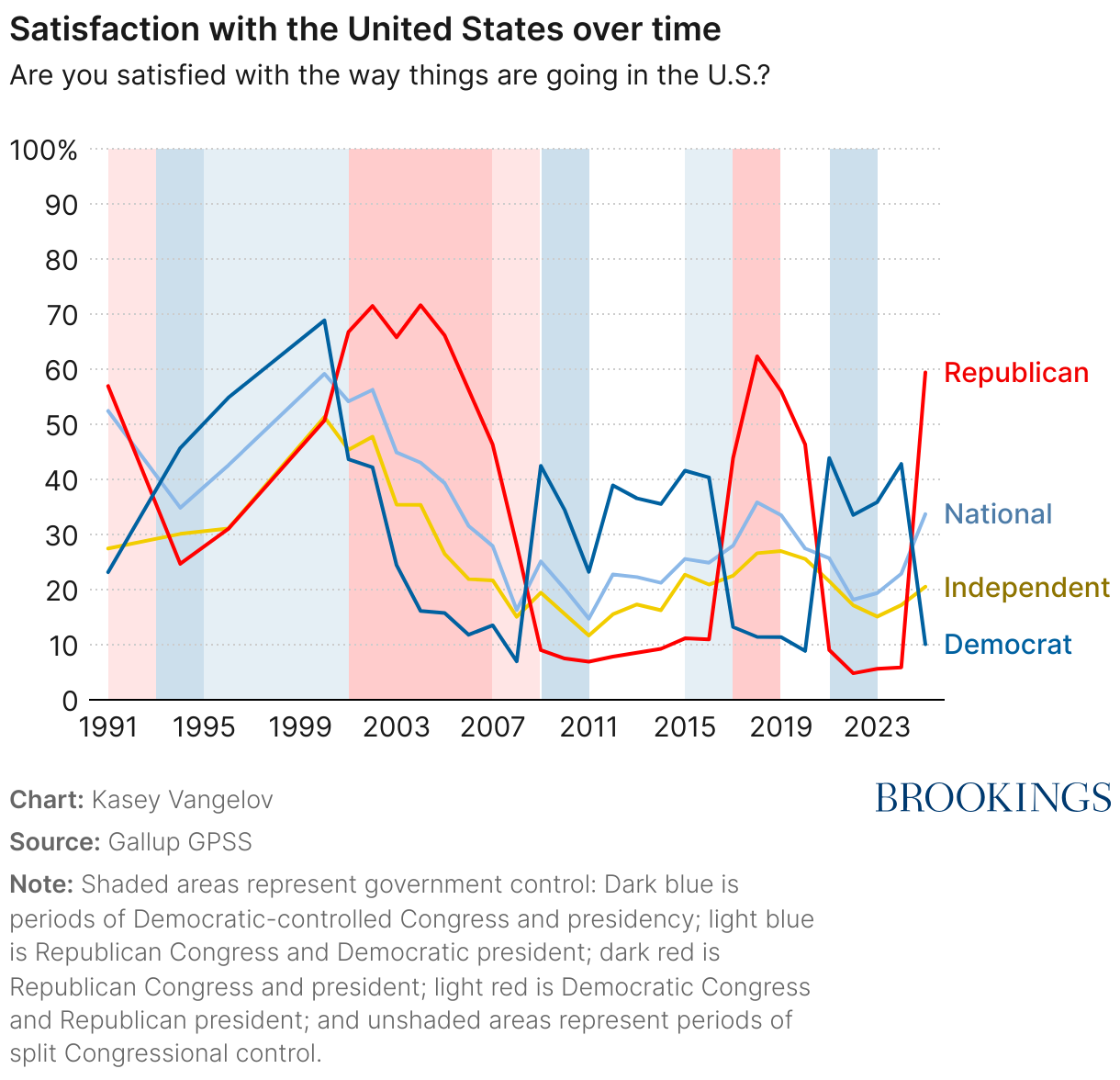
While there is a great deal of talk about how polarized U.S. politics and society have recently become, for at least two decades, satisfaction with the general direction of the country and the performance of the president has tracked with respondents’ party affiliation.
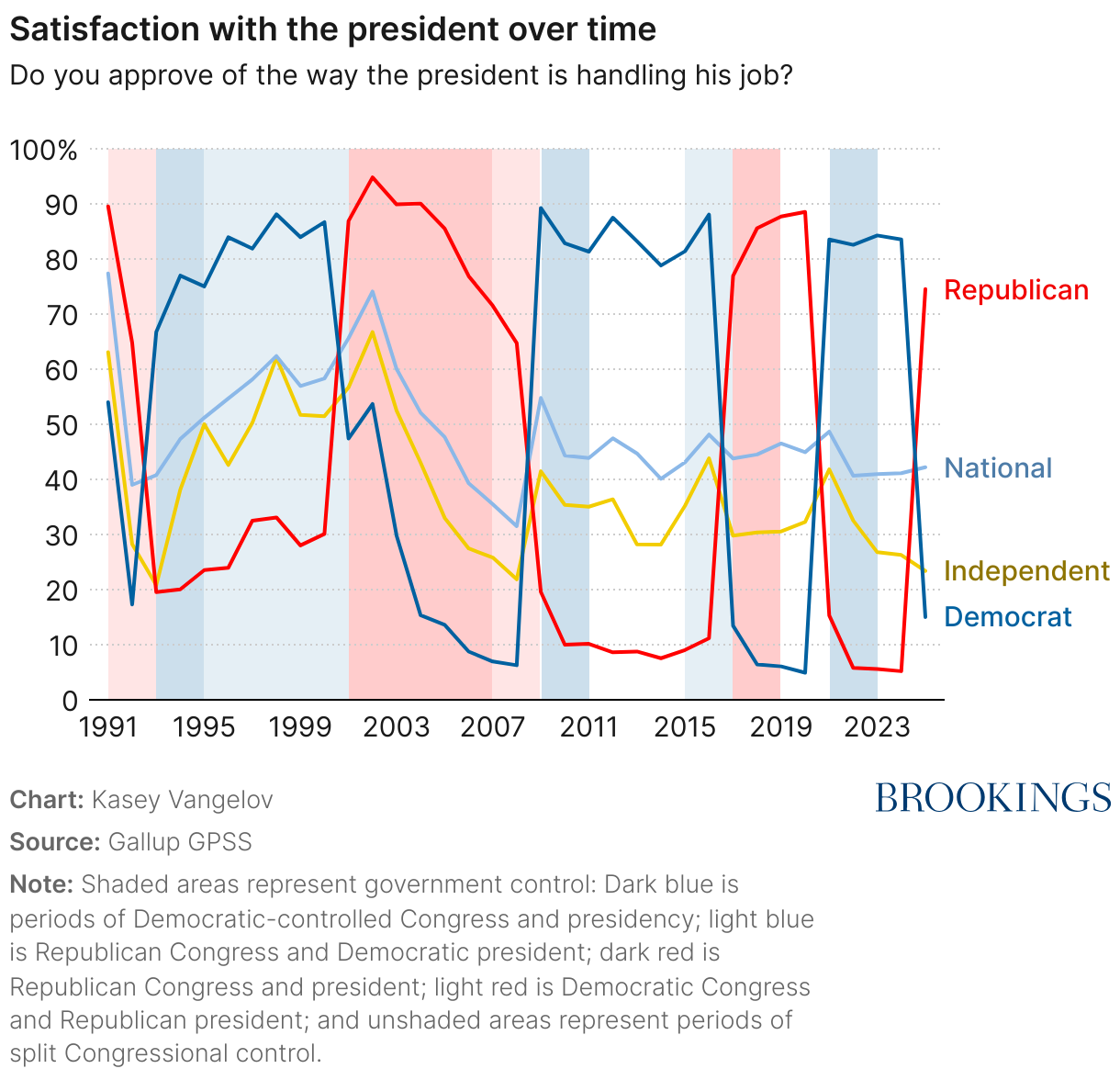
A very consistent trend in the following graph is how satisfaction with the U.S. is driven by whether respondents have the same affiliation as the president in power.
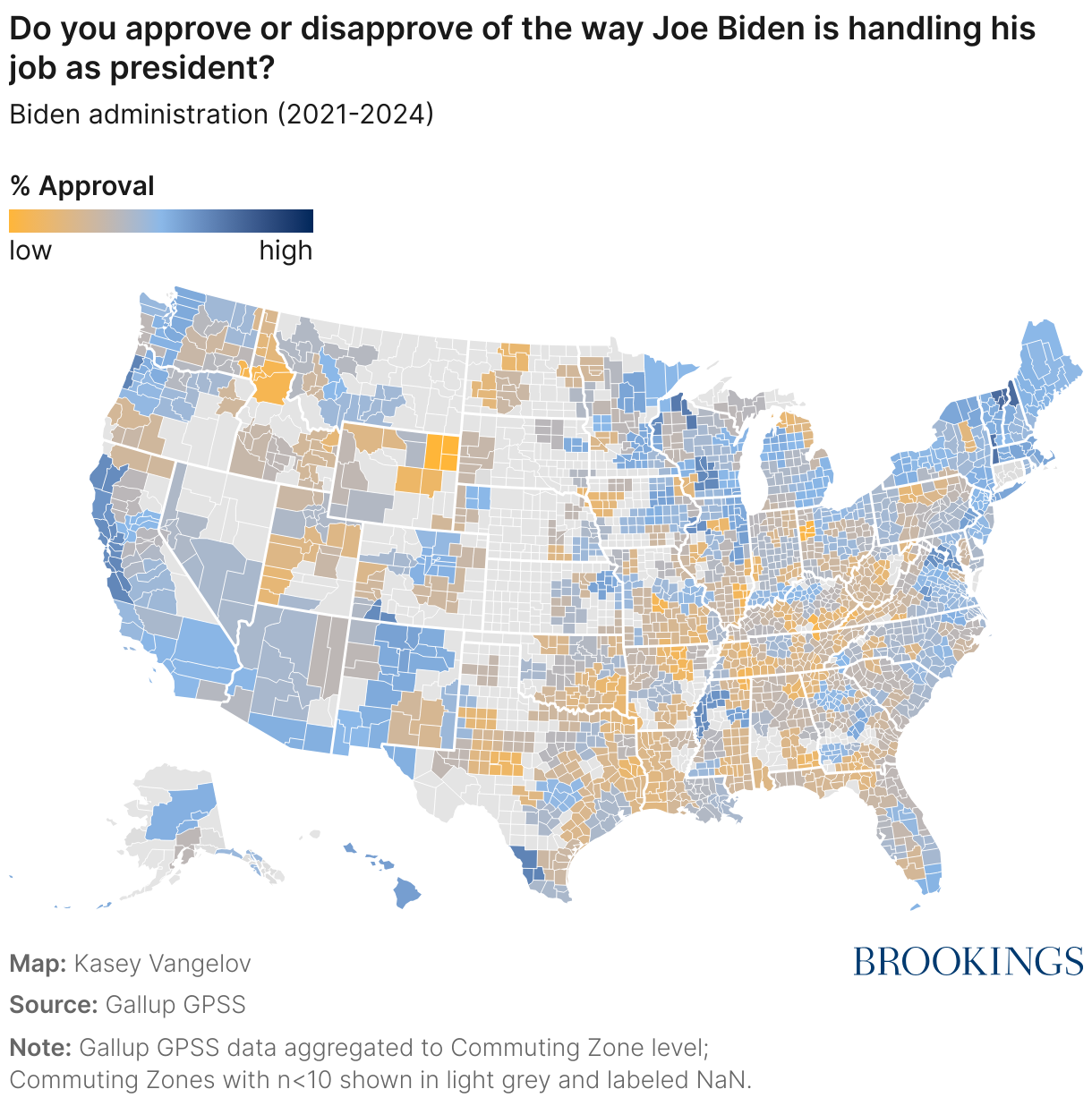
Aggregating the survey data to the commuting-zone level shows that the political divide is a geographical one as well, not just state-to-state but within states. The maps below show that many counties within states – even those in close proximity to each other—have very different political leanings and related opinions about political and other institutions.
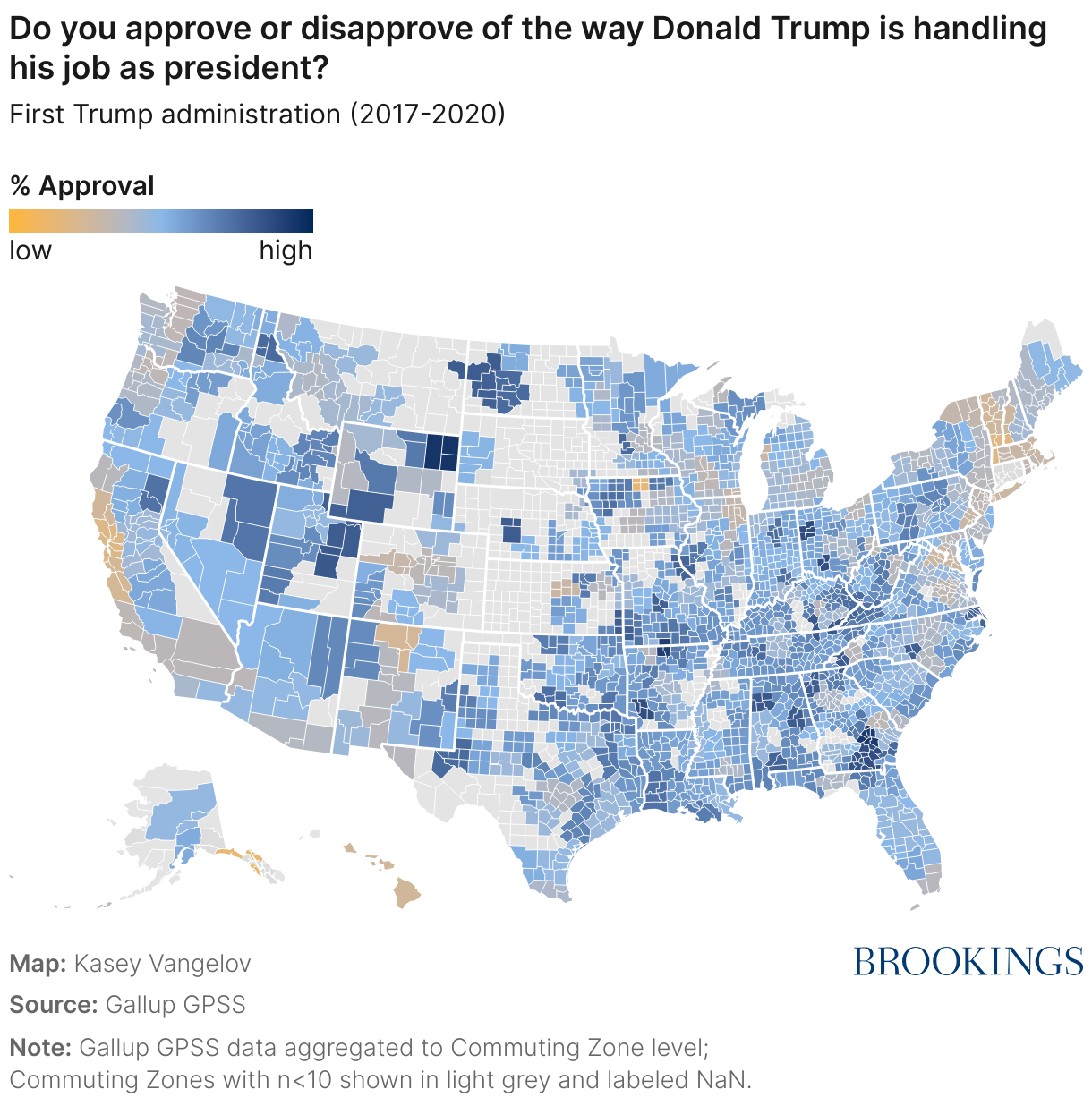
Similar to respondents’ satisfaction with the general direction of the country, attitudes towards a particular president are also driven by partisan affiliation rather than reflecting public opinion on actual policies and outcomes. There is a slight uptick in the national average among independents during exceptional events, such as September 11, 2001, the 2009 financial crisis, and the COVID pandemic, suggesting independents are more likely to focus on the issues at hand rather than partisan differences (which in turn may be why they are independents!).
Over the past few decades, Congressional approval has also demonstrated a mild partisan trend but nowhere near to the degree of presidential approval or general direction of the U.S. Notably, Congressional approval has been consistently much lower than presidential approval regardless of party. In a way it is not surprising that the public’s opinion of Congress is lower overall, since Congress includes a lot of people from the other party. Even with that caveat, the general trend in Congressional approval is negative in a way that presidential approval is not. Overall Congressional approval dropped over 20 years ago during the George W. Bush administration and has remained low since.
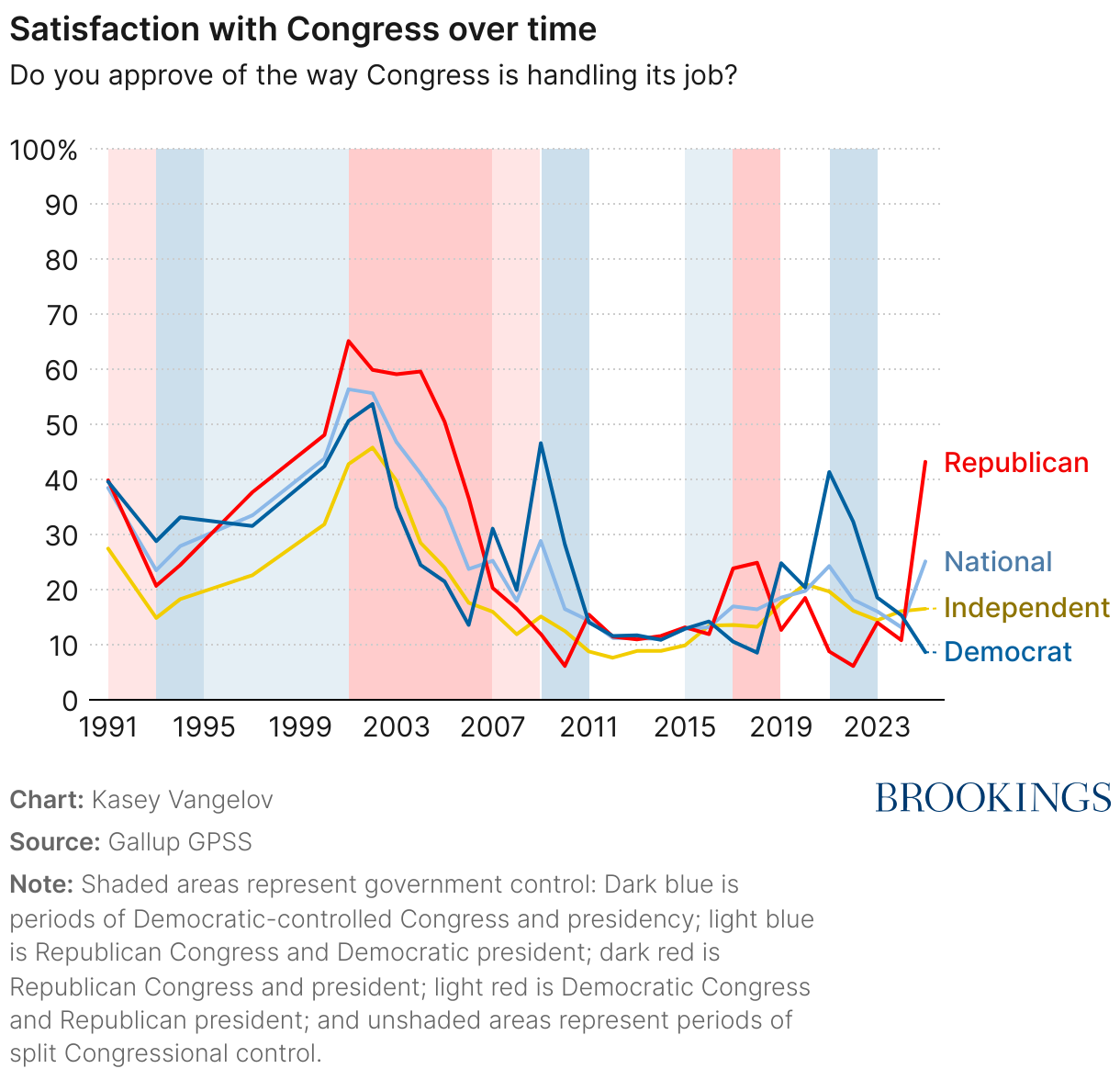
These charts demonstrate that the relationship between partisanship and political attitudes is nothing new. For decades, respondents’ approval of direction of the U.S. and the president have been driven by alignment with the president’s party. Respondents’ congressional approval has proven less sensitive to whether a respondent’s preferred political party holds the majority in the two chambers.
Confidence in institutions
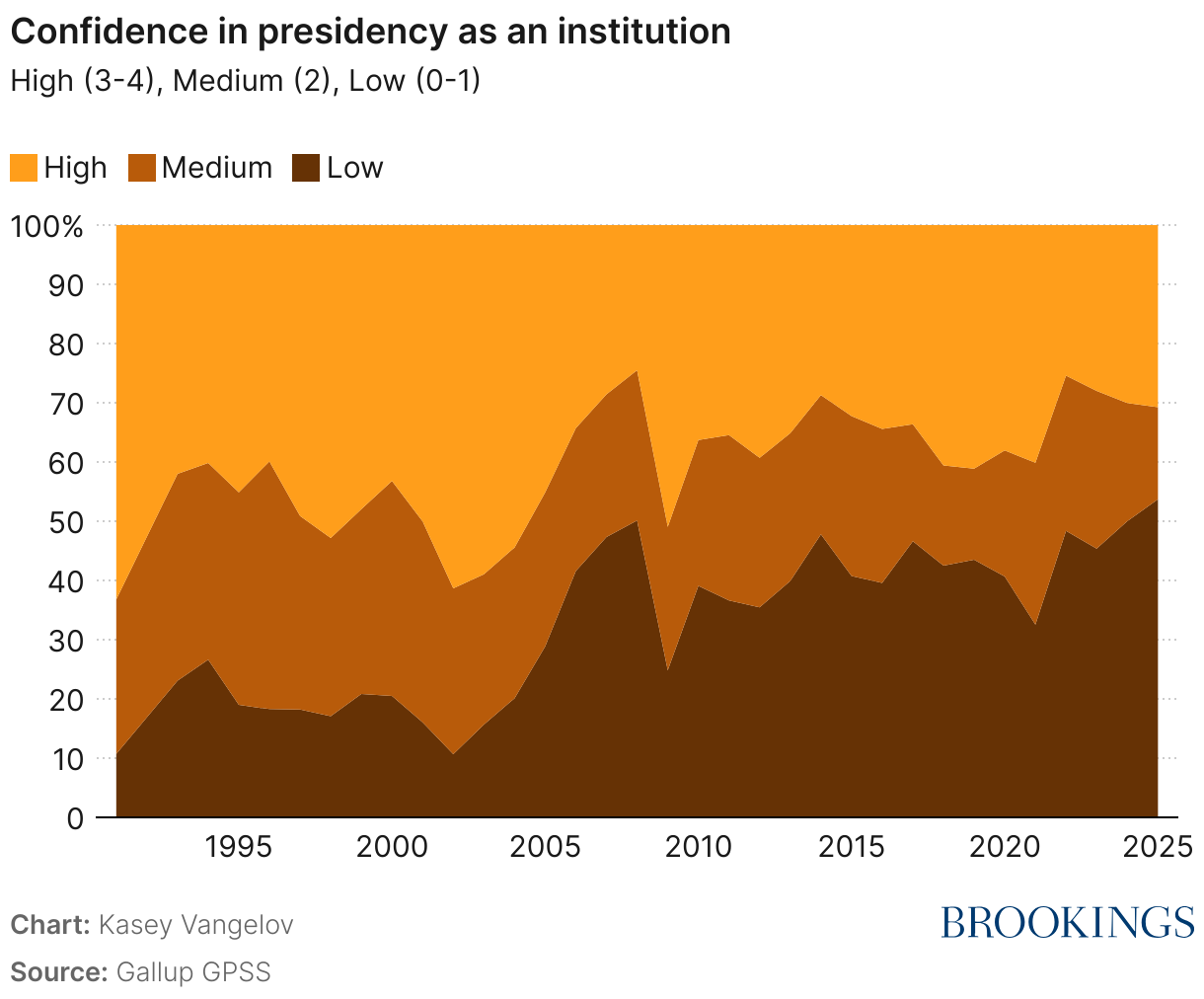
The relationship between party identity and political attitudes has remained relatively steady over time. Yet these data show considerable change in respondents’ overall confidence in key institutions. For the past thirty years the GPSS survey has asked: “Now I am going to read you a list of institutions in American society. Please tell me how much confidence you, yourself, have in each one—a great deal, quite a lot, some, or very little?” We have coded “a great deal” and “quite a lot” as high, “some” as medium, and “very little” as low.
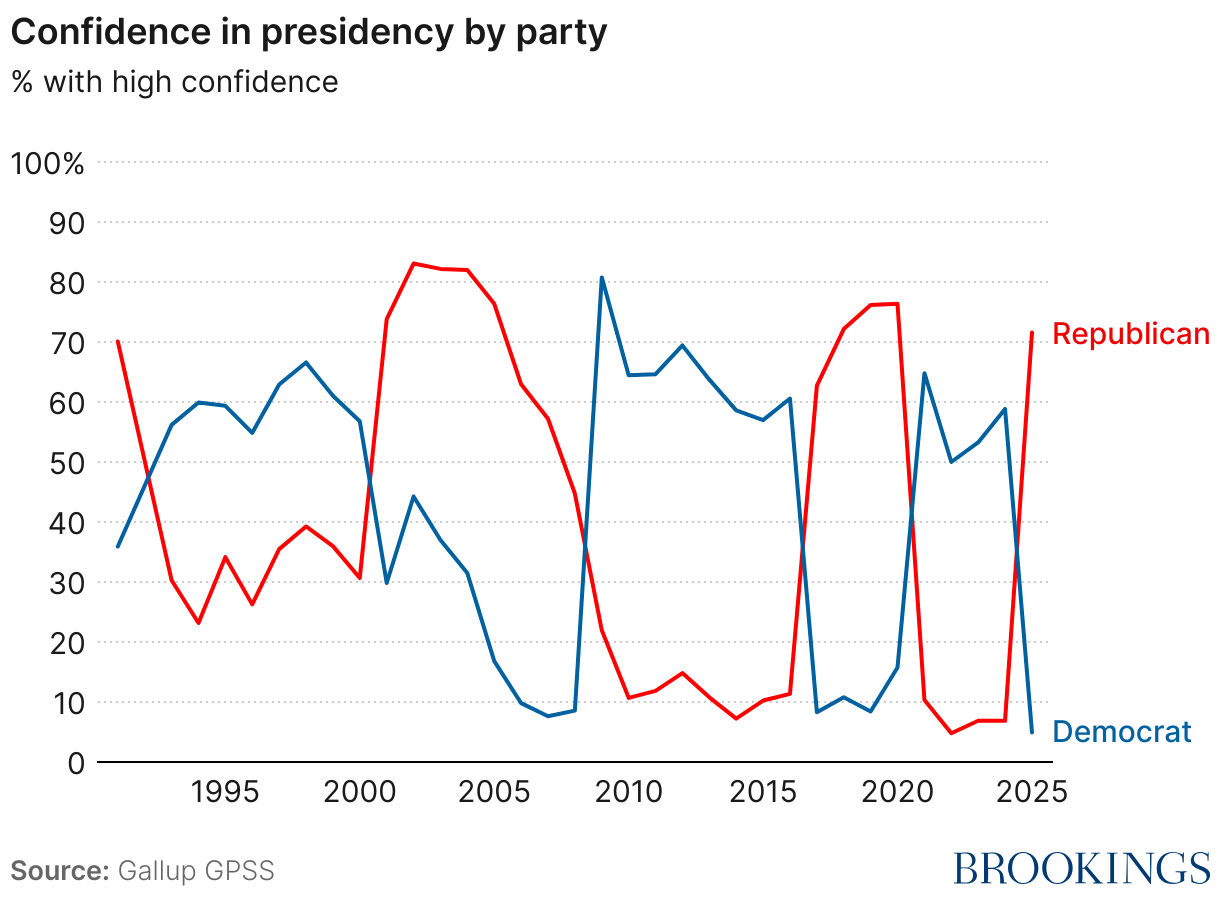
Over the past 30 years, confidence in the office of the presidency has eroded significantly, while partisan differences still track with the party of the president.
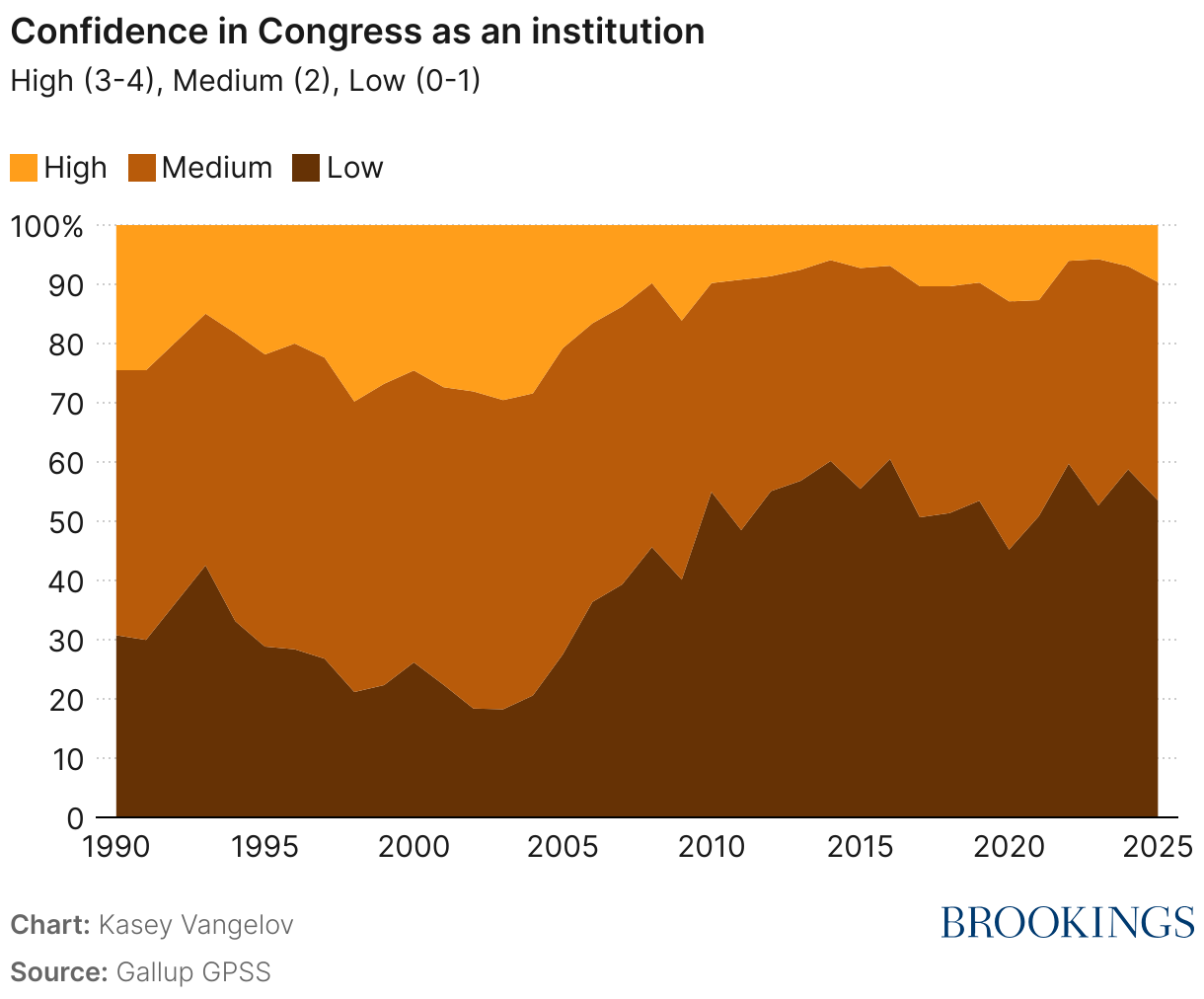
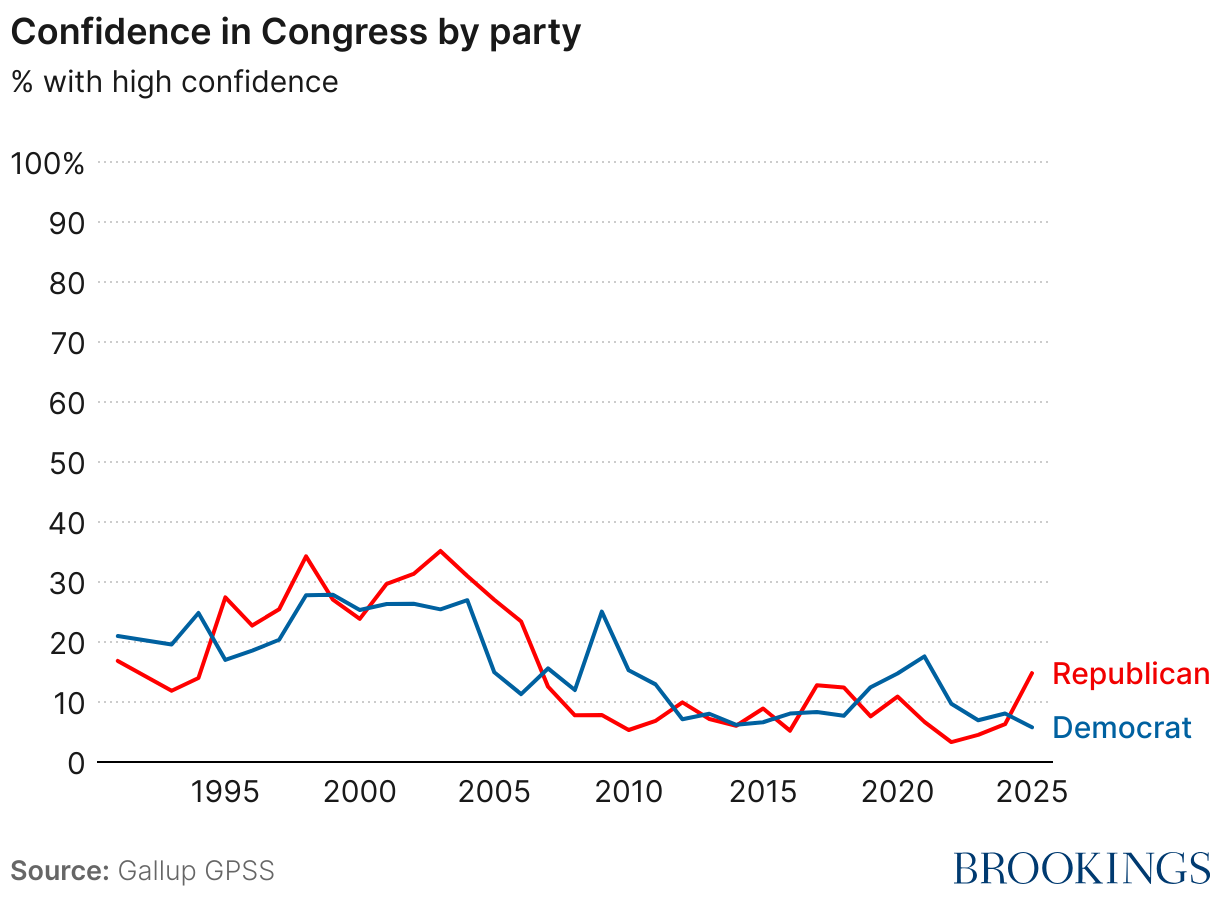
Similarly, confidence in Congress as an institution held relatively steady at the end of the 20th century but then began to deteriorate in the early 2000’s, with only 9.5% of respondents reporting high confidence in 2025, down from over 25% in the early 2000s. The deterioration is visible for respondents who identify with either Democrats or Republicans.
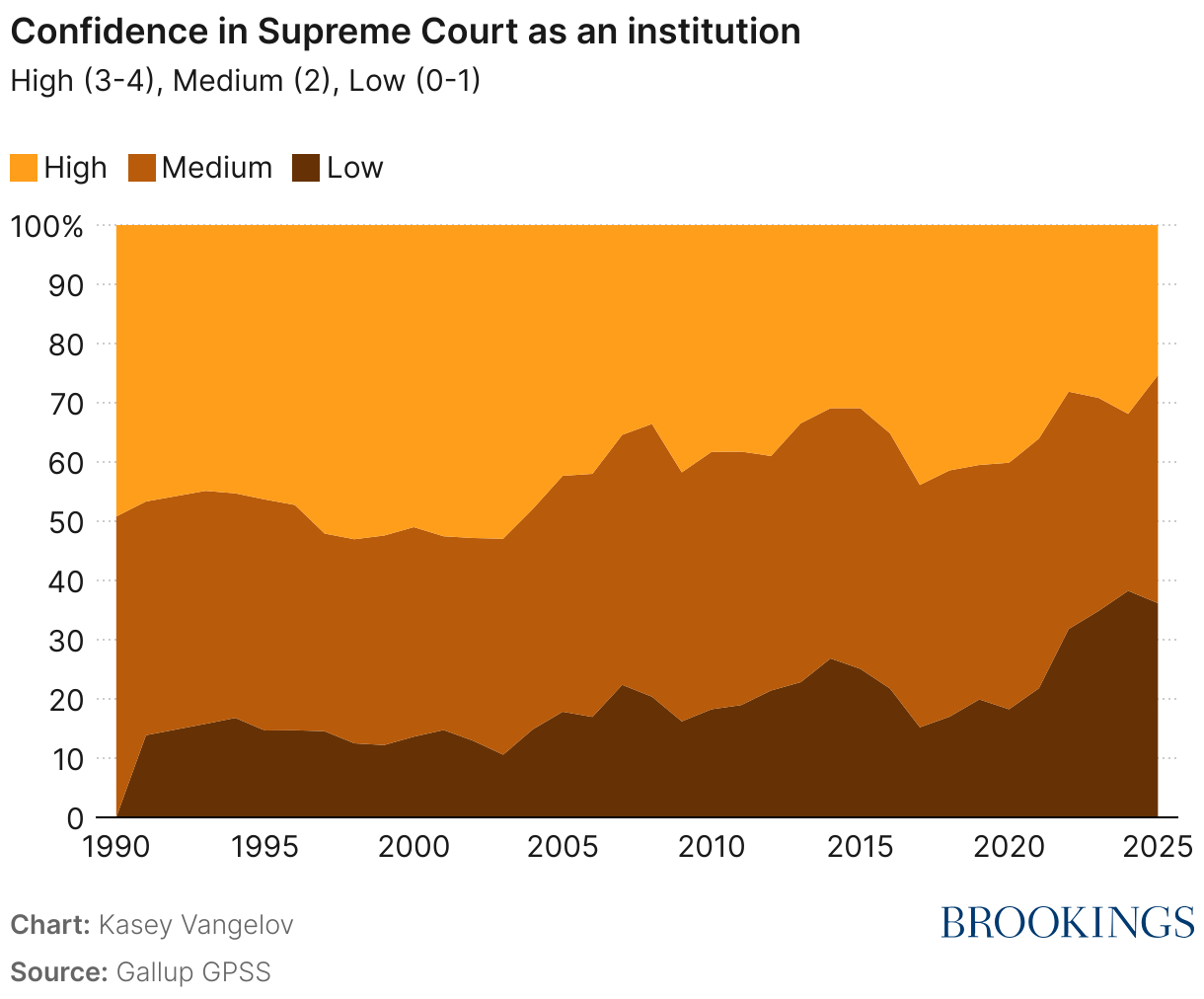
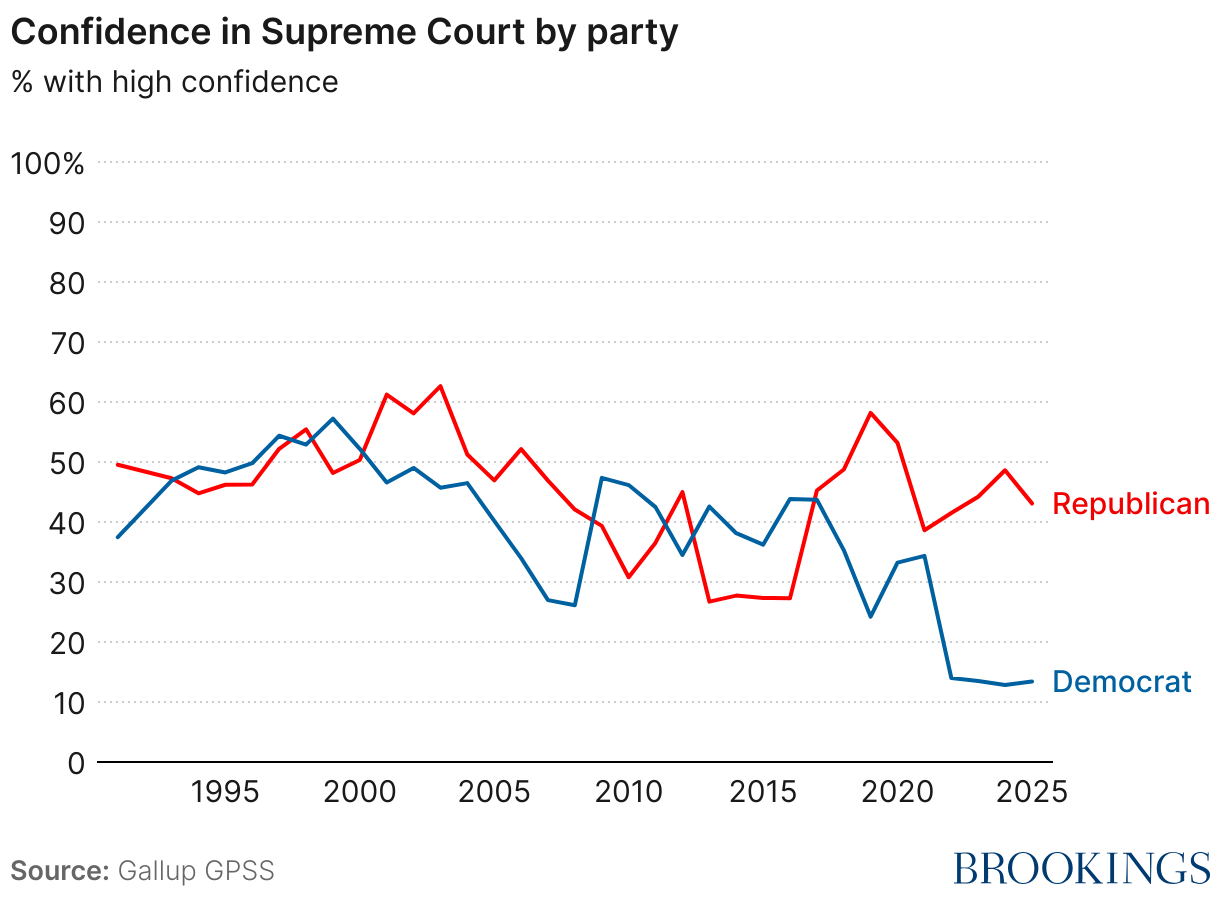
Confidence in the Supreme Court has changed along party lines more than the other institutions. There has been a long-term decline in confidence among Democrats while Republican confidence has been relatively steady. The year 2016 was a turning point for Democratic confidence in the Supreme Court; confidence plummeted and has yet to stabilize. This partisan divide has contributed to a deterioration of overall lack of confidence in the high court.
Confidence in the media
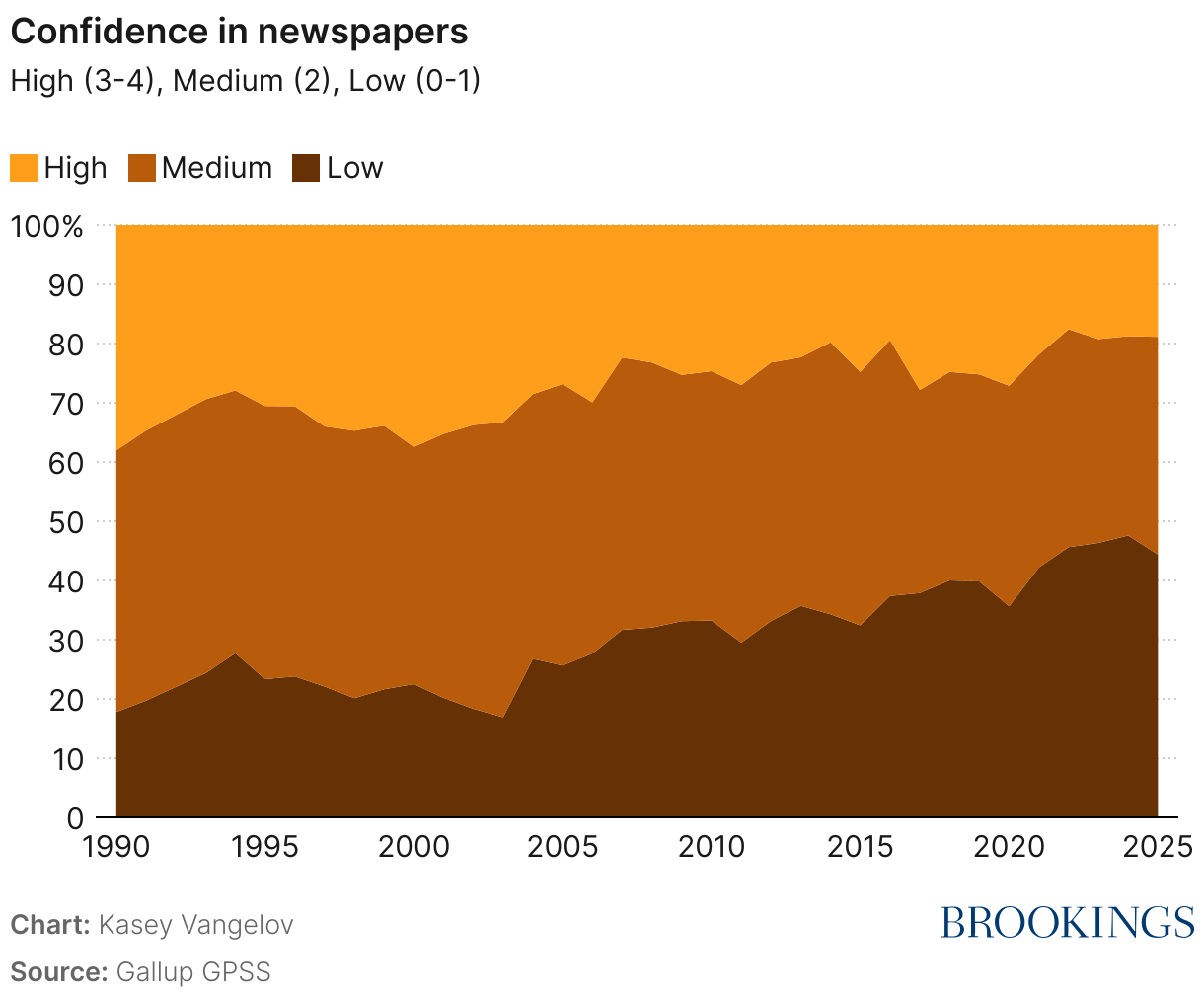
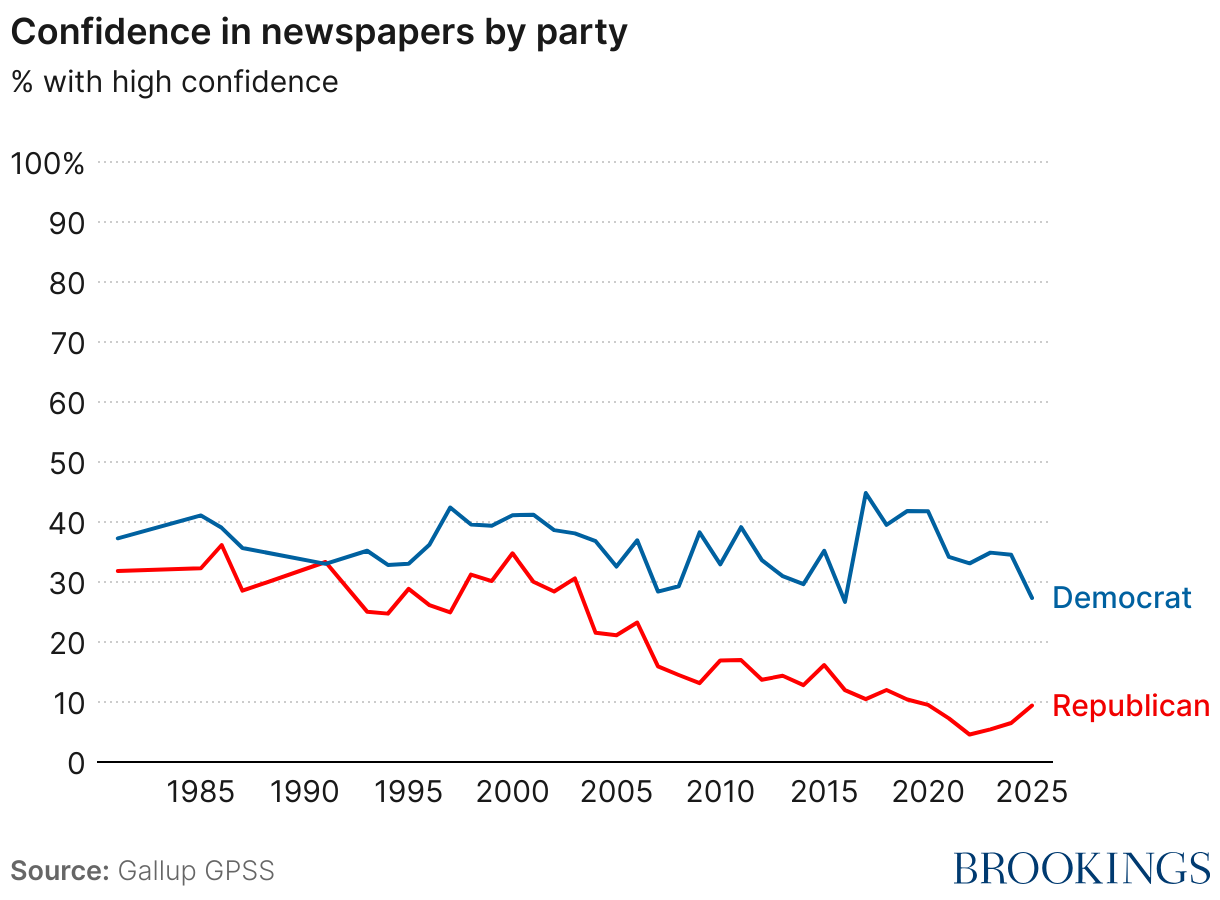
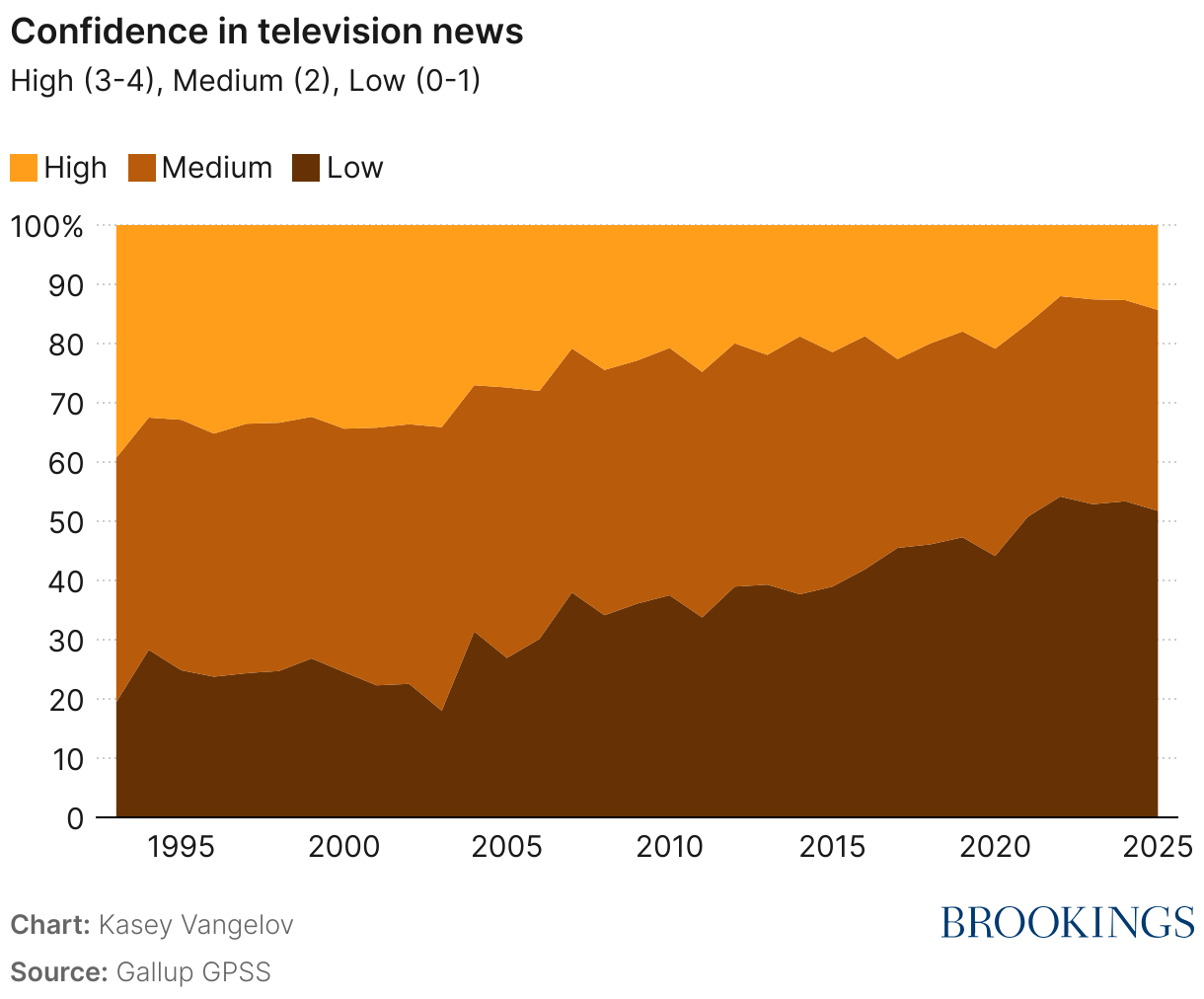
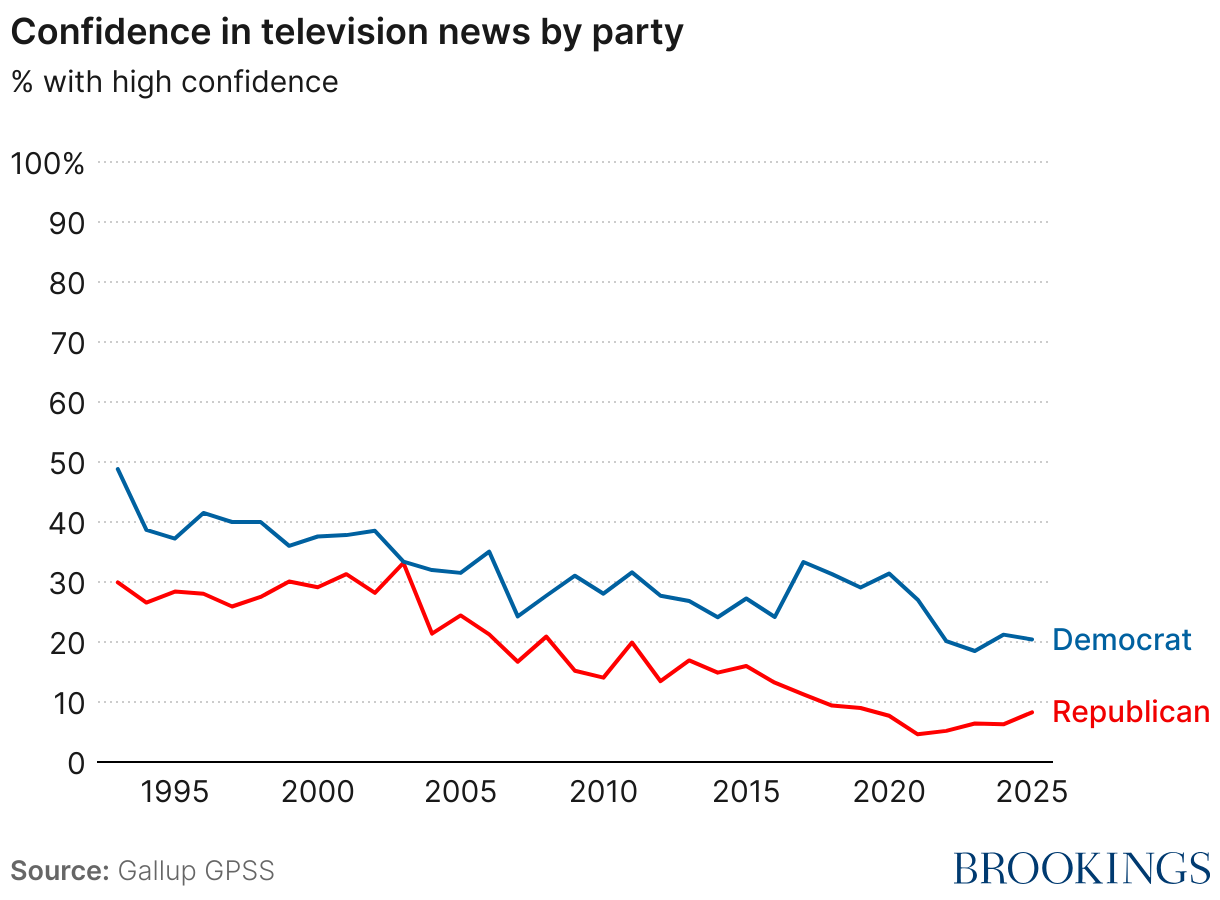
On the national scale, there has been a gradual decline in trust in media, with the decline most pronounced among Republicans. The decline in trust in the media took a big fall among Republicans during Trump’s first term but was already declining prior to that. However, confidence in media remains higher than in political institutions.
Confidence in banks and business
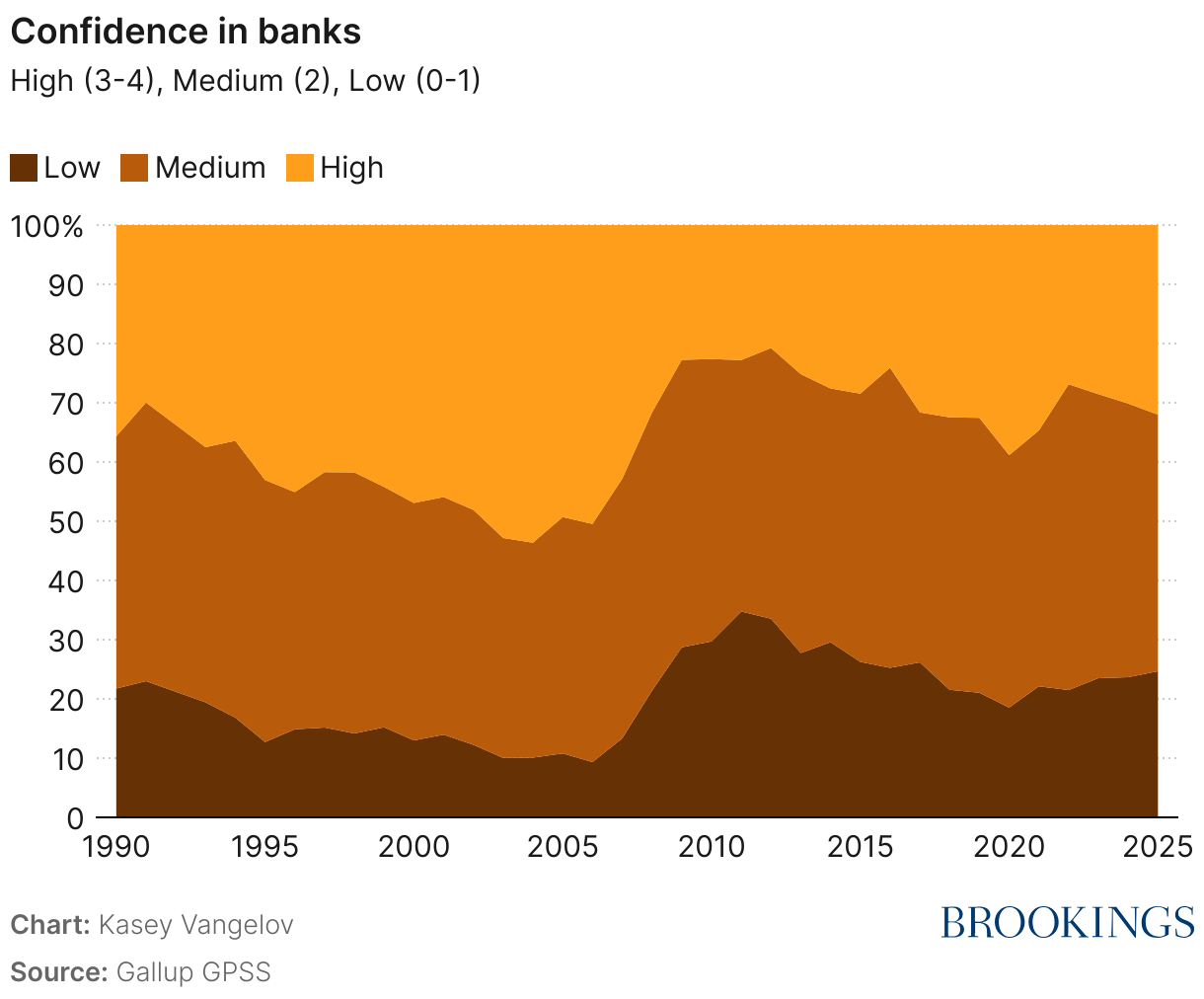
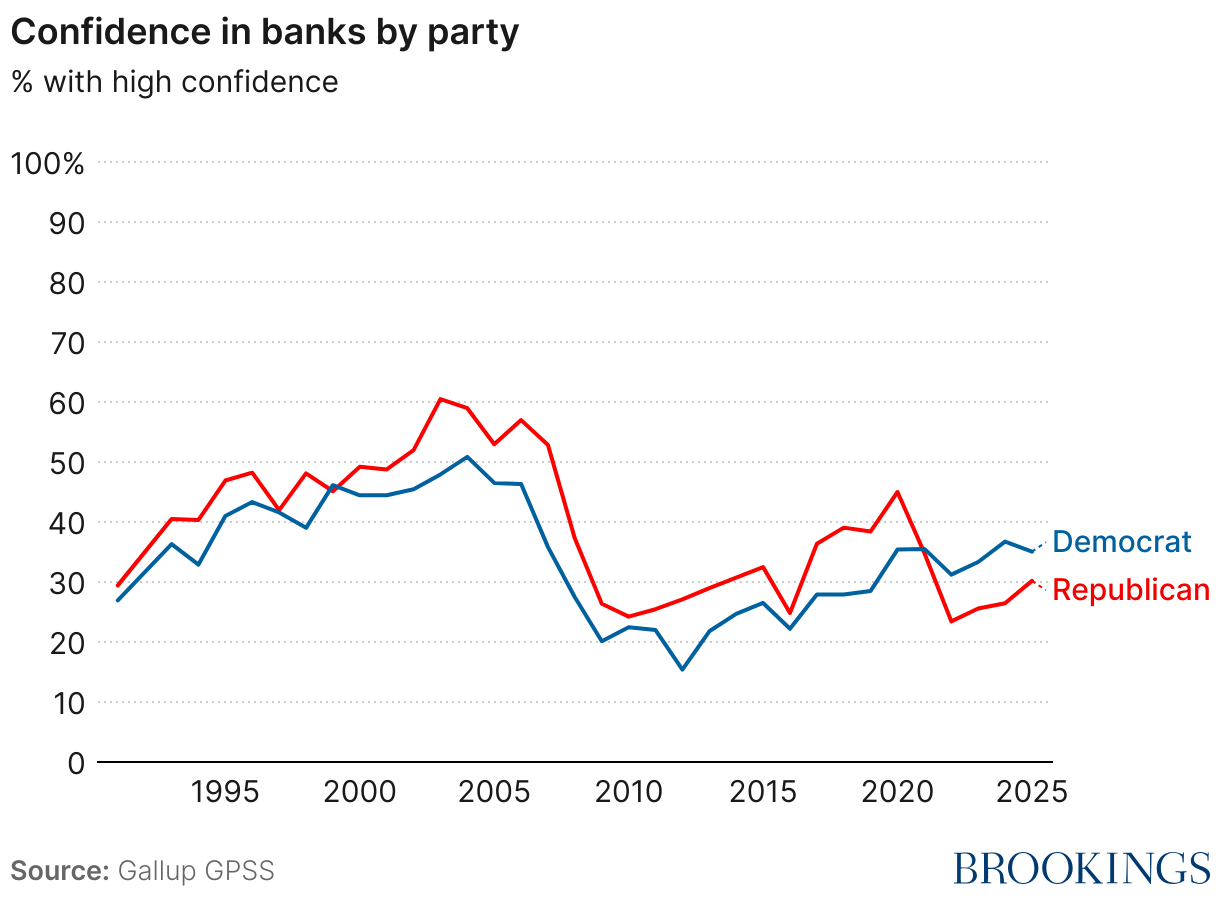
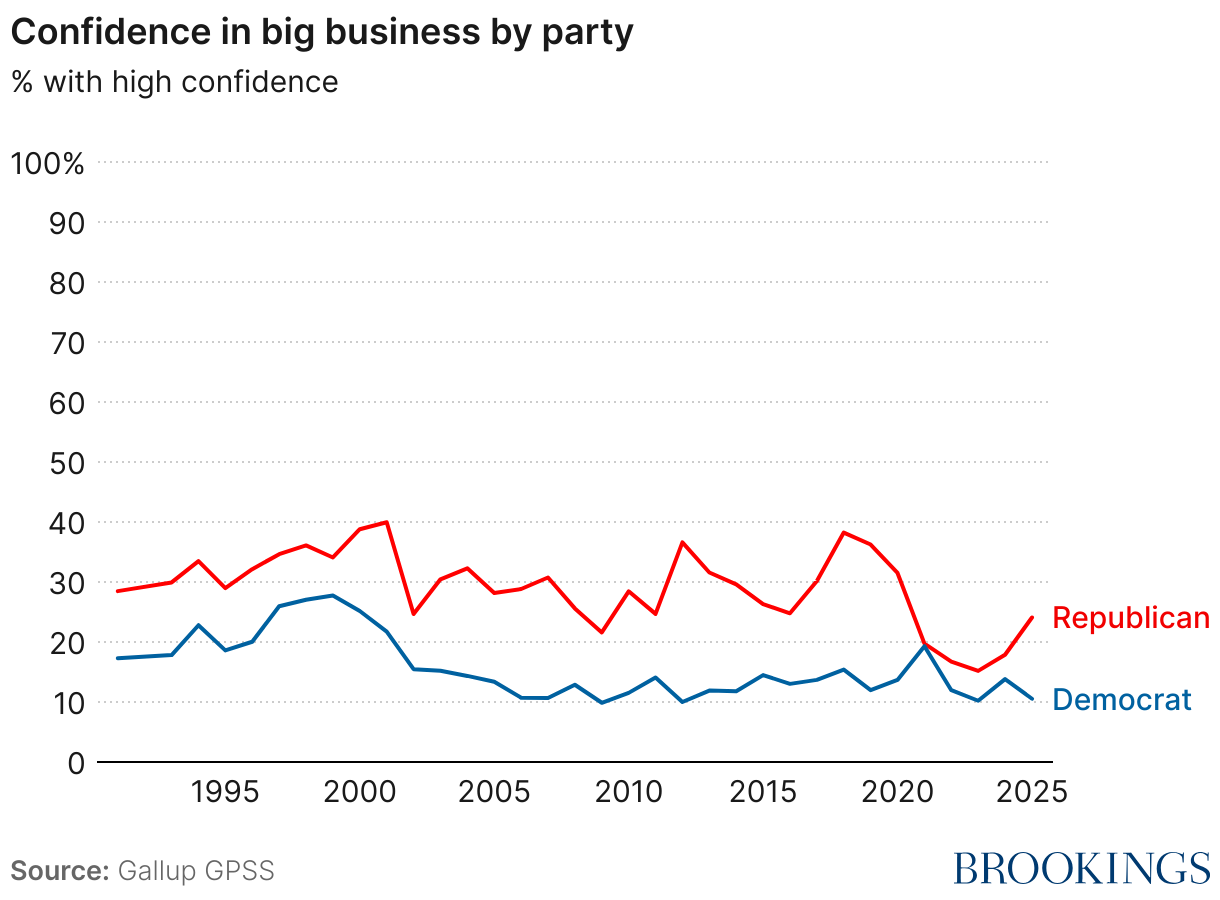
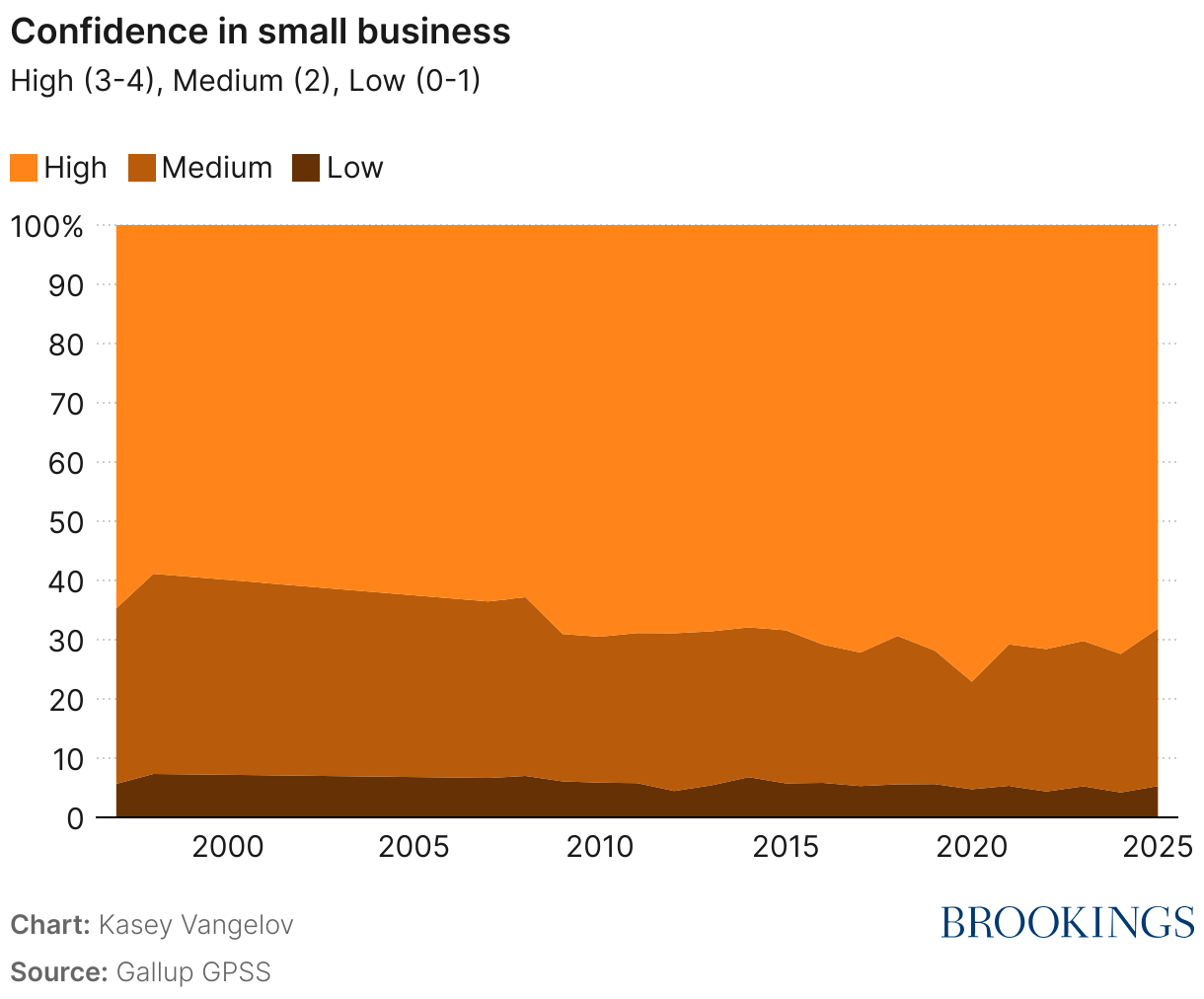
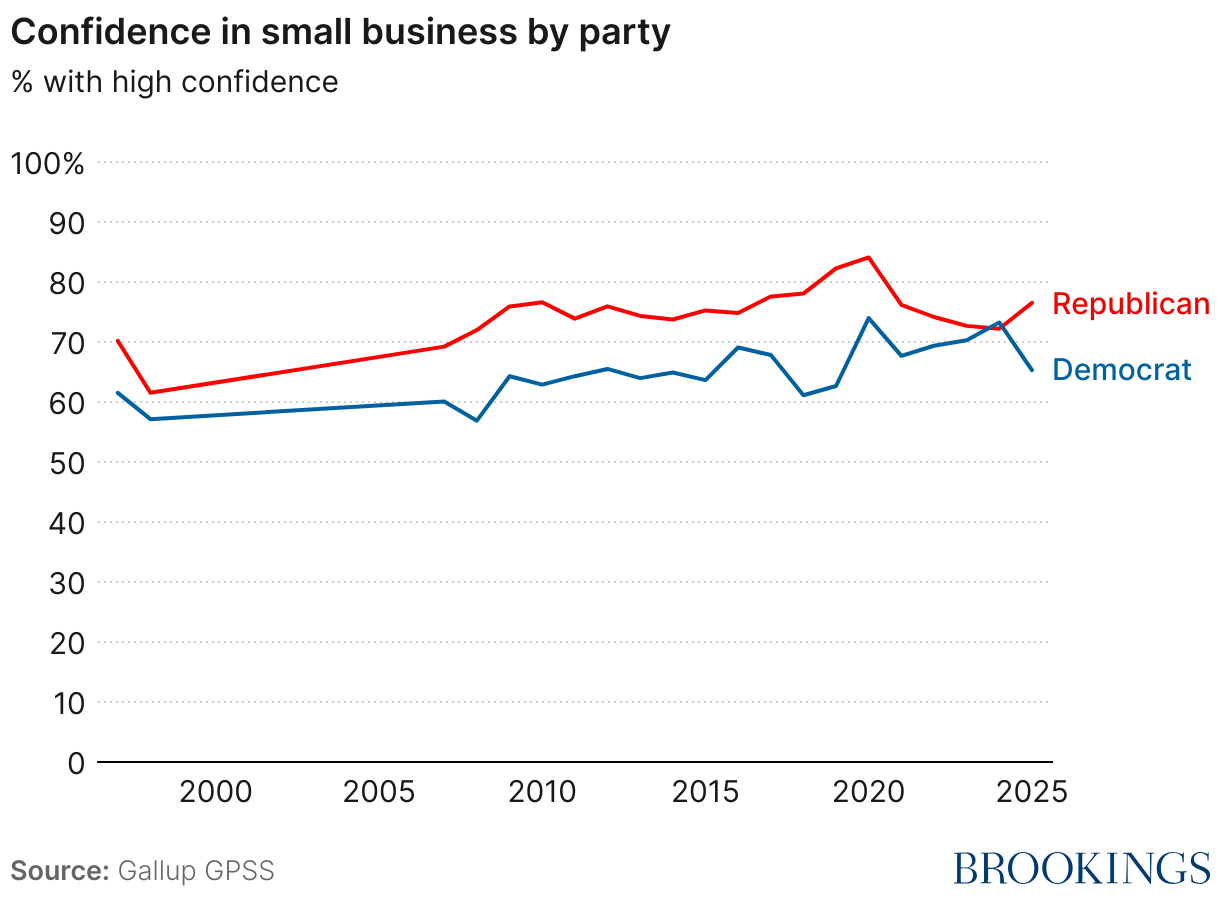
Confidence in banks dropped significantly during the 2009 financial crisis and has yet to return to pre-crisis levels Confidence in business has been mixed, with trends slightly different by partisan affiliation but also depending on whether businesses are big, medium, or small.
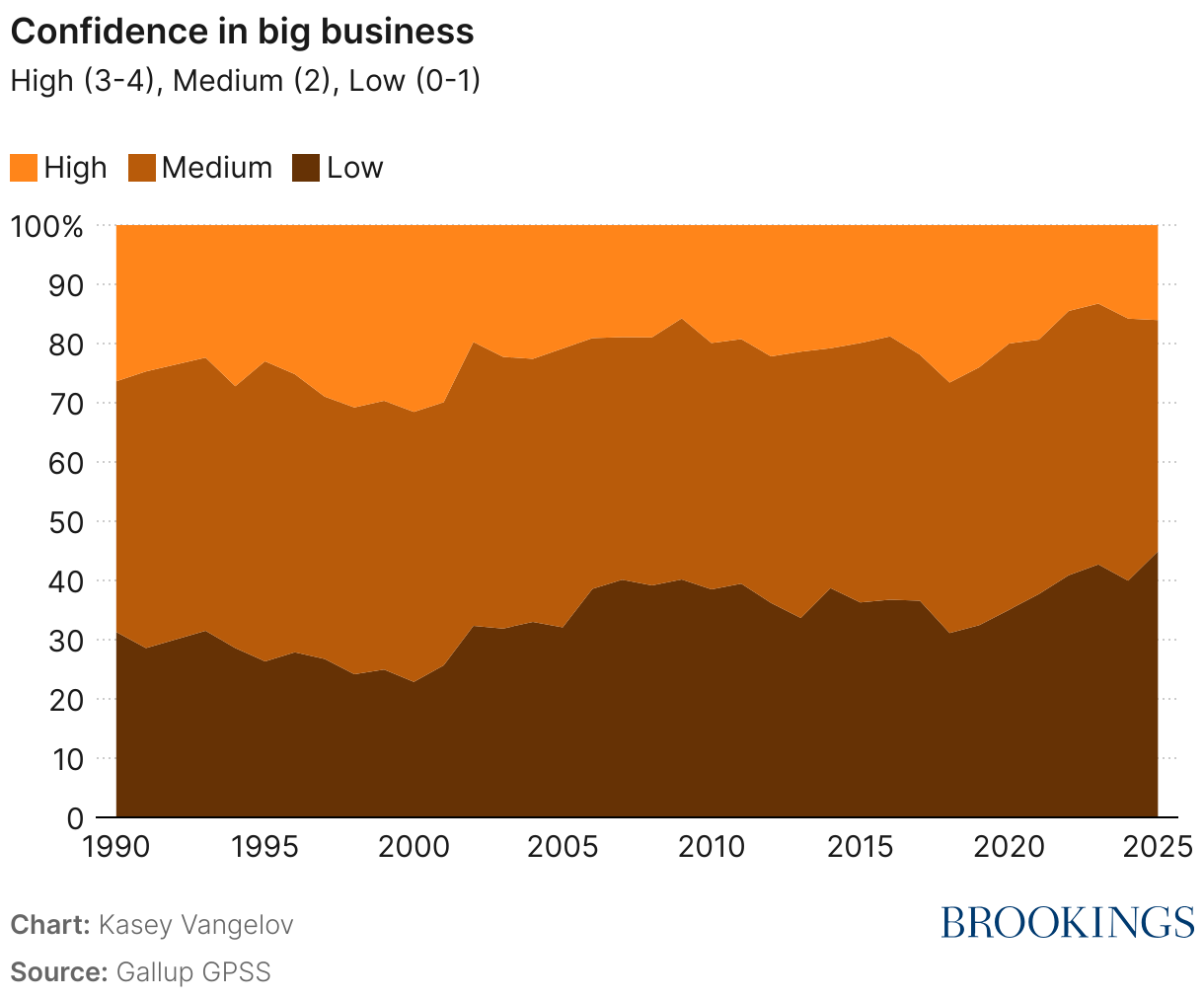
Over the past two decades, confidence in big business has declined slightly, with only 16% of respondents reporting high confidence, down from 25% in 1990. Throughout the survey period, Republicans have consistently said they have more confidence in big business than Democrats.
On the other hand, confidence in small business has remained high and even grown slightly. In 2025, more than 65% of respondents report overall report high confidence.
Since the 2010s, confidence in organized labor has increased among both Democrats and Republicans, even as the percentage of U.S. workers who are union members has declined. Democrats remain more likely than Republicans to report having “a great deal” or “a lot” of confidence in organized labor, although the majority (68%) of Republicans today report having at least “some” confidence in organized labor.
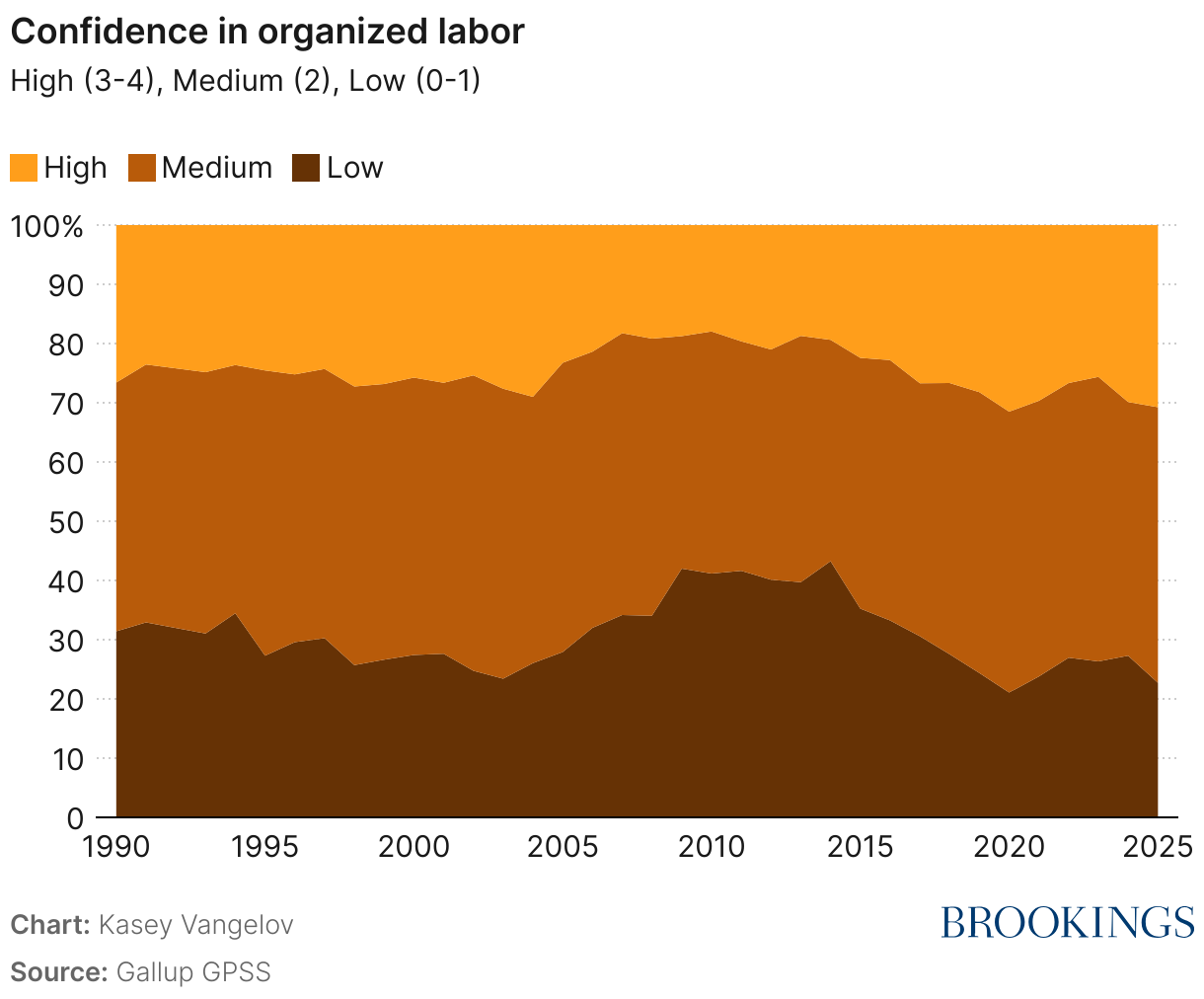
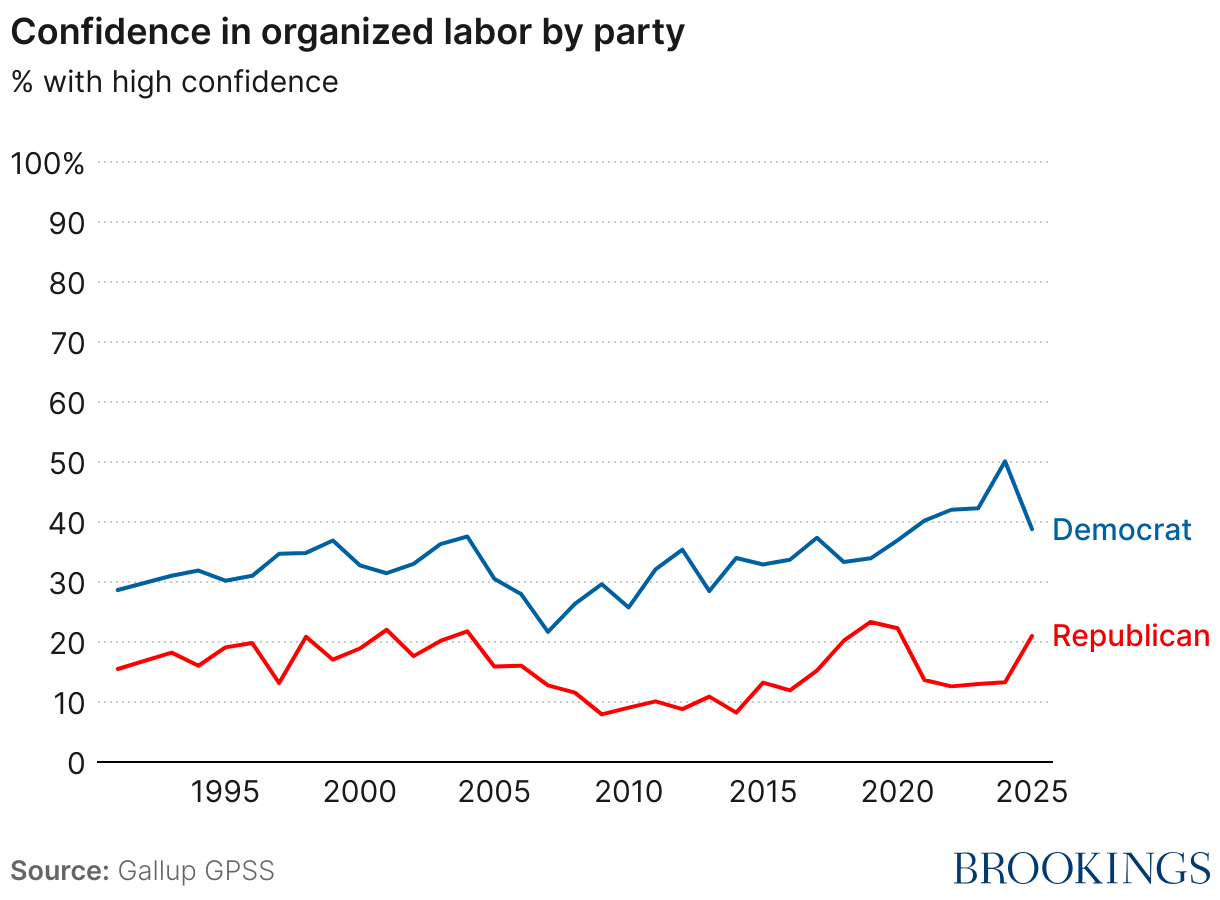
These visualizations suggest that, despite the turbulent policy environment and contentious political rhetoric, our high level of partisanship is not something new. What seems to be extraordinary in this period is the low confidence in political institutions. Confidence in the president, Congress, and the Supreme Court have all eroded over time, perhaps driven in part by the disfunction in governance that is increasingly a result of extreme polarization. Likewise, confidence in the media has declined (although less than in government institutions) and has also become increasingly partisan. However, confidence in organized labor has increased to pre-Great Recession levels across party lines. And confidence in small business remains high among both Democrats and Republicans, much like confidence in state and local government remains high across party-lines (not pictured), suggesting more favorable and united public opinion of local institutions compared to national ones.
Discussion
The decline in confidence in political institutions in general, in part but not only driven by the partisan divide, is the most consistent trend we identify, and its causes are worthy of further investigation. One of those is the partisan divide in information consumption. That in turn leads to an increase in misinformation and the related increases in the proliferation of extreme political views. Another potential cause is the decline of working-class jobs and lifestyles, with increasing numbers of workers without a B.A. having much lower quality and unstable jobs than in the past. This contributes to uncertainties in areas such as access to health insurance and higher education, the costs of which have become unaffordable for most working-class families. Workers in declining manufacturing communities and with related low levels of well-being have provided a strong basis of support for the populist agenda of the MAGA republicans.2
Some of the public opinion trends depicted above (e.g., the decline of confidence in big business or the modest rise of Democrats’ confidence in unions) could be explained by increases in inequality of incomes and opportunities during the same time. One example is the increases in inequality between workers and CEOs, which is much greater in the U.S. than in any other wealthy country. The pay gap between CEOs and workers at the lowest-paying firms on the S&P 500 rose by almost 13% between 2019 and 2024, with CEO pay rising more than twice as quickly as that of the average worker. The average CEO now makes 281 times what the average worker makes per year. At the same time, the power of organized labor has decreased dramatically, in part due to employer opposition to unions and the absence of strong labor laws in the U.S.
More generally, we hope that this data description encourages further research into the causes and consequences of diminishing confidence in political institutions. While partisanship has always been here, the dramatic decline in confidence in institutions is a more recent trend. While some possible causes for that are noted above, it is worth a deeper examination which can, we hope, provide some possible strategies that political and other leaders could use to stem and even eventually reverse the tide. Support for trusted sources of information, such as local newspapers, and making it easier for all citizens to vote as opposed to the current trend towards reducing voting modalities, such as mail-in ballots and constant gerrymandering of districts, would certainly be a good start. However, these measures alone are unlikely to solve the problem. In the wake of the longest government shutdown in U.S. history, it is clear that the stakes of our political division and its effects on effective governance are growing more costly each day.
Authors


-
Acknowledgements and disclosures
The authors thank Amy Goldstien for very helpful comments on the piece and Chris Miller for his excellent edits and graphing formatting.
-
Footnotes
- GPSS is a nationally representative, cross-sectional survey fielded every month by Gallup. Respondents are sampled through random-digit-dialing and data is collected by both landline and cellphone interviews. Each month, a minimum of 1,000 adults respond to questions focused on a specific theme, such as confidence in the political system or in institutions.
- See Pinto et al. (2020) and Monnat and Brown (2018) for more on this dynamic.
The Brookings Institution is committed to quality, independence, and impact.
We are supported by a diverse array of funders. In line with our values and policies, each Brookings publication represents the sole views of its author(s).