
This piece summarizes findings from a working paper by a research team including the authors.
I’ve always been a dreamer and dreams are special things. But dreams are of no value if they’re not equipped with wings. So secure yourself for climbing, make ready for the flight. Don’t let your chance go by, you’ll make it if you try.
Dolly Parton, "Try" (2014)
Dolly Parton’s lyrics “You’ll make it if you try” capture the essence of the American Dream. The conviction that hard work guarantees upward mobility has long defined American identity and helps explain why Americans typically support redistribution less than Europeans.
Yet today, the promise of the American Dream may be fraying. Younger generations have fewer opportunities to get ahead than their parents did. Disillusionment has set in, and belief in the American Dream is plummeting not only among immigrants but also native-born Americans, especially the young.
The American exception
While the rising economic prosperity of China and India has reduced global inequality, income and wealth inequality have risen sharply within many wealthy nations. In the United States, the top 10% of the population’s share of total income grew from about 35% in 1980 to nearly 50% today. Meanwhile, the bottom 50% watched their share drop from 20% to less than 15%. Looking ahead, the rise of AI threatens to widen these income gaps even further. Given these trends, over 80% of individuals in the Organization for Economic Co-operation and Development (OECD), a group of mostly rich countries, agree that income disparities are currently too large.
Our own data analysis of surveys from 22 countries shows that views on government redistribution differ across the globe. Generally, people in low- and middle-income countries demand more redistribution than those in high-income countries, where redistribution is already higher. Yet among wealthy nations, the U.S. stands out for significantly lower support for government redistribution than peers like Japan, the United Kingdom, and Germany (Figure 1). In 2022–2023, just over 50% of Americans supported redistribution, and more than 30% explicitly opposed the idea that the government should reduce income differences. In other rich countries, opposition rarely exceeds 20% and often falls below 10%, while active support frequently reaches up to 80%.
Factors like national economic conditions, cultural norms, and institutional settings help explain these differences. Individual circumstances and attitudes also matter: income, education, employment status, political ideology, and beliefs about social fairness and opportunities to move ahead (i.e., the American Dream) strongly shape redistributive preferences.
In a recent working paper, we study a completely new factor: childhood circumstances. We ask: Do people who experience adversities in childhood have lower or higher preferences for redistribution in adulthood?

Can childhood trauma shape adult views?
The World Health Organization estimates that up to 1 billion children between the ages of 2 and 17 experienced physical, sexual, or emotional violence or neglect in 2025. Beyond the immediate trauma, these early adversities cast a long shadow over a person’s entire life. In the short term, they can severely impair cognitive development and trigger depression. Over the long term, these experiences make survivors significantly more likely to drop out of school, struggle with unemployment, and face chronic health issues.
But how are these adverse childhood circumstances related to preferences for redistribution? On one hand, several factors suggest early-life hardship should increase support for redistribution. First, adversity often leads to less economic security later in life. Because people facing economic insecurity can directly benefit from public support, their material self-interest may naturally push them to demand stronger government safety nets. Second, early misfortune can make people realize that luck and external circumstances often play a bigger role in success than pure effort. Simply put, if people believe the system does not fairly reward hard work, they may be more likely to support redistribution. Third, childhood disadvantage can lower a person’s expectations for future upward mobility. If people do not expect to climb the income ladder, they are more likely to view redistribution as necessary. Finally, a difficult upbringing can also foster strong community solidarity, which further increases support for redistribution.
On the other hand, childhood trauma can severely damage a person’s trust in both society and institutions. If people do not trust the government to distribute resources fairly, their support for state intervention plummets. Furthermore, early hardship can sometimes make people more competitive over scarce resources rather than cooperative.
To empirically test this, we rely on a tried-and-true measure of adverse childhood experiences (ACEs) that sums self-reported exposure to seven difficulties experienced while growing up. We use data from the first wave (2022–2024) of the Global Flourishing Study (GFS), a large-scale, multi-country longitudinal survey focusing on well-being. It covers 22 countries worldwide, including the U.S., and provides a sample representing over 60% of the global adult population. The GFS includes questions on abuse, feeling like an outsider, strained relationships with mother and father, parental separation, health issues, and household financial insecurity in childhood. The resulting index scores individuals based on how many of these adversities they faced while growing up. The primary advantage of our dataset is its standardized design, which enables direct cross-country comparisons. However, cultural norms around reporting such experiences, translation nuances, and the varying relevance of specific adversities across contexts could drive some of these cross-country differences.
A second American exception
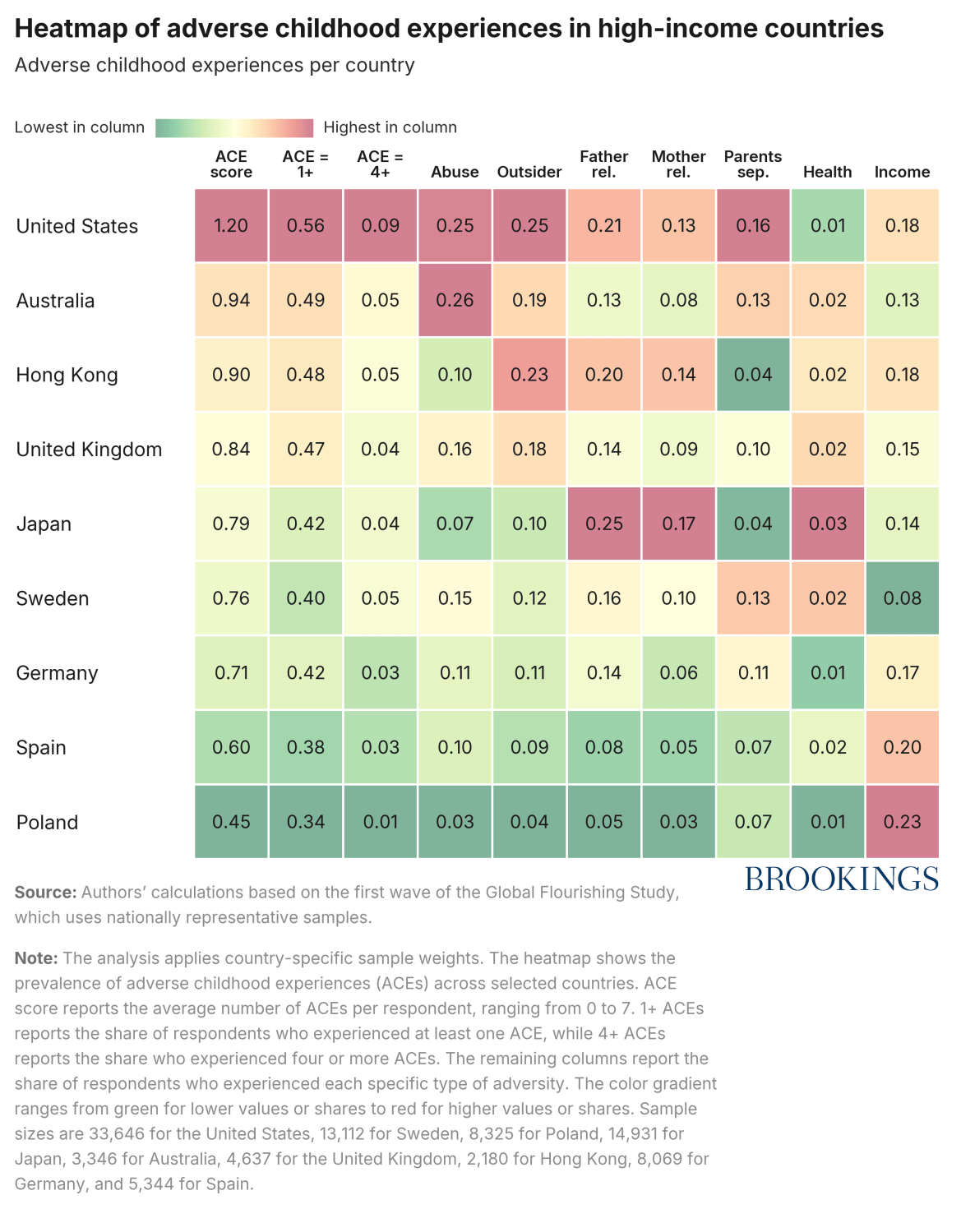
The U.S. emerges as an outlier once again, displaying higher childhood adversity scores than other high-income countries (Figure 2). The average American reports experiencing just over one childhood adversity, whereas averages in peer nations all remain below one. More than half of U.S. respondents report at least one adverse childhood experience (Figure 3). Strikingly, almost 10% of Americans reported experiencing four or more adversities, nearly double the rate in the next-highest countries (Australia, Sweden, and Hong Kong). Across nearly every dimension of hardship, the U.S. reports the highest or near-highest rates of childhood adversity among wealthy nations. The only exception is self-reported childhood health issues, where American rates remain comparable to peer countries. Our country-level estimates align with previous findings.

Early-life adversity is associated with more support for redistribution in rich countries
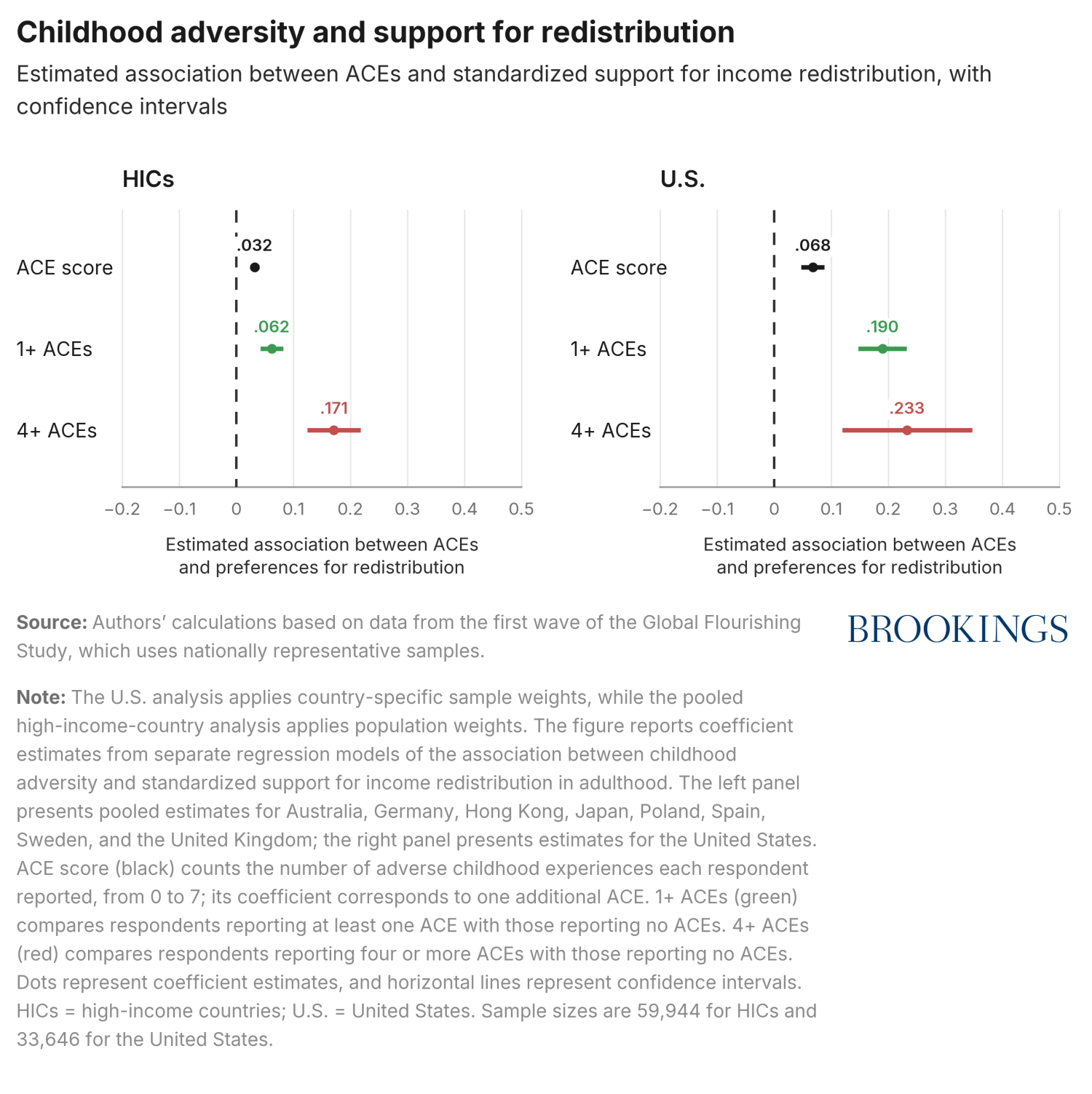
While a simple look at these national averages might suggest that high rates of childhood hardship and low overall demand for redistribution go hand in hand, our individual-level analysis reveals the exact opposite (Figure 4). Exposure to early-life adversity is associated with stronger support for income redistribution in adulthood, and this association is stronger in the United States than in other high-income countries. Experiencing one additional childhood adversity correlates with a 0.07 standard deviation increase in support for redistribution.
Clearly, going from zero adversities to one is very different from going from six to seven. To account for this, we also compared anyone who faced one or more childhood adversities against those who faced none. We found that people who experienced at least one hardship show 0.19 standard deviations higher support for redistribution. This gap grows even larger for individuals who endured four or more adversities (0.23 standard deviations).
When we group other wealthy nations and compare them to the U.S. results, the association remains positive but shrinks in magnitude. In these other high-income countries, people exposed to at least one adversity show only a 0.06 standard deviation higher preference for redistribution.
The pattern looks completely different in low- and middle-income countries (not shown), where our pooled estimates show no statistically significant association between childhood trauma and adult support for redistribution, with the relationship even turning negative in a few countries.
The American paradox
But why do these findings matter? Public preferences for redistribution shape policies that tackle inequality, and our research shows that childhood experiences are ultimately associated with those adult preferences. In five out of nine high-income countries, this pattern raises the possibility of a potential self-correcting mechanism. Exposure to hardship seems to generate broader public support for state intervention. If this support encourages governments to expand welfare, education, and health programs, those policies could reduce childhood adversity in the next generation.
In low- and middle-income countries, which typically struggle with higher baseline inequality, this mechanism does not seem to work. Because individuals exposed to trauma do not express higher preferences for government redistribution, potentially relying on informal family networks instead, politicians may not receive a clear electoral signal to strengthen formal safety nets.
The United States is a category of its own. U.S. respondents report the highest incidence of childhood adversity among the wealthy nations polled in the GFS. Yet, U.S. respondents also have the lowest overall demand for redistribution in our sample. Ultimately, even as faith in the promise of the American Dream may be dwindling, the push for stronger government action to reduce income differences for those who experienced early-life hardship seems insufficient to overcome the country’s deep-rooted resistance to redistribution.
Dolly Parton’s lyrics have a crucial line: “dreams are of no value if they’re not equipped with wings.” For any child, a stable, secure upbringing is crucial to strengthen those wings. Government investment in disadvantaged children and stronger social safety nets could help alleviate the long-term impacts of early adversity. This raises a difficult question: How can a country historically skeptical of state intervention build public support for greater investment in disadvantaged children?
The answer may lie in clearly communicating the scope of programs designed to support disadvantaged households, especially children. Rather than framing redistribution solely as a way to reduce income gaps, reforms might build broader consensus if presented as social insurance against life’s hardships. To put this into practice, policymakers could explicitly link tax-and-transfer schemes to preventing childhood adversity, or prioritize direct support that protects vulnerable households and ensures the next generation is truly equipped to escape poverty.
Authors


The Brookings Institution is committed to quality, independence, and impact.
We are supported by a diverse array of funders. In line with our values and policies, each Brookings publication represents the sole views of its author(s).