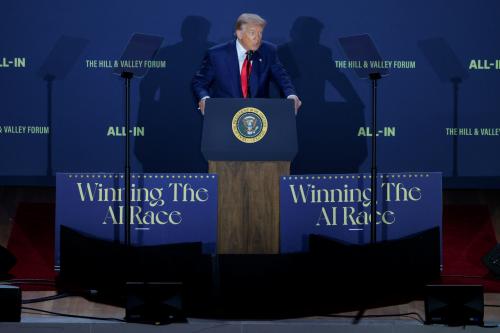
The United States is obsessed with the “race to AGI” or artificial general intelligence. American tech companies are pouring hundreds of billions of dollars into new data centers in the hopes of creating AI systems that can match or exceed human-level performance across most cognitive tasks. America’s “Big Four” hyperscalers—Alphabet, Amazon, Meta, and Microsoft—have collectively announced AI spending totaling $650 billion this year, with overall U.S. spending on AI compute infrastructure projected to surpass $2.8 trillion by 2029.
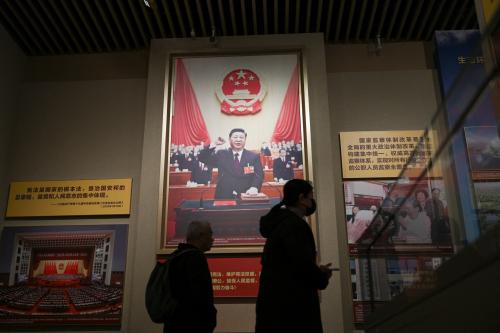
China’s AI companies are playing a different game. While they are also rushing to build world-class foundation models, the notion of “AGI” as some abstract turning point in human history is less discussed, with some exceptions, such as DeepSeek’s founder Liang Wenfeng and Alibaba’s CEO Eddie Wu. Instead, Chinese AI developers are racing along other axes of progress: efficiency, adoption, and physical integration, driven by both industry constraints and Beijing’s policy focus. Taken together, China’s approach is a fundamentally different bet on how AI will shape the future.
Efficiency
Take efficiency. While U.S. tech firms have been building out massive compute clusters with hundreds of thousands of chips, Chinese AI labs have been hyperfocused on squeezing greater performance out of limited compute and memory resources. Innovations in algorithmic architecture, such as mixture-of-experts models and efficient attention mechanisms, have allowed Chinese firms such as MiniMax and Moonshot to produce world-class AI models while drastically cutting down compute costs. DeepSeek’s V3.2 model, for example, uses a novel sparse attention mechanism to nearly match the performance of OpenAI’s GPT-5 and Google’s Gemini 3 on complex reasoning and agentic tasks, despite likely having access to far less compute.
Chinese firms have also been boosting model efficiency through quantization, an engineering approach that involves using less precise but more efficient formats like 8-bit (INT8) or even 4-bit integers (INT4). Alibaba is pioneering these techniques with its Qwen models, which can halve GPU memory usage without sacrificing performance. Moonshot AI has developed a way to apply quantization to the model training process itself to create a fast frontier-level reasoning model that runs natively in the more efficient INT4 format. Quantization not only reduces costs and increases efficiency but also enables deployment outside large-scale data centers, possibly even on personal devices.
However, some of the performance of China’s AI models may be due to “distillation” using American AI models, where outputs from advanced frontier models help train another model. Anthropic has reported large-scale “distillation attacks” by three Chinese AI labs, including DeepSeek. OpenAI and Google DeepMind have also reported distillation attacks. This might explain how Chinese AI labs can nearly match American frontier labs’ performance with less compute. Yet this is likely only a partial factor, as distillation has limitations, and Chinese AI labs publish technical reports detailing genuine innovations recognized by American AI leaders.
Adoption
Chinese AI firms are also making progress in global adoption, particularly through an open-source approach. Most of China’s leading AI models are open-source, allowing them to be freely downloaded, customized, and deployed across various platforms. In contrast, most of the top AI models in the United States are proprietary and closed-source, requiring paid subscriptions or token-based access. China’s open-source approach to AI aims to drive adoption by giving the models away for free, fostering a broader software ecosystem, and then providing paid services around model integration and support.
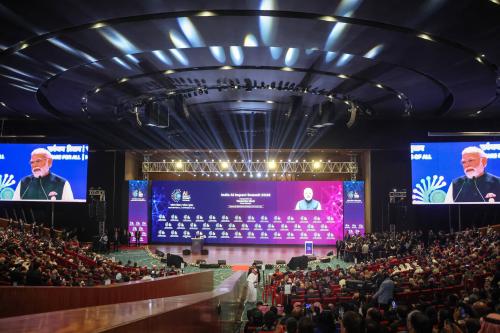
The success of China’s open-source approach is evident. Chinese AI models have overtaken U.S. models in cumulative downloads on platforms like Hugging Face. And derivative model uploads to Hugging Face built from Chinese foundation models exceeded those derived from U.S. models earlier this year. Meta’s Llama models, once the industry standard for open-source foundation models, have been eclipsed in popularity by Alibaba’s Qwen series. Additionally, Chinese cloud service providers like Huawei, Alibaba, and Tencent are actively expanding their AI service offerings globally, particularly in emerging markets.
Developers worldwide are attracted to Chinese open-source models because they provide performance comparable to top-tier, closed-source AI models at little to no cost. AI developers from Japan to Africa are building on foundation models from Alibaba and DeepSeek. Even in Silicon Valley, Chinese open-source models are gaining traction. Airbnb’s CEO Brian Chesky made headlines by revealing that his company’s customer service agent relies heavily on Alibaba’s Qwen model, which he described as “very good” and “fast and cheap.” A growing number of Silicon Valley startups now prefer to build on Chinese AI models.
Physical integration
Another area where China’s AI industry is racing forward is the integration of AI into the physical world. Examples abound in consumer products. Chinese electric car makers such as Nio, XPeng, and BYD have integrated voice-powered AI assistants and smart driving capabilities into their vehicles. Multiple Chinese companies have launched AI-powered wearable devices, such as smart glasses, including Alibaba, Xiaomi, and Huawei.
In particular, China is moving faster on truly agentic AI smartphones. These devices can operate apps like a human user to order food delivery, book concert tickets, and make travel arrangements. ByteDance recently launched an agentic smartphone with ZTE featuring a voice-activated Doubao AI assistant capable of operating apps autonomously. Huawei is taking a different approach by creating an agent-to-agent framework with app developers to offer agentic capabilities for its smartphones. Alibaba is integrating agentic AI capabilities across its sprawling ecosystem of consumer services, centered around its Qwen app.
While China’s agentic smartphones have already encountered issues with access to major apps like WeChat, they demonstrate how Chinese tech firms are already implementing AI agents in consumer devices for real-world applications.
Moreover, China is making significant strides in “embodied AI,” which includes robotics, self-driving cars, and other autonomous hardware systems. Robotaxi services from WeRide, Baidu’s Apollo Go, and Pony.ai are quickly expanding across global cities. Autonomous delivery vehicles and drones are becoming commonplace in Chinese cities like Shenzhen and Shanghai. Additionally, robotics firms like Unitree, UBTech, and AgiBot are racing to mass-produce humanoid robots by the thousands. China has a sizable advantage in these physical AI applications due to its overlapping hardware ecosystems and ability to manufacture cheaply at scale.
American companies are also pursuing AI integration into the physical world, but these efforts are often limited to a few players. Waymo and Tesla are widely regarded as global leaders in autonomous driving, but Chinese automakers are advancing faster than their Detroit counterparts. On agentic AI smartphones, Apple has yet to release truly agentic features for the iPhone, and Google has only recently unveiled agentic features for its Android operating system. Meanwhile, multiple Chinese tech companies—ByteDance, Huawei, Alibaba, and Xiaomi—have rolled out agentic capabilities.
Key drivers of China’s AI approach
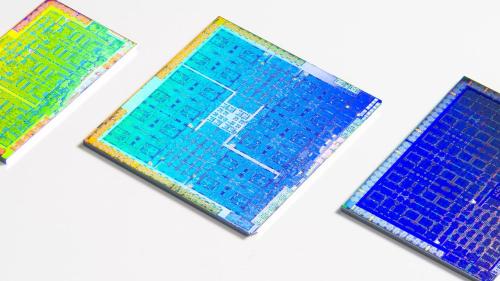
China’s alternative approach to AI is partly driven by necessity. U.S. export controls on Nvidia’s advanced AI chips and fewer financial resources make it nearly impossible for Chinese tech companies to directly compete with their American counterparts on sheer compute. Even after the United States relaxed export controls on Nvidia H200 chip sales to China, Beijing imposed import limitations to prioritize its domestic chip industry. As a result, Chinese AI developers will likely continue to lag their American counterparts on compute for the foreseeable future, barring significant changes in export controls or China’s own chip industry. Developing more efficient models is one way for Chinese AI companies to bridge this compute gap.
China’s approach to AI is also driven by policy. Chinese policymakers are deploying active state support to accelerate China’s AI development and steer its AI industry toward adoption and physical integration. China’s “AI Plus” initiative supports AI integration across sectors such as scientific research, manufacturing, education, and health care. China’s “AI + Manufacturing” initiative seeks to use AI to upgrade the country’s vast manufacturing industry. And Chinese policymakers have made “embodied AI” a target industry in the country’s latest five-year plan for economic development. Given China’s alternative approach and growing concerns over U.S. spending on compute, it might be worth asking whether the United States is sprinting down the right path on AI—or if it is even running the right race.
What the United States can do
There is still time for the United States to course-correct, and some signs indicate this may be happening. The U.S. AI Action Plan rightly advocates support for open-source models, and some leading American AI labs offer scaled-down, open-source versions of their models, such as Google’s Gemma models and OpenAI’s GPT-OSS models. The U.S. government could offer grants, subsidized compute, or incentives for AI research labs and startups to develop strong open-source models that boost the adoption of American AI models at home and abroad.
Another area where U.S. progress is being made is on standards. The U.S. government recently introduced new standards for AI agents, led by the Center for AI Standards and Innovation at the National Institute of Standards and Technology. These standards will facilitate agentic AI development and security for the American AI ecosystem, and efforts should be expanded or connected to broader international standards bodies.
But there is a deeper challenge that has no easy policy solution. How can we ensure America’s massive investment in AI data centers is sustainable and does not crowd out other areas of AI development or economic activity? Concerns have been raised that data center investments are distorting the broader economy, making up a large share of GDP growth, raising energy prices, and masking underlying problems like rising unemployment. If this issue is not addressed, the United States risks not only missing critical opportunities for AI innovation but also pulling the rest of the U.S. economy into a giant, risky bet on AGI.
Author

Related Content

The Brookings Institution is committed to quality, independence, and impact.
We are supported by a diverse array of funders. In line with our values and policies, each Brookings publication represents the sole views of its author(s).

Commentary
China is running multiple AI races
March 9, 2026