Climate change as a daily classroom reality
In many classrooms across eastern and southern Africa, climate change is not a distant scientific concept—it is a daily lived experience. Teachers are not just explaining rising temperatures or erratic rainfall patterns; they are navigating them. They are teaching adolescents and youths who come to school hungry because drought has wiped out family crops. They are improvising lessons under trees during heatwaves or in makeshift spaces when floods destroy school buildings.
This blog is grounded in the insights and experiences of teachers at the frontline of climate disruption—drawn from research carried out in schools across Zimbabwe, Malawi, South Africa, Kenya, and Rwanda. Their reflections reveal a story of hardship and challenges, yet they also stand as innovators through resilience, creativity, and leadership in the face of climate crises. Through this research, teachers provide recommendations about where targeted investment in technology, infrastructure, and professional development could significantly strengthen outcomes.
Climate change has far‑reaching implications for environmental systems, human health, economic stability, and social development. Africa, in particular, faces heightened climate vulnerability—despite contributing minimally to global emissions—making education even more crucial for building local adaptive capacity. Climate change itself disrupts education systems. Extreme heat, flooding, and drought contribute to poor concentration, health challenges, disrupted access to schools, and reduced learning outcomes. Climate change education (CCE) has increasingly become a critical focus within research as current scholarship focuses on pedagogies, barriers, teacher experiences, and systemic needs in the delivery of climate education. In addition, education is widely acknowledged as a core mechanism for building climate resilience, empowering individuals and communities with the knowledge and skills required for adaptation and mitigation. International frameworks such as the UNFCCC (Article 6) and the Paris Agreement (Article 12) emphasize education as an essential pillar of global climate action.
The power of participatory and culturally rooted climate education
Scholars argue that effective African CCE must move beyond Eurocentric models and incorporate indigenous and decolonized knowledge systems and approaches, which are deeply contextual and culturally embedded. Such approaches improve relevance and community ownership, contributing to more sustainable behavioral change. Creativity plays a strong role across African contexts: drama, storytelling, debates, art, games, and music are used to simplify complex climate concepts and increase youth engagement. This mirrors wider findings that participatory pedagogies effectively build disaster risk reduction skills and climate literacy. Recent research calls for a shift from traditional, theory-heavy classroom instruction toward place-based, experiential learning. A 2025 study in Ghana demonstrated that field‑based climate learning greatly improves learners’ environmental stewardship, social change advocacy, and climate action competencies. These transgressive pedagogies encourage learning that disrupts conventional models, grounding education in lived experiences and local socioecological realities.
However, across east and southern Africa, teachers face severe resource shortages—limited digital devices, inadequate internet access, insufficient textbooks, and poor infrastructure—hindering effective teaching. Similar challenges were documented in South Africa, Nigeria, and Kenya, where educators often lack clear strategies for integrating climate education into standard curricula. Multiple studies highlight gaps in teacher preparedness, with many educators lacking specialized climate knowledge and pedagogical guidance and training in adaptation/mitigation strategies. Exacerbating this, higher education institutions report that climate impacts slow academic progress and damage educational infrastructure.
The reviewed literature consistently highlights the urgent necessity of climate education for eastern and southern African resilience, while underscoring the superiority of experiential, participatory, and culturally rooted pedagogies, the existing chronic resource and training gaps that limit teacher effectiveness, and the potential for education systems to act as community climate resilience hubs. Collectively, these studies reveal that while African teachers face significant constraints, they also possess unique contextual insights—and with proper support, they can play a transformative role in climate adaptation and mitigation.
What research reveals: Teachers’ experiences across 5 countries
The dataset used to develop this blog included 29 teachers and educators and over 200 adolescents and youths across Kenya, Malawi, Rwanda, South Africa, and Zimbabwe, who were engaged via individual interviews and focus group discussions in a cross‑country study exploring innovative climate education practices, as well as barriers and resource needs. Participation of teachers in the research varied significantly by country, with Zimbabwe contributing the largest group of educators (16), followed by Malawi (5), Rwanda (4), and smaller cohorts from Kenya and South Africa (2 each). Despite these differences, the demographic profile shows a near gender‑balanced cohort with 15 male (51.7%) and 14 female teachers (48.3%). Most educators work in rural areas (65.5%), where climate risk is greatest and infrastructure weakest, compared to 27.6% in urban and 6.9% in peri‑urban settings. Access to technology, a key enabler for climate education, remains uneven: although all educators have mobile phones or tablets, only 72.4% have internet access or televisions, 48.3% have radios, and just 41.4% have laptops or computers. These disparities shape how effectively teachers can obtain climate information, integrate digital resources, and deliver media‑based climate education lessons. Overall, the data set reveals a highly committed yet consistently under‑resourced group of educators operating on the frontline of climate‑impacted education systems who are constrained by limited tools, connectivity, and institutional support—conditions that directly affect their capacity to deliver effective climate change education.
For many teachers, climate change is no longer a topic restricted to geography books: it is unfolding right outside their classroom windows. Floods wash away bridges, leaving learners stranded and unable to attend class. Heatwaves lead to dizziness, dehydration, and poor concentration. Droughts contribute to food shortages, leaving young people hungry, distracted, or absent altogether. And when school buildings are damaged by storms or heavy rain, lessons simply cannot take place. Educators describe these challenges not as occasional disruptions, but as the new normal—conditions that now shape school calendars, attendance patterns, and the emotional lives of learners. Despite these constraints, educators have not retreated. They have adapted—often in beautifully creative ways:
Teachers are turning scarcity into innovation
With limited textbooks, unreliable internet, or a complete lack of projectors, teachers are relying on what they do have: their voices, imagination, and the resourcefulness of their adolescents and youths. They use:
- Drama, roleplay, and poetry to simulate climate impacts.
- Songs and music to help learners remember concepts.
- Storytelling grounded in local events—failed crops, broken bridges, or extreme heat.
Teachers are bringing learning outdoors
Teachers are creating micro-demonstration sites: planting trees, establishing waste‑sorting corners, or running school garden plots. Adolescents and youths learn about soil erosion by observing gullies behind their school blocks. They learn about afforestation by planting seedlings themselves.
Teachers are using real‑life crises as teaching moments
Teachers are using crises as opportunities for delivering climate education content. Drought becomes a case study for water scarcity. A storm becomes an example of extreme weather events.
A failed harvest becomes a conversation about mitigation and adaptation. These teachers are not just talking about climate change—they help adolescents and youths understand it at the deepest, most personal and practical level.
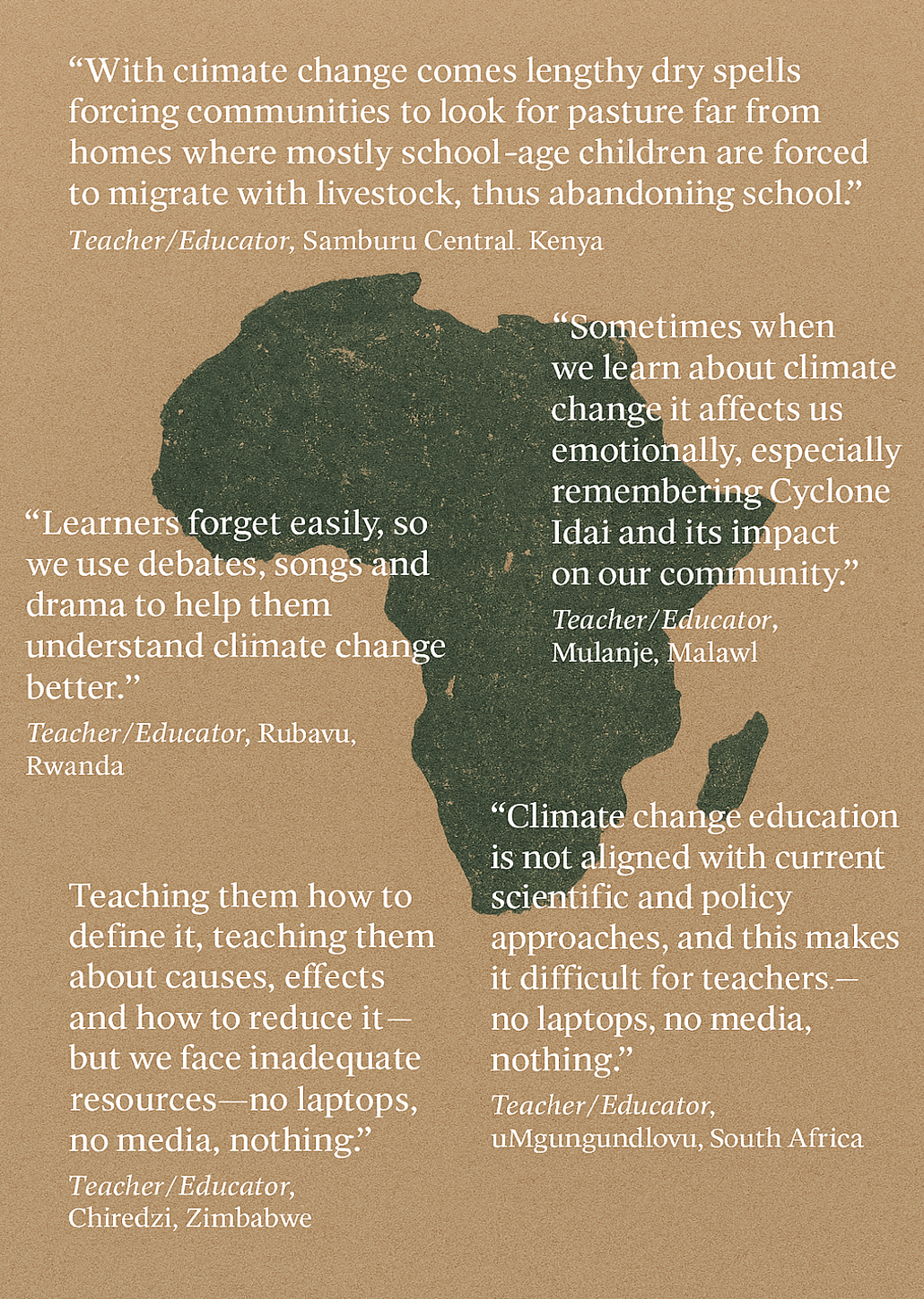
Graphic illustration of selected quotes from teachers/educators who participated in the education and climate research conducted in Kenya, Malawi, Rwanda, South Africa and Zimbabwe in 2025.
Amid innovations, the toll on teachers remains
On the other hand, climate education is demanding, and teachers are feeling the weight. Many educators report teaching without tools such as internet, reliable electricity, radios or televisions, up‑to‑date textbooks, laptops or projectors, or printed learning materials. For some teachers, even chalk is reported as a precious resource. Teachers describe being overworked and undertrained and note that they face multifaceted barriers: high teacher‑student ratios, the expectation of covering multiple subjects at once, a lack of specialized climate education training, burnout, and limited time within tight school timetables. Teachers are carrying the pressure to deliver relevant, accurate climate information while lacking opportunities for professional development.
In addition, some adolescents and youths feel climate change is “not for young people,” or see it as irrelevant to their lives. Teachers also noted that some youths are too overwhelmed by hunger, household chores, family responsibilities, lack of interest, or cultural misconceptions about new climate behaviors to engage in climate education. Teachers are teaching hungry and heat‑stricken learners: food insecurity, dehydration, and climate‑related illnesses shaping the emotional and academic climate of classrooms. Thus, teachers encounter resistance, learner apathy, or fear, and must gently break through those barriers and teach against attitudes and realities.
Across the five countries, teachers reported a shared struggle with chronic resource shortages, but the severity and accompanying challenges varied considerably. Some educators also grappled with communication difficulties and low learner interest, which together restricted meaningful engagement. Other teachers’ experiences were compounded by overwhelming workloads, teacher shortages, and disruptions linked to socioeconomic instability and climate‑related disasters. In some places, the lack of resources were further intensified by curriculum gaps and insufficient teacher training.
Across the data set, resource gaps remained the dominant challenge, but teachers additionally noted weaknesses in community, parental, or student engagement alongside limited training opportunities—suggesting that broader social dynamics shape the learning environment. These cross‑country patterns reveal a region where teachers consistently confront under‑resourced classrooms but do so within distinct national contexts. Together, the data illustrate both shared structural barriers and the diverse realities shaping climate‑education delivery across Eastern and Southern Africa.
Teachers as community climate leaders
Teachers are doing far more than just teaching. They are mobilizing entire communities around climate resilience. They are leading environmental action, spearheading tree-planting drives, clean-up campaigns, recycling initiatives, anti-burning awareness sessions, and water harvesting projects. Teachers are modeling sustainable behaviors and inspiring adolescents and youths to do the same. They are connecting with the community and partnering with NGOs, local leaders, government programs, churches, and media outlets (radio, TV, WhatsApp groups). They are acting as the bridge between information and action—helping families understand early warning systems, drought‑resistant crops, sanitation, and disaster preparedness. Many educators are teaching adults—not just adolescents and youths—sharing climate knowledge at community meetings, church gatherings, or through door‑to‑door interactions. They have become mentors to entire villages.
This study found that teachers are offering rich insights into what truly works to engage young people in climate education, including:
- Play-based and experiential learning: Drama, art, debates, games, and music were repeatedly cited by teachers as powerful teaching tools—especially in communities with limited technology.
- Peer-to-peer learning: Teachers reported that adolescents and youths teaching each other is transformative. As such, youth clubs become climate ambassador hubs where knowledge flows freely and confidence grows.
- Localizing content: Teachers note that adolescents and youths respond best when examples come from their own environment: local droughts, rising river levels, waste challenges, burning practices, and crop failures. Teachers said that context-based teaching transforms abstract ideas into lived reality.
What teachers need to succeed
Despite their ingenuity, teachers are clear about what would make their work more effective:
- Resourcing the climate classroom: Educators are asking for ICT tools (computers, laptops, phones), internet or Wi-Fi access, textbooks and printed materials, projectors and radios, weather instruments, and solar power for schools in off-grid areas.
- Training and professional development: Regular workshops, mentoring, updated climate content, and curriculum materials would empower educators to teach confidently and accurately.
- Recognition and incentives: Many teachers feel unseen. They long for acknowledgement of their efforts, more support from leadership, and meaningful opportunities to make decisions and influence climate policy and curricula.
In every district represented in the dataset, one thing is clear: teachers are not passive observers in the climate crisis. They are innovators, protectors, mobilizers, and mentors. They are guiding young people not only to understand climate change, but to act on it—to lead, to think critically, and to build communities capable of weathering storms both literally and metaphorically. They are leading adolescents and youths into a climate-resilient future. Their work is courageous. Their creativity is remarkable. Their impact is generational.
The data from this research is positioning teachers as unsung climate heroes shaping the next generation’s resilience and environmental consciousness. Teachers are calling for policymakers, NGOs, donors, and communities to center them in climate action strategies. East African governments are beginning to integrate CCE in school curricula, but coherent, coordinated policy implementation remains lacking. National policies must incorporate teacher training, resource allocation, and monitoring frameworks to be effective. Investing in teacher professional development requires continuous training in order to improve climate literacy, pedagogical confidence, and the ability to contextualize scientific concepts.
If the world is serious about addressing climate change, then supporting these educators—resourcing them, training them, celebrating them—must be at the center of the strategy.
They are planting seeds of resilience and leadership in every lesson, every club meeting, every community gathering. And from those seeds, a more climate‑resilient generation is already beginning to grow.
Author

Related Content

The Brookings Institution is committed to quality, independence, and impact.
We are supported by a diverse array of funders. In line with our values and policies, each Brookings publication represents the sole views of its author(s).

Commentary
Chalk, courage, and climate change: How educators in eastern and southern Africa are transforming challenges into action
March 20, 2026