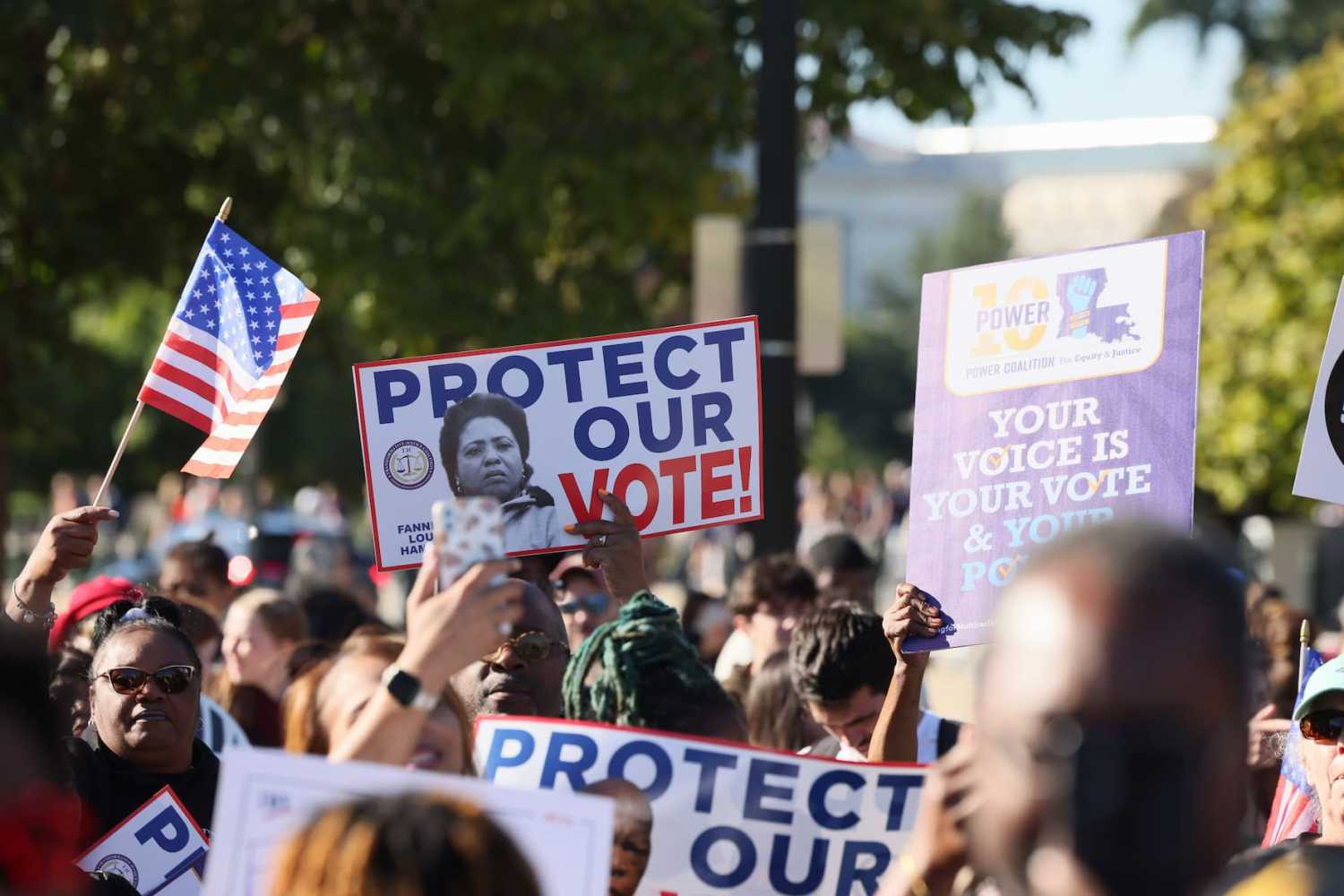
The contemporary Voting Rights Act (VRA) is far weaker than the landmark bill signed into law by President Lyndon B. Johnson in 1965. Since its enactment, the VRA has protected voters of color from many forms of voter discrimination, including literacy tests, poll taxes, and gerrymandered maps that dilute the voting power of racial and ethnic groups while disproportionately enhancing it for others. A decade of Supreme Court decisions, however, has weakened—and arguably undermined—the act’s core mandate: ensuring voters of color have the opportunity to elect “candidates of their choice.”
The Supreme Court’s decision on April 29 in Louisiana v. Callais severely limited the application of Section 2 of the VRA—the primary legal mechanism for challenging race-based voter discrimination and dilution. Historically, Section 2 has also provided the legal basis for majority-minority districts, or districts in which a racial or language minority constitutes the majority of the population. Under Section 2 (and before the recent decision), if a group of voters from a racial minority could demonstrate that they were geographically compact, politically cohesive, and large enough to form a majority, the court had mandated the drawing of majority-minority districts since a decision in 1986. That court intervention fueled the creation of majority-minority districts after the 1990 Census and helped to level the playing field for marginalized voting blocs by enhancing opportunities for these groups to elect candidates of their choice.
How will Louisiana v. Callais affect congressional representation? The evidence suggests such a ruling will have significant effects on diversity in the House, making a legislative body that is already less diverse than the public even less representative.
What did the court decide?
The dispute at the heart of Louisiana v. Callais originated in the wake of Louisiana’s 2020 redistricting cycle. In 2022, following the proposal of new congressional maps, a coalition of voters, activists, and the Louisiana NAACP accused state officials of attempting to dilute Black votes through a combination of “cracking”—dispersing Black voters across several districts to prevent a majority in any single district) and—”packing”—concentrating Black voters into one district to limit their representation to one seat.
In response to these initial legal challenges, the state established a second majority-minority district, only to be sued once again—this time by a coalition of “non-African American voters.” This group alleged that the revised map constituted an impermissible racial gerrymander that disadvantaged white voters. It is this second case upon which the Supreme Court ruled this week, ultimately siding with the “non-African American voters” and striking down Louisiana’s 6th Congressional District as a violation of the 14th Amendment. In short, the court majority declared that Louisiana had unconstitutionally used race to draw a congressional district.
Although the liberal dissenters and the six-member conservative majority disagreed on the narrowness of Wednesday’s decision, its consequences may transform the voting rights landscape. The majority opinion argued that the ruling would require a demonstration of intent to draw racially discriminatory districts, rather than merely showing discriminatory effects. The liberal justices contended, however, that this standard made it “well-nigh impossible” for plaintiffs to challenge maps as racially discriminatory under the VRA or for majority-minority districts to be established as a remedy.
While the immediate issue at hand was this second congressional map, the stakes in this case are much higher and reach far beyond Louisiana.
How majority-minority districts have shaped racial and ethnic representation
Majority-minority districts were first established on a large scale in the 1990s. Under the original wording of the VRA, successful claims of vote dilution required proof that discrimination was motivated by racial bias. Congress lowered this high burden of proof in 1982 with amendments to the act, which required plaintiffs to demonstrate that, “based on the totality of circumstances,” the minority population had “less opportunity than other members of the electorate to participate in the political process and to elect representatives of their choice.” Mapmakers viewed majority-minority districts as a legal mechanism to bolster the likelihood of electing lawmakers of color in states where Black voters were disproportionately underrepresented in Congress and state legislatures.
Following the 1982 amendment and the subsequent 1990s redistricting cycle, the number of majority-minority districts in the House of Representatives shot up from 36 to 65, an 80% increase. By the 2024 elections, majority-minority districts constituted just over one-third of all congressional districts, accounting for 148 of the 435 total seats.
As the number of majority-minority districts has increased, the number of non-white representatives in Congress has risen accordingly. (The demographic data visualized below can be found on our Vital Statistics on Congress page, which was recently updated to include the 119th Congress. All congressional demographic data reflects the 119th House membership as of the first day of the session.) This analysis focuses on Black and Hispanic representation, as previous research has not attributed the rise in Asian American congressional representation to an increase in majority-Asian districts.
While Congress remains whiter than the broader U.S. population, its composition has undoubtedly become more representative over time. The surge in Black and Hispanic representation after the 1990s redistricting cycle (highlighted in light gray) was particularly notable, as many states were required to draw majority-minority districts for the first time. The number of Black representatives in the House climbed from 25 to 38 between 1991 and 1993—an increase of more than 50%—and subsequent research has correlated this growth with the advent of majority-minority districts.
Majority-minority districts today
This relationship remains apparent today; in the 119th Congress, according to the U.S. Census Bureau American Community Survey (ACS) data, 75% of all representatives of color were elected in majority-minority districts. Among Black members, 74% represent majority-minority districts, while for Hispanic members, that figure increases to 84%. It is also noteworthy that, in the current House, Black representation is roughly proportional to Black population (both at approximately 14%), whereas Hispanic representation is still further from reflecting the size of that population (11% compared to 20%).
While a large number of representatives of color are elected from majority-minority districts, non-white candidates have also seen improved performance across a broader range of constituencies in recent years. For instance, in the 119th Congress, only eight out of the 61 Black House members were elected from majority-Black districts. Despite this trend, the median Black share of the population in majority-minority districts with Black representatives averages approximately 40%. This suggests that substantial minority pluralities, even if falling short of an absolute majority, may still be critical to the election of Black representatives.
Not all political analysts agree that robust minority representation in Congress requires the creation of majority-minority districts. While these districts may bolster the election prospects of non-white representatives, some political scientists argue they carry “unintended consequences” that assist in electing conservatives and hindering the advancement of minority interests in Congress. A more recent study focusing on the downstream effects of the 1990s surge in majority-minority districts reached the opposite conclusion, however. Variations of the “unintended consequences” argument continue to be echoed, including by Representative Terri Sewell (D-Ala.), who represents a majority-Black district in Alabama. Sewell has highlighted the disadvantages of these highly concentrated “VRA districts,” arguing that districts like her own constrain, rather than bolster, Black voting power. She instead advocates for having more minority-opportunity districts, contending that the era of minority candidates solely winning in districts with large Black majorities has ended.
Callais will likely advantage Republicans
While there is merit to both sides of the debate regarding which approach will strengthen Black representation in the long term, the more short-term effects of the gutting of Section 2 are evident.
In the current Congress, 82% of all majority-minority districts are held by Democrats. An NPR analysis estimates that at least 15 districts—all currently held by Democrats—could be redrawn to favor Republicans following the Callais decision. Due to the strong correlation between race and partisanship in the U.S., where Black voters overwhelmingly support Democratic candidates on average, the court’s ruling undermining Section 2 will likely provide a strategic advantage to the GOP.
As New York Times analyst Nate Cohn points out, much of the partisan gerrymandering of the last few decades has failed to yield a substantial or enduring advantage for either party in this decade’s House elections. However, the weakening of Section 2 could change that, with the impact potentially felt in full force after the next redistricting cycle—or sooner, given the rise of highly politicized mid-decade redistricting.
The impacts are expected to be felt most acutely in Southern conservative states. Within an hour of the decision, Florida lawmakers approved a congressional map creating four new seats for Republicans; although the map-making process was already underway, they cited Callais as the primary justification. Soon after, the Alabama and Tennessee legislatures called special sessions focused on redrawing congressional lines, and Mississippi for state lines. Looking at the region as a whole, 35 of the 40 Southern representatives of color were elected from majority-minority districts. Within this group, 83% are Democrats. Only one Black representative from a Southern majority-minority district is a Republican.
The long-term effects of major changes to the VRA may also extend beyond racial representation, potentially yielding downstream consequences for public policy. Previous research has already identified a relationship between the affirmative voting policies of the VRA and member support for civil rights legislation in Congress, as well as a link between a representative’s race and their roll-call voting patterns. This suggests that the repercussions of undermining Section 2 may manifest not only in terms of congressional diversity but also in the substance of policies affecting minority communities. Furthermore, racial representation in Congress influences the political engagement of both white and Black voters in different ways, highlighting the broader democratic implications of electing candidates of color.
The Callais decision is the latest episode in a larger story of the gradual weakening of the VRA, a trend suggesting the Supreme Court views the act as legislation with an expiration date, rather than a permanent remedy for the structural inequities that persist in American society. How this philosophy will ultimately affect the composition of Congress remains to be seen.
Related Content

Author

-
Acknowledgements and disclosures
The author would like to thank Sarah Binder and Molly Reynolds for their research support and peer review.
The Brookings Institution is committed to quality, independence, and impact.
We are supported by a diverse array of funders. In line with our values and policies, each Brookings publication represents the sole views of its author(s).