This viewpoint is part of Chapter 3 of Foresight Africa 2026, a report on how Africa can navigate the challenges of 2026 and chart a path toward inclusive, resilient, and self-determined growth. Read the full chapter on Africa’s industry-led growth.
Countries across the continent are discovering that their competitive advantages lie in leveraging their unique endowments.
Every year some 15 million young Africans will enter the region’s labor force.1 The vast majority will find work of some kind. But will their new jobs be productive work and can this youthful wave power rapid economic growth?
The development literature of a decade ago painted a pessimistic outlook for Africa because, unlike fast-growing East Asia, the region was not creating manufacturing jobs as workers moved out of agriculture.2 Indeed, in the last decade, manufacturing’s share of African GDP has languished at about 11%, less than half the share of that in East Asia.3 This conventional avenue of structural transformation appeared closed. Since then, however, an emerging literature has identified several productivity-increasing transformations: from rural to urban, from home to market, from informal to formal, and from self-employment to wage work.4
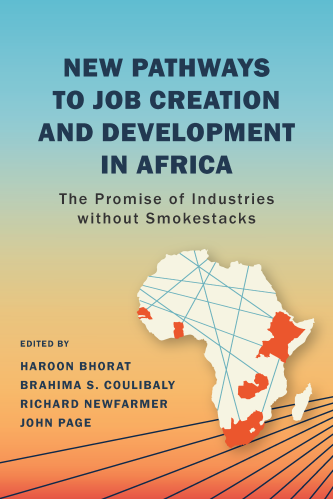
A new study from the Brookings Institution, “New Pathways to Job Creation and Development in Africa: the Promise of Industries without Smokestacks,” looked in depth at employment in eight African countries.5 It focused on activities that possess many of the key characteristics of manufacturing: that they are tradable across borders, employ workers with moderate skill levels, generate higher-than-average productivity, and demonstrate capacity for technological advancement and scale. The study centered on tourism, business services, agro-processing, horticulture and export agriculture, information technology services, and modern transport and logistics, what the authors called “industries without smokestacks.”
These “industries without smokestacks” were found to be already reshaping Africa’s economic landscape. For example, in the fast-growing East African countries of Ethiopia and Rwanda, tourism makes up a larger share of employment than manufacturing, and in Rwanda, industries without smokestacks collectively employ more than four times as many workers. In South Africa, too, these industries account for four times the workers as traditional manufacturing, with financial and business services leading in employment.6 Across East and West Africa, agro-processing has begun to link smallholder farmers with expanding urban markets and international buyers, lifting incomes and boosting rural employment. Meanwhile, the rapid rise of information and communication technology hubs in cities such as Accra, Cape Town, and Nairobi showcase the continent’s ability to leapfrog into high-value services, nurturing a new generation of entrepreneurs and innovators.7
Perhaps most encouraging was the potential for these emerging sectors to enhance productivity, create jobs, and grow exports. Research shows that these activities collectively have an average productivity several multiples of traditional agriculture and have an estimated average employment elasticity of 1.2—higher than both the overall economy and manufacturing.8 And consider exports: Between 2005 and 2022, Africa’s services exports grew more than 1.5 times faster than merchandise exports. Already, services exports alone make up about one-quarter of Africa’s export earnings.9 Countries across the continent are discovering that their competitive advantages lie in leveraging their unique endowments—from wildlife and landscapes for tourism to agricultural resources for processing and export.
Yet realizing the full potential of these sectors requires deliberate policy action. The same infrastructure constraints that limit traditional manufacturing—unreliable electricity, poor transport networks, inadequate digital connectivity—also constrain these emerging sectors. This means investing in reliable power and internet connectivity, improving transport networks and logistics, developing relevant skills training programs, and creating regulatory environments that encourage innovation and competition. It also means better statistical systems to track these industries’ contributions.
Moreover, in an era of unprecedented technological change—exemplified by the AI revolution—policy also must focus on improving educational access and quality. Only by continually creating opportunities for workers to upgrade their skills can these new technologies create productive jobs.
High-income countries can help. High on the priority list is keeping global markets open, free of border barriers, and reinvigorating the multilateral trading system; depoliticizing development assistance and integrating it into country-owned strategies; spurring technological advances to limit carbon emissions and joining international efforts to address climate change.
The lesson? Structural transformation to accelerate growth is more than manufacturing. Enacting a comprehensive development strategy holds the promise of harnessing the power of coming generations to drive sustained growth and rising incomes in Africa.
Related Content

-
Footnotes
- Athene Laws et al., “The Clock Is Ticking on Sub-Saharan Africa’s Urgent Job Creation Challenge,” IMF Blog, November 12, 2024.
- Dani Rodrik, An African Growth Miracle?, no. w20188 (National Bureau of Economic Research, 2014), w20188.
- Chris Heitzig et al., “From Deindustrialization to Job Creation: New Perspectives on African Growth,” in New Pathways to Job Creation and Development in Africa: The Promise of Industries Without Smokestacks, 1st ed, ed. Haroon Bhorat et al. (Bloomsbury Publishing USA, 2025).
- For a comprehensive literature review, see D. Golin and J.P. Kobaski “New views of structural transformation: insights from recent literature” Oxford Development Studies 2023 Vol. 51 No. 4 pp. 339- 361.
- H. Borat, B. Coulibaly, R. Newfarmer and J. Page, eds., New Pathways to Job Creation and Development in Africa: The Promise of Industries Without Smokestacks, 1st ed (Bloomsbury Publishing USA, 2025).
- Heitzig et al., “From Deindustrialization to Job Creation: New Perspectives on African Growth.”
- Besides the respective chapters for Ghana, Kenya and South Africa in Bhorat et al 2025, see also GSMA. The Mobile Economy: Sub-Saharan Africa 2023. London: GSMA Intelligence, October 2023; and Google & International Finance Corporation (IFC). e-Conomy Africa 2020: Africa’s $180 Billion Internet Economy Future. Washington, DC: IFC, November 2020; and Nayyar, Gaurav; Hallward-Dreimeier, Mary; and Davies, Elwyn. At Your Service?: The Promise of Services-Led Development. Washington, DC: World Bank Group, 2021.
- Bhorat et al., New Pathways to Job Creation and Development in Africa, 25, 30.
- Richard Newfarmer et al., “Promoting Services-Led Transformation and Exports in Africa,” in LDC Trade Priorities – Looking Forward (World Trade Organization, 2024).
The Brookings Institution is committed to quality, independence, and impact.
We are supported by a diverse array of funders. In line with our values and policies, each Brookings publication represents the sole views of its author(s).



Commentary
Africa’s new economic transformation: More than manufacturing
February 19, 2026