On this day in 2011, Tunisians overthrew their long-time dictator, Zine El Abidine Ben Ali, igniting the Arab Spring. Fifteen years later, after a failed experience with democracy, Tunisians again face the same conditions that fueled their revolution: a poor economy, a repressive regime, and a lack of hope. But while the grievances for revolution have returned, the factors that had facilitated Tunisia’s revolution and transition to democracy—a supportive military, a strong civil society, and a cooperative political class—have largely disappeared. An uprising today would therefore look very different than it did in 2011.
A more politicized military
Let’s begin with the military. The army played a pivotal role in the 2011 revolution through its unwillingness to fire on protesters, leaving Ben Ali no choice but to flee the country. That reluctance to defend Ben Ali stemmed in part from his choice to neglect and marginalize the military, as well as the officer corps’ neutral, apolitical sense of professionalism.
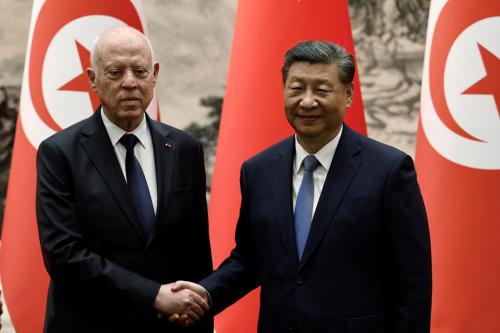
However, under President Kais Saied, things have changed. The military is no longer neglected: Saied has appointed military officers as ministers; expanded the army’s roles in agriculture, public works, and health; and promoted the top officers to ranks they had rarely seen. The officers now have far more interests in preserving Saied than they ever did for Ben Ali. Moreover, Saied has also eroded the military’s professionalism, dragging it into politics by ordering it to shut down the parliament in 2021 and forcing it to take sides in a political dispute. After five years of enhanced political influence, it is far from clear whether the military will quickly withdraw to the barracks as it did after the 2011 revolution. An uprising today might therefore have to contend with a potentially more politicized military than Tunisians were lucky enough to face the first time around.
A weaker civil society
Second, consider civil society. Tunisia boasted strong organizations, led first and foremost by the Tunisian General Labor Union (UGTT), which helped facilitate both the revolution and political transition. The UGTT’s decision to join the revolution was a crucial turning point, with its general strike in Sfax on January 12 arguably the single largest protest of the campaign. And when the transition stalled in 2013, the UGTT’s considerable legitimacy among the public and political elite allowed it to spearhead a national dialogue that put the transition back on track.
Yet, today, the UGTT—and civil society writ large—is a shell of its former self. Even prior to Saied’s takeover in 2021, the UGTT had increasingly lost popularity, becoming viewed as too political, too intransigent, or even corrupt. Delegitimized, the UGTT was then cowed and coopted into supporting Saied’s takeover. Although it has finally begun to criticize Saied, the UGTT has only been able to muster a few thousand into the street so far. The general strike the UGTT announced for this coming January 21 will be a critical test, but the seemingly forced resignation of its leader, Noureddine Taboubi, since that announcement sheds doubt on whether a strike will even go forward. The strong civil society that Tunisia had once enjoyed now seems weak and coopted—unlikely to drive a revolution or safeguard a transition.
A more fragmented political class
A third factor that had smoothed Tunisia’s transition to democracy was its cooperative political class. While Ben Ali had been repressive, there had still been a range of opposition parties—both legal and underground—that could develop name recognition and ideological positioning. After the revolution, those party leaders had enough trust in each other, and enough legitimacy among their own bases, to bring their sides together and find consensus over the 2014 constitution.
Tunisia today hardly has any parties to speak of. Saied has imprisoned the leaders of all major political parties and sidelined parties more generally in his “bottom-up” political process. Moreover, the few Tunisians still interested in these parties have struggled to unite across ideological lines. If a revolution and transition were to occur, the actors that would emerge onto the scene are likely to be far weaker, more disorganized, and less cooperative than the parties Tunisia was blessed with between 2011 and 2015.
Less faith in democracy, less help from abroad
Finally, even secondary factors like public opinion and external support have shifted. Over the last 15 years, Tunisians have become increasingly disillusioned with democracy, along with democratic institutions like parties, parliaments, and courts. Were a revolution to emerge today, democracy is unlikely to be a major priority among the protesters. Tunisia is also unlikely to enjoy the influx of foreign aid from the United States and Europe that it had been fortunate enough to receive during its transition. Instead, it is likely to face increasingly interventionist regional powers from the Persian Gulf to Turkey, potentially alongside Iran and China.
Revolution under new constraints
None of this is to say that a revolution today would not succeed. But the protagonists would need to strategically adapt to this new environment. The military is no longer a given and would need to be approached carefully. Maintaining nonviolence, fraternizing with the troops on the ground, and potentially also promising to preserve the officers’ new political influence will be essential to securing their defection. Meanwhile, existing political parties and civil society organizations must reinvent themselves, offering new faces and new ideas, to win back their public support. Tunisians disaffected with these institutions, as well as younger Tunisians with no attachment to any of them, likewise need to form their own organizations. While licensing new political parties is unlikely in today’s repressive environment, organizing into more informal, social movements—such as the anti-pollution protest movement that rocked Gabes last fall—can offer similar organizational advantages.
In short, Tunisia in the coming years may well see mass protests again. But if and when it does, it will unfold in a much more challenging environment—one marked by a more politicized military and the absence of strong, trusted social and political institutions. Revolution may return, but it will not resemble 2011.
Author

Related Content
The Brookings Institution is committed to quality, independence, and impact.
We are supported by a diverse array of funders. In line with our values and policies, each Brookings publication represents the sole views of its author(s).
Commentary
15 years later, is a new Tunisian revolution possible?
While the grievances that spark revolution have returned, an uprising today would look very different from 2011.
January 14, 2026