Topics View All
Geography View All
Content Type View All
Trending:
Research Activities
General Information
Economics
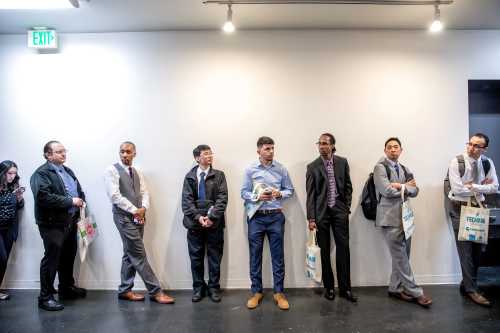
Employment numbers are improving, but only slightly. Millions of Americans remain out of work or underemployed as the economic recovery continues slowly. Brookings experts look at monthly jobs reports, examine ways to get Americans back to work, and recommend ideas to move the country back to prosperity and economic stability.
Reuters/Rick Wilking - A job seeker talks to an exhibitor at the Colorado Hospital Association health care career fair in Denver April 9, 2013.
Blog Post
Unemployment Likely To Fall to 7.2% in September, With Smaller Gains Going Forward
October 3, 2013, Regis Barnichon
In the latest unemployment rate forecast of the Barnichon-Nekarda model, Regis Barnichon predicts that the decline in the unemployment rate will continue, bringing it to 7.2% for September 2013.
Refine by: U.S. Economic Performance | U.S. Metro Areas | Unemployment | Labor Policy
In the News
The bottom line is, the women's situation [in Japan] is not going to improve until you address more fundamental equity issues. September 10, 2013, Mireya Solís, Los Angeles Times
The bottom line is, the women's situation [in Japan] is not going to improve until you address more fundamental equity issues.
The suburbs were created to house the new middle class in the 20th century, but the economy they were built around is vanishing. In the 21st century most of the good jobs are in the cities. June 7, 2013, Bruce Katz, Financial Times
The suburbs were created to house the new middle class in the 20th century, but the economy they were built around is vanishing. In the 21st century most of the good jobs are in the cities.
Really the location of employment relates to a number of different issues that affect the long term health, inclusivity, and sustainability of metropolitan areas. May 7, 2013, Elizabeth Kneebone, North Country Public Radio
Really the location of employment relates to a number of different issues that affect the long term health, inclusivity, and sustainability of metropolitan areas.
We've been in a very, very slow recovery now since 2009 and what we've been seeing is a very, very slow decline in the unemployment rate... increases in employment that barely keep up with the growth of the population. May 3, 2013, William T. Dickens, Yahoo! News
We've been in a very, very slow recovery now since 2009 and what we've been seeing is a very, very slow decline in the unemployment rate... increases in employment that barely keep up with the growth of the population.
The jobs that are growing fastest are jobs that don't pay very high wages. Lower-wage jobs are among the most suburbanized. April 23, 2013, Elizabeth Kneebone, The Huffington Post
The jobs that are growing fastest are jobs that don't pay very high wages. Lower-wage jobs are among the most suburbanized.
15 years ago in this country, we thought that [telecommuting] was the death of distance and that it was just going to ruin cities and we didn't see that at all. We see that people really do benefit from face-to-face conversations. Face-to-face conversations are going to be critical for many, many metropolitan jobs. There are many jobs that will require you to be face-to-face. Telecommuting does have a role [but] it's not going to solve all of our problems. March 10, 2013, Robert Puentes, WTOP Washington
15 years ago in this country, we thought that [telecommuting] was the death of distance and that it was just going to ruin cities and we didn't see that at all. We see that people really do benefit from face-to-face conversations. Face-to-face conversations are going to be critical for many, many metropolitan jobs. There are many jobs that will require you to be face-to-face. Telecommuting does have a role [but] it's not going to solve all of our problems.
The number of unemployed continues to shrink, and job gains entirely in the private sector continue to be fast enough so that we can be whittling down the problem of both long-term unemployment and regular unemployment. March 9, 2013, Gary Burtless, National Public Radio
The number of unemployed continues to shrink, and job gains entirely in the private sector continue to be fast enough so that we can be whittling down the problem of both long-term unemployment and regular unemployment.
[Washington, DC's reliance on goverment is] a relatively less dangerous addiction than others. Diversification can never be sold until it’s too late. Complexity breeds resilience. It’s true in natural systems, and it’s true in economics. March 7, 2013, Mark Muro, Washington Post
[Washington, DC's reliance on goverment is] a relatively less dangerous addiction than others. Diversification can never be sold until it’s too late. Complexity breeds resilience. It’s true in natural systems, and it’s true in economics.
We don't want to promote a zero-sum competition between regions in the U.S. If we want to focus on advanced manufacturing, as we should, I think the moderately high-tech industries are a good place to start. When companies are clustered together it tends to attract the kind of skilled labor force that they need and attract the suppliers that they do business with. February 25, 2013, Howard Wial, ChicagoBusiness.com
We don't want to promote a zero-sum competition between regions in the U.S. If we want to focus on advanced manufacturing, as we should, I think the moderately high-tech industries are a good place to start. When companies are clustered together it tends to attract the kind of skilled labor force that they need and attract the suppliers that they do business with.
In a way, Colorado was by virtue of its older economy a more equal place than the rest of the United States. But it's just picked up in droves these elements of the national economy and it's now more like a caricature of the United States in terms of the imbalance between the high end and the low end—where the high end is disproportionately employing highly educated whites and the low is probably employing disproportionately, less educated Latinos and African Americans. January 21, 2013, Alan Berube, I-News Network
In a way, Colorado was by virtue of its older economy a more equal place than the rest of the United States. But it's just picked up in droves these elements of the national economy and it's now more like a caricature of the United States in terms of the imbalance between the high end and the low end—where the high end is disproportionately employing highly educated whites and the low is probably employing disproportionately, less educated Latinos and African Americans.
View All Research on Job Creation ›Show 10 More
You have not selected any newsletters.
Sep 25
Brookings Institution
Sep 19
Get Updates