
CNN February 17, 2026
This is potentially a seismic shift in Chinese politics under Xi, and how he governs – this really demonstrates nobody in that system is safe, truly… [The purge has] reached a crescendo..."
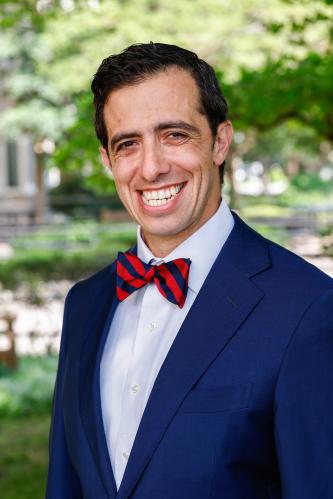
Jonathan A. Czin is the Michael H. Armacost Chair in Foreign Policy Studies and a fellow in the John L. Thornton China Center. He is a former member of the Senior Analytic Service at CIA, where he was one of the intelligence community’s top China experts.
Czin led the intelligence community’s analysis of Chinese politics and policymaking, playing a central role in assessing and briefing senior policymakers on President Xi Jinping, his rise to power, and decisionmaking on an array of key issues and crises. From 2021 till 2023, he was director for China at the National Security Council, where he advised on, staffed, and coordinated White House and inter-agency diplomacy with the People’s Republic of China, including all of President Biden’s interactions with President Xi, and played a leading role in addressing a wide range of global China issues.
He also served as advisor for Asia-Pacific security affairs in the Office of the Secretary of Defense, and overseas at a CIA field station in Southeast Asia. Czin holds a master’s in international relations from Yale University, graduated magna cum laude from Haverford College, and studied at Oxford University. He is proficient in Mandarin Chinese.
This is potentially a seismic shift in Chinese politics under Xi, and how he governs – this really demonstrates nobody in that system is safe, truly… [The purge has] reached a crescendo..."
As far as the corruption problem goes, I think that Xi has concluded that he had no other option but to cull virtually the entire generational cohort at the top [of the People’s..."
Zhang [Youxia]’s removal means that truly nobody in the leadership is safe now… I think corruption concerns are probably real, though those are typically more a pretext to remove..."
Instead of coming running for negotiations, Xi is the one that is making moves and the United States is struggling to keep up.
[Beijing is going on offense with its expanded rules on rare earth products, an attempt to] start setting the terms of the bilateral dynamic… I think (Xi) sees it as a sign that he has..."
By purging these officers before the plenum altogether and all at once, Xi is sending a clear shot across the bow to the military high command ahead and asserting his dominance.
[Xi] can either elevate one of the other CMC members, Liu Zhenli or Zhang Shengmin, in accordance with party tradition. Doing this would of course create another vacancy on the CMC that..."
Jonathan Czin was interviewed by NPR “The World’s” Carolyn Beeler about the significance of China’s new rare earths export controls.
[President Xi is] looking for ways to seize the initiative. The Trump administration is having to play a game of whack-a-mole and deal with these issues as they come up.
The only clear agreement today appears to be on when the two leaders will next meet in person: in late October, at a summit in South Korea. And even that might have been a win for Xi.