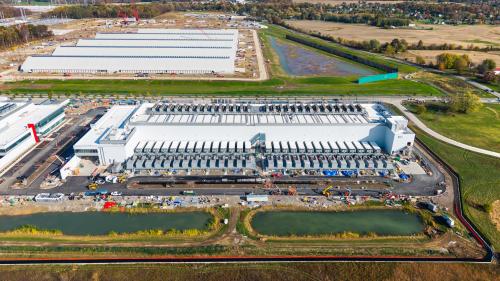
Data centers are both controversial and critical to the artificial intelligence technologies undergirding the digital economy. Data centers house thousands of file servers and networking equipment to enable e-commerce, data analytics, health care, and other functions of a connected society. Without abundant data centers, the digital revolution could potentially stall, restricting access to the benefits of digital technologies for individuals, communities, governments, and businesses.
Despite the crucial role of data centers in the emerging economy, protests have arisen throughout the country over financial, energy, and environmental concerns. Plans to build data centers have been stymied in Ohio, Georgia, Virginia, Arizona, and Indiana over worries about increases in electric bills, noise, and light pollution, and the possible dangers of AI itself. Public opinion surveys reveal a “techlash” where worries about AI’s impact on jobs, privacy, security, and human safety combine to increase concerns about wealth accumulation and corporate power in the tech sector, forming a populist backlash. Voter worries have roiled recent elections in New Jersey, Virginia, and Georgia, where opposition to data centers was part of campaign promises. Left unchecked, these community concerns could slow down the rapid construction of data centers, weaken AI growth, and slow AI revenue streams, all of which would limit the AI benefits promised by tech firms and government officials.
In this report, we explain how AI companies can work more closely with local leaders to establish viable community benefit agreements (CBAs) to address public concerns. These agreements should be legally binding and developed collaboratively with host communities to demonstrate reciprocity between the developers of data centers and the communities in which they are housed. In particular, communities need to know the cost of data centers, understand who pays, examine local benefits and risks, and have back-up plans for the long-term evolution of AI.
A community benefit agreement for data centers should include quantifiable data on the job opportunities, tax revenue, workforce training programs, health and well-being contributions, and other benefits of proposed facilities. Combined with metric tracking and rigorous evaluation programs, CBAs can mitigate community concerns and help community leaders and residents achieve a better understanding of how data centers function and affect local areas. They can also ensure that the process involves mutual respect among all parties.
Community benefit agreements are formal documents that spell out the costs and benefits of data centers for specific communities and detail areas for cooperation. CBAs should be an important part of the community negotiation process with AI companies and explicate the building and operating costs, among other factors of interest to residents and government leaders. CBAs should be transparent and publicly available to help residents not involved in community discussions better understand what is happening in the pre- and post-construction phases. Negotiated as formal contracts, they should be subject to legal safeguards and provide communities with a way to anticipate potential problems and address them before construction begins.
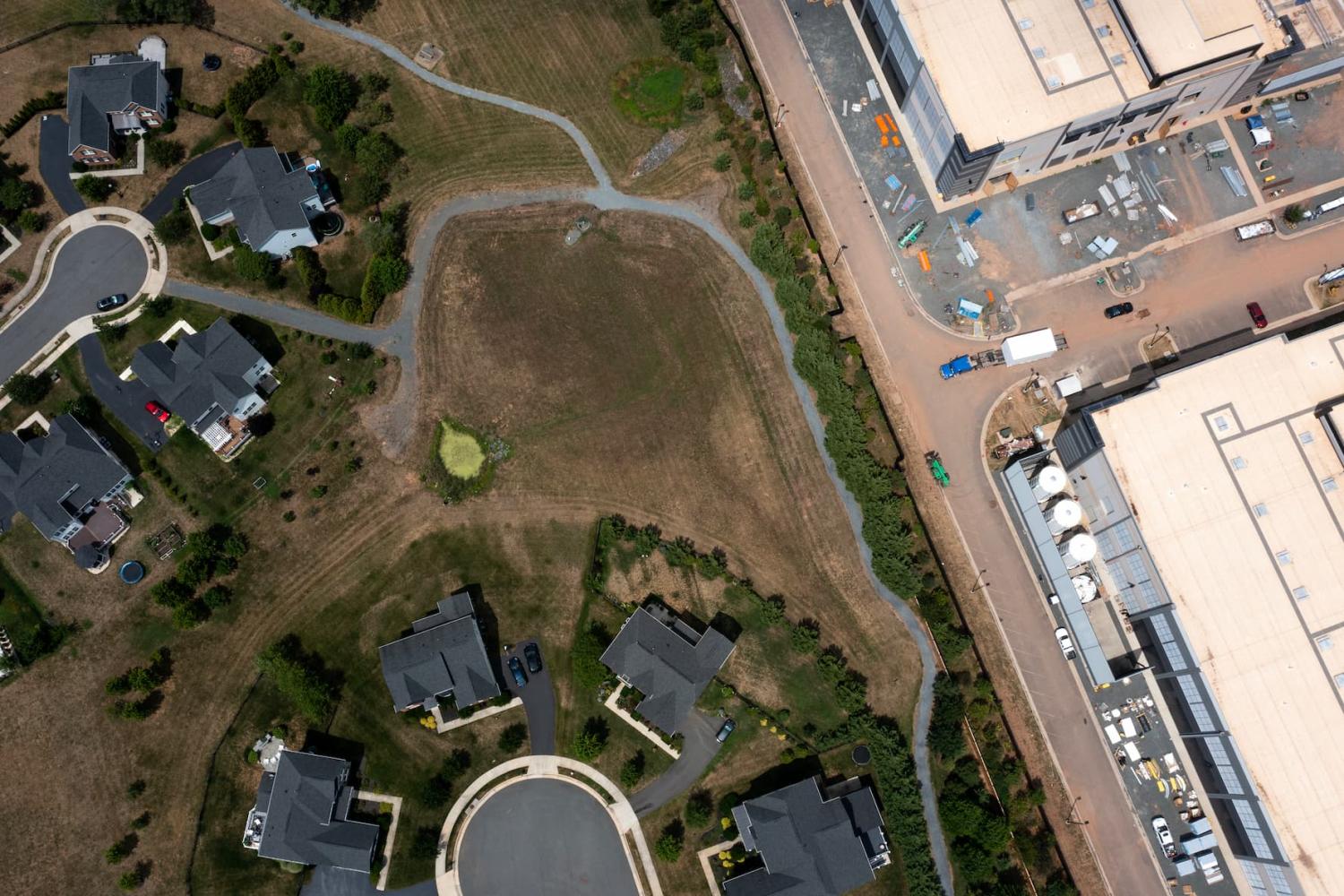
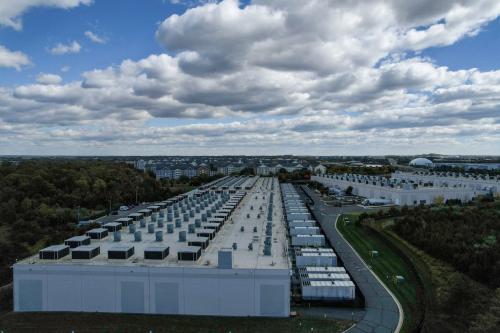
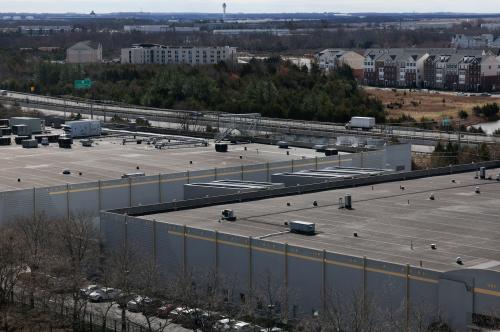
In an earlier paper, we outlined growing local concerns about data centers. Residents complain about various issues, from electric rates and water usage to noise and light pollution. People can see the large scale of such developments—which often are the size of several football fields or more—and fear the facilities will overwhelm local resources and subject communities to long-term financial and environmental degradation.
Some contracts are heavily redacted such that key sections are hidden from the public. The redactions involve energy requirements, water usage, cost-sharing, and infrastructure enhancements. Full transparency is important to keep local communities well-informed, so they have a realistic sense of how data centers will affect their areas, and for companies to avert complete resistance to new construction.
A few organizations have examined what should be part of CBAs. The Sabin Center for Climate Change Law at Columbia University published a best practices guide for clean energy infrastructure projects. While not limited to data centers, it argues that local communities can be aided by direct payments, a community fund, hazard monitoring, and requirements for local labor. The NAACP also developed a framework for improving community transparency, engagement, and investment, which is helpful to evaluate data center impact and potential local benefits. In the end, communities, government, and AI companies should have a path toward open dialogue to determine how to best leverage data centers and ways to extract the greatest value in accordance with those conversations.
Communities across the United States have begun to develop various types of community benefit agreements. For example, the city of Cleveland has used CBAs since 2013 for a variety of economic development projects. It distinguishes between “standard” agreements, covering projects under $20 million in business investment, and “expanded” ones for more expensive projects. Developers are required to specify hiring targets, meet low-income employment goals, and create mentorships, apprenticeships, and internships, with additional commitments for large-scale projects.
Lancaster, Pennsylvania, developed more focused CBAs for data centers. Chirisa Technology Parks wanted to develop a 450,000 square-foot data center and had a $6 billion commitment from cloud provider CoreWeave. Local officials then worked with business officials to negotiate an agreement that they thought would facilitate the project while helping the community. The discussions took several months but ultimately generated a written contract that restricted water usage to 20,000 gallons a day, established reliance upon clean energy, and set strict noise levels, among other provisions.
Officials in Cedar Rapids, Iowa, negotiated a “community betterment” agreement with Google and QTS. The contract provided a “20-year, 70 percent tax exemption, as long as the project meets the job threshold of at least 31 full-time positions at a high-quality wage rate of at least $26.20 per hour after construction.” City officials touted the data center’s economic development benefits along with the job and wage guarantees as vital for the locale’s future. Google agreed to pay the city “$400,000 for the next 15 years,” while QTS provided “$18 million over the next 18 years.”
Leaders in West Des Moines, Iowa, negotiated an agreement with Microsoft to build several data centers there in return for benefits of interest to that community. The firm will rely completely upon renewable energy sources, such as wind power, and its data centers will generate over $2 billion in tax revenues. The facilities have also created at least 3,000 construction jobs and 400 permanent positions.
Officials in northern Indiana announced plans for a $15-billion investment by Amazon to build data centers there. As part of the agreement, the company committed to creating 1,100 new positions, supporting infrastructure improvements with local utilities, and developing STEM learning opportunities for K-12 schools in the area.
El Paso, Texas, leaders negotiated an agreement with Meta to develop a $1.5-billion data center in return for an 80% abatement of property taxes over 35 years. As part of the plan, the company specified its water usage starting at an average of 750,000 gallons per day and said it would deploy a closed-loop cooling system that would recycle water instead of using more local resources. Meta promised to publish a sustainability report each year that would detail its water and electricity usage and indicated it planned to employ 1,800 construction workers and 100 operating employees at the facility.
Several key features stand out in these agreements, including transparency, affordability, and sustainability for communities. These manifest in firms making direct payments, creating community funds, and delineating tax revenues, and affect issues such as infrastructure improvements, construction and operating jobs, electric rates, water usage, noise levels, light pollution, workforce training, health and well-being services, digital access for the underserved, and public dashboards with key metrics.
Taken together, these agreements address key community concerns and explain how companies will deal with those matters. While some AI companies prefer more behind-the-scenes negotiations, CBAs should not be subject to non-disclosure agreements because transparency is core to determining and understanding both the costs and benefits. Failure to deliver upon key commitments can form the basis of lawsuits, civil actions, or government penalties. One proposal calls for fines of up to $50,000/day for “willful violations” of specified agreements. Explanations on the other themes are below.
Direct payments or community funds
Companies can help communities by making direct payments or establishing community funds that local leaders can use for high-priority projects outside of data centers. Much of the enticement for data centers has to do with the projected tax revenues for states and localities. Most communities are under financial stress due to a slowing economy and sometimes unsteady federal support for local initiatives. Direct payments or community-directed funds can provide local leaders with some flexibility to invest in areas that are not well-covered by other sources.
A proposal entitled the “Community-Integrated AI & Data Center Development Act” calls for the creation of a community investment fund that would be financed by an “annual contribution equal to at least 0.5% of gross revenue to a locally administered fund for infrastructure, education, or public services.” The goal is to ensure that data center developers contribute to local communities at a level commensurate with their revenue streams to help localities address projected concerns related to their activities or other areas in need of critical resources.
Tax revenues
Tax revenues are a primary driver for localities approving data center deals. However, the potential of tax revenue from data centers is only realized once the business is up and running. For this reason, CBAs should provide realistic projections of expected tax revenues and have some commitment by AI companies to commit revenue, also in the case of an AI bubble occurring. Further, tax assessments should include the tax revenues minus any tax abatement incentives offered to developers and operators who, in many states, are receiving substantial tax discounts to build in certain communities.
Most large-scale projects compile data on expected taxes based on their level of economic activity and business operations. Developers commission expert assessments of expected tax revenues. These projections, along with the models used to estimate them, should be made public so residents can see how these developments may benefit their community. This process can also help residents examine whether the projections are realistic, since many economic development projects overestimate the expected revenues to win community support. Every community considering a data center needs to ensure that the government is engaging in careful consideration of the tax benefits, as well as drawbacks, as part of the negotiations.
Officials should also be careful about how they negotiate tax abatements, as one key aspect is the length of the tax exemption. Agreements can range from 10 to 50 years and have different trigger points. Leaders should tie abatements to the number of jobs created or the amount of tax revenue generated. Having abatements that last too long or are not directly linked to job creation and retention likely would be risky because the abatement may outlast the functioning of particular data centers. Nothing would be worse for communities than having a decommissioned data center that generates little tax revenue yet still receives tax exemptions.
One firm announced it will not seek reductions in property tax rates from local communities in exchange for building data centers in those areas. It says it will add to local tax bases and thereby help those locales pay for vital municipal services.
Data center location and infrastructure improvements
Some data center projects require rezoning and infrastructure improvements to roads, bridges, power grids, or water treatment plants. Land use is a contentious issue in many areas, and land acquisition needs to be in accordance with local zoning requirements and economic development plans. When possible, data centers can be located in industrial corridors or away from residential areas.
The CBAs should outline how rezoning requests are handled, what infrastructure improvements are required, who is going to pay, expected benefits in terms of local usage, longer-term economic benefits, and how the infrastructure improvements would aid local communities. These are particularly compelling points for communities to consider, especially those that are in need of general infrastructure improvements, including outdated electricity grids or eroded irrigation systems. Data center development projects could provide a means to secure funding or technological support for needed ventures, working with other federal agencies now committed to infrastructure modernization. Another way AI companies can help is to provide free hardware or software for power grid or water treatment improvements, which are tenets of improved infrastructure in the digital age. Since most power transmission lines are over 25 years old, power grid improvements will probably be a long time in the works. However, AI companies, alongside community leaders, residents, and local businesses, should be part of the broad solution for infrastructure improvements.
Exit fees could also be negotiated for situations where a data center might close or the project faces some risk of collapsing. If left unchecked, utility companies or grid operators could be stranded and left holding the financial bag if data center projects do not start or close after a few years. Communities can protect themselves by specifying exit fees that get charged to data center developers when projects don’t operate for the agreed-upon length of time. As far as real estate acquisition, communities can also negotiate how the space could be repurposed to avoid empty data centers, especially in states with huge clusters of physical facilities. For example, communities should be asking themselves if an abandoned data center can be repurposed as a community asset, including a youth center or incubator for aspiring tech entrepreneurs.
Construction and operating jobs
Community benefit agreements should enumerate the number of construction and operating jobs from pre-construction and construction to post-building development. For example, Meta’s $1 billion data center in Kansas City generated around 1,500 construction jobs as compared to 100 operations jobs when the data center was fully functional. Well-designed benefit agreements can tie tax abatements to the specific number of jobs a project creates. They can also require there be no worker layoffs during the course of the abatement, on top of provisions that mandate workers can join unions, make no less than $20/hour, or be paid a living wage appropriate for that locale. Good-paying jobs are vital for every community; local leaders can use these agreements to specify what they want and make sure companies follow up on their commitments. Failure to meet specified targets would subject companies to fines or civil action.
In this area, communities can encourage the use of local trades professionals, from plumbers to electricians. Having a commitment to hire locally can ensure that, in the absence of new jobs, place-based enterprises are supported. Where local trades professionals are not available, the community can consider working with their state workforce office to determine regional talent availability and ensure that compensation stays within the general community, or at least close to it.
Electricity rate coverage
One of the biggest public concerns about data centers is their impact on electricity rates. These rates have increased in various places across the country, leading people to request more detailed information from AI companies, elected and appointed officials, public utility commissions, and their energy providers. Many factors contribute to rising electricity rates, such as inflation, tariffs, the cost of energy generation, aging power lines, government regulations, and environmental compliance. For residents, the key issue is whether they will bear higher electricity costs linked to nearby data centers, particularly when states have offered discounted rates to attract those facilities.
It is very difficult to pinpoint what portion of the rising costs is attributable to data centers. In looking at electricity rate increases from 2019 to 2024, a study undertaken by the Lawrence Berkeley National Laboratory argued that a considerable amount of the rise was due to the costs of improving electrical wires and poles, as well as “wildfires, storms, and natural gas exposure.” In addition, research by energy consulting company Energy +Environmental Economics found that “data centers generate sufficient revenue to cover their costs and, in many instances, generated surplus revenue, providing a potential net benefit to other ratepayers.”
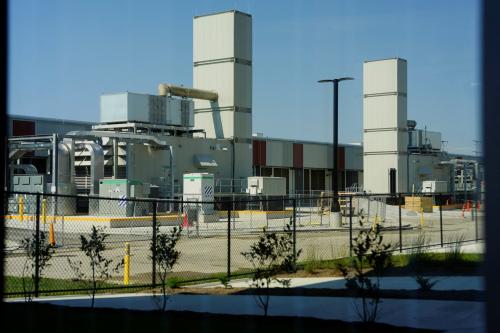
In their benefit agreements, companies should explain how they plan to meet the cooling and heating needs of data centers and what costs they will bear as opposed to what they expect from local utility companies. Several firms already engage in some type of cost-sharing, but the level varies from state to state. The Public Utilities Commission of Ohio recently passed a measure “requiring large new data center customers to pay for a minimum of 85% of their subscribed electricity usage—regardless of actual consumption—for up to 12 years.” Other companies are utilizing colocation energy sources found near their data centers to provide power for those facilities.
Water usage
Water utilization is an important consideration in data centers. As our Brookings colleague Joe Kane has noted, data centers can require considerable amounts of water. Water is a scarce resource in many parts of the U.S., and CBAs need to outline data center needs, how their consumption could affect other businesses, and the impact on residents. Local officials need to make sure that water will be available for all other activities and priorities. In instances where the irrigation system is eroded, AI companies should work with local communities to mitigate the challenges and partner on projects that address waning water usage. They should also deploy closed-loop cooling systems that reduce water utilization over evaporation models.
Noise levels and light pollution
Because cooling units are often located on the top or sides of data centers, these facilities can be noisy and disruptive to those who live nearby. Residents in several areas have complained about high noise levels as well as light pollution. Due to security concerns, most data centers are very well lit to make sure their physical perimeter is well-protected and the electronic equipment is not harmed. Companies need to specify what the projected noise and light levels are, what the impact might be on nearby homes and businesses, and what they plan to do to mitigate nuisances to local inhabitants. AI companies should submit to noise and pollutant studies, so communities have a broad and transparent understanding of these issues.
Environmental hazard monitoring
Companies can help local communities monitor environmental hazards by setting up appropriate testing and measurement tools as well as engaging in site reviews that ensure compliance with state and local laws. This will enable appropriate tracking of air and water contaminants and make sure data centers are not contributing to problems associated with these risk factors. Such reviews should also be done after construction, once the data center is fully operational. By taking a proactive stance on environmental hazards, firms can help communities deal with these matters and assuage residents that their concerns are taken seriously.
AI companies will face a key challenge related to environmental remediation: The federal charge to expedite and possibly override environmental compliance. President Trump’s AI Action Plan details these actions, which could encourage companies and states to pursue faster timelines for building and opening data centers. Environmental hazard monitoring should not be compromised—or pose threats to data center development. Leaders must establish clear baselines for monitoring potential environmental impacts while assuring communities against public health threats.
Workforce training
Assessing the job creation and workforce development gains of data centers is crucial to their success. Many communities are suffering from shortages of electricians, welders, pipefitters, plumbers, and other trades workers. Since locales need them to construct data centers, companies can train these individuals to work on their facilities while increasing the local supply of workers in the trades. Having requirements for businesses to rely on local labor would help communities develop their own talent and create a pool of workers that would benefit the entire area. To go further, AI companies could collaborate with community colleges to invest in their trades curriculum and use AI-enabled content for licensing and recertification of existing trades workers.
As noted in the Cleveland example, benefit agreements can create apprenticeships, internships, and mentorships to establish career paths for young people. Youth unemployment is more than double the national level in the United States, and with the advent of AI and emerging technologies, entry-level jobs are at risk. Companies can mitigate some of these barriers by developing programs that help young workers, create pathways to employment, and possibly lead to working in one of the more lucrative technology jobs at the local data center.
Recently, Microsoft launched a TechSpark program that provides professional development opportunities for local communities, and other firms have launched similar initiatives. Microsoft has trained 34,600 individuals in 46 communities over the past two years, offering one example of how companies can enable residents to benefit from the digital economy.
Health and well-being services
Many have compared the data center boom to coal mining, which had a plethora of long-term adverse impacts on the health and well-being of workers and residents, some of which are still being mitigated in coal states like West Virginia. Although many environmental concerns are often treated as pre-construction issues, companies should remain committed to the long-term health and well-being of communities affected by data centers.
CBAs should specify how firms will support local communities, including by sponsoring annual wellness days or improving local health departments’ capacity to use AI-powered health dashboards. Most cities already have mobile health outreach programs, and companies could provide financial support for these services. Given that health and scientific discovery are among the more significant reasons for increased data center development, it makes sense for AI companies to get more involved in supporting the well-being of residents and ensuring that data centers enable high-compute advances in health.
Digital access for the underserved
As Nicol Turner Lee has noted in her book “Digitally Invisible: How the Internet is Creating a New Underclass,” digital access remains a challenge in several communities across America. Up to 22% of Americans lack broadband access at home, and many others suffer from low broadband speeds; these families may not be able to benefit from AI in areas that improve quality of life, including health, education, finance, and employment.
A community investment fund can include money to support digital access. For example, a data center developer in Huntsville, Alabama, worked with local leaders on projects that “spurred broadband expansions that improved internet access for rural residents.” In that case, the community leveraged data center development to expand digital access and extend broadband services to underserved areas. To further support AI adoption, companies can work with national and community-based organizations to improve AI literacy and advance AI applications in education and health care. It is imperative that these plans extend beyond the construction phase to ensure that data center investments leave lasting improvements in community connectivity and awareness.
Public dashboard tracking key metrics
To make sure communities have the information they need to evaluate data center impact, community benefit agreements should include a public dashboard that tracks key metrics, such as job creation, tax revenues, electricity utilization, water usage, and workforce development. These dashboards could be hosted on town, county, and city websites to ensure accountability for data center developers and allow officials, residents, and reporters to determine whether data centers meet their stated goals.
These areas could form the basis of a CBA template that includes challenges for government, community, and industry stakeholders to solve together. The formation of a community advisory board could also be useful in managing these projects from conceptualization to implementation.
The data center boom is just underway. Companies are justifying it because these facilities are the backbone of AI and other emerging technologies. Public fears have weakened and, in some instances, stalled support for data center construction and operations.
This paper is intended to address the list of public concerns and play a critical role in finding ways for the various stakeholders to work toward more consensus and compromise. State and local leaders should consider this list when negotiating or searching for ways to engage their constituents in productive conversations on proposals.
Well-crafted community benefit agreements can address public concerns and mitigate known problems of data centers. This includes enumerating the costs and benefits of these facilities and making clear what local communities should expect in terms of corporate support, government investment, and community engagement. Greater transparency on each of these fronts would help assuage the worries of the American public.
Related Content
Authors


-
Acknowledgements and disclosures
Amazon, Google, Meta, and Microsoft are general, unrestricted donors to the Brookings Institution. The findings, interpretations, and conclusions posted in this piece are solely those of the authors and are not influenced by any donation.
The Brookings Institution is committed to quality, independence, and impact.
We are supported by a diverse array of funders. In line with our values and policies, each Brookings publication represents the sole views of its author(s).