This report was amended on January 22, 2026 to provide additional clarity about which actions were taken under the Regional Transportation Optimization initiative.
Mail-order pharmacies are a core part of the nation’s health infrastructure. By filling prescriptions for patients who cannot easily access a retail pharmacy, they extend the reach of the health system. The postal network enables this reach by fulling its mission of providing affordable, reliable, and universal delivery to every address in the country. For millions of Americans—particularly those in rural areas or with limited mobility—this delivery makes consistent access to prescribed medication possible. But on-going changes to U.S. Postal Service operations could put that access at risk.
In new research co-authored with Josh Feng and Matthew Higgins, I find that roughly 6% of all asthma and diabetes prescriptions nationwide were filled by mail. Moreover, the share of Medicare beneficiaries using mail-order rises sharply with distance to the nearest pharmacy: Patients living 10 miles further from a pharmacy are roughly 20% more likely to fill their prescriptions via mail-order.
This dependence makes current postal reforms especially consequential. Under the 2021 Delivering for America (DFA) plan, the U.S. Postal Service (USPS) extended formal delivery standards for some First-Class Mail, consolidated mail processing into regional hubs, and reduced the frequency of mail pick up for processing. While the DFA changes are intended to improve efficiency and service performance, these efforts have, so far, produced slower and less reliable mail that disproportionately affects those in low-density areas. Our estimates suggest that about 3.7 million Medicare beneficiaries live in areas where these three risks converge: limited pharmacy access, high mail-order use, and exposure to these postal network changes.
Postal restructuring overlaps with health care vulnerabilities
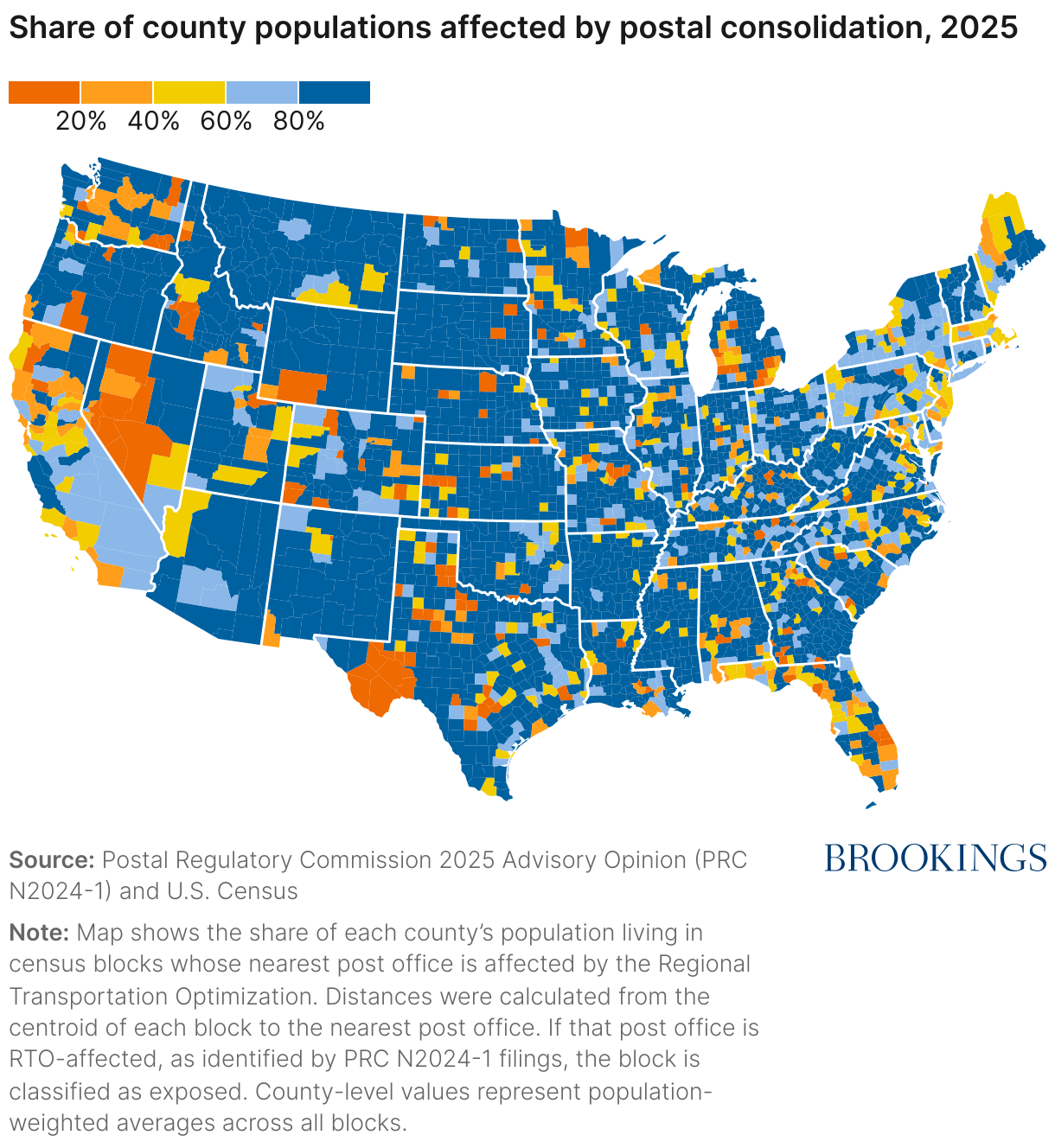
Figure 1 maps the counties most affected by these postal network changes. Exposure is concentrated in rural and low-density regions—places already facing longer travel distances and fewer pharmacy options. These are also communities where mail-order use is high, meaning that slower or less predictable delivery directly threatens access to essential medications. In this way, the geography of postal restructuring overlaps with the geography of health care vulnerability.
Operational changes seeking efficiency have uneven costs
The DFA plan aims to stabilize USPS finances after years of operating losses driven by declining mail volumes and rising costs over the last decade. To reduce expenses, the plan consolidates processing and transportation through initiatives such as the Regional Transportation Optimization (RTO) initiative. These steps are intended to improve long-term efficiency, but their short-term effects have been uneven, and questions have been raised about the ultimately likelihood of their success. What is unambiguous is that communities located farthest from regional processing centers face the greatest risk of slower or less reliable mail, despite the fact that they also are more likely to rely on the mail for prescription access and other essential goods. In this way, a financial reform meant to preserve the Postal Service’s financial performance may instead introduce geographic inequities in its reach—in direct conflict with its universal service obligation.
Slower delivery can disrupt medication adherence
Delivery speed and reliability are both essential to medication access. USPS has emphasized that the initiative is intended to improve reliability, even as other elements of the DFA lengthens average delivery times. Whether that tradeoff achieves its intended balance remains to be seen. From a health perspective, however, even small delays can matter.
Research consistently shows that timely access to medication supports adherence and prevents costly complications. Mail-order programs are associated with 30-40% higher adherence rates compared with retail pharmacy use, particularly for chronic conditions that require uninterrupted treatment. Delays in delivery can interrupt medication routines, leading to higher rates of emergency department visits and hospitalizations.
Because mail-order prescriptions depend on the Postal Service’s nationwide delivery network, postal performance becomes a determinant of public health. Slower delivery and degraded reliability can undermine the routine behavior that adherence depends on, eroding the very reliability gains the agency seeks to achieve. If patients begin to view mail delivery as unreliable, they may adjust their behavior in ways that reduce the effectiveness of mail-order channels as tools for sustaining consistent care.
Multiple risks converge in “Triple-Burdened” communities
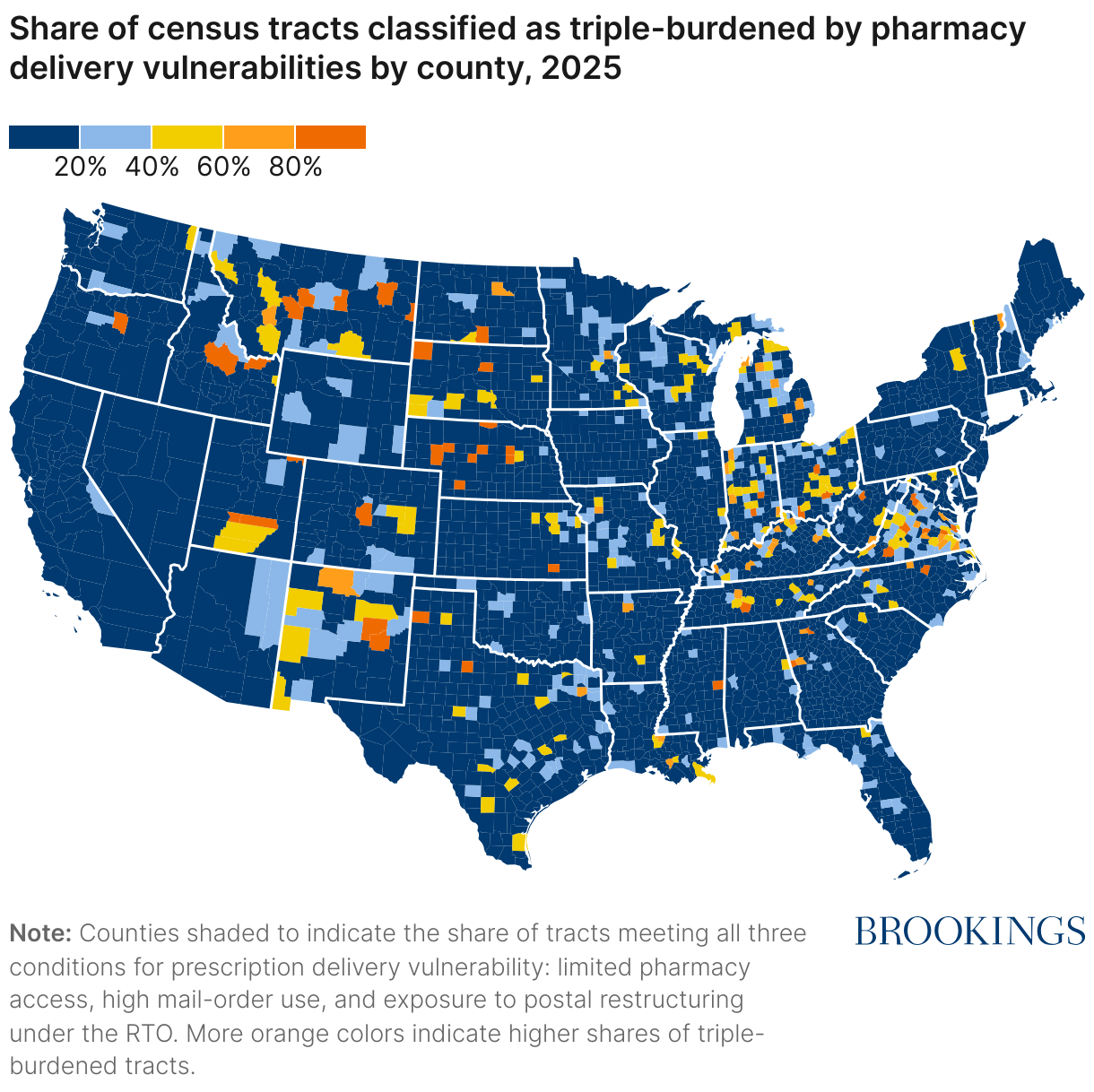
Limited pharmacy access, high mail-order reliance, and postal restructuring do not occur in isolation. Our analysis identifies the “triple-burdened” places where these three risks overlap. Roughly 3.7 million Medicare beneficiaries and 6% of the total population live in areas that meet all three conditions.
Figure 2 maps the geography of this overlap. Concentrations appear across Appalachia, the rural South, the Upper Midwest, and parts of the Mountain West; these places are generally characterized by longer travel distances, older populations, and high exposure to postal network changes. Given this, even modest slowdowns to postal delivery under the proposed changes could interrupt the supply of essential medications.
The postal network as health infrastructure
Together, these findings highlight that the postal system performs an underappreciated but essential public health function. Its universal reach, mandated by its universal service obligation, allows mail-order channels to compensate for pharmacy closures, transportation barriers, and the consolidation of retail access in rural areas. When delivery slows or becomes uneven, the consequences are likely to ripple through medication adherence and chronic disease management.
The DFA plan seeks to restore financial stability to the USPS, but operational reforms that produce geographic disparities risk shifting the follow-on costs of non-adherence onto the health system instead. Accounting for those indirect effects should be an essential requirement in aligning postal modernization with its public service mission. Maintaining reliable, geographically neutral and affordable mail delivery is not only a matter of operational performance; it is a condition for the continuity of health care. In much of rural America, the postal route and the prescription supply chain are one and the same.
Related Content
Author

The Brookings Institution is committed to quality, independence, and impact.
We are supported by a diverse array of funders. In line with our values and policies, each Brookings publication represents the sole views of its author(s).



Commentary
When slower mail becomes a health risk
Postal network changes and prescription delivery
December 4, 2025