On December 24, 2025, a quiet change took effect in the Postal Service’s Domestic Mail Manual. The new section (DMM 608.11) now clarifies that a postmark will no longer indicate the date a piece of mail was deposited with U.S. Postal Service (USPS). The Postal Service notes this misalignment “has and will become more common” as it continues consolidating its processing network and standardizing transportation schedules under the Delivering for America (DFA) plan.
Although the rule is technical, its implications reach well beyond postal operations. For more than 70 years, legal and administrative systems have treated a postmark as reliable evidence of when an individual met a deadline: when a ballot was mailed, when a tax return was filed, when a court document was submitted, or when an application was received. This reliance made sense in a network where most mail entered processing close to where it was deposited, keeping the postmark closely aligned with the date of mailing.
But what happens when the legal and administrative systems that depend on postmarks face a network where postmarks no longer reflect when something was sent? The DFA aims to strengthen USPS’ financial position, but it also disrupts an evidentiary tool that has long been woven into election law, tax administration, court procedure, and many other regulatory frameworks. This report examines that unintended consequence: how the modernization effort changes the timing of postmarking and what risks this shift poses for institutions that depend on postmark-based deadlines.
Why the USPS is redesigning its network: The logic and constraints of Delivering for America
Understanding the widening postmark timing gap requires understanding why the Postal Service is changing its network at all. The DFA plan reflects the USPS’ strategy for addressing financial instability and modernizing an infrastructure that has not been substantially reconfigured in decades. The volume of letters, long the most profitable category of mail, has fallen sharply over the last decade and a half, reducing the revenue that once supported nationwide operations. At the same time, package volumes have grown in ways that place new demands on a system designed to handle paper, not parcels. These shifts have produced a structural mismatch: The Postal Service must meet its statutory obligations with a network whose scale and configuration no longer align with how Americans use the mail.
The consolidation of mail processing is intended to bring the network into closer alignment with these realities. Many facilities built for higher operating volumes now run below their intended capacity, while others require upgrades that are difficult to justify as letter mail volumes continue to fall. Concentrating operations into a smaller number of regional centers allows the USPS to make fuller use of automation, standardize transportation schedules, and deploy staff and equipment more efficiently. From the agency’s perspective, these changes are necessary to create a processing network that can support consistent service on more sustainable financial footing.
Network consolidation has been paired with revised First Class Mail service standards that permit longer delivery windows for much of the country. By extending expected delivery times for mail now traveling longer distances for processing, USPS aims to reduce reliance on costly air transportation and shift more volume to surface transport. These adjustments are part of the same effort to reshape the network around predictable, lower-cost operations. But they also signal a recalibration of expectations: Timely delivery is being defined differently than when the legacy network and its service standards were put in place.
Finally, the DFA made changes to transportation schedules under the Regional Transportation Optimization (RTO) in a parallel push for standardization. Many post offices that once dispatched mail for processing twice per day now send mail only once in the morning, meaning that items deposited after the cutoff generally do not begin moving through the system until the following day. This effect is most pronounced in less dense and rural areas, where distances to processing centers are longer. These changes are intended to create more reliable and efficient transportation schedules, but they also alter when a piece of mail technically enters the USPS system for sorting and delivery.
None of these reforms were designed with postmark timing in mind. The DFA plan is aimed at aligning the network with contemporary mail flows and achieving cost-savings that can improve long-term financial stability. But taken together—more centralized processing, slower service standards, and new transportation schedules—they change the timing and location of a mail pieces’ first handling. This shift has downstream implications for legal and administrative systems that rely on postmarks as evidence of timely action, with disproportionate effects for rural communities.
From local mail centers to regional hubs: How processing is changing
What a postmark is and why it matters
A postmark is the dated imprint applied by USPS during “cancellation”—the process that marks a stamp as used and identifies the date and place of processing. It is not applied when a customer hands a letter to a mail clerk or drops it in a mailbox. Instead, USPS applies the postmark at the first mail processing facility, using automated cancellation machines or manual hand-stamps for certain classes of mail.
How mail was processed in the legacy network
In the legacy network, a mailed letter typically entered processing and was postmarked the same day that it was deposited. A sender dropped a stamped mailpiece at a post office or collection box, where USPS collected outgoing mail—often multiple times per day—and dispatched it to a nearby Sectional Center Facility (SCF), the local automatic mail-processing plant serving its surrounding three-digit ZIP code region. Because these facilities were geographically close and dispatches were frequent, cancellation and postmarking usually occurred during evening or overnight processing, consistent with service standards that treated much local mail as overnight or next-day delivery. As a result, the postmark applied during cancellation generally reflected the date the letter was mailed.
This system was supported by a nationwide network of 195 SCFs. This scale and geographic distribution made same-day entry into processing routine rather than exceptional, embedding the postmark’s reliability into legal and administrative systems.
How Delivering for America changes where mail is first processed
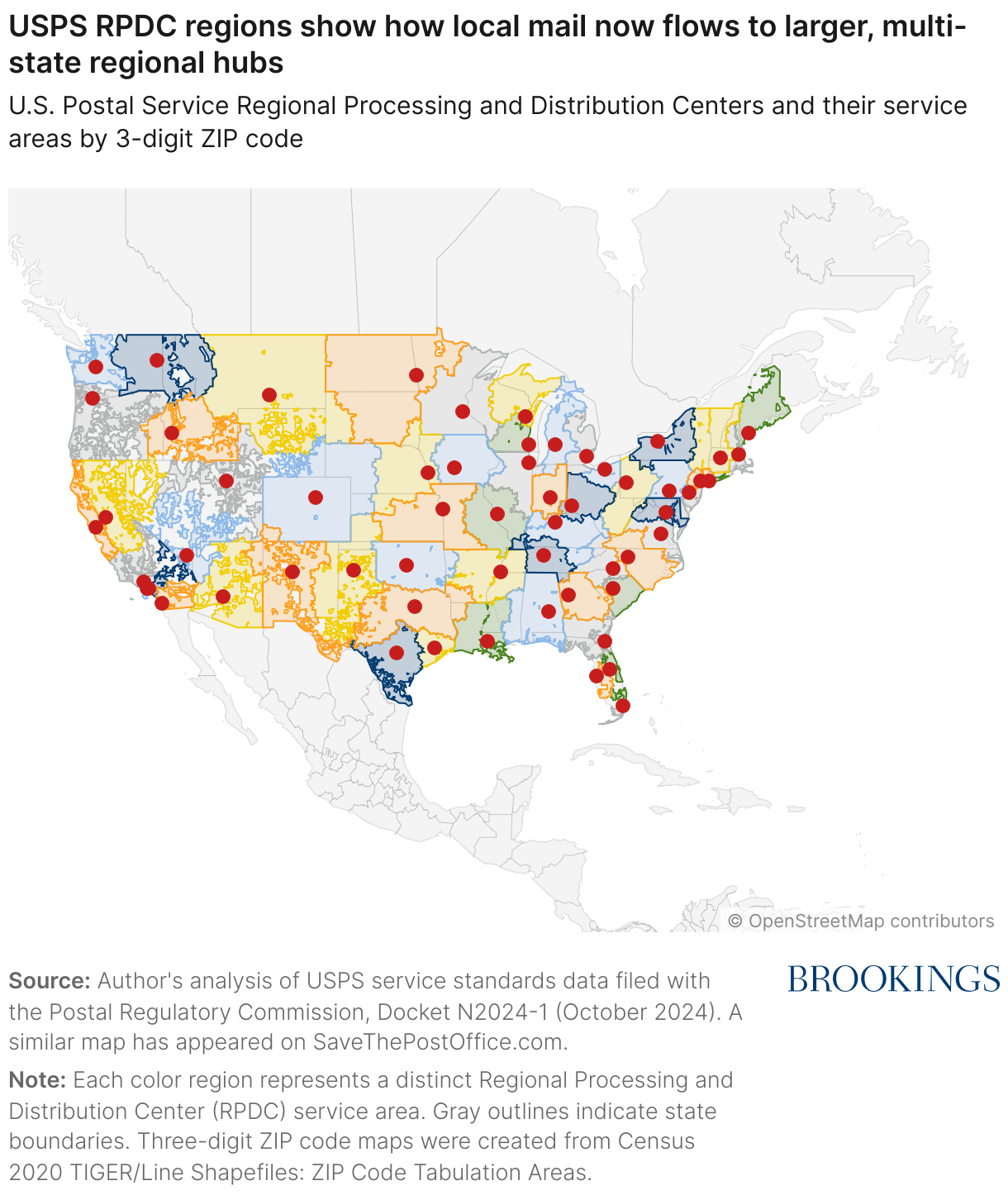
The DFA plan consolidates mail processing from a more decentralized network of nearly 200 sectional center facilities into roughly 60 Regional Processing and Distribution Centers serving much larger territories. These new hubs consolidate originating mail from many former SCF regions, sometimes spanning multiple states. Instead of mail traveling a short distance to a nearby processing plant, it now travels to a regional facility that may be hundreds of miles away. The scale of these service areas is visible in Figure 1: Multi-state processing regions now cover much of the country, and only a handful of states retain processing facilities that operate primarily within their borders.
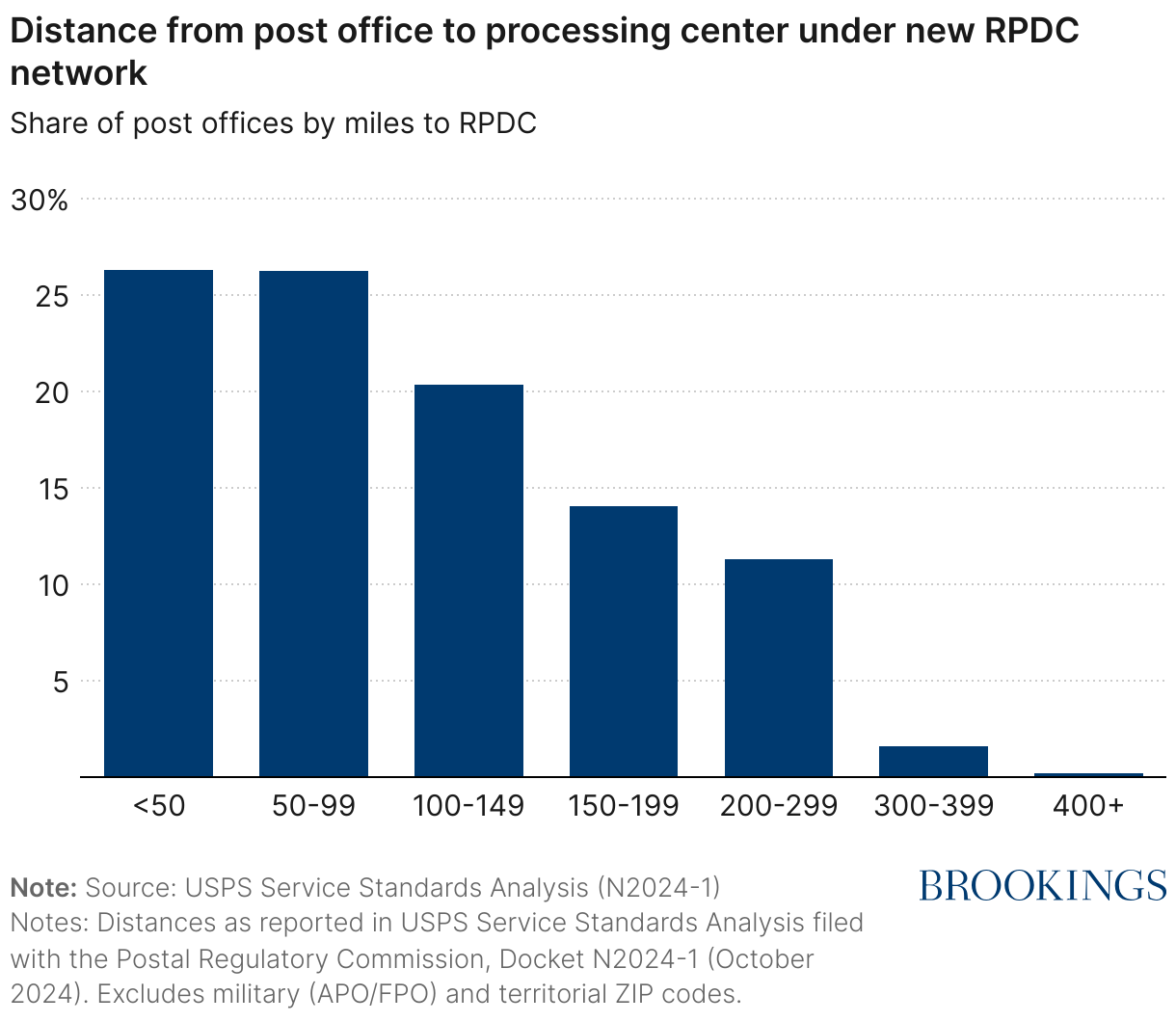
The consolidation results in sometimes especially long distances between many post offices and the facility that performs the first processing of their mail. Under the RPDC network, fewer than 30% of post offices are within 50 miles of their RPDC, while a similar amount are between 150 and 500 miles away (Figure 2). The result is a system in which the first handling event occurs significantly farther from the point of mailing than in the legacy network.
These long distances do not imply operational failure; they reflect the logic of a regionalized network designed to concentrate volume and increase automation. But they mark a structural departure from the system that long kept processing close to home.
How the RTO changes when mail begins moving through the system
Separate from network consolidation, the operational changes under the Regional Transportation Optimization (RTO) program alter when mail begins moving toward a processing center. Under the RTO, post offices located more than 50 miles from their assigned RPDC or Local Processing Center will shift to a single morning dispatch. This replaces the multiple daily dispatches that previously allowed late-afternoon mail to reach processing the same day.
RTO does not affect every post office, nor is it intended to. But because the criterion is distance-based, its impact is concentrated in rural, small-town, and less densely populated regions, where long travel distances to RPDCs are most common (Figure 3).
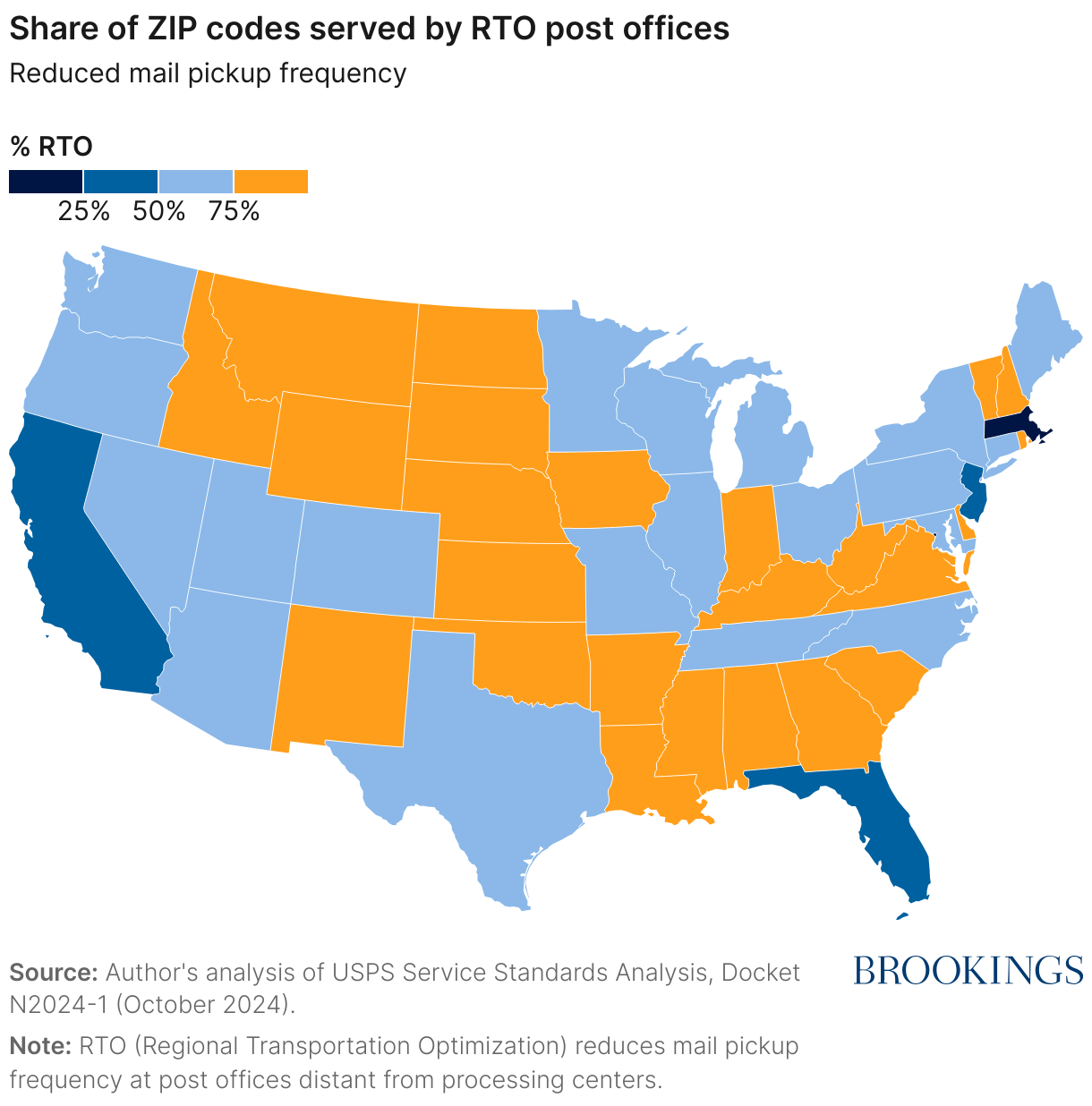
For these communities, acceptance into the USPS processing network now occurs with the next morning’s dispatch. Mail dropped off during the day must therefore wait until the following day to move toward the RPDC. When paired with the long distances to RPDCs, this can substantially increase the time before USPS first processes it.
Why these changes create compounding delays before postmarking
The redesign of the processing network and the adoption of RTO schedules are independent developments, but together they widen the gap between when a letter is mailed and when USPS applies the postmark. When mail begins its journey only once each morning and must travel farther to reach its processing center, the first handling event occurs later and with greater variability than in the legacy network. In the new network, a letter from an RTO-affected post office travels an average of 139 miles to get to its RPDC, with maximum distances exceeding 500 miles. By comparison, a letter from a post office that is not affected by the RTO travels an average of just 27 miles to its RPDC and is still dispatched multiple times per day.
These structural changes shift the practical meaning of a postmark, as the USPS acknowledges in the recently finalized change to the DMM: “the postmark date does not inherently or necessarily align with the date on which the Postal Service first accepted possession of the mailpiece … [and] this lack of alignment has and will become more common with the implementation of the Regional Transportation Optimization (RTO) initiative.” Because legal and administrative systems rely on postmarks as evidence of timely action, the combined effect of these changes carries consequences that extend beyond postal operations.
Where these timing effects are most severe
DFA consolidation also introduces another form of geographic separation: Many communities now send their mail to a processing center located in a different state. While crossing a state line is not inherently significant for postal operations, it is a practical indicator of how much the footprint of first processing has expanded under the RPDC network. In the legacy SCF system, most mail was processed in state; under DFA, entire regions now enter the network at distant, multi-state hubs. Cross-state processing therefore serves as a useful proxy for where processing has moved substantially further from the point of mailing.
Based on ZIP-Code level processing assignments filed by the Postal Service with the Postal Regulatory Commission in Docket N2024-1, ten states will have 100% of their mail processed out of state. These include small New England states (Vermont, New Hampshire, Rhode Island, Connecticut), where mail now flows primarily to Massachusetts facilities; mid-Atlantic states whose mail is consolidated into Maryland or Pennsylvania plants; and rural western or southern states (Wyoming, South Dakota, West Virginia, Arkansas, Mississippi), which lack an in-state RPDC and whose mail is routed to large hubs in neighboring states. For residents of these states, mail crossing a state line is no longer an exception; it’s the new baseline for first processing. Under the legacy network, no states saw 100% of their mail processed out of state.
Exposure also varies meaningfully within states. Metropolitan areas, even in highly affected states, often remain unaffected from RTO because of their proximity to processing facilities and the volume of their outgoing mail. Rural and small-town post offices, however, frequently fall outside of the 50-mile radius, placing them at the center of the operational changes introduced under DFA.
To understand where the two mechanisms converge, I classify ZIP codes by whether they are served by an RTO post office (a post office shifting to one processing center dispatch each morning) and whether their mail is processed in or out of state, yielding four categories of risk to timely postmarking (Table 1). Over 25% of ZIP codes are low risk, meaning that mail is processed in-state and dispatched multiple times per day. About 52% of ZIP codes are in one of two moderate risk categories, facing just one of the two risk factors. And nearly 22% of ZIP codes are high risk, meaning that they are exposed to both RTO and cross-state processing.
|
In-State Processing |
Out-of-State Processing |
|
|
Non-RTO Post Office |
Low Risk |
Moderate Risk |
|
RTO Post Office |
Moderate Risk |
High Risk |
Notes: Author’s analysis of USPS Service Standards Analysis, Docket N2024-1 (October 2024). Percentages represent share of ZIP codes in each category. Out-of-state processing determined by comparing ZIP code state to assigned RPDC state.
Even in low-risk ZIP codes, however, postmarking timing is not fully insulated from variability. Most local First-Class Mail is subject to a two-day delivery expectation. In the redesigned network, meeting that standard makes overnight cancellation less critical than it was under the legacy network that often sought to turnaround local mail overnight. Moreover, routine calendar gaps, such as Sundays and postal holidays, can further delay when mail first enters the system. As a result, closer proximity to a processing center reduces, but does not eliminate, the risk that a postmark will reflect a later date than the date of deposit.
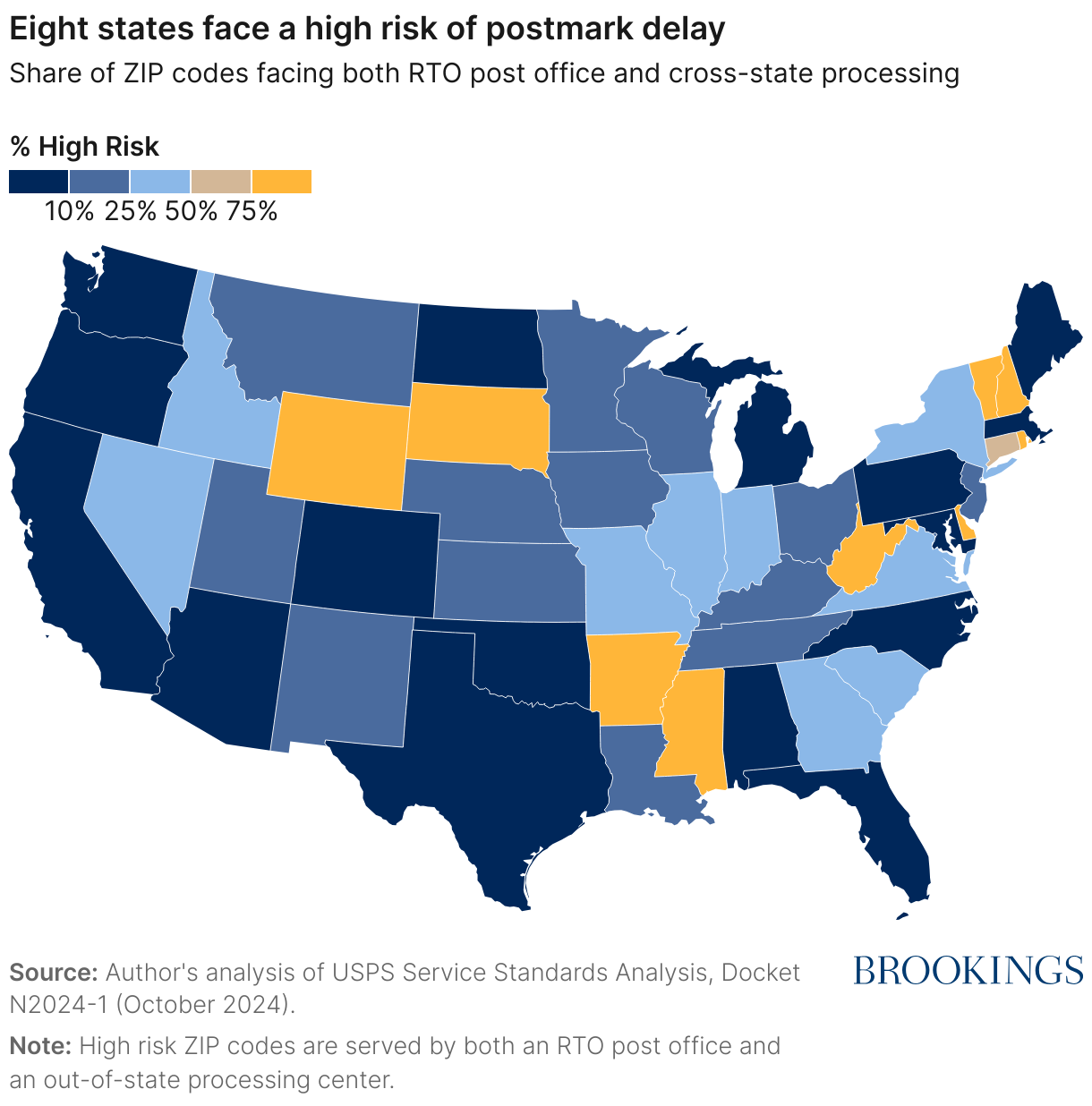
While the national distribution of risk factors provides a sense of overall exposure, it does not show how these patterns are arranged geographically. Figure 4 breaks these numbers down by state, showing the share of ZIP codes in each state that fall into the high-risk category. In several states (Wyoming, Vermont, South Dakota, West Virginia, Arkansas, and Mississippi), nearly all mail will face both delay factors. Elsewhere, moderate exposure appears across the central and eastern United States, from Missouri and Virginia through Illinois and South Carolina, with roughly one-third to one-half of ZIP codes affected. By contrast, large and populous states such as California, Texas, Florida, and Pennsylvania have very few high-risk ZIP codes.
Systems that rely on postmarks
Elections
In many states, the postmark on a ballot return envelope is the legal determinant of whether a mailed ballot is timely. State election codes typically require ballots to be received by Election Day or, in some states, to be postmarked by Election Day and received within a short grace period. According to the National Conference of State Legislatures’ Table 11 (updated Nov 21, 2025) 34 states require ballots to be received on or before Election Day, while 16 states and the District of Columbia will count ballots after they arrive if they are postmarked on or before the statutory mailing deadline. The operative assumption here is that a timely postmark is treated as reliable evidence of timely mailing.
Election officials have already expressed concern that this assumption may no longer hold under current USPS operational changes. In formal comments to the Postal Service in September 2025, the Montgomery County, Maryland Board of Elections warned that the proposed changes to the DMM—clarifying that a postmark “does not inherently or necessarily align” with the date USPS first accepts possession—could increase the number of ballots rejected as untimely. The Board noted that “almost half” of Montgomery County’s mailed ballots in recent elections were sent to election officials via USPS and cautioned that delayed postmarks would undermine Maryland’s statutory framework, which relies on postmarks for determining ballot timeliness.
Civil society groups have raised similar concerns. In September 2025, The Center for Election Confidence urged USPS to preserve consistent postmarking practices for ballots and other time-sensitive mail, emphasizing that postmarks have long served as a trusted marker of whether voters met statutory deadlines. The organization warned that changes to postmarking practices would introduce uncertainty into election administration in jurisdictions that rely on postmarks to determine whether a ballot was timely cast.
These concerns are not hypothetical. In Iron County, Utah most post offices now operate on RTO schedules and mail processing has shifted from an in-state SCF to an out-of-state RPDC. In the June 2024 primary election, hundreds of ballots arrived with postmarks dated after the state’s statutory mailing deadline. Utah law requires that ballots be postmarked by the day before Election Day, and the late-postmarked ballots prompted local officials to initially delay certification of the results. After review, the Iron County Commission ultimately voted 2-1 to certify the election without counting the late-postmarked ballots, concluding that state law provided no discretion to include them.
Emerging legal uncertainty could further reshape how post-Election Day mail-in ballots are treated. The U.S. Supreme Court has agreed to hear Watson vs. Republican National Committee, a challenge to state laws allowing ballots that are postmarked by Election Day to be counted, even when they arrive after Election Day. The Court will decide whether election-day statutes preempt these rules. This decision could upend ballot-receipt deadlines in more than a dozen states and sharpen the operational stake of USPS delivery timing ahead of the 2026 midterm elections.
Together, these examples illustrate how the meaning and reliability of a postmark directly affect election administration. When USPS network changes increase the postmarking gap, the statutory promise in postmark-deadline states—that voters who mail ballots by the deadline will have them counted—depends on operational timeliness that are increasingly variable and out of the control of the voters themselves. As previously discussed, this variability is concentrated in specific regions of the country, raising the likelihood that postmarking-based deadlines will produce geographically uneven effects.
Federal tax filings: The IRS mailbox rule (Section 7502)
Federal tax law codifies one of the clearest uses of postmarks. Under 26 U.S.C. Section 7502, often called the “mailbox rule,” a tax return or other filing that is delivered after its deadline is nevertheless treated as timely filed if it was postmarked on or before the due date. Congress enacted this rule in 1954 to codify the long-standing practice that the Postal Service’s postmark serves as reliable evidence of when a taxpayer placed a document in the mail. The statute applies broadly to individual and business returns, extension requests, refund claims, certain payments, and petitions filed with the U.S. Tax Court.
Because many tax deadlines are mandatory, the postmark can determine whether a filing is accepted or rejected. A late postmark generally means the document is late, regardless of whether the taxpayer actually deposited it on time. Courts have consistently applied the statutes this way across decades of litigation, emphasizing that Section 7502 protects timely postmarks, not timely mailing in the abstract.
Structural delays in applying postmarks therefore carry direct legal consequences. If network changes produce later postmarks for documents that were mailed on time, a taxpayer may appear to have filed past a statutory deadline, with consequences ranging from denied extension requests to the loss of refund claims or the jurisdictional dismissal of a Tax Court petition. Unlike some state election systems, which allow for grace periods or alternative evidence of timely mailing, Section 7502 treats the postmark as the filing date itself.
Other legal and administrative systems that rely on postmarks
Beyond tax administration, several other legal systems rely on postmarks to determine whether individuals have met enforceable deadlines. U.S. Supreme Court Rule 29.2 treats certain filings as timely if they are mailed through USPS and postmarked on or before the final day for filing, and similar provisions appear in the Federal Rules of Appellate Procedure for some categories of mailed submissions. These rules depend on the postmark as the natural timestamp for litigants who rely on the mail rather than electronic filing systems
Administrative agencies use postmarks in the same way. The Equal Employment Opportunity Commission, the Social Security Administration, and many state unemployment and licensing agencies treat documents as timely if they bear postmarks dated on or before the statutory deadlines. Because these deadlines are often mandatory and agency discretion is limited, the postmark frequently determines whether a claim or appeal can proceed.
State law and private transactions also rely on USPS postmarks as evidence of timely mailing. Insurance statutes, consumer notification requirements, and the common-law mailbox rule all assume that the postmark reasonably reflects when a party placed a document in the mail. In these contexts, like those previously discussed, the functioning of deadlines depends on postmarks tracking mailing behavior closely.
USPS’ position and proposed explanation
USPS has acknowledged in its final rule that the widening gap between when mail is deposited and when it receives a postmark is an expected result of changes to the processing network, not a change in how postmarks are applied. The agency emphasizes that it is not altering postmarking practices themselves; rather it is changing where and when mail is processed, and updating the DMM to reflect how postmarking has long functioned within the network.
In its notices, USPS describes the update to the DMM as a clarification of longstanding operational reality: A postmark on a piece of mail reflects processing, not acceptance, and the agency does not treat it as evidence of when a sender deposited an item. USPS further notes that the operational variability described earlier is inherent to a network organized around regional processing centers and standardized transportation.
In the final rule above, USPS also notes that these dynamics may matter to mailers who rely on postmarks as evidence of timely action. As a mitigation, the agency advises customers to request a hand-stamped postmark at the time of mailing if they require confirmation of the deposit date. USPS presents this option as readily available at any retail counter but fails to acknowledge that this option may be especially burdensome in less dense and rural communities where post offices are far apart and sometimes staffed for limited hours. These constraints are also likely to fall disproportionately on individuals who face mobility challenges, lack reliable transportation, or cannot easily wait in line for retail service, including many older adults and people with disabilities.
The mitigation also does not resolve the underlying legal ambiguity that has been introduced by USPS’ formal declaration that a postmark reflects processing rather than deposit. For systems that treat a postmark as evidence of timely mailing, this distinction raises questions about whether a hand-applied postmark can serve the evidentiary function that automated cancellation has historically provided, or whether statutory and administrative frameworks must now reassess the role of postmarks altogether.
Financial pressures vs. public obligations under DFA
USPS developed the DFA as a necessary response to a long-standing structural pressures that limit its ability to maintain the legacy processing network in a fiscally sustainable way. Declining letter volumes have reduced the revenue base that historically supported nationwide operations, and capital needs accumulated over decades now exceed what the agency can fund under its statutory requirement to break even. USPS argues that a geographically dispersed network of originating plants, built for much higher mail volumes, has become financially unsustainable and cannot support the investment needed to modernize equipment, automate operations, or stabilize service. Consolidation into regional centers and the standardization of transportation schedules are framed as the only viable means of aligning the network with present-day mail flows and financial obligations.
Embedded in this explanation is a tension that has shaped the Postal Service for much of its modern history. USPS is expected to operate with the fiscal discipline of a self-funded enterprise while simultaneously upholding a universal service obligation rooted in public access rather than market demand. For decades, high mail volumes muted this conflict: The revenue generated by paper-based communications subsidized a broad and uniform delivery network that functioned as shared public infrastructure. As that revenue based has eroded with digitization, the alignment between USPS’ financial imperatives and its public responsibilities has become harder to sustain.
DFA represents an institutional attempt to navigate this tension. USPS argues that consolidating operations and standardizing transportation are necessary steps to preserve nationwide service in the long term. Yet, the consequences of these choices extend well beyond the agency itself. The resulting timing divergence described earlier alters operational features that legal and administrative systems have relied on for decades, and the effects fall unevenly across the country, with the greatest burdens in places where the universal service obligation is most central to civic participation, economic activity, and access to government services.
DFA responds to genuine financial constraints, but the reforms it introduces reshape elements of postal operation that have long served as quiet connective tissue for elections, tax administration, court procedure, and other functions that rely on timely, predictable mail entry and universal access for all Americans. What was once a marginal timing discrepancy is now structurally embedded in the redesigned network. As USPS adapts to its fiscal environment, institutions that depend on the stability of prior practices must reassess long-standing assumptions about how the mail functions within their systems.
Conclusion
The timing divergence between mailing and postmarking resulting from recent structure changes at USPS unsettles a long-standing evidentiary convention that has quietly supported a wide array of legal and administrative processes, from local and state agencies to federal programs and Supreme Court procedures. Since at least the 1950s, these systems assumed that a postmark reliably indicated when a piece of mail was sent, without needing to account for how postal operations produced that alignment, in part because postal practices were broadly aligned with the needs of these systems.
The Postal Service has made clear that this timing gap is now an accepted norm, rather than an occasional exception, under the redesigned network. As a result, operational reforms within the USPS carry systemwide consequences for institutions that rely on timely mail entry but do not control the conditions that determine it. This shift reveals a governance gap for a public institution that is expected to function both as national infrastructure and a self-funded enterprise. The Postal Regulatory Commission may choose to examine these effects, but its oversight authority does not extend to ensuring that postal operations remain aligned with statutory deadlines.
At the same time, the configuration of the redesigned network is not fully settled. Implementation of the RPDC model continues to evolve as USPS moves from planning to execution, and the agency has already adjusted elements of its consolidation strategy in response to operational and local considerations. For example, in February 2025, USPS announced that it would retain certain local originating mail processing at the Dakota Central facility in Huron, South Dakota, rather than relocate those operations out of state, allowing locally mailed letters to continue to be processed—and postmarked—within the state. This decision illustrates that the timing and location of first processing remain subject to ongoing adjustment as the DFA plan is implemented.
Responding to this growing divergence between mailing and postmarking will therefore require coordination beyond the Postal Service. Public bodies and regulated entities that depend on mailed submissions to establish timeliness will each need to reassess whether current rules reflect contemporary postal practices and whether alternative means of verifying timely action are necessary. Modernizing the postal network may be essential to fiscal sustainability under the current funding model, but the costs of parallel adjustments in systems that depend on that network must also be recognized when evaluating the impact of the DFA. Without such alignment, operational changes at USPS will continue to produce unintended and uneven effects across the public and private spheres that rely on mail function.
Related Content


Author

The Brookings Institution is committed to quality, independence, and impact.
We are supported by a diverse array of funders. In line with our values and policies, each Brookings publication represents the sole views of its author(s).