This audio recording is part of the UNGA 2025 special episode of the Foresight Africa podcast. Listen to the third episode of the three-part series, which includes interviews with three other speakers on site at the event.
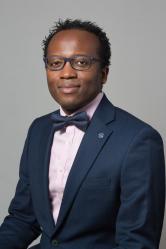
Landry Signé, senior fellow in the Global Economy and Development program and the Africa Growth Initiative at the Brookings Institution and host of the Foresight Africa Podcast, attended the U.N. General Assembly in September to speak with some of organization’s top leaders and international partners on the U.N.’s successes and future in a changing world.
In this interview, Landry Signé speaks with Abdoul Salam Bello, Chief of Economic Affairs in the U.N.’s Office of the High Representative for Least Developed Countries, Landlocked Developing Countries and Small Island Developing States (OHRLLS). With a long career in international development, including as Executive Director of the World Bank Group, Bello discusses how the U.N. continues to coordinate and tailor support to countries amidst new global challenges.
Transcript
LANDRY SIGNÉ: Before we begin, could you please state your full name and title for the recording?
ABDOUL SALAM BELLO: My name is Abdoul Salam Bello. I’m the former Executive Director at the World Bank for Group Africa Two. But currently I serve as a Chief Economic Affairs in the Office of Higher Representative for the Least Developed Countries, Landlocked Developing countries and Small Island Developing States.
LANDRY SIGNÉ: Welcome to the Brookings Institution Foresight Africa Podcast show.
ABDOUL SALAM BELLO: Thank you for having me. Very glad to be here.
LANDRY SIGNÉ: After 80 years of the United Nations, what do you see as the organization’s most enduring achievements and how should these be built upon for the future?
ABDOUL SALAM BELLO: 80 years is quite a long period. Enduring achievement, I would say is still being here and relevant for 193 countries today. Also providing support to the most vulnerable countries. Leaving no one behind. Especially in the context of conflict, humanitarian issues, through peacekeeping operations, providing the platform for negotiation. Peaceful resolution of conflicts but also providing solution for development response going forward. So, I would say achievements are quite substantial in this regard.
LANDRY SIGNÉ: Amazing. How do you envision the UN as a whole and your office in particular, adapting to a rapidly changing global landscape marked by new technologies, shifting power dynamics and global crisis?
ABDOUL SALAM BELLO: I would say one, what is important is leave no one behind. But also ensuring that one size doesn’t fit all. So, coming with custom tailored approaches solutions but also being adaptive to the global changes the global environment. Should be the political landscape, should be the economic landscape working also to influence, for instance, the global financing architecture for it to be more inclusive.
I think those elements are quite important. And this is also part of our agenda here at OHRLLS. We have three programs looking after. The Least Developed Countries that do have program of action; the Landlocked Developing Countries, for which we conclude d a conference just one month ago in Awaza, Turkmenistan, which came with a program of action called the Awaza Program of Action, but also the small island developing states with a program called ABAS. Antigua and Barbuda Action Plan for the SIDS. So overall, we cover 91 countries, but that’s why we say that leave no one behind, but also have a custom tailored approach, meaning that through those program also the point is to reflect on the reality and the needs of those vulnerable groups, but also making the right advocacy for their voice to be heard, strengthened, but also supporting their strategies, mainstreaming those program of action, helping through their respective strategies. Building also a partnership through the other UN institutions, like the resident coordinators of the United Nations, but also the MDBs, the think tanks among others.
For instance, one of the initiatives we have in the context of ABAS is what we call the center of excellence for the SIDS. Which has various components: an investment facility to mobilize private capital to support businesses, looking at the global realities, I would say in this context, but also a data hub that we look also at new technology, disruptive event, leveraging to some extent artificial intelligence.
So, the institution has to remain relevant, but by doing so, also remaining connected to the global agenda.
LANDRY SIGNÉ: Amazing. What unique advantages and opportunities does the multilateral system offer countries today as they seek to advance their national priorities while contributing to global public goods?
ABDOUL SALAM BELLO: Advantage opportunities for the multilateral system for countries. I would say one is maybe we can reverse the question. So, what if the system doesn’t exist? To whom will they turn to advance their agenda. Nowhere. So, the UN provides that platform, and you see it even with all the gatherings, the statements made by the various heads of delegation during the general assembly.
In addition to that, the number of meetings at that strategic level to develop partnership, foster cooperation, but also to mobilize, to work with other institutions or organizations such as universities, think tanks, even charities to come up with innovative solutions.
So, I would say being relevant, being present, creating the platform, having what we call the convening power. To bring as much as possible, all the stakeholders together to help address specific issues.
LANDRY SIGNÉ: Fantastic. Looking ahead, what key priorities and recommendation will guide your office’s work during this 80th session of UNGA, and how do you hope this will shape the next phase of the United Nations’ role in global governance?
ABDOUL SALAM BELLO: The vulnerable groups are 91, that are from the least developed countries to the landlocked developing countries, to small island developing states.
For each of these groups, we have series of activities and engagements regarding some specific activities needs that for which either they need some supports, we are helping create that platform, or even a statutory discussion like the ministerial level meeting to monitor the implementation of the respective program of action.
We’ll have the launching of the Center of Excellence for ABAS sometime this week. We will be at the OASIS, which is the small island developing state platform, meeting this week. But also, two important ministerial meetings: one for the Least Developed Countries one for the Landlocked Developing Countries for which also we are providing support. To have the leaders of these respective groups reflect on the implementation of the program of action, reflect on the reform of the United Nations, but also supporting initiatives, partnership that helps foster the implementation of those programs. For instance, in Awaza, in Turkmenistan, we had very good engagement with the AIIB, the Asia Infrastructure Investment Bank that pledge up to $10 billion over the next five years to support the landlocked developing countries.
So those are the initiatives. We believe also that are very, not only ambitious, but also are meant to provide results, impact impactful solution for the various constituents. On the other program you have the online university for instance, that we are working to support on the landlocked developing countries.
I mentioned the center of excellence for the small island developing states. Those are the initiative that are there. But what is important is to keep the engagement with the member states and to keep. Supporting mainstreaming, the implementation of those respective programs.
The very last element is of course we have this initiative called the Multidimensional Vulnerability Index, the MVI, looking at how we think about resource allocation for the most vulnerable countries. Of course we supported various reports in this regard, but also engaging now with the MDBs multilateral development bank to have them also buying in and reflecting on to which extent that the MVI also will be of relevance in the future of resource allocation. Knowing that, talking about today the reduction of the ODA the climate challenges, most of the countries are going through debt issues. So those kinds of initiatives also can bring new reflections, new solutions.
And it speaks also to the previous question you had on how we work in the changing environment, so we need to keep remaining adaptive to those. Thank you.
LANDRY SIGNÉ: Amazing. Thank you so much for your time.
ABDOUL SALAM BELLO: Thank you. Thank you.
Authors
-
Acknowledgements and disclosures
The Foresight Africa podcast is brought to you by the Brookings Podcast Network. Send your feedback and questions to [email protected]. Special thanks to the production team including Fred Dews, producer; Dafe Oputu, and Nicole Ntungire, associate producers; Gastón Reboredo, audio engineer; and Izzy Taylor, communications manager in Brookings Global. The show’s art was designed by Shavanthi Mendis. Additional promotional support for this podcast comes from my colleagues in Brookings Global and the Office of Communications at Brookings.
The Brookings Institution is committed to quality, independence, and impact.
We are supported by a diverse array of funders. In line with our values and policies, each Brookings publication represents the sole views of its author(s).

Commentary
The United Nations at 80: Adapting to support the world’s most vulnerable states
Foresight Africa podcast at UNGA 2025
February 19, 2026