Introduction
Recent debates over postal service modernization, consolidation, and service performance have focused largely on improving operational efficiency and financial performance. Much less attention has been paid to the broader economic benefits of the postal network, including how universal service may support local economic activity and contribute to patterns of economic growth. These considerations may be especially relevant in rural and less dense areas, where private carriers offer fewer local access points and the postal network often provides the only nearby retail mailing and shipping infrastructure. This study examines one dimension of that relationship by analyzing how access to postal infrastructure is associated with small-business activity in rural counties, treating the postal network as part of the physical infrastructure that supports everyday economic activity.
Small businesses play a central role in the U.S. economy. Firms with fewer than 500 employees account for the vast majority of U.S. businesses and employ nearly half of the private-sector workforce, while also serving as a primary source of job creation. More than three-quarters of these firms are very small: Non-employer and owner-operated businesses account for the majority of business establishments nationwide and are particularly prevalent in service-oriented sectors such as professional services, transportation, real estate, health care, and retail trade. Operating at a small scale, these businesses are more likely to rely on shared external infrastructure rather than in-house administrative, logistics, or distribution systems. As a result, differences in the local infrastructure environment can shape patterns of business entry, persistence, and local activity.
Rural economies differ from urban economies in ways that make small businesses especially central to local economic activity. Business activity in rural areas is heavily concentrated in very small firms. As a result, small businesses play an outsized role in providing essential goods and services and supporting local employment and earnings. At the same time, markets for labor, inputs, and professional services are thinner, and routine business activities often require greater travel distances. These structural features mean that access to basic infrastructure plays a more direct role in enabling small-business operations than in denser settings, where firms can more easily substitute among providers and services.
Within this environment, the U.S. Postal Service (USPS) supports a range of routine business functions, including sending and receiving parts and supplies, shipping goods to customers, sending contracts and other time-sensitive documents, maintaining a stable mailing address through a post office box, and handling payments and official correspondence. The Postal Service frequently serves as the most accessible option for these services in rural areas, as private carriers may have limited presence and impose location-based surcharges. Survey evidence from the Postal Service’s Office of the Inspector General (OIG) underscores this reliance: In fiscal year 2022, more than 60% of small and very small businesses reported visiting USPS retail locations two to four times per month, compared with roughly 50% for UPS and FedEx. The same survey found that small businesses cite convenient locations, competitive pricing, and knowledgeable retail associates as primary reasons for choosing USPS over private carriers. In addition, OIG data indicate that businesses rent approximately 250,000 post office boxes nationwide, highlighting the role of postal address services for firms that lack a fixed commercial location.
Despite the value of USPS services and infrastructure to small businesses, their role in supporting local economic activity has been understudied. Most existing evidence describing the role of the network consists of descriptive and oversight reports produced by bodies such as the Government Accountability Office, the United States Postal Service Office of the Inspector General, and the Postal Regulatory Commission. One exception is a national analysis that finds some evidence that post office closures are associated with short-run decreases in employment. Closure-based analyses, though, face inherent limitations because, as will be later explained, post office closures are infrequent, exposed to political pressures, and unevenly distributed across communities; this limits their usefulness for understanding broader economic relationships.
This study takes a different approach by treating postal access as long-standing, geographically fixed infrastructure and asking whether proximity to post offices is related to small-business activity in rural counties. Using administrative tax data on small businesses, patterns are examined both in aggregate and across industries. Rural counties with closer access to post offices consistently have higher levels of small-business activity, with the strongest relationships concentrated in sectors that account for a large share of rural self-employment. Because post office locations change infrequently, the evidence points toward postal access supporting small-business activity rather than simply coinciding with places that are already economically stronger. In other words, this work suggests that the postal network plays an economically meaningful role for rural small businesses.
The universal service obligation makes postal access central to rural economies
A defining feature of the U.S. postal system is its universal service obligation (USO), which requires the Postal Service to provide affordable and reliable service to all communities, regardless of geography. Unlike market-based delivery systems, the postal network is not designed to expand, contract, or reprice services in response to local profitability. Instead, post office locations, service standards, and pricing are structured to ensure broad geographic coverage and continuity of access nationwide.
This institutional mandate is especially consequential for rural and less dense areas—communities that, because they have small customer bases, private carriers would be unlikely to serve on commercial terms. As a result, the USO embeds the postal network into rural economies in the form of shared infrastructure rather than a discretionary retail service. Similar universal service frameworks govern postal systems in most other high-income countries, including those with corporatized or privatized national posts, reflecting a widely shared view that postal networks perform an essential public function beyond their immediate financial performance.
The economic relevance of this access is shaped by the structure of rural economies themselves. Employment and business activity in rural areas is more heavily concentrated in small firms, labor and consumer markets are thinner, and businesses are less able to internalize logistics, administrative or distribution functions. In this context, shared infrastructure plays a more direct role in enabling routine economic activity. The postal network is one such infrastructure—often overlooked in the discussion of rural development but deeply embedded in how small businesses operate and local markets function.
Postal access is stable by design and distinct from private carrier networks
In addition to its service mandate, the postal network differs from private delivery systems in how its physical footprint is determined and maintained. Post office locations are the product of well-established institutional and political processes rather than short-run market demand. As documented by the USPS OIG, the geographic distribution of post offices has remained remarkably stable over the past several decades, even as population has shifted and overall mail volumes have declined.
This stability is reinforced by statutory and procedural constraints on post office closures, particularly in rural areas. Rural post offices cannot be closed solely on the basis of operating losses; instead, closure decisions are subject to explicit guardrails that prioritize access and community service. As a result, postal access does not adjust in practice to local economic conditions in the same way that private retail or logistics networks do. This makes proximity to post offices a predetermined feature of place rather than an outcome of recent economic growth or decline.
Private carriers such as UPS and FedEx operate under a fundamentally different model. While they provide nationwide delivery coverage, access and cost vary systematically with geography. Rather than maintaining a fixed retail footprint or uniform pricing, private carriers manage service in low-density areas through explicit geographic price differentiation. Both UPS and FedEx apply delivery surcharges to shipments destined for zip codes classified as rural, extended, or remote, raising per-shipment costs for businesses operating in less dense areas. In many rural communities, private carriers also rely on the Postal Service to complete last-mile delivery, effectively making the postal network a common final delivery channel even for privately-originated packages.
The Postal Service does not impose comparable geographic surcharges, reflecting the separation between pricing and local delivery costs that is embedded in its universal service framework. More importantly, delivery is only one component of access. In rural areas, private carriers often offer more limited or no local retail presence for accepting outgoing mail or packages, while post offices provide a publicly accessible point of entry for a full suite of services. Even when distances are modest in absolute terms, greater distance to a post office can increase time costs, complicate scheduling, and reduce operational flexibility—particularly for sole proprietors and very small businesses with no or few dedicated staff.
Taken together, the structure of rural economies, the institutional stability of the postal network, and the pricing and access practices of private carriers suggest that postal access may play a more consequential role in rural business activity than in denser markets. Because post office locations are fixed and provide common access points for multiple services, variation in proximity to postal infrastructure offers a meaningful way to characterize differences in access across rural counties. The sections that follow examine how this variation is related to patterns of small business activity.
Measuring small-business activity and proximity to post offices
The analysis draws on county-level administrative data on unincorporated business activity from the Internal Revenue Service’s Statistics of Income (SOI) program. These data report annual counts of non-agricultural unincorporated businesses by county and industry, providing a fine-grained geographic measure of small-business activity over time. The analysis includes annual data from 2017 through 2022, the most recent years of complete tax data available.
Unincorporated businesses include sole proprietorships, partnerships, and other owner-operated businesses; this group covers many of the smallest businesses commonly discussed in small-business policy. Throughout the analysis, business activity is measured as the rate of unincorporated businesses per 1,000 tax returns filed in a given county, which accounts for differences in county size and population.
The analysis focuses on rural counties, defined as those classified as small metropolitan, micropolitan, or noncore under the National Center for Health Statistics (NCHS) urban-rural classification. These areas capture much of rural America while excluding large metropolitan counties where denser networks of alternative providers likely dampen the relevance of postal access. Restricting the sample in this way highlights settings where distance to postal infrastructure more plausibly shapes routine business activity without presupposing this relationship.
Although agricultural production is excluded by construction, the analysis captures the vast majority of small-business activity in rural areas. In small metropolitan, micropolitan, and noncore counties, most self-employment is concentrated in non-agricultural sectors such as construction, retail, transportation, personal services, and health services. According to Census Non-Employer Statistics, agriculture accounts for just 2.5% of non-employer establishments and 2.8% of non-employer receipts in these counties, indicating that the analysis reflects the dominant form of small-business activity in rural areas.
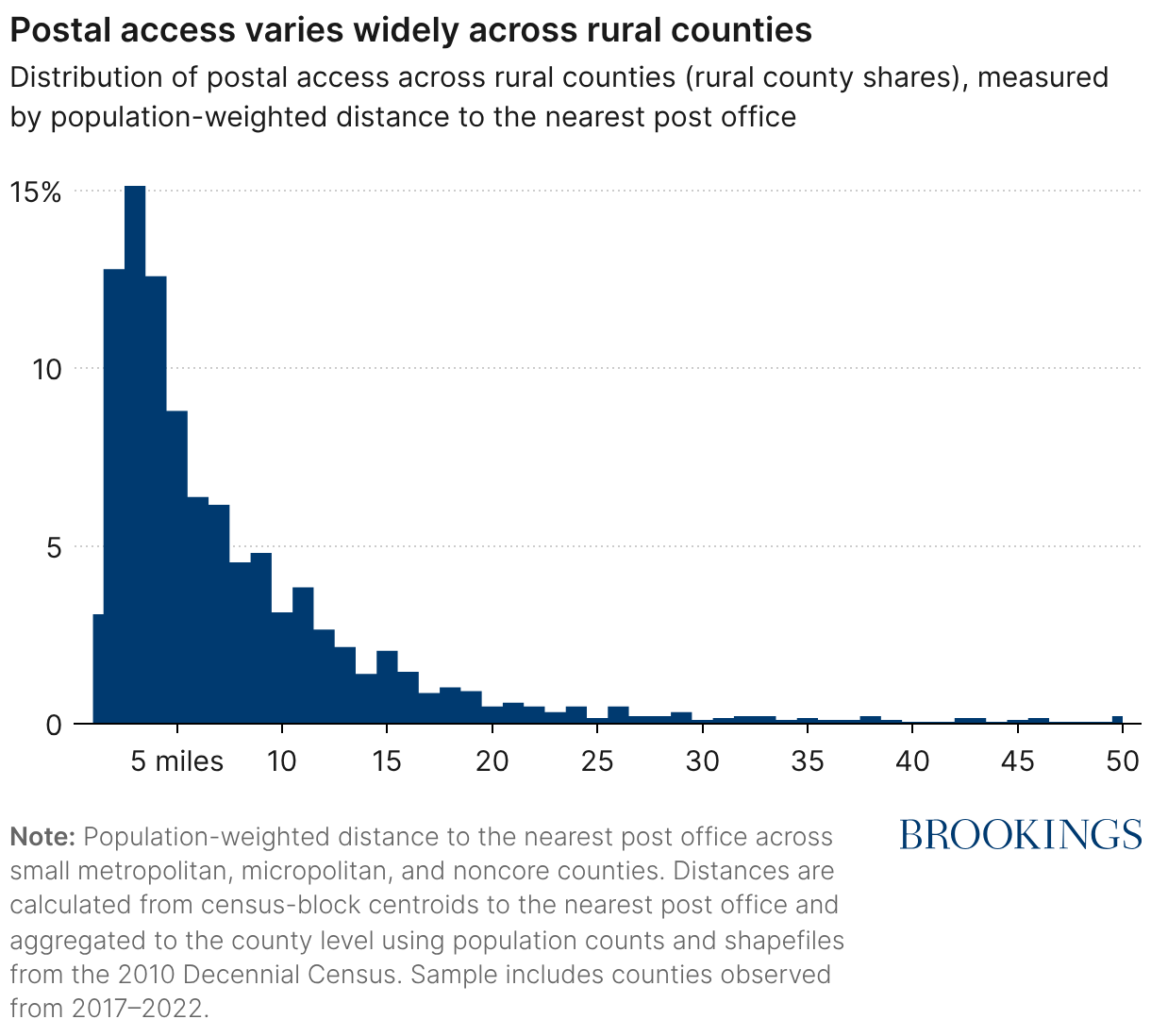
Postal access is measured using population-weighted distances to the nearest post office. Distances are calculated at the census-block level by computing straight-line distances from each block centroid to the closest post office. Block-level distances are then aggregated to county-level using block population weights from the 2010 Decennial Census. This approach captures the average distance businesses in a county must travel to reach retail postal services. Figure 1 shows the distribution of population-weighted distance to the nearest post office across rural counties, illustrating substantial variation in postal access within the analytic sample. In particular, while the average distance to a post office in rural counties is roughly 8.2 miles, 25% of counties have residents within 3.6 miles and 10% of counties have residents more than 16.2 miles.
Fixed postal locations allow for meaningful comparisons across similar rural counties
Because post office locations are effectively fixed, differences in proximity to postal infrastructure in rural areas are unlikely to reflect recent changes in local economic conditions. Instead, they reflect historical population distribution and the legacy footprint of the postal network. This institutional stability makes comparisons of business activity across counties based on post office access informative rather than mechanical because post offices have not been located in response to short-run business growth or decline.
To characterize this variation, counties are placed into three evenly-sized groups based on the distance to the nearest post office faced by their residents, or those with high, mid, and low access to post offices. Counties with high access are those with residents located within roughly 4 miles of a post office, counties with mid access are those with residents between 4 and 8 miles, and those with low access are those with residents more than 8 miles from a post office. Importantly, counties in these distance groups are broadly similar along most socioeconomic dimensions. As shown in Table 1, counties with high, mid, and low access to post offices have comparable median household income, educational attainment, poverty rates, unemployment, and broadband availability. The primary difference across these groups is population size: Counties with low access are smaller on average, but this seems to reflect historical population distribution rather than systematically weaker economic conditions.
|
Distance Terciles |
|||||
|
High Access |
Mid Access |
Low Access |
All Counties |
||
| Average Distance (Miles) |
3.0 |
5.9 | 15.8 | 8.3 | |
| Small Business Rate (per 10,000 returns) | 142.8 | 145.8 | 136.8 | 141.8 | |
| Population | 47,841 | 31,655 | 18,636 | 32,723 | |
| Median Household Income | 51,289 | 49,948 | 50,082 | 50,440 | |
| Bachelors + (%) | 20.9 | 19.0 | 19.8 | 19.9 | |
| Poverty Rate (%) | 16.2 | 16.1 | 16.0 | 16.1 | |
| Unemployment Rate (%) | 5.6 | 5.6 | 5.3 | 5.5 | |
| Broadband Access (%) | 76.1 | 74.1 | 73.3 | 74.5 | |
| County-Years | 3,706 | 3,701 | 3,696 | 11,103 | |
Notes: Table reports mean county characteristics by terciles of population-weighted distance to the nearest post office. Characteristics include income, education, poverty, unemployment, and broadband access as captured by the American Community Survey. Sample includes small metropolitan, micropolitan, and noncore counties, 2017–2022.
This difference in access also has a clear operational interpretation. Residents moving from a high to a low access county must travel an additional 12.8 miles on average to reach the nearest post office. Even when traveling an average of 40 miles per hour, this implies roughly 40 additional minutes of round-trip travel time to complete routine postal tasks. For small businesses that rely on regular use of postal services, these additional time costs can accumulate into a meaningful operational friction.
Greater distance to post offices is associated with lower small-business density
The relationship between postal access and small-business activity is visible in the raw data. Figure 2 plots unincorporated business rates against population-weighted distance to the nearest post office for all rural counties. Figure 2A shows the unconditional relationship; Figure 2B removes average differences across states. In both cases, counties located farther from post offices tend to have lower rates of small-business activity.
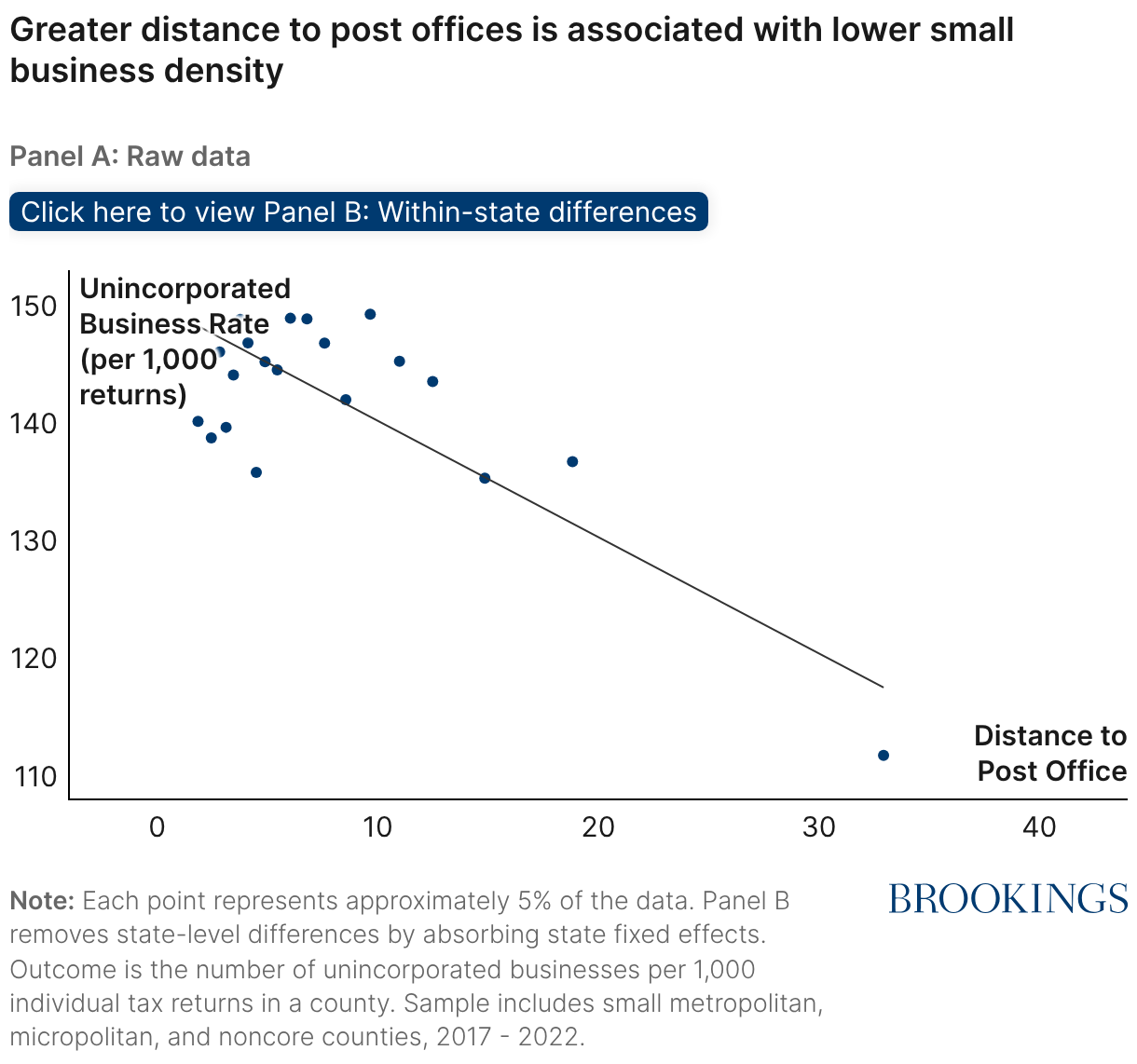
This relationship is formalized using a regression models to compare counties within same state and year and adjust for differences in population, income, education, poverty, unemployment, and broadband access. Technical details and regression results (Appendix Table A1) are provided in the appendix. Across all specifications, greater distance to the nearest post office is associated with lower levels of unincorporated business activity. In other words, counties that are otherwise similar tend to have fewer small businesses when access to postal services is more distant. The relationship is robust to the inclusion of control variables and alternative ways of accounting for state and time variation.
In practical terms, estimates show that moving from counties with high to low access is associated with roughly six and a half fewer unincorporated businesses per 1,000 tax returns, relative to an average of about 140 unincorporated businesses per 1,000 returns in rural counties. In rural areas, where small businesses account for a large share of local economic activity and service provision, this difference represents a meaningful reduction in business presence. Because post office locations change infrequently, this distance reflects a persistent gap in the local operating environment for rural small businesses rather than a short-run fluctuation.
Industry-level variation points to a postal access mechanism
Small businesses likely differ widely in how central postal services are to their routine business operations. If access to a post office affects business activity through operational channels like shipping and receiving materials, handling documents, or in-person postal interactions, then its relevance likely varies across industries.
Consistent with this hypothesis, the average relationship between postal access and small-business activity masks substantial variation across sectors. Figure 3 illustrates this heterogeneity by plotting estimates from industry-specific regressions of the relationship between population-weighted distance to the nearest post office and unincorporated business activity, accounting for variation by state and year and adjusting for county characteristics. The figure shows that sensitivity to postal distance is concentrated in a subset of industries while other sectors effectively exhibit no sensitivity to postal access.
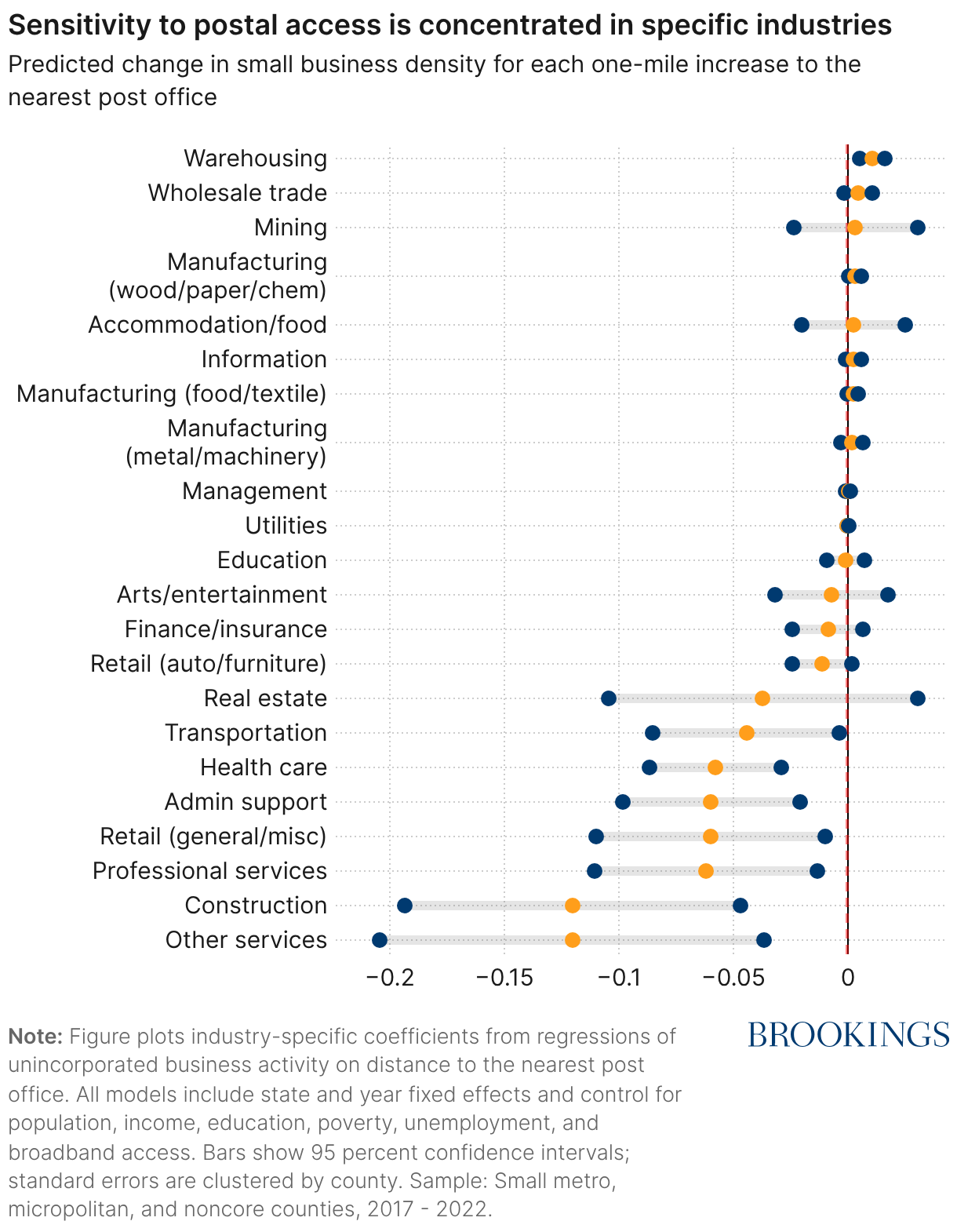
The industries that exhibit the strongest sensitivity to postal access are construction and repair trades, retail, transportation services, administrative support, and health and personal services—sectors that account for a large share of the rural small-business activity. These industries tend to involve frequent in-person tasks and provide local services that cannot easily be handled remotely. In these settings, greater distance to a post office raises time costs, complicates coordination, and reduces day-to-day flexibility, which can discourage the entry of small-scale businesses in these industries.
By contrast, industries such as manufacturing and wholesale trade tend to rely on centralized logistics systems and established distribution networks. As a result, routine access to local postal services likely plays a much smaller role in daily operations. Consistent with this, business activities in these sectors shows no relationship with distance to the nearest post office.
To make this contrast clearer, industries are grouped based on whether industry-specific estimates suggest a systematic relationship between distance to the nearest post office. Regression estimates that pool industries within each group are reported in Appendix Table A2. These estimates confirm that relationship between postal distance and small-business activity is concentrated in one set of industries, while the remaining exhibit no detectable relationship with postal distance once grouped.
It’s also important to consider whether these industry patterns reflect broader differences in local business environments rather than access to postal services. For example, counties with better post office access might have zoning or land-use rules that are more permissive of small retail and service establishments, leading to both higher small-business density and closer proximity to post offices. Table 2 provides little support for that explanation. The distribution of business activity across industries is broadly similar in counties with high, mid, and low access to post offices: roughly 70% of small businesses are in industries that are sensitive to post office access in all rural counties. This indicates that the results are unlikely to be driven by pre-existing differences in industry mix that correspond to where post offices are located. Instead, these findings suggest that postal access is associated with differences in the level of small-business activity within the same types of industries across counties.
|
Sensitive Industries |
Insensitive Industries |
|
| High Post Office Access | 69 | 31 |
| Mid Post Office Access | 71 | 29 |
| Low Post Office Access | 71 | 29 |
Notes: Table reports the share of unincorporated business activity by industry across postal-distance terciles. Industries are grouped based on whether distance to the nearest post office is significantly associated with lower unincorporated business activity. Classification is based on industry-specific regressions controlling for state and year fixed effects and county characteristics.
Taken together, these patterns clarify the relationship between postal distance and small business activity. Sensitivity to postal distance is concentrated in a specific set of industries for which routine access to postal services is plausibly more consequential, while business activity in other sectors shows little relationship to postal distances. The structure is difficult to reconcile with explanations based on industry composition or local sorting alone and is more consistent with postal access shaping small-business activity within particular lines of work.
Broadband expansion complements but does not replace postal access
Broadband is often viewed as a potential substitute for physical infrastructure in rural areas, including for small businesses. Consistent with this view, federal and state policy has emphasized the importance of digital connectivity as a tool for rural development, raising the question of whether improvements in broadband access diminish the economic relevance of proximity to postal services.
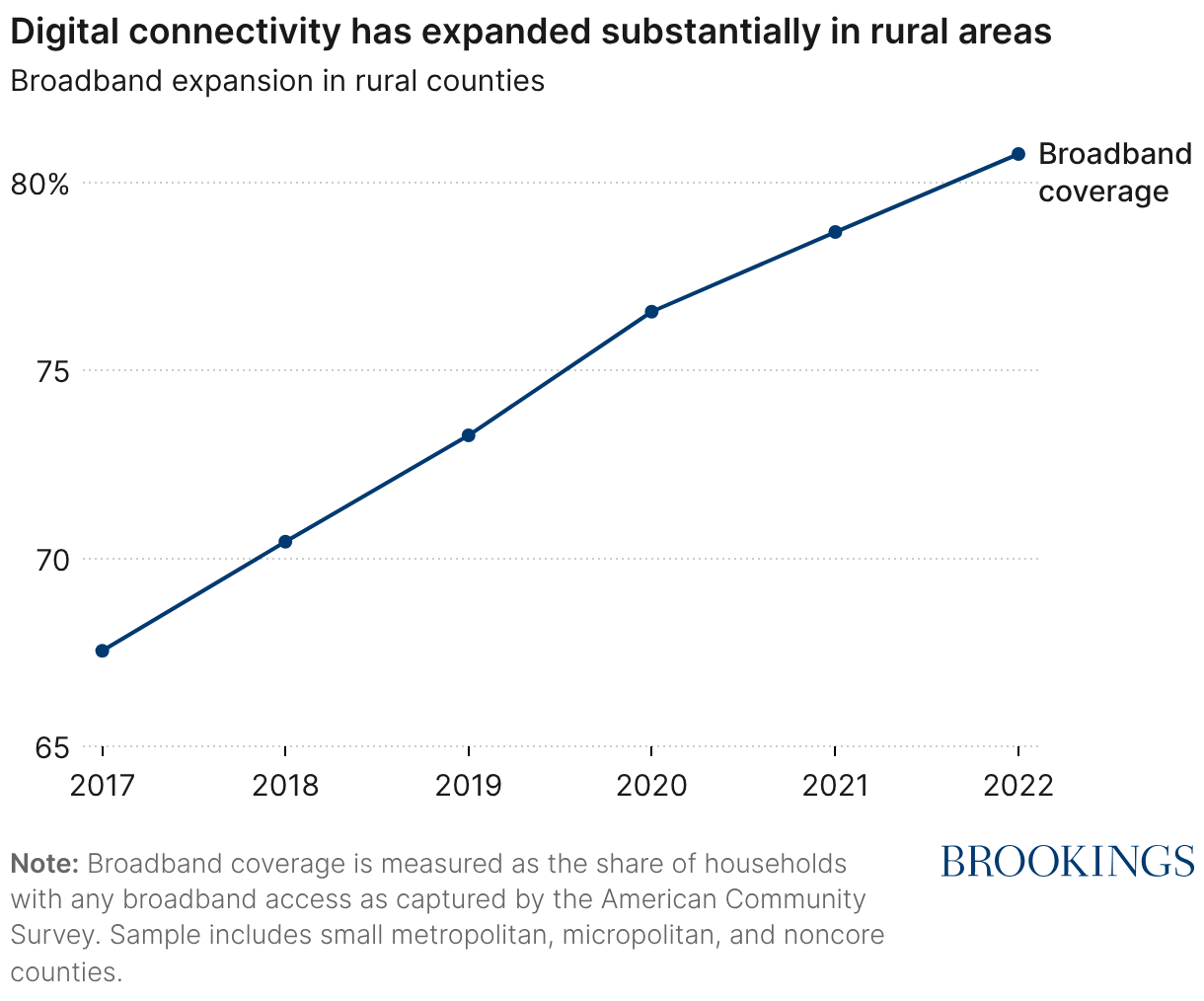
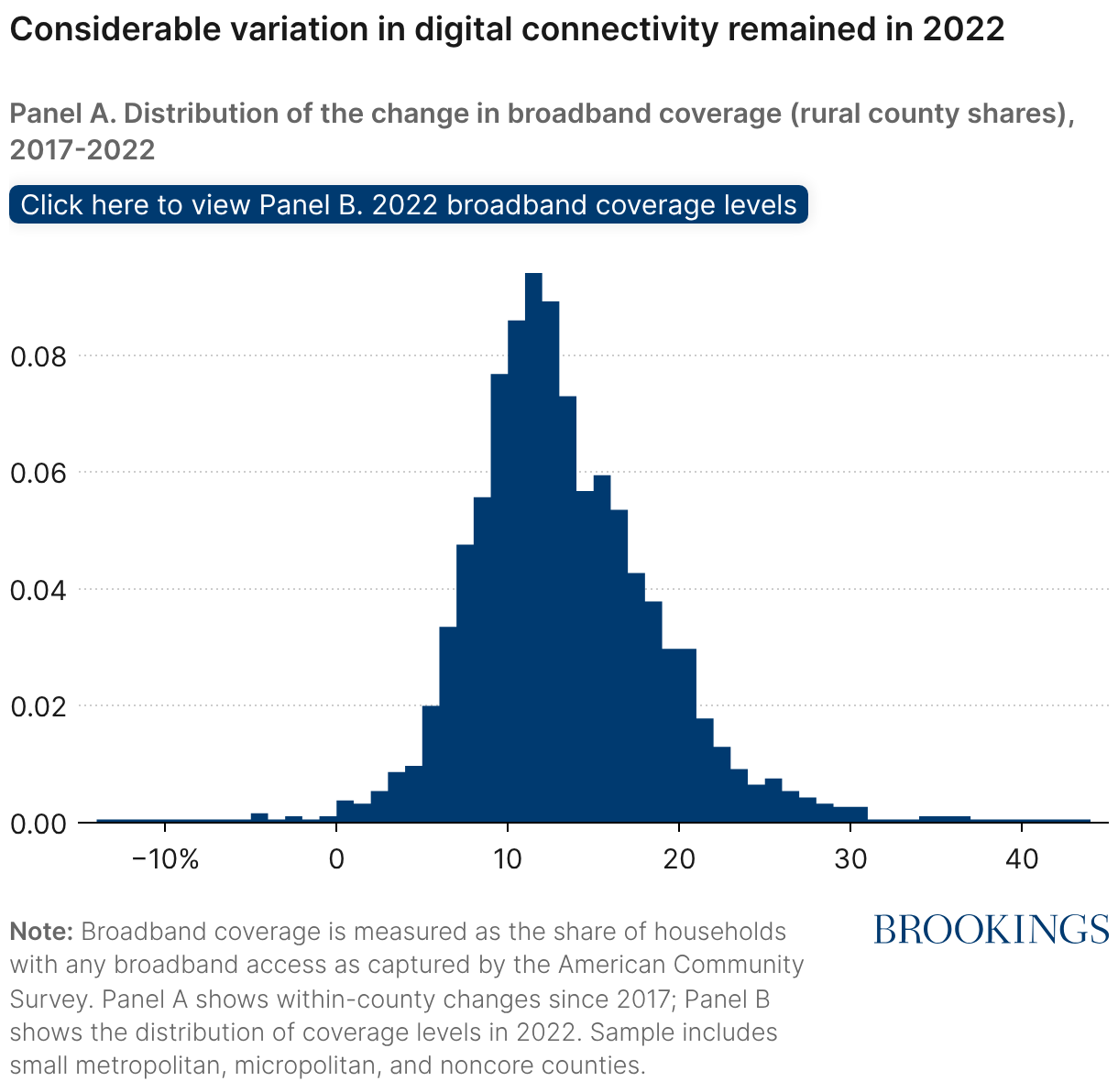
Figure 4 documents patterns of broadband availability across rural counties between 2017 and 2022. Coverage expanded over this period, but gains were uneven across places. While many counties experienced substantial increase (Figure 5A), levels of digital connectivity remain far from uniform (Figure 5B). In 2022, fewer than 5% of rural counties had broadband coverage exceeding 90%, while roughly one-quarter remained below 78%.
To assess whether broadband substitutes for postal access, the analysis examines how the relationship between postal distance and small-business activity varies across counties with different levels of digital connectivity. Counties are grouped into low, moderate, and high broadband coverage categories, and the relationship between distance to the nearest post office and small-business activity is estimated separately within each group using a regression analysis. Regression results are reported in Appendix Table A3.
This analysis shows that greater distance to the nearest post office is associated with lower levels of small-business activity in each broadband group, including counties with the highest levels of digital connectivity. In addition, findings suggest the magnitude of the relationship is smaller in the most digitally connected counties, but that it does not disappear even in these high access counties.
A complementary approach tests this relationship directly by interacting postal distance with broadband coverage. As shown in Appendix Table A4, the interaction term is positive, indicating that broadband partially offsets the distance penalty. However, the net effect of postal distance remains negative even at high levels of broadband coverage. At 90% broadband coverage—near the top of the observed distribution—each additional mile from a post office is still associated with lower small-business activity in postal-sensitive industries.
Together, these results suggest that broadband expansion and postal access support rural small-business activity through distinct and complementary channels. Improved digital connectivity appears to reduce—but not replace—the economic relevance of physical access to postal services.
Interpreting the results: What the analysis can and cannot show
The results documented above describe clear negative associations between distance from post offices and small-business activity in rural areas. Interpreting these patterns requires clarity about what the analysis is designed to capture and what it is not.
The analysis focuses on how long-standing differences in access to post offices intersect with small-business activity across rural counties, rather than on the effect of any single policy change. It examines whether inherited differences in proximity to post offices are related to patterns of small-business activity across otherwise similar rural counties. This distinction matters because, in many studies of the economic effects of physical presence—such as research on Social Security offices, benefits enrollment centers, retail establishments, or banks—locations may open or close in anticipation of local demand rather than shaping activity itself. Importantly, several features of the postal network reduce the relevance of this concern in the present context.
To begin, and as previously described, post office locations have been largely fixed for decades and do not adjust to short-run local economic conditions by design. This institutional stability makes it less likely that observed differences in postal access simply reflect recent economic growth or decline.
In addition, as shown in Table 1, rural counties with high post office access and those with low post office access have similar economic and demographic characteristics, including earnings, education, poverty, unemployment, and broadband access. In other words, from a small-business perspective, the underlying economic conditions look much the same; what differs across these counties is access to postal infrastructure. The analysis further accounts for these observable characteristics directly and compares counties within the same state and year, reducing the influence of broader regional differences or nationwide shocks.
Finally, the structure of the results themselves support a mechanism-based interpretation. The strongest association between postal distance and small-business activity appears in industries where routine interaction with postal services is plausibly more important, while no such relationship is observed in sectors that rely on centralized logistics or nonlocal supply chains. This pattern is difficult to reconcile with a simple sorting explanation and instead suggests that postal access intersects with specific types of business activity, even though the analysis cannot claim definitive causal effects.
Taken together, these patterns indicate that the analysis captures meaningful relationships between inherited differences in postal access and small-business activity in rural areas. While the results should not be interpreted as causal estimates, they provide evidence that proximity to postal infrastructure is systematically related to where and how small businesses operate, offering insight into a dimension of rural economic infrastructure that is not easily observed through profitability or service-volume metrics.
Evaluating the future of the Postal Service requires recognizing its economic benefits
The findings in this paper point to a dimension of the U.S. postal network that is often underemphasized in debates about the future of the U.S. Postal Service: its role as part of the economic infrastructure that supports everyday business activity, particularly in rural areas. Over the past decade, discussions of postal reform have focused heavily on long-run financial sustainability, declining mail volumes, and the appropriate scope of public involvement in mail and package delivery. These debates tend to emphasize the costs of maintaining a nationwide network, especially in low-density areas where per-location revenues are limited and the fixed costs of delivery are high.
Oversight and audit reports from the USPS OIG consistently document that many rural post offices operate at a loss when evaluated on a location-by-location basis. Importantly, this pattern does not necessarily reflect low use or operational inefficiency. Relative to the populations they serve, rural posts often generate more revenue per person than suburban or urban locations, even though many operate more limited retail hours. Rural offices also tend to be lower-cost operations, but they serve smaller markets, resulting in lower total revenue and the highest per-capita costs.
These financial outcomes are best understood as a direct consequence of the Postal Service’s universal service obligation rather than inefficiency. Rural post offices are maintained to ensure geographic access, not because they are expected to respond to local demand or profitability. International comparisons reviewed by the OIG further indicate that loss-making rural postal outlets are a common feature of universal service systems, not a deviation from them. In this respect, the fiscal challenges associated with rural service are not unique to the U.S. Postal Service but reflect general tradeoffs inherent in universal service models.
The evidence presented here highlights an economic implication of this institutional design that is not captured by conventional accounting metrics. Rural counties with better access to post offices have higher levels of unincorporated businesses, particularly in service and trade sectors that rely on routine, local interaction with postal services. These relationships persist after accounting for broadband access and other local economic conditions and are concentrated in industries where distance to postal facilities plausibly affects daily operations. In this sense, the postal network functions not only as a delivery system but also as a form of shared infrastructure that shapes where small businesses operate and thrive.
From the perspective of local economic activity, these patterns matter. Small businesses that depend on postal access account for a substantial share of non-agricultural self-employment in rural communities. The results of this study underscore that the economic role of the postal network is neither diffuse nor abstract; in fact, it is key component of the specific forms of economic activity that are central to the provision of local goods and services.
Taken together, the findings point to an implicit tradeoff in postal reform discussions. The same features of the postal network that generate fiscal pressure—geographic reach, location stability, and insulation from profitability—also appear to support economic activity in parts of the rural economy where alternatives are limited. Recognizing this role does not imply that existing network configurations are optimal or that efficiency improvements are unwarranted. It does suggest, however, that debates about the future of the Postal Service should consider both the costs of maintaining nationwide access and the economic functions that access supports.
Two and a half centuries after its founding, the Postal Service’s universal service mission continues to support local economic life, particularly in rural areas where stable, place-based infrastructure remains central to small-business activity. The evidence presented here suggests that the postal network deserves a more explicit place in conversations about economic growth and public infrastructure. Discussions about the future of the Postal Service involve difficult tradeoffs, but these tradeoffs are best assessed with a clear understanding of both the costs and the economic functions served by the system.
Related Content



Author

The Brookings Institution is committed to quality, independence, and impact.
We are supported by a diverse array of funders. In line with our values and policies, each Brookings publication represents the sole views of its author(s).