The paper summarized here is part of the spring 2026 edition of the Brookings Papers on Economic Activity, the leading conference series and journal in economics for timely, cutting-edge research about real-world policy issues. Research findings are presented in a clear and accessible style to maximize their impact on economic understanding and policymaking. The editors are Brookings Nonresident Senior Fellows Janice Eberly and Jón Steinsson.
See the spring 2026 BPEA event page to watch paper presentations and read summaries of all the papers from this edition. Submit a proposal to present at a future BPEA conference here.
President Trump’s historically unprecedented tariff increases last year raised U.S. trade protectionism to the highest level in at least 80 years but so far have had only a small effect on the overall economy, according to a paper discussed at the Brookings Papers on Economic Activity (BPEA) conference on March 26.
In 2025, the United States raised average tariff duties from 2.4% to an 80-year high of 9.6%, note the authors, Pablo Fajgelbaum of the University of California-Los Angeles and Amit Khandelwal of Yale University. “Alternatively, measured by tariff revenue as a share of GDP [gross domestic product], U.S. trade policy is more restrictive than at any point in the last 110 years,” they write.
However, although the tariff hike was larger than the 1930 Smoot-Hawley tariffs (blamed by many economists for deepening the Great Depression), the aggregate impact on the U.S. economy appears small (between 0.1% of GDP and minus 0.13%), they write, based on the model they used to evaluate the tariffs.
That’s because federal revenue generated by the tariffs and gains to U.S. producers largely offset the tariffs paid by U.S. importers. Tariff revenue last year was $264 billion, more than triple 2024 revenue. While the aggregate net economic impact may be small, the authors note that the tariffs also have distributional impacts between producers and importers. They estimate roughly 90% of the tariffs have been passed through to importers, with foreign exporters absorbing only about 10% of the cost by lowering their before-tariff prices.
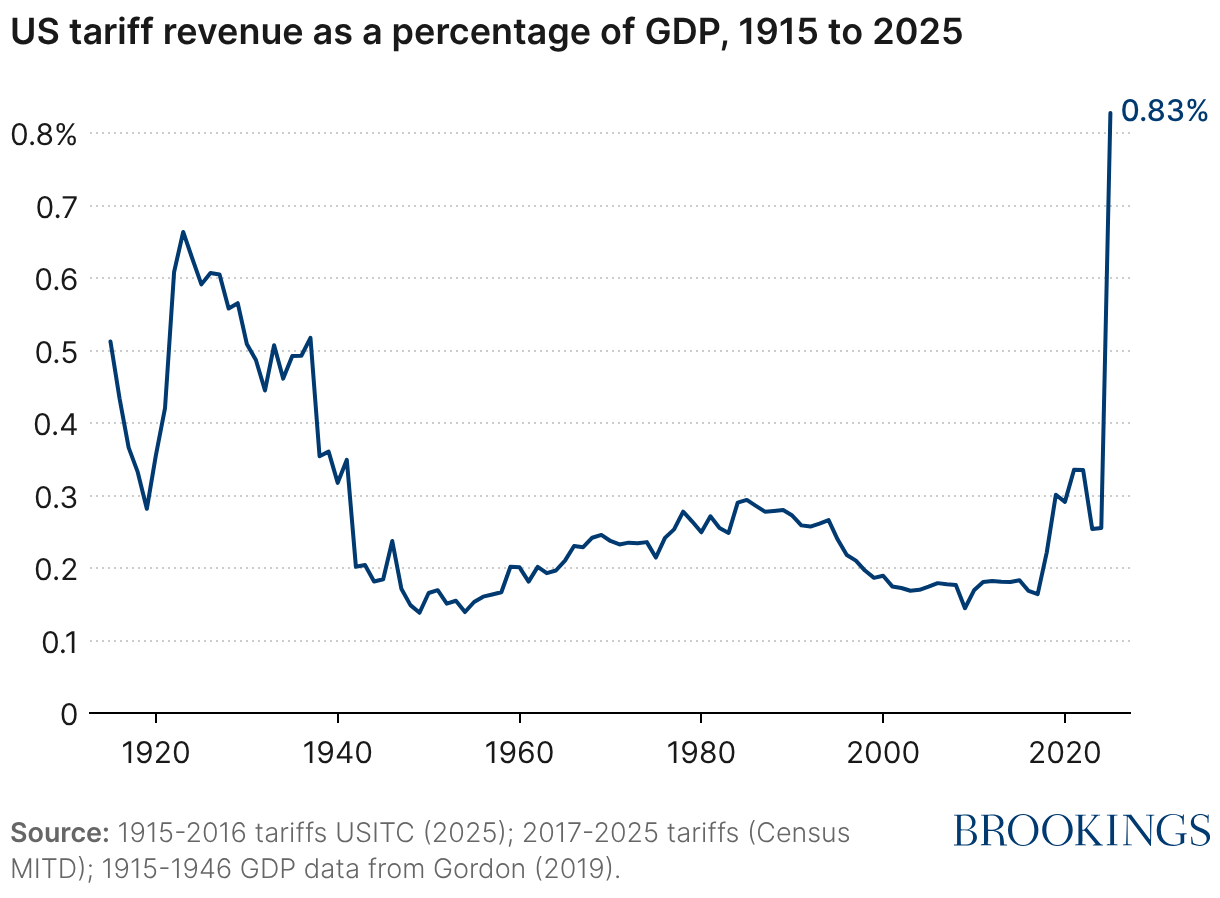
Also, they write, “with the exception of China, the majority of U.S. exports have not faced retaliatory tariffs.” And, the tariffs’ magnitude may be smaller than perceived by the public because announced tariffs “exceeded the actual tariffs imposed at the border.” Moreover, 57% of imports entered the United States duty-free. That includes most imports from Canada and Mexico, which enter under the United States-Mexico-Canada Free Trade Agreement of 2020.
While the authors find evidence that the tariffs are achieving the administration’s objectives of raising federal revenue and decoupling trade with China, they don’t find evidence—or it’s too soon to know—whether other stated objectives will be achieved: lowering import prices (minus the tariffs), reducing the U.S. trade deficit, increasing trade with friendly nations, increasing manufacturing jobs and wages, and re-shoring strategic industries.
The authors find that the reduction of U.S.-China trade, which began shrinking with the application of tariffs in 2018, during the first Trump administration, “accelerated markedly in 2025.” However, the overall U.S. goods trade deficit in 2025 rose modestly from 2024 and manufacturing jobs declined slightly despite the tariffs.
They also found that the tariffs were “seemingly unrelated to [trading partners’] pre-existing geopolitical alignment” with the United States and “tariffs on NATO and strong defense allies are only slightly lower than tariffs on the rest of the world.”
While the paper focuses on 2025, it notes ongoing uncertainty and that long-run impacts may differ from the short-term impacts if, for example, countries in addition to China begin to retaliate. The Supreme Court in February ruled that President Trump exceeded his authority in imposing roughly 70% of the tariffs without clear congressional authorization. The next day, President Trump announced he was imposing global tariffs of 15% on all imports under a different law than he cited last year.
“Although there is uncertainty regarding how U.S. tariff policy will evolve in 2026 and beyond, we believe that tariffs will remain an active instrument of U.S. international policy,” the authors write.
Authors


CITATION
Fajgelbaum, Pablo and Amit Khandelwal. 2026. “Tariffs in 2025: Short-Run Impacts on the U.S. Economy.” BPEA Conference Draft, Spring.
-
Acknowledgements and disclosures
David Skidmore authored the summary language for this paper. Chris Miller assisted with data visualization.
The Brookings Institution is committed to quality, independence, and impact.
We are supported by a diverse array of funders. In line with our values and policies, each Brookings publication represents the sole views of its author(s).