President Trump has said repeatedly that he wants the Federal Reserve to cut interest rates to bring down the cost of the large and growing federal debt.
In June 2025, on Truth Social, he said: “If ‘Too Late’ [Fed Chair Jerome Powell] at the Fed would CUT, we would greatly reduce interest rates, long and short, on debt that is coming due. … He is costing our Country a fortune. Borrowing costs should be MUCH LOWER!!!”
In July 2025, also on Truth Social, he said: “Fed should cut Rates by 3 Points. Very Low Inflation. One Trillion Dollars a year would be saved!!!”
And The Wall Street Journal reported in December 2025 after an interview with the president: “Asked where he wants interest rates to be a year from now, Trump said, ‘1% and maybe lower than that.’ He said rate cuts would help the U.S. Treasury reduce the costs of financing $30 trillion in government debt.”
The federal government does spend a lot on interest—about $970 billion in fiscal year 2025 (3.2% of GDP and 14% of all federal outlays). Over the past several years, it benefited from issuing bonds during a period of very low interest rates—on average, it is paying 3.3% on its debt. But bond-market interest rates have been rising.
CBO estimates that if all interest rates—including those on 3-month Treasury bills and 10-year Treasury notes—were 0.1 percentage point higher each year than they are in CBO’s economic forecast, rising government net interest costs would cause deficits to exceed the agency’s baseline projections by $351 billion (or 1.6%) over the 2026–2035 period.
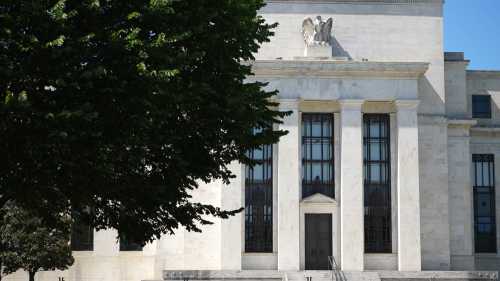
This post explains why the Fed and most economists believe that making the Treasury’s borrowing cheaper should not be the Fed’s objective.
What would happen if the Fed did succumb to President Trump’s demands?
If the Fed were to set the short-term interest rate that is its primary tool lower than necessary to achieve its congressional mandated goals of maximum employment and price stability, history suggests that the likely result would be unwelcome inflation. Lower rates tend to stimulate borrowing and faster economic growth, and when demand grows faster than supply, prices rise. In the latter part of the 20th century, Argentina, Brazil, and Israel suffered high inflation when their central banks kept interest rates low at times of large budget deficits.
“Lessons of history are stark, especially when central banks are forced to help finance budget deficits by keeping interest rates too low,” former Fed Chair Ben Bernanke said in a recent Hutchins Center video. Added former Fed Chair Janet Yellen in the same video: “The result has almost always been high and sustained inflation.”
Has the Fed ever explicitly suppressed interest rates to lower federal borrowing costs?
Yes. The Fed put an 0.375% ceiling on short-term Treasury securities and a 2.5% ceiling on 30-year bonds during World War II. To maintain that rate as the Treasury borrowed more, the Fed bought more Treasury securities to keep interest rates from rising. When the war ended, the Fed gradually allowed rates to rise. But in November 1950, with the Korean War beginning, President Truman asked the Fed to reaffirm its commitment to keep long rates below 2.5%. The Fed balked. The result was the March 1951 Treasury Fed Accord, which freed the Fed to set rates as it deemed appropriate to manage the economy. (For more, see this Federal Reserve Board history.)
What about quantitative easing?
Most of the time, the Fed sets very short-term interest rates and lets the bond market move longer-term interest rates which depend on the market’s expectations about the economy, inflation, the federal deficit, and future Fed short-term interest rates. But when the Fed’s short-term interest rate hit zero during the Global Financial Crisis of 2008-2009, and during the COVID pandemic, and Fed policymakers decided the economy needed more stimulus, the Fed bought trillions in long-term Treasuries and mortgage-based securities in what is called “quantitative easing” (QE), with the stated objective of lowering long-term interest rates. And, although saving the Treasury money was not the reason for QE, it did have that effect.
What do economists mean by “fiscal dominance”?
Fiscal dominance occurs when government borrowing is so large that the central bank is pressured to keep interest rates low to reduce the government’s borrowing costs, even if economic conditions call for higher interest rates. “Fiscal dominance is dangerous because it typically results in higher and more volatile inflation or politically driven business cycles,” Yellen said at the January 2025 American Economic Association meetings. “When the central bank is constrained from raising rates or shrinking its balance sheet because that would increase debt service or trigger fiscal stress, inflation expectations may become unanchored. Households and firms may come to expect that inflation is the path of least resistance for managing high debts. Once such expectations take hold, stabilizing prices becomes significantly more costly… Fiscal dominance is also likely to raise term premia and borrowing costs as investors become concerned that the government will rely on inflation or financial repression to manage its debt. In addition, a central bank that is perceived as an arm of the Treasury may have less space to act forcefully in a crisis. For all of these reasons, avoiding fiscal dominance has been a central objective of modern central banking frameworks.”
The approach that has prevailed in the U.S. for the past several decades is sometimes called monetary policy dominance. Here’s how Yellen defines that: “The Fed is not and must never become the fiscal authority’s financing arm. Fiscal policy’s job is to set taxes and spending, and to finance deficits through issuing debt to the market at prevailing interest rates. It is the responsibility of Congress and the president—not the Federal Reserve—to insure that the government’s intertemporal budget constraint is satisfied. It is their duty to ensure that the path of debt is sustainable.”
How much could higher inflation lower the costs of debt?
For many debtors, inflation is a plus. It allows them to pay back their loans with cheaper dollars. But inflation wouldn’t do much to lighten the burden of the federal government’s debt. Two reasons: (1) Much of the federal government’s debt is short-term. When it matures, it will be replaced by debt at then-current interest rates, and those rates will be higher if there’s more inflation. About 22% of the debt outstanding matures in a year or less; the weighted average maturity of the federal debt is under six years. (2) The government is running big deficits, so it has to borrow more every year at current interest rates.
David Romer, an emeritus professor of economics at the University of California, Berkeley, and a nonresident fellow at Brookings, estimates that if the Fed engineered an unexpected jump in inflation from 2% to 10% with the current maturity of the federal debt, this would erode the value of the federal debt by 15% after five years—and that calculation assumes no increase in real (or inflation-adjusted) interest rates or the risk premium that investors demand for holding U.S. Treasury securities.
In their February 2025 paper, “Assessing the Risks and Costs of the Rising Federal Debt,” Brookings’ Wendy Edelberg, Ben Harris, and Louise Sheiner said. “The effect of an inflation rate that is 3 percentage points higher than assumed in the CBO baseline is quite small—the projected debt-to-GDP ratio after 30 years is 152% in the high inflation scenario versus 166% in the baseline, meaning that the cost of debt service in that year is just 0.08% of GDP lower. Even inflation that is 10 percentage points higher than under the baseline only brings the debt-to-GDP ratio in 30 years down to 134% of GDP.”
Author

Related Content
The Brookings Institution is committed to quality, independence, and impact.
We are supported by a diverse array of funders. In line with our values and policies, each Brookings publication represents the sole views of its author(s).
Commentary
Should the Fed cut interest rates to make it cheaper for the federal government to borrow?
January 9, 2026