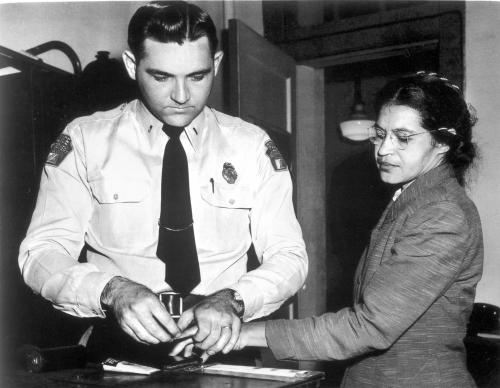
When taught about civil rights, most Americans learn about Rosa Parks. Parks is famously known for refusing to give up her seat on a Montgomery bus in 1955. Because of Rosa Parks’ sacrifice and actions during the bus boycott, the public began to refer to her as “the mother of the Civil Rights Movement.” Monikers like this downplay the role Black women play in the American political system. A modern-day example would be the media referring to Black women as the “backbone of the Democratic Party,” then failing to reckon when Americans refused to vote for a Black woman to become president. Black women have always fought for the Black community and its needs, despite being taken for granted, including Rosa Parks. Despite her prominence during the Civil Rights Movement, the public knows little about her personal life before and after the bus boycott that shaped the Civil Rights Movement and brought Dr. Martin Luther King, Jr. to the foreground of the movement. To many of us, Parks’ life has been reduced to that cold evening on Dec. 1, 1955.
Even though she was deemed the “mother of the Civil Rights Movement,” Rosa and her husband Raymond did not have children of their own. However, Parks was what Patricia Hill Collins refers to as an “othermother.” Collins defines othermothering as “a series of constantly renegotiated relationships that African American women experience with one another, with black children, with the larger African American community, and with self.” Within the Black community, these othermothers are known by different titles, such as “play sisters,” “aunties,” godmothers, and grandmothers. These are the Black women who mother others’ children in the parents’ presence and absence, and are supported by the child’s biological parents and extended community. Othermothers are the Black women whom their Black women counterparts trust to guide and care for their children, provide food, and share hard truths that may not be well-received if stated by anyone else.
The Black community views othermothers as strong figures due to their commitment to the community’s health and prosperity. Rosa Parks was no exception, using her role as a civil rights activist and othermother to support, mentor, and inspire African American youth. She restarted the Montgomery NAACP Youth Council, where she galvanized African American youth and teens, such as Claudette Colvin, to challenge segregation. Colvin would become famous for refusing to give up her seat on a Montgomery bus nine months before Parks. Parks also hosted gatherings to raise funds for the Scottsboro Boys case in 1931. They were nine Black boys from Scottsboro, Alabama, who were wrongly accused of sexually assaulting two white women. Parks was fired from her job a month into the boycott, and her husband quit his job in protest after being told that he could not speak about his wife or the Civil Rights Movement. Due to financial challenges and death threats, the couple moved to Detroit, Michigan, where Rosa continued her practice of being involved in the community and caring for Black youth.
For my dissertation, “The Knowledge Within: Conceptualizing African American Political Knowledge,” I had the privilege of speaking with one of Mrs. Parks’ former neighbors in Detroit. “The Knowledge Within” looks specifically at the Black community and explores what the group knew about politics. The focus group included Parks’ former neighbor along with his coworkers, and prior to starting, the group was unaware that he had grown up knowing Parks. During our conversation, he discussed growing up in Detroit and how he was surrounded by politics. The participant referred to Rosa Parks as “Mrs. Rosie” several times, prompting me to ask a clarifying question to confirm he meant Rosa Parks. He said yes, and we were struck by how affectionately and casually he spoke about her—because she had lived just four streets away. He had been her paperboy and recalled the immense influence she carried and how generously she shared her knowledge with Detroit’s Black community. His reflection on “Mrs. Rosie” underscores her lasting local impact many years after the Montgomery bus boycott.
Parks’ agency and influence are unsurprising given that she continued to remain active in the NAACP and fight for civil rights. For instance, Mrs. Rosa Parks and Mrs. Elaine Eason Steele began the Rosa and Raymond Parks Institute for Self Development in 1987. The two knew one another from working together as seamstresses, and Steele worked for Parks as a volunteer after she graduated from high school. Parks referred to Steele as the daughter she never had, another reminder of how prevalent othermothering is in the Black community. Park’s husband, Raymond, was also a civil rights activist, and Parks and Steele created the Institute to honor Rosa and Raymond’s love and care for young people. The Institute continues to focus on providing career training for young people, engaging in community betterment projects, and educating youth about civil rights. Until the very end, Rosa Parks dedicated her life to providing opportunities for young people and fought for civil rights. It is essential that we remember her not just as a mother of the civil rights movement, but as an othermother within the Black community in Montgomery and Detroit.
Now, when I think of Rosa Parks, I think of her as Mrs. Rosie. I no longer solely view her as an older Black woman who refused to give up her seat because she was tired. Instead, I think of her as an auntie, a family friend, and a neighbor whose refusal to give up her seat was inspired by the acquittal of Emmett Till’s murderers. I think of her as one of the lovely older ladies at church who expects children to “mind their manners,” and always has peppermints and strawberry candies in her purse to give them. I see her in the younger Black women who do not have children but make it their business to nurture, educate, and protect Black children. Othermothers like Mrs. Rosa Parks will continue to leave their mark on the Black community.
When thinking about the current state of the Black community, the Pew Research Center found in its May 2025 study that two-thirds of African Americans believed that the nation has not made enough progress on racial equality. While Parks and others from the civil rights era fought for integration, society should not abandon the Black community. I urge each person to join a local organization, such as your local National Urban League chapter, to better understand and fight for Black social and political issues at the local, state, and national levels. Many organizations, such as the NAACP, also have youth programs, and it is imperative that the broader community support these programs by volunteering and encouraging Black youth to become involved in community betterment projects, just like Mrs. Rosie. Lastly, discussing political issues and educating the next generation is important to make sure that individuals and the community are armed with factual information needed to best represent the Black community’s interests, especially in the age of misinformation and disinformation. We must embrace these roles as othermothers, mentors, and volunteers, especially in a time when very few of us know our neighbors and many Black folks don’t live in majority Black neighborhoods anymore. The bottom line is that no one is coming to save us, so we must save ourselves.
Author
Related Content

The Brookings Institution is committed to quality, independence, and impact.
We are supported by a diverse array of funders. In line with our values and policies, each Brookings publication represents the sole views of its author(s).
Commentary
Rosa Parks: A mother of the movement and the Black community
December 9, 2025