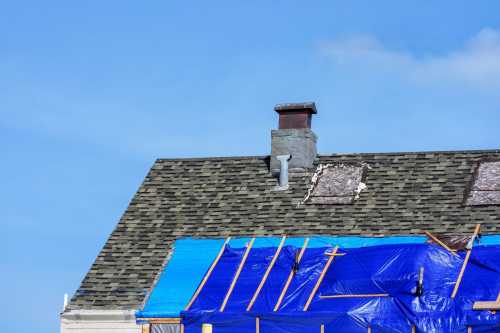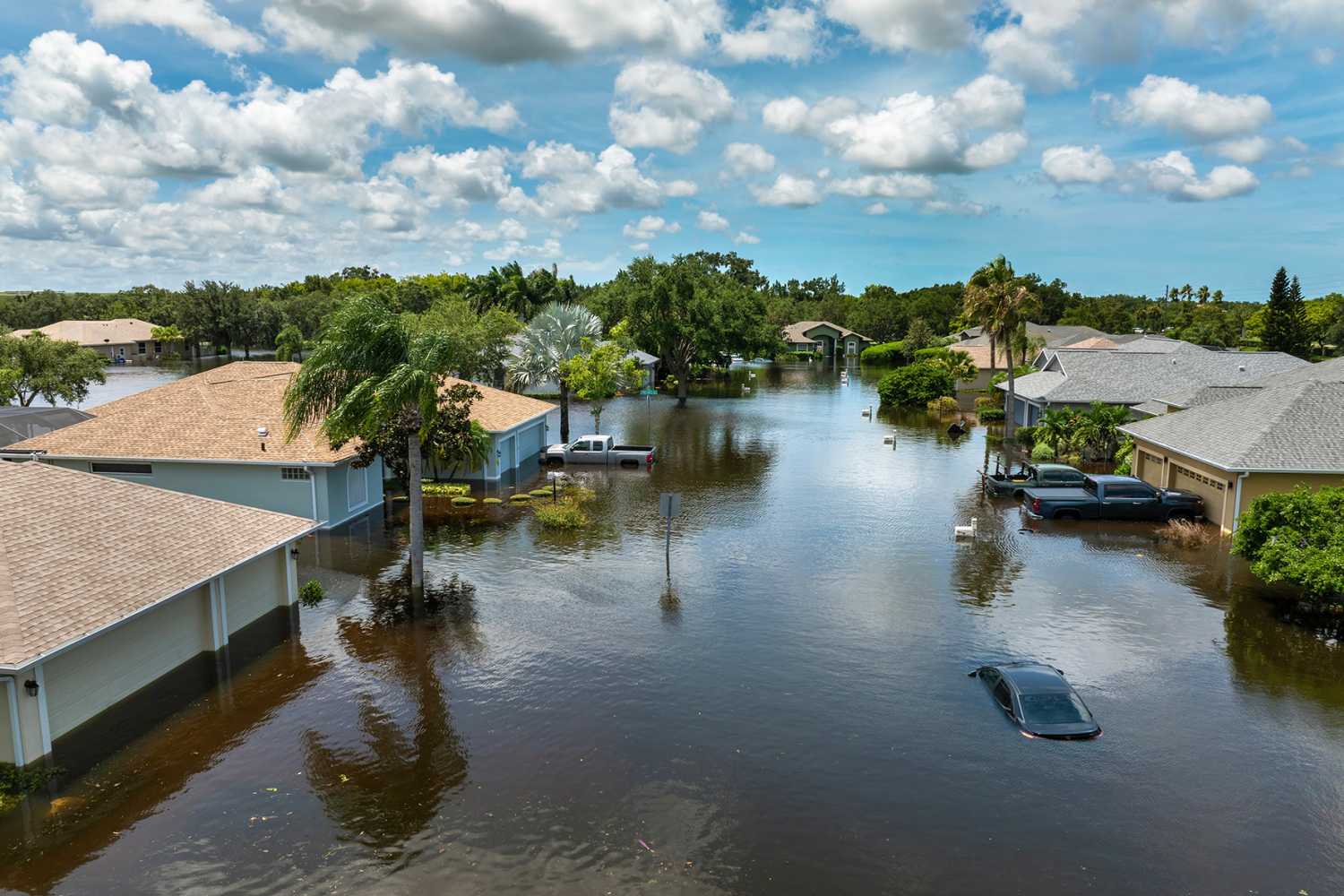
Climate change is bringing threats such as flooding, wildfires, extreme heat, and drought to communities across the United States and the world, endangering people, infrastructure, ecosystems, and properties. Unfortunately, our current systems of property and land governance—including land use, taxes, insurance, and zoning—often limit how well we can respond to those threats. These systems tend to treat land as a fixed set of parcels mainly meant to build wealth, which can lead to inequality and an inability to collectively adapt at scale.
While property and land governance systems in the U.S. have historically supported democracy and opportunity for some, they have also contributed to divisions and disadvantages for others. This way of managing land is fueling growing inequality, housing crises, and racial wealth gaps. And in the process, it’s also leaving many groups more vulnerable to climate risks. A 2021 Environmental Protection Agency report found that socially vulnerable populations—including racial minorities, low-income individuals, and people with less education—are far more vulnerable to climate change hazards such as flooding and extreme temperatures. And as research by Brookings and others has shown, rental housing, public housing, and manufactured housing—which are forms of housing and land tenure disproportionately used by low-income households—all face elevated vulnerability to climate impacts.
Planning for climate adaptation often ignores the fact that property is a social institution that can change; people assume current systems are fixed and unchangeable. But they’re not, and we can do better. Addressing climate challenges is not just about engineering or funding (though both are important topics). It also requires that we rethink and improve our property institutions and practices so they serve everyone better.
As we detailed in a December 2025 journal article, “Governing Land on a Dynamic Earth,” policymakers, constituents, planners, interest groups, and others can and should expand how they think about property by learning from the variety of property arrangements that already exist in communities around the world and even in the U.S. Many of these models offer clues to needed innovations, but remain underutilized.
Climate adaptation often creates disparities between those who can adapt or even benefit from changing landscapes and climate conditions, and those who lose everything. But a broader view of property offers opportunities to reduce these disparities and promote adaptation that is more effective, efficient, and equitable.
Three ways our current property systems fail us
Adapting to climate risks requires public and private action at multiple scales, but existing property institutions impose constraints in at least three fundamental ways:
- The illusion of permanence: Assuming stable spatial conditions constrain attempts to cope with environmental change. Parcel maps depict coastlines and rivers with rigid lines, as if they are permanent. We assume that a property right is permanently fixed to a stable piece of land, but our legal and planning systems struggle when that land moves, is inundated by flooding, or otherwise radically changes. Zoning ordinances assign entire land parcels to specific uses without accounting for changes in landscape and climate conditions. Among other challenges, this static treatment of land has led to a mounting wave of lawsuits adjudicating whether private owners or the public bear the burdens of lost land when sea levels rise and coastal erosion reshapes the boundaries between land and water (see photo). When owners armor shorelines to protect their property, these structures often simply shift risks to unprotected neighbors while coastal beaches and wetland ecosystems are eventually lost to sea level rise.
- Fragmentation: Dividing land into fragmented parcels constrains collective decisionmaking and resource pooling. Most forms of climate adaptation require collective action. Even if an individual retrofits their home and removes flammable vegetation on their lot, their wildfire risks still depend on what their neighbors do. Likewise, new green or gray flood protections typically span multiple parcels and affect many households. Neighborhood- or block-level relocation is typically necessary to enable efficient and effective ecosystem restoration in areas imperiled by climate threats.
However, rather than encouraging collective forms of property holding that might facilitate community decisionmaking in the face of climate change, federal housing and disaster recovery programs tend to have the opposite effect by prioritizing individual single-family homeowners. Many programs are founded on dated assumptions that undercut effectiveness and equity, as recent Brookings research shows. For instance, while floodplain buyouts or home elevation grants help individual households take action, they do not enhance neighborhood-wide resilience or sustain community ties. Some programs explicitly exclude diverse forms of shared land tenure—such as condos, co-ops, manufactured housing communities, and Tribal land—that disproportionately serve low-income residents. The Federal Emergency Management Agency (FEMA), in its interpretation of the Stafford Act (which governs federal disaster declarations and aid), does not define co-ops and condos as housing, meaning that the shared portions of these properties (e.g., foundations, parking, utilities, roofs and exteriors, elevators) are not eligible for coverage under the National Flood Insurance Program or disaster assistance, except through small business loans.
- Commodification: By commodifying land, property systems inhibit adaptation choices that would leave more land for natural ecosystems and affordable, resilient housing. Across scales, our property and governance systems consistently privilege maximizing property values above all other aspects of relationships between people and places. At an individual level, homeownership is a critical pathway to multigenerational wealth-building, especially for low- and middle-income households. Climate-exacerbated disasters and difficult choices to abandon homes can eliminate decades of efforts toward upward mobility.
At a municipal level, local governments rely on property taxes to fund roads, water services, staff, and schools. Market devaluation of risk-exposed properties and corporate shifts in investment away from climate-imperiled municipalities mitigate risks for some, but erode municipal budgets. For instance, Barre, Vt., which has suffered some of the most severe repetitive flooding in the nation, recently denied most applicants a FEMA buyout because the town could not afford the lost revenue that would result if those homes left the property tax rolls, even though new state regulations advocate expanding land for river corridors. Conversely, communities with stronger housing markets often try to build their way out of fiscal climate vulnerability, promoting densification in risk-prone areas.
At a macro level, mortgage markets, bond markets, and insurers also rely on the sustained value of property. Climate-change-related disasters and relocation can fundamentally disrupt the stability and profitability of these systems. However, the Trump administration has abandoned efforts to integrate climate risk into the federal government’s support for mortgage markets. Meanwhile, state governments are increasingly at risk as public insurance programs (e.g., Florida’s Citizens Property Insurance Corporation) step in to prop up insurance and housing markets where private insurers have left.
The combined effect is that it is difficult for communities to adapt to climate change in ways that advance affordable, resilient housing and ecological restoration at a meaningful scale. In the absence of collective adaptation, reliance on individual property-by-property adaptation can widen inequalities, both in “sending communities” from which people flee and in communities that receive displaced people. These practices may also contribute to climate gentrification, in which resilience investments reduce housing affordability and contribute to the displacement of current residents. Research suggests that climate gentrification is already underway in some cities, including Miami, Tampa, and other South Florida communities.
As climate change reshapes neighborhood-level habitability, the constraints of dominant property regimes create zero-sum tradeoffs between risk reduction, affordability, prosperity, and ecological health.
Supporting the transformative potential of diverse property models
Transforming property and related systems seems like a tall order, but existing practices are already more diverse than most people realize. The U.S. and other countries have many property models that support more flexible, cooperative, and just land relations. Many of these alternative land-governing structures can address the significant adaptation challenges we have outlined.
For starters, approximately 25% of owned homes in the U.S. are in residential developments or buildings governed by homeowners’ or condo associations, especially in Western and Sun Belt states that have experienced major population growth and real estate development since the mid-20th century. Multifamily housing co-ops in New York City, limited equity cooperatives in Washington, D.C., and cooperatively owned and governed resident-owned community (ROC) manufactured home parks are some of the other shared ownership models that allow residents to make decisions together, including decisions about when, where, and how to adapt to climate change.
Members of shared ownership communities can pursue collective adaptation by: 1) investing in shared infrastructures and spaces (e.g., managing vegetation in fire-prone regions or installing green stormwater infrastructure); 2) setting rules and incentives (e.g., requiring fire-safe landscaping practices or allowing window shading devices to reduce heat risk); or 3) pooling revolving funds or other financing for household adaptation (e.g., installing fireproof siding or flood barriers on doors and garages).
Notwithstanding such options, most of these forms of shared property have yet to focus on climate adaptation. In fact, homeowners’ associations (HOAs) and condominium associations are famous for their dysfunctional governance and fixating on aesthetic conformity and property values at the expense of wider community concerns. It’s no surprise, then, that shared ownership does not necessarily result in adaptation or more equitable and sustainable outcomes. As Brookings noted in 2021, the tragic collapse of Champlain Towers in Surfside, Fla., came after residents failed to agree on fixing known structural risks caused by saltwater corrosion exacerbated by sea level rise. Similarly, after Hurricane Sandy, residents of Breezy Point, a 500-acre cooperative of single-family homes in Queens, N.Y., restored the destroyed community to its former condition without addressing underlying risks. Preparing condo associations, co-ops, and HOAs to effectively plan for climate adaptation will require significant support and regulatory action.
Some communities facing persistent climate change threats are turning to community land trusts (CLTs) to organize collective adaptation and safeguard against displacement driven by climate gentrification. In San Juan, Puerto Rico, eight low-lying communities along the Caño Martin Peña canal formed a CLT, a joint neighborhood group, and a state-chartered community planning agency. Together, with philanthropic support, they have led a decades-long process of community-driven flood adaptation, including relocating residents from the most flood-prone canal-side areas into safer homes on trust land within the neighborhoods, and planning new green infrastructure and public spaces along the canal. Other communities are using CLTs to prevent displacement following reconstruction after wildfires (e.g., Lahaina, Hawaii) and hurricanes (e.g., the Florida Keys). In California’s San Francisco Bay Area, the Sogorea Te’ Land Trust is “rematriating” land under Indigenous stewardship to advance a range of goals, including community food security and climate resilience. While some communities are beginning to coordinate collective adaptation through CLTs, many CLTs are constrained by a lack of funding and the model’s incompatibility with existing subsidy programs.
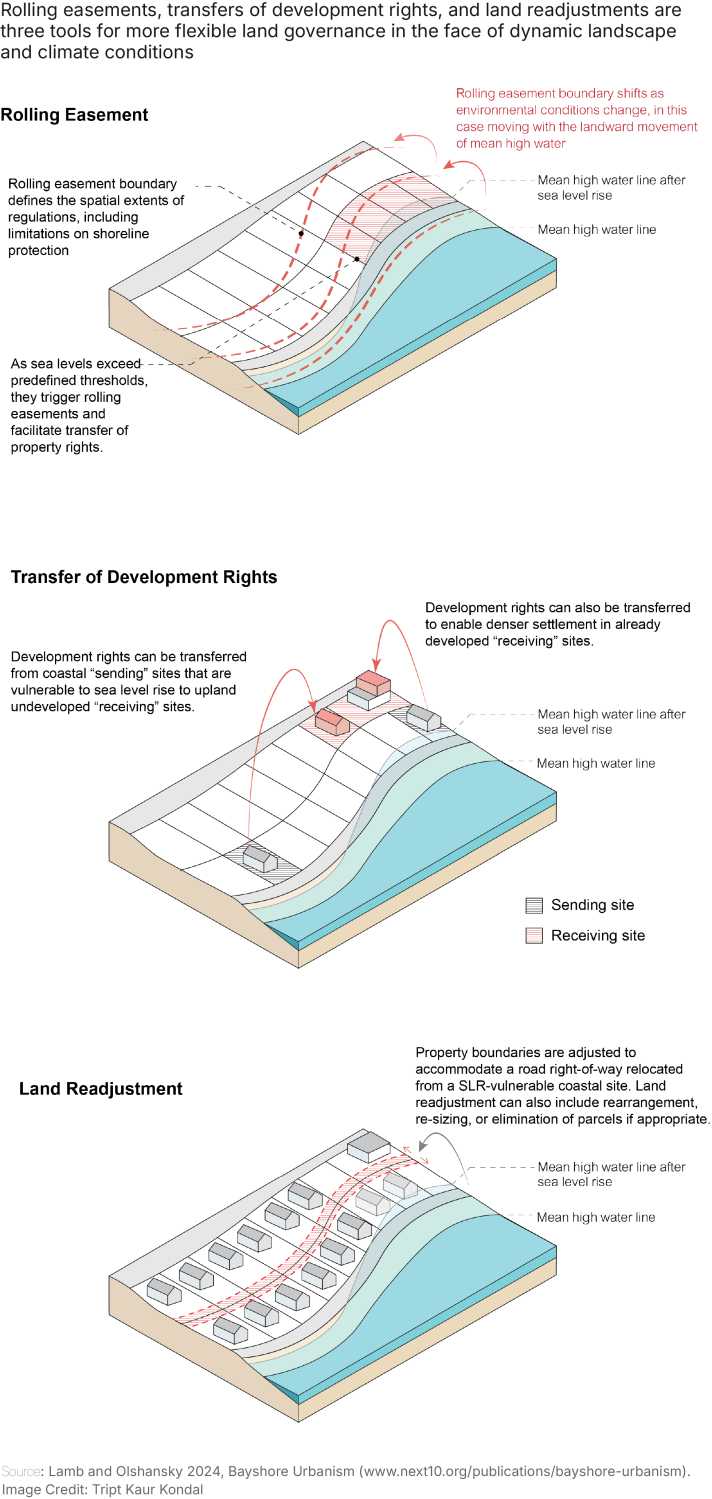
At a larger institutional level, governments in the U.S. and elsewhere have explored tools to spatially shift property rights (see Figure 1). For example, many coastal states—including Maine, New Hampshire, Rhode Island, South Carolina, Texas, and Oregon—have adopted legal tools to make existing coastal regulations more dynamic. In the context of shorelines vulnerable to sea level rise, rolling easements can enable long-term adaptation by prohibiting shoreline hardening and transferring property rights to a public entity or land trust as waters rise. This approach is especially useful in enabling wetland ecosystems to migrate landward as sea levels rise, preserving the ecological and resilience benefits of these landscapes. Selling a rolling easement on a climate-vulnerable property can also allow owners to obtain some monetary value while allowing for the transformation of the landscape, rather than either resisting those changes (e.g., via seawalls) or losing their entire financial investment.
Other ways of moving property rights are promising, but not yet widely used for climate adaptation in the U.S. For example, transfers of development rights (TDRs)—long used to protect open space from development—could be used to shift development away from the most climate-vulnerable places. Land readjustment—which re-subdivides land parcels to create space for improvements such as roads, railways, or open space—has been used worldwide after disasters to enable safer reconstruction while preserving existing residents’ property rights. Though three states have tried and failed to pass land readjustment laws in the past, Silverton, Ohio passed a resolution to use land readjustment to enable commercial development. While government-led land readjustment can lead to expropriation and displacement, communities such as the neighborhood of La Candelaria in Medellín, Colombia have experimented with participatory and inclusive models based on community control. Rather than top-down mandatory expropriation, resident participation helped shape land readjustment terms there that provided replacement housing based on original property size, set provisions for larger families to have larger homes without overcrowding, and protected renters from displacement after the project.
How enabling policies can help
While making sweeping changes to existing property regimes may seem impossible, it is not hard to imagine crafting state and local policies that draw from existing innovative examples of flexible and collective-action-oriented land governance. Property systems are more flexible than they seem, but we need to reform property-related institutions (e.g., public finance, taxation, land use planning) to overcome the tendency to default toward static, fragmented, and commodified treatments of land. Below, we give examples of strategies for building the legal and financial capacity of state and local governments to support equitable and sustainable adaptation.
Catalyze: Encourage the creation and expansion of limited equity shared ownership models that can help low- and moderate-income communities adapt
The model pioneered by the nonprofit ROC USA holds real promise for a range of communities. The organization provides subsidized financing for mobile home park residents to cooperatively buy their communities while also delivering technical and financial support to enable both physical upgrades—including climate adaptive upgrades—and effective governance. Public agencies and private financing institutions can learn from ROC USA’s successes by supporting the growth and effectiveness of shared equity housing through a range of strategies.
- State governments can:
- Adopt policies to encourage tenants and residents to purchase and create shared equity communities, including by:
- Requiring that residents be notified and have an opportunity to purchase when the property where they live goes up for sale.
- Providing subsidized lending and preferential tax treatment for property sales to resident groups.
- Local governments can:
- Prioritize cooperative and shared equity housing models for public affordable housing funding and publicly owned lands.
- Adopt policies to encourage tenants and residents to purchase and create shared equity communities, including by:
Equip: Support existing homeowners’ associations, condo associations, and other shared equity communities with financing and technical assistance to adapt shared spaces and infrastructure
Where collective property institutions already exist, they need help to adapt. State and local governments can facilitate resource sharing and collaborative planning among such common-interest communities. These groups are well positioned to enable adaptation through changes in their management of shared space (e.g., vegetation management for wildfire risk reduction) and infrastructure (e.g., green stormwater infrastructure). They can also shape adaptation on private properties governed through community covenants and regulations. Recent examples of state-level legislation shaping adaptation in communities governed by HOAs and condo associations include bills in Florida limiting HOAs’ ability to deny resident requests to install hurricane protections, and providing matching funds for hurricane mitigation retrofits in condominium developments. After the Surfside condominium collapse, Maryland House Bill 107 (2022) mandated that HOAs and other similar organizations conduct reserve studies and annually fund the reserve amount for recommended repairs and maintenance.
- State governments can:
- Amend legislation regulating common-interest communities to encourage or require them to plan for and adapt to mounting climate threats through planning mandates, insurance requirements, and reserve funding policies.
- Establish or revise grants, loans, and subsidy programs to support adaptation in shared equity communities (HOAs, condo associations, multifamily housing, co-ops, and CLTs).
- Local governments can:
- Engage existing shared equity and common-interest communities in vulnerability analysis and adaptation planning.
- State and local assistance for adaptation in these communities could be contingent on requirements that they provide broader public benefits such as improved access, ecosystem restoration, or floodwater management that benefit surrounding areas.
Learn: Build institutional capacity to enable, test, and coordinate property and development transitions
While community ownership can help address neighborhood-scale property challenges, climate impacts will require government intervention at larger district, city, state, or regional scales. State governments have purview over local tax policy, including property taxes; municipal bankruptcy, annexation, or mergers; land use, coastal, and flood regulations; affordable housing; and insurance policy. This makes state governments an especially powerful actor in shaping the future of local climate adaptation.
Historically, state and local governments have created new institutions—such as land banks, special districts, and redevelopment authorities—to enable collective action when building infrastructure, public spaces, and new urban districts. While some of these institutions have been critiqued for mass displacement and wealth stripping, the property-related challenges of adaptation will likely require similar new and repurposed public institutions that overcome fragmented, static, and unequal property conditions.
- State governments can:
- Convene legal and planning experts to explore state-specific possibilities and barriers to adopting and promoting more dynamic approaches to land governance (e.g., rolling easements, TDRs, land readjustment, land trusts, and land banks).
- Assess fiscal risks of climate-change-related municipal default and explore strategies to reduce property tax dependence and the attendant skewed incentives for development, adaptation, and retreat.
- Assess existing tools for redevelopment such as land trust, land bank, TDR, and other land-swapping models to enable compact development and ecological restoration, and consider whether and how they need to be reformed or whether new entities must be created to enable equitable adaptation at scale.
Reimagining property systems can both protect against short-term climate impacts and promote long-term community well-being
The high costs of adapting to climate change threats will require innovation in how U.S. communities govern land. In other words, it is property systems, not just the structures built on property, that must be adapted.
While cities increasingly grapple with the infrastructure and fiscal threats of climate adaptation, they often ignore the role of underlying property and land governance practices. Inherited systems for governing land are ill suited to enabling adaptation, whether in the form of new infrastructure or changes to settlement location and form. While adaptation will require flexibility, collective action, and redressing deepening inequalities, dominant property systems offer the opposite. They are overwhelmingly inflexible, fragmented, and deeply unjust.
The good news is that a wide range of promising land governance practices already exists in the U.S. and other parts of the world. Operating at multiple levels of government, these innovative practices hold tremendous potential. With supportive policies in place, innovations in law, planning, design, and investment can reimagine property systems to not only reduce the risk and losses from climate change, but also to remake cities and towns for greater social equity and ecological health.
Authors



-
Acknowledgements and disclosures
Next 10, a nonpartisan nonprofit organization, generously supported earlier phases of Zachary Lamb and Robert Olshansky’s research, with a primary focus on vulnerability along the San Francisco Bay. We would also like to thank the student research assistants at the University of California, Berkeley and Cornell University who have contributed to related research, including Tript Kaur Kondal, Sarah Atkinson, and Mary McGee.
Finally, we would like to thank the team at Brookings for their feedback on this piece, including Xavier Briggs, Manann Donoghoe, Tracy Hadden Loh, and Michael Gaynor.
The Brookings Institution is committed to quality, independence, and impact.
We are supported by a diverse array of funders. In line with our values and policies, each Brookings publication represents the sole views of its author(s).