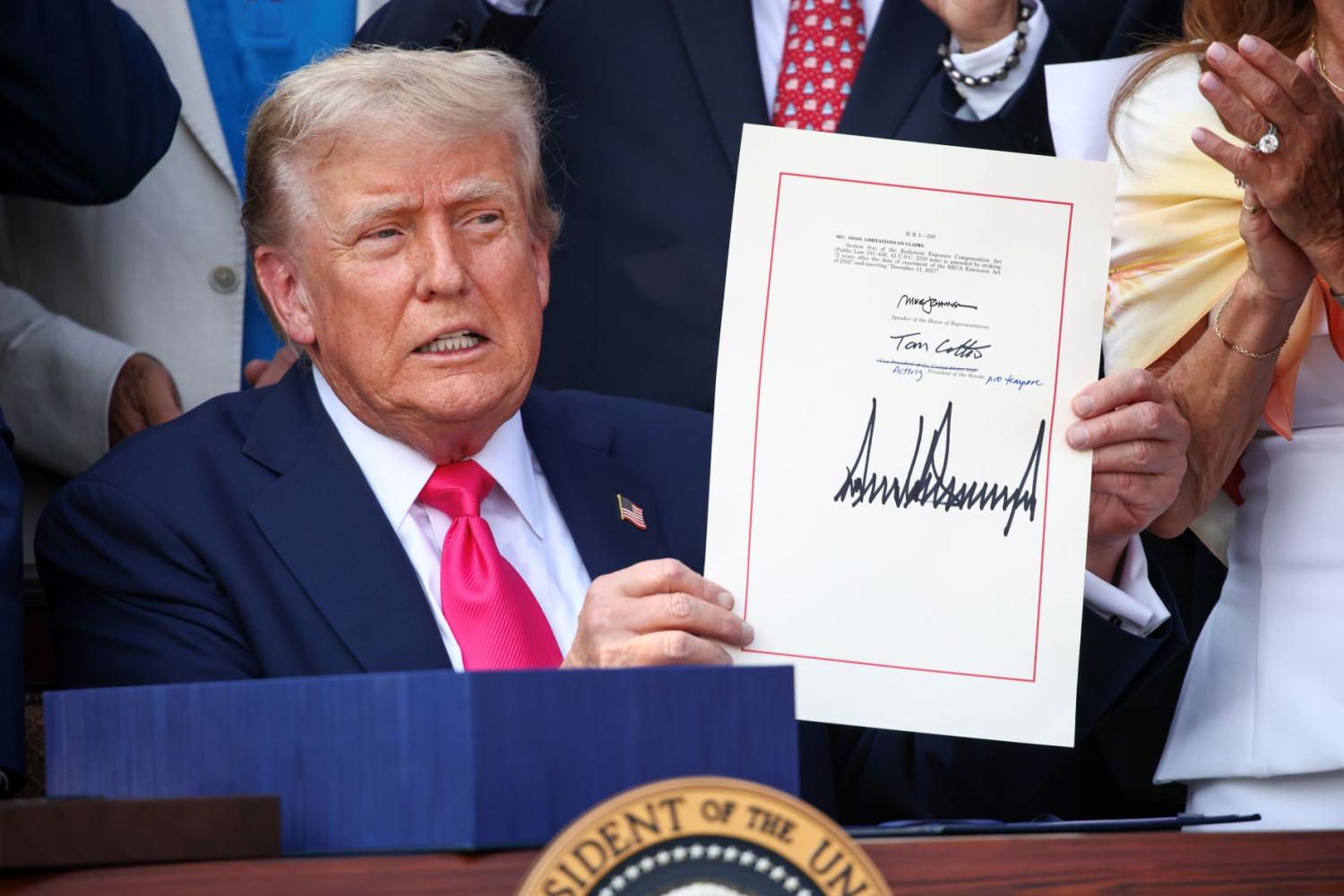
The “One Big Beautiful Bill Act of 2025” (OBBBA), signed into law July 4, 2025, is a sweeping tax-and-spending package that could reshape federal fiscal policy for decades to come. In a new paper, we provide a comprehensive but, of course, preliminary analysis of the Act. Ultimately, its effects will be better understood as more evidence accumulates over time.
The Act permanently extends the temporary individual income and estate tax provisions enacted in the Tax Cut and Jobs Act (TCJA) of 2017 and expands several of those provisions. It also introduces new targeted temporary deductions for tip income, overtime pay, and senior taxpayers; enacts large business tax cuts, most notably by providing permanent full expensing of many forms of investment; and increases spending on border security and defense. These changes are partially financed by cuts in clean energy incentives and Medicaid, the Affordable Care Act, the Supplemental Nutrition Assistance Program (SNAP), and other programs that serve low-income households.
Despite these cuts, the Act as written will raise federal deficits by between $3.7 and $5.1 trillion over the next decade under conventional scoring, with larger costs if temporary provisions are extended. By 2054, the Act will raise the debt-to-gross domestic product (GDP) ratio by 28 percentage points as written, by 45 percentage points if temporary provisions are made permanent, and by higher amounts if higher deficits raise interest rates.
For comparison, the fiscal resources spent in the OBBBA would have been sufficient to resolve Social Security’s long-term financing problem.
OBBBA will boost the economy in the short-term, through higher after-tax income, and in the medium term, largely through lower taxes on capital and labor. However, major models project that, over longer periods, the higher deficits that OBBBA creates will reduce national saving and hence reduce future national income, either by pushing up interest rates and crowding out private investment or by increasing indebtedness to foreigners. The result will be a smaller long-run economy than otherwise. Due to weak growth effects, dynamic scores of the Act tend to show higher deficits than conventional scores.
The distributional consequences are stark. Permanent rate cuts and business tax provisions direct the largest benefits to high-income households, while many of the spending cuts fall on low-income and immigrant families. When plausible assumptions about deficit financing are incorporated, a majority of households—and nearly all low-income households—end up worse off. Recent tariff policies, though not part of the OBBBA, amplify the regressive tilt of the overall tax system.
The Act’s scope is unusually broad, with generally negative effects on health coverage, higher education financing, charitable giving, clean energy, and immigration. The temporary, targeted provisions introduce new horizontal equity concerns and add complexity to tax compliance and administration.
Finally, the OBBBA is notable not only for its substance but also for the procedures used to enact it. Senate Republicans relied on a “current policy” baseline that treated extending TCJA provisions scheduled to expire as having zero fiscal cost. This departure from long-standing budget conventions marks a significant change in federal policymaking, and weakens procedural guardrails intended to constrain deficit expansion.
Related Content


Authors




The Brookings Institution is committed to quality, independence, and impact.
We are supported by a diverse array of funders. In line with our values and policies, each Brookings publication represents the sole views of its author(s).