The paper summarized here is part of the spring 2026 edition of the Brookings Papers on Economic Activity, the leading conference series and journal in economics for timely, cutting-edge research about real-world policy issues. Research findings are presented in a clear and accessible style to maximize their impact on economic understanding and policymaking. The editors are Brookings Nonresident Senior Fellows Janice Eberly and Jón Steinsson.
See the spring 2026 BPEA event page to watch paper presentations and read summaries of all the papers from this edition. Submit a proposal to present at a future BPEA conference here.
A new method of aggregating and analyzing a wide range of noisy and often conflicting government and private U.S. labor market data, as described in a paper discussed at the Brookings Papers on Economic Activity (BPEA) conference on March 26, helps explain how the economy avoided a recession from 2023 through 2025.
The authors—Scott Brave and Bart Hobijn of the Federal Reserve Bank of Chicago, Erin Crust and Ayşegül Şahin of Princeton University, and Stefano Eusepi of the University of Texas-Austin—estimate time series for the informal narratives often used by policymakers and business analysts that center on concepts such as labor demand, labor supply, and matching frictions (difficulties in pairing job seekers with suitable job openings).
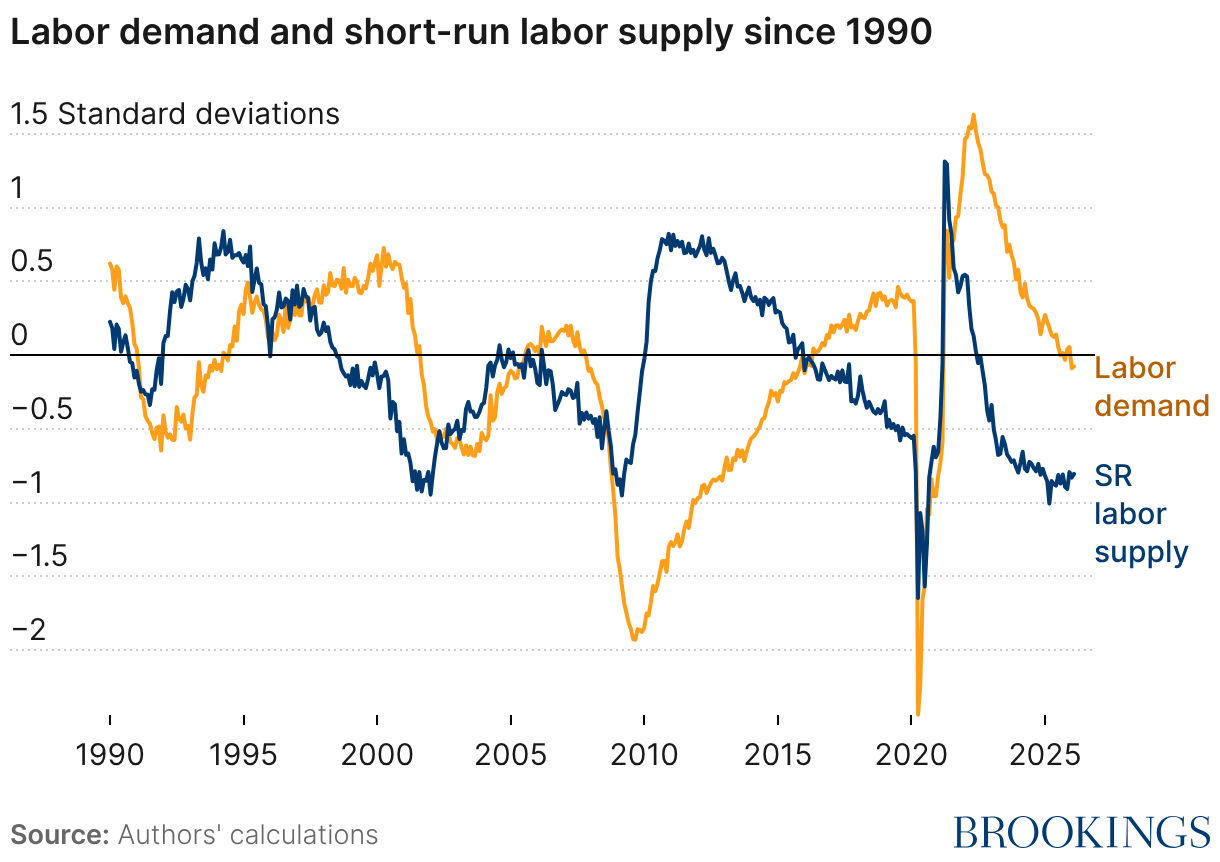
Beginning in mid-2022, labor demand started to decline, suggesting a recession might be developing. But short-run labor supply also fell and, thus, the unemployment rate rose only moderately.
“We interpret this combination—recession-like declines in labor demand without a sharp increase in unemployment rate—as a distinguishing feature of a soft landing relative to a recession,” the authors write.
The authors first use a textual analysis of speeches and publications to establish how policymakers’ narratives are informally linked to labor market indicators. They then use a statistical method to formalize these links and extract the implicitly implied paths for each narrative, providing a structured way to assign economic meaning to the data without relying on complex structural models.
Their monthly dataset runs from January 1960 through February 2026 and contains 94 indicators including payroll employment, unemployment rates, hours worked, job openings, job quits, and wages.
They examine the interaction among labor demand, the supply of labor, and matching frictions that cause an imbalance between demand and supply. The labor supply is measured by population growth, including immigration, and whether people participate in the labor force or, for instance, attend school or care for children at home.
“The narrative framework provides a coherent interpretation of the post-pandemic soft landing by showing how shifts in both labor demand and labor supply jointly shaped the evolution of key labor-market indicators during this period,” the authors write.
The authors point out that short-run labor supply tends to decline during the first part of recessions, rise sharply around the end of recessions after the unemployment rate peaks, and then gradually declines again during the subsequent expansion. After recessions there is a large pool of readily employable workers, which makes it easier to expand employment without increasing wages. As the recovery continues this pool shrinks. In this sense, the short-run labor supply factor captures how both the availability of workers and the responsiveness of labor demand evolve over the business cycle. What is unusual in the current labor market is that despite the weakening of labor demand, short-run labor supply remains subdued.
The authors also write that their framework, because it analyzes such a wide range of indicators, can fill in the gaps when government reports are delayed, such as during the federal government shutdown last fall.
“Missing observations in individual series, such as gaps in unemployment or job openings data, do not prevent estimation,” they write.
Authors





CITATION
Brace, Scott, Erin Crust, Stefano Eusepi, Bart Hobijn and Ayşegül Şahín. 2026. “Making Sense of Labor Market Indicators Amid Data Imperfections.” BPEA Conference Draft, Spring.
-
Acknowledgements and disclosures
David Skidmore authored the summary language for this paper. Chris Miller assisted with data visualization.
The views expressed in this paper are those of the authors and not necessarily those of the institutions that they are affiliated with, including the Federal Reserve System, the Federal Reserve Bank of Chicago, the National Bureau of Economic Research, Princeton University, and U.T. Austin. Parts of this paper were prepared with the assistance of generative artificial intelligence (GenAI) tools. The authors reviewed, edited, and take full responsibility for the final version of the manuscript.
The Brookings Institution is committed to quality, independence, and impact.
We are supported by a diverse array of funders. In line with our values and policies, each Brookings publication represents the sole views of its author(s).