This analysis draws from a Brookings event held on January 28, 2026. To watch the full video of the panel and read a transcript, click here.
One year into President Trump’s “America First” trade policy, the U.S. is not simply adjusting tariff levels. It is navigating a structural shift whose durability remains untested. To examine the economic and strategic implications, Brookings convened four experts with different perspectives: Kelly Ann Shaw, President Trump’s former deputy assistant to the president for international economic affairs; Nora Todd, special assistant to the president and senior director for international economics and labor to President Biden; Wendy Edelberg, Brookings senior fellow in Economic Studies, and Dan Rosen, co-founder of Rhodium Group. In this analysis, I synthesize that discussion and provide my own observations to examine what this moment reveals about the direction and durability of U.S. trade policy. To watch the full video of the panel and read a transcript, click here.
A durable break?
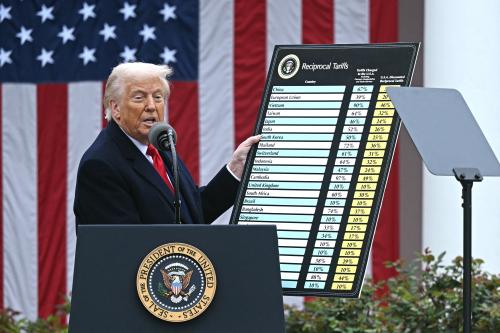
During the Brookings discussion, Kelly Ann Shaw emphasized that different tariffs serve different objectives: “Reciprocal” tariffs counter what the administration views as imbalances in foreign trade barriers; national security actions focus on strategic supply chains and domestic production capacity; and a broader foreign policy category treats tariffs as instruments of economic statecraft rather than tools of trade policy. She argued this structure explains both the breadth of the tariff actions taken under the America First trade policy in 2025 and the administration’s use of multiple rationales.
Nora Todd, accepting this account of the Trump administration’s priorities, argued that Congress bears responsibility for setting the objectives of U.S. trade policy—a responsibility it has largely ceded to the executive. While public sentiment toward the administration’s tariffs is generally negative, dissatisfaction with the World Trade Organization-centered system that preceded them also runs deep. In her view, this exposes the limits of a simple tariffs–versus–free trade debate and points toward a more nuanced approach to trade policy. While acknowledging Congress’s constitutional role in setting trade and tariff policy, Shaw cited the executive’s comparative advantage in negotiation and responsibility for foreign policy.
Is there a future for the rules-based system?
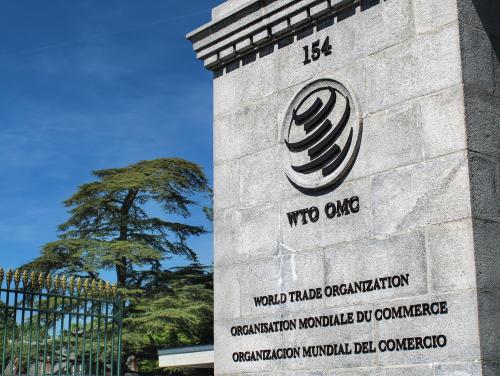
Technological change, geopolitical competition, and the uneven outcomes associated with the era of liberalization and globalization have strained the multilateral trade framework built after World War II and institutionalized through the WTO. As Nora Todd emphasized, these pressures predate the current administration. In Congress, frustration had been building across both parties that the WTO rules were outdated, difficult to revise, and poorly suited to address China’s economic practices. That erosion of confidence made a sharp departure from established trade policy more likely—and a simple return to the status quo politically improbable.
However, Todd cautioned against treating frustration with the WTO-centered system as justification for abandoning a rules-based approach altogether. In her view, the problem is not the existence of binding trade rules but their inadequacy for this phase of globalization. The task now is to determine what updated rules fit this moment—and what tools and guardrails Congress should build so that trade delivers the “quality” outcomes voters want, including on labor and environmental standards.
Executive discretion, uncertainty, and economic costs
A defining feature of U.S. trade policy in 2025 is the shift toward executive discretion and away from predictable, rules-based processes. That discretion has manifested in rapid policy shifts through unilateral announcements and reversals—often with little warning. For American businesses, the result is an environment in which the rules governing cross-border commerce can change overnight. Even when tariffs do not ultimately rise as high or last as long as feared, uncertainty about their scope, duration, and legal basis can delay investment, disrupt supply chains, and complicate pricing and sourcing decisions. The cumulative effect is a more volatile—and at times paralyzing—business environment.
Wendy Edelberg argued that although uncertainty did not derail the macroeconomy in 2025, it still has real and uneven consequences. At the firm level, frequent changes and additional layers of complexity like Section 232 tariffs on steel, aluminum, and copper that apply only to the value of metals embedded in imported products impose disproportionate burdens on small and medium-sized businesses. Larger firms, with the means to invest in specialized legal and trade expertise, are generally better positioned to manage tariff exposure. Smaller firms rarely have comparable capacity, and obtaining outside support can absorb a disproportionate share of their operating budgets, increasing their vulnerability to abrupt policy shifts.
Edelberg described similarly uneven effects at the household level: Tariffs are simply taxes paid by American importers on goods sourced abroad, and the costs of which are ultimately largely borne by American consumers in the form of higher prices. Because lower income households devote a larger share of their budget to affected goods and services, they tend to bear a disproportionate share of the burden, Edelberg noted.
What about China?
Trade policy decisions perceived as domestic in Washington also reshape economic and strategic incentives abroad. China looms particularly large in this regard.
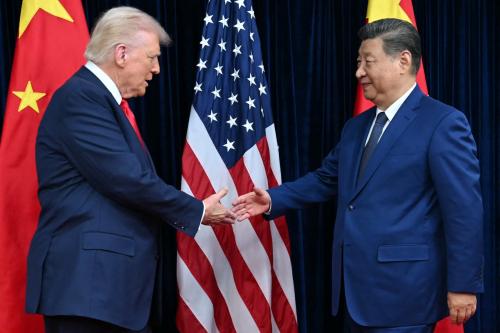
In 2025, U.S. trade actions were imposed forcefully on longtime U.S. allies as well as China, seemingly shifting the focus of U.S. trade policy away from Beijing. On the Brookings panel, Dan Rosen argued that this shift relieved the pressure on China that had begun to push it to rebalance its growth away from exports and towards domestic consumption. China entered the year expecting sustained pushback from the United States, reinforced by coordinated pressure from other advanced economies, Rosen noted, and responded by deploying fiscal support, consumption subsidies, and property-sector stabilization—steps consistent with long-delayed rebalancing toward domestic demand rather than reliance on exports.
However, Rosen explained that by mid-2025 those efforts were radically scaled back. China concluded that the broad reach of U.S. tariff increases would not meaningfully limit its ability to sustain export-led growth and that its trade surplus could continue to expand. The strain U.S. policy placed on relationships with allies, combined with Beijing’s calibrated deployment of its critical minerals leverage, reduced the likelihood of a coordinated effort to constrain China’s export-led model. Rosen further contends that this same leverage contributed to a U.S. pullback on national security restrictions limiting China’s access to certain advanced technologies—restrictions first formulated under the first Trump administration and strengthened under Biden.
Shaw disputed that this amounted to a strategic retreat from confronting China. In her view, concerns about subsidization, excess capacity, economic coercion, and overdependence in critical supply chains remain central to the Trump administration’s trade actions, including many instances of the use of nominally country-agnostic Section 232 authorities. She views any current détente between Washington and Beijing as unlikely to endure. Furthermore, while allies may face near-term strain, she contends that as exports from China move into their markets, other countries will confront political and economic pressures similar to those experienced in the United States, potentially widening the base for pushback rather than weakening it.
As the Brookings panel discussion made clear, imposing heavy trade pressure on U.S. allies while sending mixed signals about the U.S. approach to China risks undermining economic security goals and supply chain resilience while eroding trust among partners on whose cooperation the United States depends. Nora Todd argued that weakening allied confidence in U.S. support makes it harder to sustain a durable strategy toward China. She argued that a more coherent approach—shaped with stronger congressional involvement and greater consistency across trade and economic security tools—is necessary to stay tough on China while maintaining allied backing. As Dan Rosen suggested, without the kind of coordinated effort that China initially feared, U.S. trade measures alone are unlikely to impose meaningful constraints on its export-led growth model or its accumulation and use of economic leverage.
What does this moment reveal?
Trade policy in 2025 reflects the priorities of the current president, executed through executive discretion rather than through the rules and norms that once coordinated U.S. trade policy across branches of government and anchored it in multilateral frameworks. That shift has not been grounded in a broadly shared political or institutional consensus. Even if tariff changes become less frequent or dramatic, uncertainty will remain a defining feature of the environment in which American businesses make decisions so long as the underlying framework governing trade policy remains unsettled.
Trade policy has always fused economic policy and foreign policy objectives, often uneasily. It shapes growth, distributional, and industrial outcomes at home, while simultaneously structuring relationships with allies, competitors, and adversaries abroad. In a period of high geopolitical tensions, using trade tools to pursue strategic ends may be unavoidable. Recognizing this reality underscores the need for candor about tradeoffs: using trade policy to pursue strategic and national security objectives may be necessary in today’s geopolitical environment—but it is not costless.
Making sense of this will require a national conversation that takes economic, strategic, diplomatic, and distributional considerations seriously and simultaneously. It will also require greater recognition that the effectiveness of U.S. trade policy depends in significant part on the responses of other governments, whose interests and choices shape whether U.S. measures achieve their intended objectives. Brookings will continue to convene and inform that conversation as policymakers and the public confront the challenging economic and strategic choices that lie ahead.
Related Content
2026
Author

The Brookings Institution is committed to quality, independence, and impact.
We are supported by a diverse array of funders. In line with our values and policies, each Brookings publication represents the sole views of its author(s).
Commentary
Is US trade policy on a new path?
February 19, 2026