



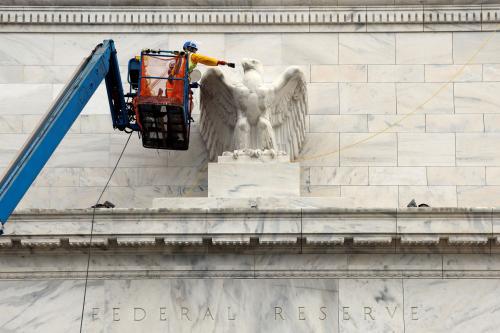
Since the Great Financial Crisis of 2008, the Federal Reserve has amassed roughly $6.6 trillion in assets, primarily in the form of Treasury securities and government-guaranteed mortgage-backed securities. Some, including President Trump’s nominee to be the next chair of the Federal Reserve Board, have suggested that the Fed should reduce the size of its balance sheet. On this episode of the Brookings Podcast on Economic Activity, Darrell Duffie of Stanford University discusses how the central bank could achieve that goal and the pros and cons of ample reserves. Duffie is interviewed by David Wessel, director of the Hutchins Center on Fiscal and Monetary Policy.
Related Content
- Listen to the Brookings Podcast on Economic Activity on Apple, Spotify, YouTube, or wherever you like to get podcasts.
- Learn about other Brookings podcasts from the Brookings Podcast Network.
- Sign up for the podcasts newsletter for occasional updates on featured episodes and new shows.
- Send feedback email to [email protected].
Transcript
[music]
EBERLY: I am Jan Eberly, the James R. and Helen D. Russell Professor of Finance at Northwestern University.
STEINSSON: And I’m Jón Steinsson, Marek Professor of Public Policy and Economics at the University of California Berkeley.
EBERLY: We are the co-editors of the Brookings Papers on Economic Activity, a semi-annual academic conference and journal that pairs rigorous research with real-time policy analysis to address the most urgent economic challenges of the day.
STEINSSON: And this is the Brookings Podcast on Economic Activity, where we share conversations with leading economists on the research they do and how it will affect economic policy.
EBERLY: Welcome to season eight of the BPEA podcast. This year we’ll be listening to discussions about papers from the Spring 2026 BPEA conference hosted by Brookings on March 26th and 27th.
STEINSSON: As always, we have a number of timely topics to discuss this season, including tariffs, AI, and healthcare costs.
EBERLY: And today we’re starting this season with research on monetary policy, finance, and the macro economy. It’s a perennial favorite topic of the Brookings Papers that’s as important as ever.
David Wessel, Director of the Brookings Hutchins Center on Fiscal and Monetary Policy, will be speaking with Darrell Duffie, the Adams Distinguished Professor of Management and Professor of Finance at Stanford University, about Duffie’s new paper, “The payment system puts a floor on the Fed’s balance sheet.”
STEINSSON: This is really a very timely paper. Kevin Warsh, President Trump’s nominee to be the next Chair of the Federal Reserve, has said that he thinks the Fed’s balance sheet is too large and needs to be shrunk. But can that really be done without disrupting financial markets?
Many commentators point to the fact that the Fed’s balance sheet was dramatically slimmer prior to the 2008 financial crisis and ask, why can’t we just go back to how monetary policy was conducted then? I’ve always found this to be a very interesting argument and struggle to answer people that make this argument, and that’s why I’m particularly excited about Darrell’s paper.
He really nails it in terms of explaining why things are different now versus prior to 2008, but then also presents several very interesting proposals for how we might slim the Fed’s balance sheet, even though things are quite different today.
EBERLY: Now let’s turn it over to David.
[2:35]
WESSEL: The Federal Reserve’s balance sheet, its portfolio, has grown from less than $1 trillion before the Global Financial Crisis of 2008-9 to over $6 trillion now, and the person who Donald Trump has nominated to be the next chairman of the Fed would like to shrink the Fed’s balance sheet.
And so, I’m really happy to have Darrell Duffie with us today to talk about if the Fed wants to shrink its balance sheet – it has been shrinking a little bit – what would it have to do?
So, Darrell, can we first start out with like, the Fed owns a lot of treasury bills, it owns a lot of mortgage backed securities – that’s on the asset side of the balance sheet – but you’re focused more on the liability side. So, what does the liability side of the Fed’s balance sheet look like?
[3:27]
DUFFIE: The largest liability is the deposits that commercial banks have at the Fed, currently almost $3 trillion, but there’s a close runner up, which is the amount of paper currency in circulation, which is $2.4 trillion.
And then I would mention one more, which is important: it’s the deposit account that the US government has at the Fed, which is currently around $1 trillion dollars, and it goes up and down a lot.
WESSEL: Right. So, in order to shrink the Fed’s balance sheet, it’ll have to reduce the amount of bank deposits, the called “reserves.” It’s not gonna be able to do much about currency, and we can talk a little bit about the treasuries account.
But first, can you talk a little about what are the benefits and what are the costs of the Fed having such a big balance sheet by historical standards?
[4:17]
DUFFIE: Well, the benefits are pretty tangible. I’ll get to the cost in a minute.
The first, and probably most important to the Fed, is that when the Fed says, we’re targeting a given interest rate – let’s say it’s 3% – they really want market rates to be about 3%. And if reserves are not sufficiently abundant, then there’s some scarcity in the market, and that scarcity causes market interest rates to pop up and down., particularly when it pops up ,it’s a problem for implementing monetary policy because the Fed’s not getting the rates that it targets.
Another cost is exactly that scarcity effect, which represents a real cost to banks as they try to manage the sufficiency of their reserve balances to make payments, primarily, it’s the most important.
Governor Chris Waller of the Fed recently and amusingly said that we don’t want banks digging into the couch cushions looking for money. He said, that’s massively inefficient and stupid. So, why deny them the balances that they need if it’s costly for them to go after them? I would say those are the two primary ones, but there’s another one, which is reserves are really a very useful form of liquidity.
So, when a bank needs money in a hurry, like in a crisis or another bank needs money in a hurry, and your bank has some extra reserve balances, that can help get banks through a liquidity crunch. And eliminating problems with that kind of liquidity squeeze is also valuable. I would list those primarily, and as I said, they’re quite tangible.
On the cost side of having a large balance sheet, it’s quite intangible, but also important. There are political costs. The Federal Open Market Committee, which sets policy for the Fed, has mentioned that it’s sensitive to the amount of interest that the Fed pays to commercial banks on their deposits, the reserves. And so, it’s not a great look, at least to some, and including some in Congress, that large banks are getting paid a lot of interest by the Fed.
Now, that is not really a cost because if the banks were not getting that interest on reserve balances, they could get it on treasure bills, for example, and it would be kind of a wash, and the Fed is benefiting to the extent that it has interest expense that it pays to banks. It’s benefiting from the assets that it holds backing those reserves, and it’s kind of over the long run a wash, but it has been mentioned.
There’s also mention in the FOMC minutes generally about the political costs of having a large balance sheet. You can see that in transcripts of the Federal Open Market Committee, where some members of the committee say, well, we’re sensitive to the fact that the public thinks a large balance sheet is not a good look for the Fed as well. So those are both political costs.
They’re also mentioned by a number of people, including some Fed speakers, about the footprint of the Fed. If, for example, the Fed is supplying banks with abundant reserves, then they don’t need to go to each other in money markets to get funding back and forth among the banks, and that can atrophy the money markets, and basically the Fed has a bigger presence in financial markets than some might think appropriate.
Another thing worth mentioning is the Jackson Hole paper by Raghu Rajan and Viral Acharya about seven or eight years ago when they noted that every time the Fed creates a lot of new reserve balances, say from quantitative easing, suddenly the banks need all those balances and it’s hard to go backwards. So, there’s this ratchet effect that they referred to by which banks can become addicted, and that means that it’s hard if you don’t keep the balance sheet down in size, it will eventually grow bigger and bigger. So, that’s something of concern to some people.
I remember the Swiss National Bank expanding its balance sheet to control the price of its currency, and it got bigger and bigger and people kept saying, well, it’s not really a problem, the central bank’s balance sheet can be arbitrarily large. And then finally the Swiss National Bank said, well, maybe it’s getting too big, so we have to stop growing it.
WESSEL: So, the Fed’s current approach is to have enough reserves in the system – they call it ample reserves – so that the money market works well, and that market interest rates are roughly where the Fed wants to be.
This is the ample reserves system, and that is, as you describe in your paper, in part, determined by what the demand for reserves is: how much the banks want to hold in this very liquid asset. But as I said, Kevin Warsh would like to reduce the size of the balance sheet.
So, let’s say that you flee Stanford for Washington and you join the Federal Reserve Board; we should be so lucky. And they say to you, well, Darrell, you’re an expert on this stuff. What are the things we need to do if we wanna reduce the demand for reserves, which will allow us to reduce the size of the Fed’s balance sheet. So why don’t you talk about what a couple of your ideas are?
[9:30]
DUFFIE: Great. I really like the way you couched that question because the premise didn’t have me taking a stand on whether the Fed should have a small balance sheet or not, and I really don’t have a stand. Those costs and benefits are hard to balance, and I don’t want to get into, you know, what’s the right thing to do.
But if the Fed does decide to reduce its balance sheet, there are better and worse ways to do it. Of course, it could immediately try to sell assets, and that would really disrupt financial markets, and it would also lead banks without enough reserve balances to conduct their business because they do depend on them so heavily.
So how could you make banks less dependent on such a large quantity of reserve balances? Well, after all, you know, before the financial crisis, like in 2007, the whole financial system was running on about $10 billion or less of reserve balances, and now we have, as I mentioned, $3 trillion, a factor of 300 times more. So, if we could do it, then why can’t we do it now?
Well, there’s a number of issues here. One is liquidity regulations, which are much easier for the banks to meet just by holding reserve balances. So, there’s a certain demand associated with reserve balances that’s hard to get rid of with the current regime of liquidity regulations. The largest banks, the G-SIBs, the globally systemically important banks, they are supposed to be able to demonstrate on a daily basis that they don’t need to go to the Fed for more balances. They have enough on their own.
So, with those liquidity regulations being what they are, banks don’t want to go to the Fed for balances. They wanna store lots of balances themselves, have them just in case they need them. And some have suggested that those liquidity regulations should be relaxed. I’m not sure how much you can do with that, but there are one or two things that the Fed could consider.
Should I mention those?
WESSEL: Yeah. Lemme just make clear that with, the reason we have these liquidity rules is it’s a reaction to the global financial crisis when the banks we discovered didn’t have enough liquidity and that caused problems for the whole financial system. So, the government made a lot of rules that said you have to have more liquidity.
So, in a pinch you can buy treasuries or meet the demands of your customers. And really part of the question that the banks are raising is, did the pendulum swing too far? And you’re saying, well, maybe it did. And if we swing it the other way, then they’ll need less reserves.
[11:56]
DUFFIE: Yeah, that’s right. And again, and this issue in my paper, I don’t take a really strong stand that we need to dial back liquidity regulations, but I mentioned if you were gonna look at this, there are a couple of areas.
One is the fact that, banks can get liquidity from the Fed to the extent that they store collateral with the Fed in the discount window, but they don’t get credit for that when their supervisors are determining whether they’re meeting their liquidity regulations. Well, the Fed recently clarified that they do get credit for that collateral to the extent that it’s very highly liquid assets like treasury bills, for example, but they don’t get credit for other types of collateral that they’re able to and do store in the discount window.
So, to me that seems like the ready source of liquidity. Maybe it ought to count. It seems natural if it’s properly collateralized, that it ought to count towards a resource that they have.
WESSEL: Let’s just be clear. The banks park reserves at the Fed, and that’s their money. It’s just like the money in my checking account. When you talk about the discount window or other things, they’re borrowing money from the Fed very short term, and that’s where there’s this reluctance to do it because the supervisors don’t give them credit for that liquidity as much as you think they should.
[13:10]
DUFFIE: That’s right. Every little thing here would cause a cost benefit analysis to judge whether it’s appropriate, but that’s one area where I would first look.
Another area that I would look at is the way that the liquidity regulations are written. They specifically advantage holding reserve balances, prioritizing them, in effect over holding things like treasury bills. And maybe there’s a good reason for that because reserve balances are perfectly liquid and available for any use in a moment’s notice. But if you put a specific advantage for reserve balances into the way that you test liquidity, you’re creating a natural demand for reserve balances that I don’t think was originally intended in the liquidity regulations. Again, I’m not certain that this is something that should be dialed back, but it’s something that could be looked at.
I have a few other ideas in the paper for what the Fed could do. One of the things that the Fed could do is smooth out the bumps and the available supply of reserves that are caused particularly at quarter ends. This is a bit wonky, but let me just walk through it quickly.
At the end of each quarter, foreign commercial banks are monitored for capital adequacy, so their regulators in other parts of the world, in Japan and Europe and elsewhere, they’re checking up on them, but only on quarter ends. And so, what happens is at the end of each quarter, the banks and the rest of the world are saying, well, if we could just get rid of some of these reserves and other assets, we would meet our capital requirements.
Between the quarter ends, they expand their balance sheets, but at the end of the quarter they drop and quite a lot of reserve balances, like not unusually between $1-400 billion just on the day of the end of the quarter. It’s quite remarkable.
So, what that means is there’s a giant bump, and that bump in the availability of reserve balances causes market interest rates to pop up at the end of each quarter, typically between 10 or more basis points. And that’s somewhat disruptive, and it also makes it hard to keep the average path of reserve balances down. You have to keep it high enough so that you manage these quarter end bumps.
Okay, that’s all by preamble. What could the Fed do about that? The Fed could say, well, quarter end’s coming up, here’s what we’re gonna do: we’re gonna pop an extra $100 or $200 or $300 billion of reserve balances into the market on the day of the end of the quarter, every quarter. And with that, you won’t have this bump.
That sounds like the opposite of lowering the balance sheet. It sounds like it’s increasing the balance sheet. But you’re only doing it on quarter ends, which means on average you can keep the whole path of reserve balances lower because the bumps won’t be as big.
Annette Vissing-Jorgensen at the Board and Bill Nelson at the Bank Policy Institute have suggested offsetting the bumps that are caused when the federal government suddenly increases the size of its deposit account at the Fed, and that sucks reserve balances away from the banks. You could neutralize that effect by doing market operations. The Fed could buy and sell treasury bills, for example, to neutralize those effects, taking out more bumps and allowing the average path to be yet lower without causing these temporary strains and the availability of balances.
WESSEL: And then the other thing you suggest as a possibility is to change the way the Fed pays interest on reserves. Once upon a time, the Fed didn’t pay interest on reserves and the banks didn’t put much on reserve, but that changed in 2008, and now the banks have interest bearing accounts at the Fed, and you suggested there might be a way to change the way they set those interest rates that would discourage them from parking so much money at the Fed.
How would that work?
[16:54]
DUFFIE: Yeah, well, you can’t just lower the interest rate without doing anything else because then the Fed wouldn’t be fighting inflation the way that it needs to fight inflation these days or in another, at another time, it would basically lose control of monetary policy if it just said, we’re gonna lower the interest rate to discourage banks from holding balances.
But what you could do and what some other central banks do is to pay the banks a different interest rate once they have more than enough to meet their payment requirements. So, every day, the banks have to pay out a lot of reserve balances. If they have enough to do that, they probably don’t need more. You could lower the interest rate after that point.
If that happened, then banks with more than enough reserves would try to lend them to other banks because they don’t want a low interest rate on those extra balances. And other banks would say, good, I need those, and that’ll make the amount of balances you need to run the system lower.
And some other banks might say, no, I don’t want anymore, there’s too much, and the Fed could just take those balances back and keep monetary policy running. The problem with this proposal is twofold. Number one, it would be very controversial and would take a long time to set up. That’s the biggest concern.
The other one is, how much is too much? When does a bank have enough reserves? That’s not easy to determine, and there are various approaches for dealing with that that are mentioned in my paper.
This proposal to tier down the remuneration of reserves, I’m not optimistic that the Fed would actually pull this off if it had to reduce its balance sheet. This might be the very last on the list of its approaches to doing that. But it would work. It would just be quite a lot of effort and communication.
WESSEL: So Darrell, I wonder in a final question, sometimes people think, well, this is just the plumbing, and we’ll let the plumbers deal with it. The academics and the technicians at the Fed.
When you talk to students at Stanford or people outside of the small set of people who actually make this policy, how do you explain to them the importance of getting this right?
[19:02]
DUFFIE: That’s a terrific question, David. In fact, I just gave my PhD students a question on their final exam related to this, and we talked through the importance of understanding how this plumbing works, and it is plumbing and it’s not that exciting for many economists, but it has a rich set of incentives, and it puts important constraints on the Fed.
After all, when chair nominee Kevin Warsh spoke last spring about the importance of reducing the Fed’s balance sheet to him, he talked about the political independence of the Fed. So here we go all the way from the underground plumbing of the monetary system, all the way up to the independence of the Federal Reserve.
Kevin Warsh’s concern is that to appearances, the Fed has a very large balance sheet compared to what it did before. That causes some, especially people that are not familiar with the plumbing, to think that the Fed is being adventurous. It’s out there buying willy-nilly whatever it wants to buy, and maybe the wings of the Fed should be clipped and keep it, you know, closer to the earth and not so adventurous in going out and buying things here and there.
As you mentioned at the beginning of our conversation, this is not really about buying assets. It’s about how much liabilities are needed to run the financial system in a plumbing sense. So here we go from plumbing to this major political economic issue of the Fed’s independence, all in one leap.
WESSEL: Great. Well, Darrell thank you very much for the paper and the very clear explanation.
[20:28]
DUFFIE: Thank you, David. You know it’s always a pleasure to talk to you.
[music]
STEINSSON: Once again, I’m Jón Steinsson
EBERLY: And I’m Jan Eberly.
STEINSSON: And this has been the Brookings Podcast on Economic Activity. Thanks to our guests for this great conversation and be sure to subscribe to get notifications about new releases of this podcast.
EBERLY: The Brookings Podcast on Economic Activity is produced by the Brookings Podcast Network. Learn more about this and our other podcasts at Brookings dot edu slash podcasts. Send feedback to podcasts at Brookings dot edu and find out more about the Brookings Papers on Economic Activity online at Brookings dot edu slash B-P-E-A.
STEINSSON: Thanks to the team that makes this podcast possible. Fred Dews, supervising producer Chris Miller, co-producer, Gaston Reboredo, co-producer and audio engineer. Show Art was designed by Katie Meris. And promotional support comes from our colleagues in Brookings Communications.
Participants



The Brookings Institution is committed to quality, independence, and impact.
We are supported by a diverse array of funders. In line with our values and policies, each Brookings publication represents the sole views of its author(s).



Commentary
PodcastHow can the Fed reduce its balance sheet?
April 2, 2026
Listen on
Brookings Podcast on Economic Activity