This is a summary of an event held on March 18, 2026. You can watch the full video of the event here.
On March 18, The Hamilton Project and Hutchins Center on Fiscal and Monetary Policy hosted an event on homeowners insurance and climate risk. In conjunction with the event, The Hamilton Project released a policy proposal from Benjamin Collier, Benjamin Keys, and Philip Mulder for a federal reinsurance entity to strengthen the U.S. homeowners insurance market. The Hutchins Center also released a blog summarizing new work by Adam Solomon that explores public natural catastrophe reinsurance programs in other countries.
Aviva Aron-Dine, director of The Hamilton Project, introduced the fireside chat between Minnesota Commerce Commissioner Grace Arnold and Colorado Insurance Commissioner Michael Conway. David Wessel, director of the Hutchins Center, moderated the conversation.
The commissioners discussed the major drivers of homeowners insurance premium increases—both named hail risk as a primary concern in their states—and what states are doing, and can do, to improve the affordability and availability of insurance. Among other policies, Commissioner Arnold pointed to Minnesota’s mandated insurance discount for homeowners who enhance their homes’ resilience. Commissioner Conway highlighted Colorado’s efforts to improve risk modeling and to be sure that property and casualty insurance companies provide incentives for community-wide mitigation efforts as well as those of individual homeowners.
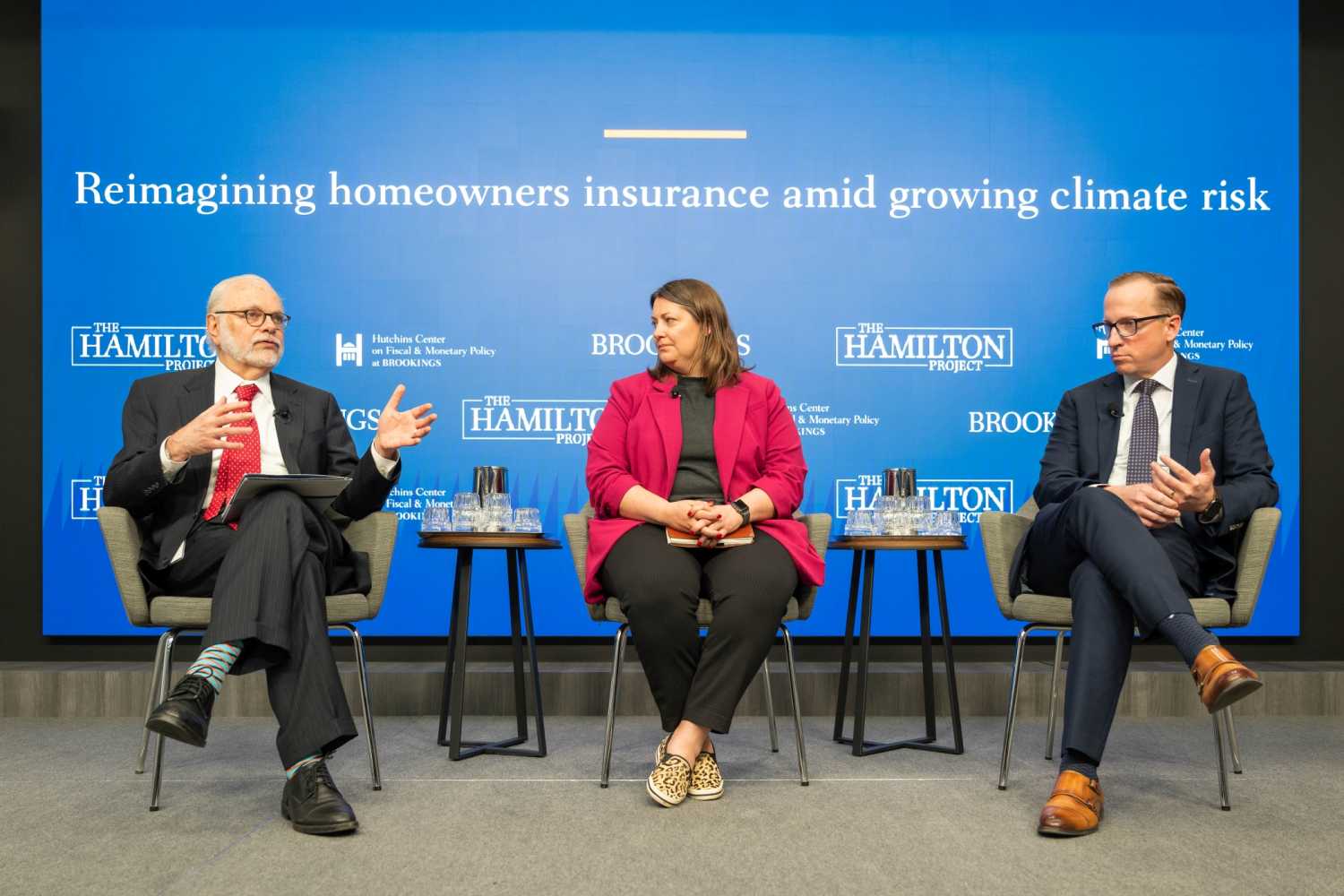
David Wessel, Minnesota Commerce Commissioner Grace Arnold, and Colorado Insurance Commissioner Michael Conway speak at The Hamilton Project and Hutchins Center’s event, “Reimagining homeowners insurance amid growing climate risk.”
In the first panel discussion, Benjamin Keys (University of Pennsylvania), Adam Solomon (NYU), and Thomas Holzheu (Swiss Re Institute) discussed the role of reinsurance—both private and public. The panel was moderated by Nellie Liang (Brookings Institution).
Keys outlined the case for a U.S. federal property reinsurer, “US Re.” Properly designed, US Re could help ensure households have access to consistent and affordable coverage, reduce burdens on state and local governments, and help stabilize mortgage and housing markets.
Solomon offered lessons from foreign governments’ interventions in their insurance markets, emphasizing the importance of (1) risk-based pricing, (2) mitigation incentives, and (3) broad participation.
Holzheu shared his perspective from the private reinsurance industry, arguing that premium increases are largely driven by claims and rising catastrophe losses, not the cost of capital or inefficiencies within the reinsurance market.
The second panel discussion featured Judson Boomhower (University of California, San Diego), Rebecca Diamond (Harvard University), and Roy Wright (Insurance Institute for Business and Home Safety), moderated by Michael Wara (Stanford Doerr).
Echoing Keys and Solomon, Boomhower reiterated the value of insurance pricing. He emphasized the importance of setting prices to reflect risk, as well as mitigation, but also emphasized that pricing reforms alone cannot solve the challenges facing the homeowners insurance market.
Diamond shifted focus from what homeowners pay insurers pre-disaster to what insurers pay homeowners post-disaster. She highlighted the challenges that homeowners may face in filing claims and a lack of data on how successfully, and with how much hassle, homeowners secure payment from insurers when they experience a catastrophic loss. “I think understanding the insurers’ role in the recovery process is as important, if not more important, than the premium,” Diamond said.
Wright discussed the role of both the government and the private sector in scaling mitigation. Wright argued that policy interventions such as discounts are most effective when targeted at times homeowners are already taking action. For example, meeting a FORTIFIED standard is a relatively small incremental cost for a homeowner who is replacing their roof after a storm. The panel also discussed the importance of considering the benefits of resilience in updating building codes even though they may raise the cost of building houses.
To conclude, Wara asked each panelist to name one change—in data availability or policy—they would like to see. The answers were:
- Improving access to data on how people use their insurance policies (Diamond);
- Exploring whether there is a better alternative to policies that set a ceiling on coverage that doesn’t cover the cost of replacement or rebuilding damaged homes (Boomhower); and
- Focusing on restraining the forces that are driving up insurance premiums, including rising risks and the rising costs of replacing or rebuilding (Wright).
Authors


Related Content
2026
The Brookings Institution is committed to quality, independence, and impact.
We are supported by a diverse array of funders. In line with our values and policies, each Brookings publication represents the sole views of its author(s).



Commentary
Event recap—Reimagining homeowners insurance amid growing climate risk
March 20, 2026