Nine out of 10 Americans support the idea that all workers should have the right to take paid time off from their jobs. So why is getting paid time off so hard for American workers?
The United States is the only advanced economy that does not guarantee workers any paid time off. That stark fact tends to get lost because our public debates usually focus on specific categories of time off like paid sick leave, paid parental leave, short-term disability leave, and vacation days. While those debates matter, they’ve also distracted us from a simpler truth: All workers need some time off, and too many have no paid time off at all.
When a worker can’t take a paid day off, the ordinary disruptions of life can become financial emergencies: the fever that turns into lost wages; the parent-teacher meeting you can’t afford to attend; the appointment you delay; the day you should rest but don’t. Over time, a culture of work without rest not only pushes costs into the future but causes a cascade of growing costs that spill over to families, workplaces, and communities. These are the kinds of hidden costs that make the economy feel unfair to so many Americans, leaving them feeling like they’re doing their part, but not getting a fair share in return.
That’s why I proposed in a Hamilton Project policy proposal that earned paid time off (ETO) should be a basic right for workers. Just as all American workers should be paid a minimum wage, all American workers should be able to take an occasional day off and not lose pay.
A 21st-century update to a 1938 law
The Fair Labor Standards Act (FLSA) is the foundation of American workers’ rights. It created the federal minimum wage, established overtime protections tied to the 40-hour workweek, and set child labor protections—historic standards that helped define what a fair workplace means in the United States.
But there is a glaring hole in those standards: The FLSA does not guarantee paid time away from work. Modern work and modern life require taking some time away from work; that’s why basic rights for workers in the 21st century must include the right to take paid time off. Americans agree. A survey fielded by RAND in March 2025 found that nine out of 10 adults surveyed support making earned time off a right for all American workers.
So I’m proposing a straightforward update to the FLSA: Add the right for all workers to earn paid time off as a new baseline right alongside the 40-hour workweek, overtime protections, and the federal minimum wage. Specifically, for every 25 hours of work, people should accrue at least one hour of paid leave, amounting to two weeks of leave per year for full-time, full-year employees.
The public already agrees: Make earned paid time off a right
In March 2025, RAND’s American Life Survey (2,003 respondents via internet and phone) included questions that The Hamilton Project posed to ascertain public views on earned paid time off. The survey found that over 90 percent of workers support the right to earned paid time off (figure 1). 94 percent of workers who already have some form of paid leave support this right, compared to 83 percent of workers who do not have any paid leave. 89 percent of adults who are not currently working support this right. The lowest level of support among workers was among self-employed, independent contractors, or gig workers, who still had a very high 79 percent in support of a right to earn paid time off.

A right to earned paid time off also enjoys strong support across demographic groups, with at least 85 percent support from men and women, and across race and age groups.
The RAND survey found stronger support for a new right to earned paid time off compared with other types of paid leave policies (figure 2).
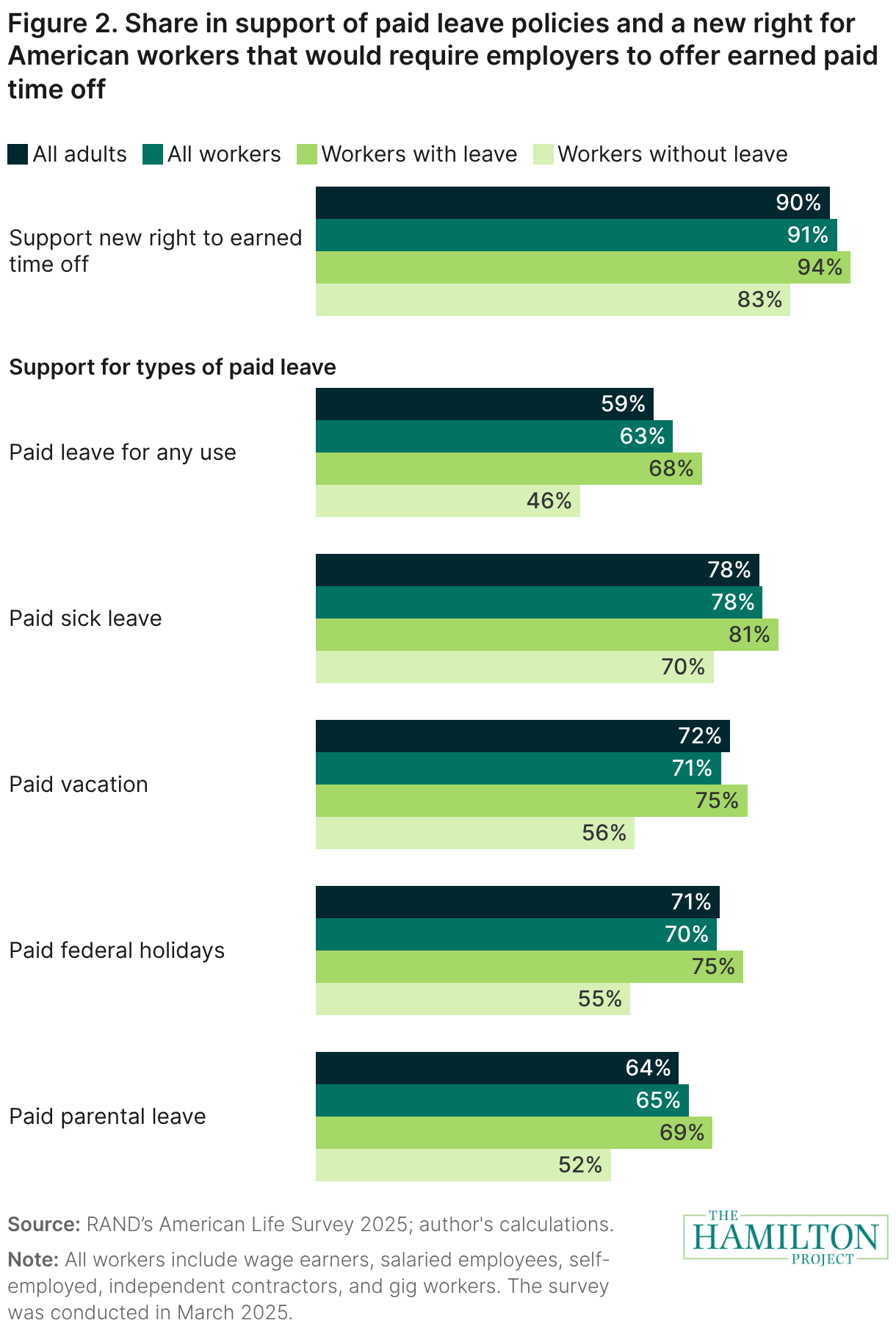
While figure 2 reveals high levels of support for all kinds of paid leave, these shares are all lower than the support for a new right to earned time off. Earned time off connects paid time off with the work that was done to earn it, and makes salient the need to be able to take time off for those who work. In general, support for paid leave is highest among those who currently have access to paid leave, demonstrating how those who already have access to paid leave would like to see their access enshrined into a right that cannot be taken away. Comparing the high level of support (nine out of 10 respondents across all adults) for a new right to earned time off with the lower level of support for all forms of paid leave demonstrates that workers want this right set in law more than they want a specific leave program implemented by government.
Americans clearly believe that working people deserve a baseline right to paid time off. They understand that paid time off cannot be a discretionary perk. To be sure, many workers already have some paid leave, either because their employer offers it or because they live in a state or city that has stepped in. But that’s exactly the problem: Access depends on your job, your bargaining power, and where you live. That’s not just a fairness problem. It’s a productivity problem, a public health problem, and a workforce stability problem.
The idea: Make earned paid time off a right
Here’s the core of my proposal: Paid time off should be earned through work, and it should be available to all qualified workers as a protected right.
Just as the minimum wage establishes a wage floor, a federal earned paid time off standard would establish a time-off floor. A baseline right is what labor standards are for. The minimum wage doesn’t exist because most people earn the minimum wage; it exists because a floor matters. Earned time off is the same idea applied to time.
My earned paid time off proposal starts with straightforward first principles:
- It’s earned, not granted. Eligibility is based on time worked. Workers receive paid leave only after they’ve accrued it.
- It’s universal. It should cover workers across job types and work arrangements, including part-time and part-year work and, importantly, workers in alternative arrangements.
- It’s flexible. Workers control how they use it—vacation, caregiving, personal needs, medical needs—without employers needing to pursue costly verification and documentation. And without workers having to justify their needs to their employer.
How earned paid time off would work
My proposal for earned paid time off modernizes the FLSA to establish a new right alongside the 40-hour workweek, overtime protections, and the federal minimum wage: the right for all qualified workers to earn paid time off. Earned time off is especially well-suited for today’s labor market because it ties directly to time worked. In the proposal, I outline how earned paid time off can extend beyond traditional employment.
1) ETO works for all workers.
- All employers with one or more employees (and independent contractors) would be covered.
- App-based gig workers could qualify by meeting consistent work requirements and could accrue leave based on time on the app and average earnings, following models already used in some places.
- Tipped workers should be paid their normal wage or their full applicable minimum wage, whichever is higher.
2) ETO accrues hourly.
- Full policy: At least one hour of paid leave for every 25 hours worked, up to 80 hours per year (two workweeks) for a full-time, full-year worker.
- Phase-in: For the first two years, the accrual requirement would be lower—one hour per 50 hours worked, up to 40 hours per year—before stepping up to the full standard.
3) ETO is available for use quickly.
- Leave must be available once a worker has accrued at least four hours.
- Employers who front-load leave at the start of a 12-month period don’t need rollover; employers who don’t front-load must allow accrued leave to remain available for at least 12 months after accrual.
4) ETO can be used to meet any need.
- Earned time off is simple because it can be used for any need.
- Workers manage their scarce time budget, to choose the best use of their paid time off
- Workers should be able to use ETO in two-hour blocks or less, so it can cover a doctor’s appointment or a parent-teacher conference.
5) ETO sets clear expectations and protects both employers and workers.
- Employers cannot retaliate against workers for using earned time off.
- Employees must give a minimum of two weeks’ notice to employers when an absence is forecastable by at least two weeks.
- Employers may not require documentation of why leave is being used.
- The goal is a system that supports planning and trust rather than paperwork and suspicion.
A federal baseline that reduces the paid leave patchwork
A major advantage of a federal ETO right is simplicity. Right now, employers operating across locations must comply with a complicated and inconsistent system of state and local earned leave laws. My proposal recommends treating ETO like the minimum wage:
- Federal law sets the floor.
- States can set a higher standard.
- Federal law should preempt standards that are lower, so the country doesn’t keep building a compliance maze.
This helps workers by setting a national baseline and helps employers by reducing regulatory complexity.
What about costs?
Paid time off has costs. But those costs are often misunderstood.
In the proposal, I break costs into three buckets:
- Compliance/recordkeeping,
- Disruptions from absences, and
- Payroll costs of paying workers while they’re away.
Two points matter most:
First, the policy is modest and phased.
At full implementation, 80 hours of paid leave represents about 4 percent of annual work hours for a full-time worker. The phase-in begins at about 2 percent and steps up later. This scale is comparable to the pace at which compensation packages routinely change over time, making adjustment feasible.
Second, the economics of benefits matter.
Over time, compensation tends to rebalance—meaning a portion of the cost is absorbed through slower wage growth, while employers also benefit from offsetting gains like:
- Less “presenteeism” (being at work but unproductive),
- Improved retention and recruitment, and
- Higher productivity when workers can rest and handle life responsibilities before they snowball into crises.
A federally guaranteed right to earned paid time off would ensure that all working Americans—including part-time and part-year workers, and workers in alternative arrangements—have the ability to earn time off without risking their paycheck. It would also help align U.S. labor standards with those of other advanced economies, where paid time away from work is treated as part of a fair workplace. In America, if you work hard and play by the rules, you should be able to afford to take an occasional day off and not lose pay for it.
Author

Related Content

The Brookings Institution is committed to quality, independence, and impact.
We are supported by a diverse array of funders. In line with our values and policies, each Brookings publication represents the sole views of its author(s).



Commentary
Earned paid time off should be a basic right
April 13, 2026
Key takeaways: