This commentary is a response to Zack Cooper’s December 5, 2025, commentary, “How should the United States cooperate with Europe on China strategy?“, published as part of Brookings’ Reimagining Europe’s security project.
The European Union’s (EU) China policy is stuck. So, too, is U.S. China policy. Countries on both sides of the Atlantic have gone too far down the path of competition with China to return to the earlier era of commerce and comity. Yet neither side of the transatlantic partnership seems able to chart a clear way forward for coping with the multifaceted China challenge. The recent crisis in transatlantic relations has only compounded the quandary. It has also dramatically dimmed the prospects of Zack Cooper’s appropriately modest agenda for transatlantic cooperation on China. Instead, a growing number of EU governments seem to be looking to China as a way to de-risk from the United States. At best, transatlantic China policy may drift toward a narrow set of cooperation areas—and even in those areas, it is not clear that either side has the tools it needs to cope with the challenge.
Dysfunction within and between the United States and Europe is limiting their ability to compete with China. By contrast, China’s own domestic challenges—namely, its industrial overcapacity—are enhancing its global leverage and reach. China, for its part, likely recognizes that its overcapacity is creating friction with other countries, but Beijing seems utterly uninterested in remedying the roots of the problem. This dynamic was most evident in October 2025, when China’s leaders doubled down on their current industrial policies in their recommendations for China’s next five-year plan, as Allie Matthias and I wrote last November.
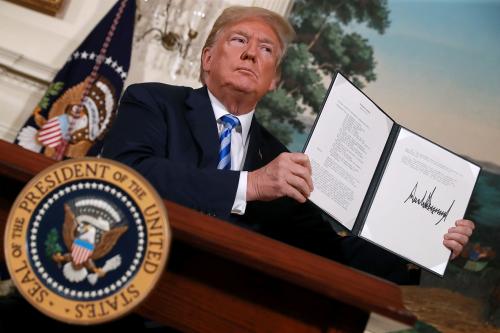
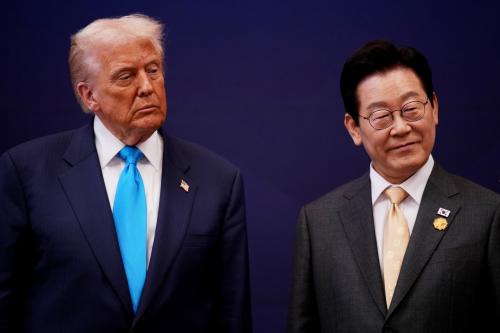
Meanwhile, even before the transatlantic crisis over Greenland, the space for coordinated efforts on the China challenge had diminished. After its post-Liberation Day climbdown from its trade war with Beijing, the Trump administration shifted its focus from competing with Beijing to mollifying it. This dynamic only accelerated following President Donald Trump’s meeting with Chinese President Xi Jinping in South Korea in late October. The administration’s 2025 National Security Strategy articulated more hostility toward the United States’ European allies than toward China.
European leaders seem to understand the nature of the problem. Yet the core issue for Europe and Washington is less about diagnosing the China challenge than about how to implement solutions and whether they will have the desired effect. As French President Emmanuel Macron made clear during his December visit to China and in a subsequent Financial Times column, he understands the economic security challenge China poses. He also threatened consequences if China fails to address the problem.
Yet the desire of many EU member states to diversify away from the United States has only made dealing with the China challenge even more nettlesome. Indeed, leaders from EU states have spent more time this month discussing imposing economic costs on the United States over its threats to Greenland than countering China. And even if the EU can muster the political will to fire its economic “bazooka”—aka its Anti-Coercion Instrument, which encompasses a suite of tools—at Beijing, it is not clear that those measures alone would prompt China to change course. There are at least three reasons why even aggressive EU measures may fail to change China’s behavior:
- Demand for Chinese goods. Some Chinese economists judge that robust U.S. and European demand for Chinese goods will continue to propel China’s export machine, regardless of tariffs. Even after the EU imposed anti-subsidy tariffs on Chinese electric vehicles in 2024, Chinese automobile firms like BYD increased their market share last year. As Brookings scholar Kyle Chan has recently noted, U.S. and Chinese firms are even going through a process of “recoupling,” despite last year’s trade war.
- China’s lessons and leverage from the trade war. China learned from its second trade war with the United States. Beijing now knows that it can weather a de facto embargo and, more importantly, can leverage its control of supply chains to get the United States and a divided EU to back down.
- Unintended consequences for Europe. Even if the EU erects effective protectionist barriers, they might make European companies even less internationally competitive with Chinese firms, since European firms would face less intense Chinese competition at home.
All this suggests that European and U.S. economic security tools will only have the desired impact on China if the United States and Europe—along with other major economies—act together. U.S. Treasury Secretary Scott Bessent has suggested such a strategy. The effort, however, only started bearing some fruit in late 2025, when Mexico announced 50% tariffs on a range of Asian goods, including those from China. It has since lost ground with Canada’s decision to decrease its tariffs on Chinese electric vehicles.
So far, the administration has largely lacked the wherewithal and willingness to cooperate with European allies to address China’s overcapacity. The prospect of that changing in the near future seems unpromising. Last summer’s U.S.-EU trade arrangement has not yet been implemented, with both sides accusing the other of violations. Meanwhile, German Chancellor Friedrich Merz is likely to visit Beijing in February, and Trump is preparing for an expected April summit in Beijing. These trips could make the United States and EU member-state leaders less willing to address contentious issues. As I have written elsewhere, the U.S. administration has been loath to address these macroeconomic imbalances directly with Beijing, and it has instead focused bilateral trade negotiations on particular sectors, firms, and products.
In the high-tech sector—another area Cooper identified for transatlantic cooperation—the Trump administration appears to be switching from a strategy of export control to one of export promotion. The U.S. decision to allow Nvidia to sell its second most powerful AI chip to China underscores that shift. As a result, the U.S. export control regime against China, which the first Trump administration initiated, is in a precarious position. It could very well disintegrate further in the coming year, particularly if European governments and firms follow America’s lead and also sell their most advanced wares to China.
Dissuading China from enhancing its support for Russia’s war against Ukraine could be another area of coordination, though even there, the prospects seem limited. While Trump has claimed that he discussed the war with Xi, the early discussion of a “reverse Kissinger” to break up the Sino-Russian entente seems not to have survived contact with the reality of Moscow and Beijing’s deepening partnership. In the months since, the administration’s diplomacy with Beijing has been preoccupied with trade rather than long-term security issues, narrowing the space to coordinate with the EU on this issue, if not foreclosing the possibility altogether.
By process of elimination, then, the two most promising areas for transatlantic cooperation on China seem to be securing supply chains and enhancing the defense industrial base. On supply chains, the Trump administration has been saying and doing the right things to enhance U.S. access to critical minerals. Indeed, the United States and the EU must cooperate on this issue, lest they find themselves jockeying over the same finite pool of resources—such as rare earth elements—that exist outside of China. The G7 has taken up the issue, and the Trump administration’s Pax Silica initiative could also be a propitious venue for deepening cooperation on critical minerals.
When it comes to refurbishing the U.S. defense industrial base, Trump is likely to welcome increased European purchases of U.S. military equipment and greater investments in U.S. defense production—especially since EU defense investments have climbed over 60% since 2020 and over 10% in 2025, to about 381 billion euros ($450 billion). The conundrum for European governments is whether expanding their dependence on the United States is sustainable amid Washington’s animus toward its European allies.
These dynamics are symptomatic of Europe’s deep strategic conundrum: it finds itself relatively isolated among today’s great powers, whose views toward Europe range from belligerence (Russia) to contempt/predatory (United States) to uncompromising (China). The common denominator for today’s Russia, China, and the United States is a conviction that a more coherent, unified Europe is not in their interest. Each, in its own way, works to make that outcome less likely. After Trump’s Liberation Day tariffs went into effect last spring, many analysts expected Beijing to pursue a “charm offensive” with Europe. Instead, China chose to intensify rather than alleviate Europe’s dilemmas, likely judging that a tougher line on Europe could subvert a unified European approach toward China. The recent shift in rhetoric from leaders of key EU member states is only likely to validate Beijing on the wisdom of its strategy.
Author

Related Content


-
Acknowledgements and disclosures
The author would like to thank SpongeBob SquarePants for effectively distracting his kids while he wrote this article.
The Brookings Institution is committed to quality, independence, and impact.
We are supported by a diverse array of funders. In line with our values and policies, each Brookings publication represents the sole views of its author(s).
Commentary
Can an alliance divided against itself compete with China?
January 30, 2026