Artificial intelligence (AI)’s capacity to automate work and displace workers is substantial. But AI also has transformative potential to act as a force-multiplier for human skills and expertise by expanding worker capabilities. This potential arises from AI’s capacity to collaborate with workers, enabling them to be more effective at their existing tasks, tackle new tasks, and acquire new expertise.
A conceptual framework for pro-worker AI
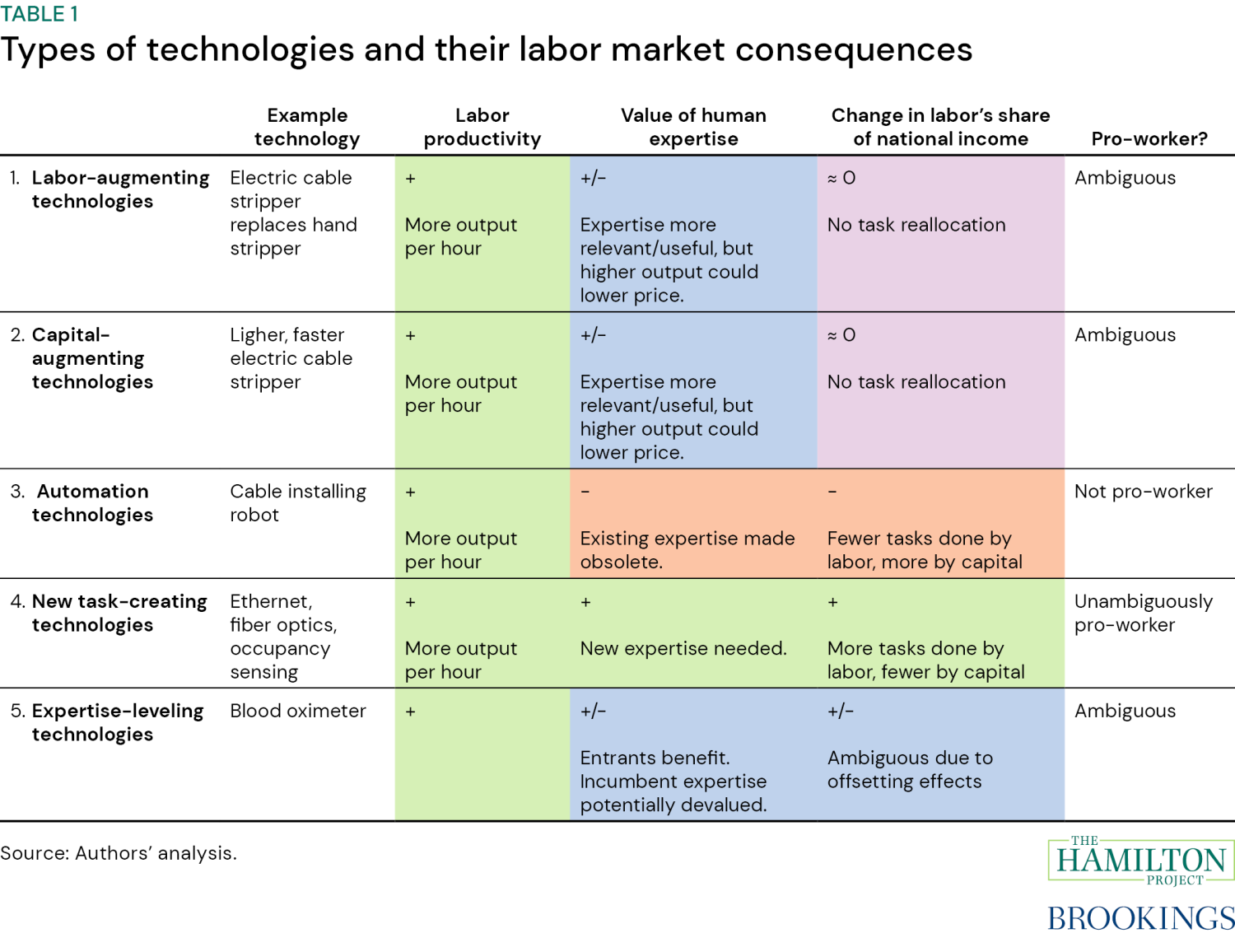
We define pro-worker technologies—including proworker AI—as technologies that make human skills and expertise more valuable. To identify what types of innovations are likely to be pro-worker, it is helpful to group technologies into five broad, economically distinct categories:
- Labor-augmenting technologies make workers more effective at the tasks they already do.
- Capital-augmenting technologies make machines (e.g., algorithms, processes, innovations) better, cheaper, or faster at performing their current tasks.
- Automating technologies directly reshape the division of labor between workers and machines by substituting machinery or algorithms for tasks that were previously performed by workers.
- Expertise-leveling technologies enable a new set of workers to perform tasks that previously demanded expertise from another domain(s).
- New task-creating technologies create new human tasks.
As shown in table 1, one of the five categories, new task-creating technologies, is unambiguously pro-worker, and one of the five categories, automation technologies, is unambiguously not. New task-creating technologies generate demand for novel human expertise. Distinct from the other categories, they increase both the variety and the quantity of work demanded, as well as the value of the expertise required to perform these new tasks. Other technology types can either increase or decrease the value of human skills and expertise. This does not mean they are necessarily socially undesirable, but they pose additional labor market trade-offs, measured in earnings, inequality, and opportunity.
Why isn’t pro-worker AI everywhere?
Pro-worker tools are arguably pro-firm tools as well because they enable workers to produce more value. Yet anecdotal evidence suggests that a great deal of the current AI focus is on task automation and the development of high-level capabilities in line with artificial general intelligence (AGI), with less energy and investment flowing toward the development of pro-worker AI. Why isn’t there more investment in developing pro-worker AI? One reason is incentives: Leading firms perceive greater economic return to building and deploying technologies that automate expertise than those that create new tasks or workers and increase the value of skills and expertise. Additionally, the AI field’s central focus on Artificial General Intelligence (AGI), meaning machines that exceed all human capabilities, also makes it less likely that firms will devote resources to developing pro-worker AI innovations. It is not the responsibility of individual firms to make our AI-intensive future work well for workers, but it is in all our collective interest to ensure that this occurs.
Moving the needle toward pro-worker AI
We see nine ways that public policy could channel advances in AI in a pro-worker direction.
- Shaping pro-worker AI in health care and education. We recommend focusing on specific sectors and activities where opportunities are already abundant.
- Building AI expertise in government. The federal and state governments could and should set goals for AI deployment. To achieve this, AI expertise will be badly needed within governments.
- Using grant-making to support worthwhile AI investments. Grant-making should be constructively directed to shape the course of (some) AI development in a pro-worker direction.
- Fostering competition for excellence. We suggest that R&D and procurement activities in this domain should use a Defense Advanced Research Projects Agency (DARPA)-style competitive prize model.
- Rebalancing the tilted investment playing field in the tax code. Policy should aim to create a more symmetric tax structure, where marginal taxes for hiring and training workers and for investing in equipment and/or software are brought into closer alignment.
- Fostering private sector competition. Antitrust enforcement could foster greater competition in technology development, creating space for new business models that are more conducive to pro-worker AI.
- Harnessing worker voice. Establishing institutional mechanisms for worker input is essential.
- Discouraging “expertise theft.” Building legal frameworks that support workers’ ownership of their capabilities and creative output would give workers greater control over how their expertise is used, reduce the commodification of human knowledge, and preserve incentives to invest in skill development and innovation.
- Loosening up licensure. Licensure requirements and scope of practice boundaries may protect incumbents from upstart entrants, reducing potential gains from newly empowered human experts.
Related Content



Authors



The Brookings Institution is committed to quality, independence, and impact.
We are supported by a diverse array of funders. In line with our values and policies, each Brookings publication represents the sole views of its author(s).