Climate change: A growing threat to education in eastern and southern Africa
Ensuring that school children around the world have access to high-quality, inclusive, and relevant teaching and learning experiences that prepare them for the future is becoming increasingly difficult. Climate change is presenting serious barriers to educational achievement, impeding children’s (especially girls’) ability to learn, thrive, and aspire to a brighter future.
A growing body of evidence demonstrates that climate shocks—heavy rainfall, extreme heat, drought, and landslides—affect learners both directly and indirectly. These events disrupt education by damaging school infrastructure, increasing absenteeism, and impairing concentration and learning outcomes, as cognitive development can be impaired by malnutrition. Taken together, all these climate-related factors keep children out of school.
Synthesis work by Education Development Trust (2024) details how poorer and rural learners experience the greatest learning losses during such events, exacerbating existing inequities. A UNICEF report estimates that 40 million children had their education disrupted as a result of climate-related disasters.
The African continent is widely acknowledged as one of the regions most susceptible to the negative impacts of climate change—a third of the countries most vulnerable to climate change are in eastern and southern Africa. Recent scholarship underscores that Africa is warming faster than the global average, heightening climate vulnerability across the continent. Evidence from 2023-24 also shows that last year was the warmest on record globally, with escalating heatwaves and floods compounding risks to schooling.
Children and young people are disproportionately affected as climate shocks deepen existing inequities and reduce opportunities to learn and thrive. In Malawi, drought has resulted in prolonged primary school closures and, consequently, drop out. In recent years, Kenya has experienced both severe drought and large-scale flooding, destroying the livelihoods of pastoralist communities and forcing families to sacrifice education, especially that of girls. In Rwanda, school leaders report that climate change is having a significant impact on student attendance. In South Africa, flooding is affecting school attendance and leading to school closures.
A study conducted in Zimbabwe by the author of this blog and co-authors found that “in-school adolescent girls are experiencing climate induced health challenges related to physical illness, and mental health disorders which in turn contribute negative impacts on their education including absenteeism, lateness to school, punishment by school authorities, difficulties in concentrating and sleeping during lessons, as well as learning losses.”
Evidence gaps and the rising importance of climate education
While more is known now about the intersection between education and climate change than perhaps a decade or more ago, plenty still remains unknown. There are gaps in evidence, for example, on the most innovative and contextually relevant climate education and skills development approaches for adolescents and youths in order to prepare them for a more solid role in climate adaptation and action in their countries. Thus, as education becomes increasingly recognized as a non-negotiable part of climate response strategies, there is a need for continuous knowledge generation on what works for adolescents and youths, where and with whom. Global and regional frameworks increasingly position education as a core pillar of climate adaptation and resilience. Article 6 of the UNFCCC and Article 12 of the Paris Agreement call on countries to integrate climate change education to enhance public awareness and action. UNICEF’s “Strategy for Climate‑Resilient Education Systems in Eastern and Southern Africa” (2025) highlights climate‑responsive teaching, safer school infrastructure, and strengthened early warning systems to protect learning continuity.
What adolescents and youths are saying: Insights from a multi-country study
A recent multi-country study led by CARE Zimbabwe, in collaboration with multiple partners across Malawi, Kenya, Rwanda, South Africa, and Zimbabwe, captured rich insights from over 200 adolescents, youths, educators, and stakeholders on the frontlines of climate education. The study revealed that across the five countries, adolescents and youths are not passive recipients of climate education but rather active co-creators of knowledge.
This collaborative research study included seven organizations: Education Development Trust, Teach for Zimbabwe, Forum for African Women Educationalists Zimbabwe, Creative Centre for Community Mobilizing, Asante Africa Foundation, Right to Play, and One Planet. Data was collected via a standardized digital survey tool (powered through Kobo Collect) with a mix of quantitative and qualitative questions, which was deployed in 11 districts, as well as through focus group discussions. Across all the participating countries, adolescents (10-18 years) constituted the greater proportion of respondents (63.2%), followed by youths (19-35 years) at 15.1%, teachers/educators (12.1%), and stakeholders (9.6%).
Most of the study participants highlighted that they heard about climate change and understood its connection to various aspects of their lives—education, health, and livelihoods. A significant majority—86% of adolescents and 97% of youths—believe climate change affects their education and skills development and expresses a strong desire to acquire knowledge that enables them to adapt rather than merely understand the problem. As one youth participant from Kigali put it, “We want to learn how to adapt, not just understand the problem.”
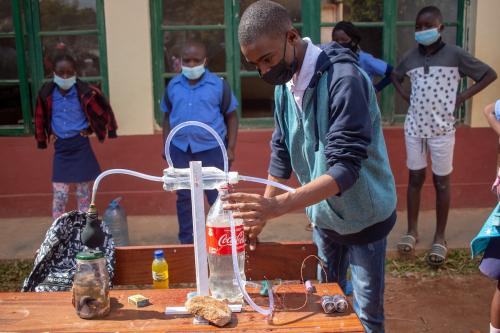
The study also found that schools remain the primary source of climate-related information, complemented by homes, workplaces, community platforms, and peer learning. It was also clear from the data that climate education in these contexts is deeply rooted in community engagement and storytelling, with adolescents often learning through play-based approaches such as drama performances, songs, tree planting campaigns, waste management clubs, radio programs, and community meetings. Adolescents and youths’ voices challenge educators, policymakers, and practitioners to rethink how climate knowledge is delivered, calling for innovation, relevance, and action.
By investing in adolescent- and youth-led, tech-enabled, play-based, and community-rooted approaches, education systems in Africa can nurture a generation that is not only climate-aware but climate-ready. Across the region, young people emphasize learning beyond the classroom through interactive, practical, and community-based experiences. Study participants argue that traditional lecture-type lessons are no longer enough; instead, they seek drama, poetry, and role play to make concepts relatable, school clubs and clean-up campaigns to turn theory into action, and field visits and tree planting exercises to connect learning with lived realities. Evidence from the Global Center on Adaptation shows that community‑based, play‑based, and youth‑led models in schools can significantly enhance climate learning and spur local adaptation actions—from peer‑learning circles to practical projects. These case studies affirm that schools can function as hubs of innovation and resilience-building when adolescents co-create climate knowledge.
We use football to teach about climate change. During competitions, we share messages about the environment.
Educator, Mulanje
The data also points to young people having clear ideas for improving climate education, advocating for a blend of formal and informal learning channels. While the evidence shows that schools remain central, they are often under-resourced. Community leaders and NGOs were identified as instrumental in playing a vital role in outreach, while digital access—through phones, Wi-Fi, and online platforms—was seen as essential for supporting youth-led advocacy. Social media platforms such as WhatsApp and Facebook were cited as popular learning tools. The following enablers for climate change were identified:
- Schools remain central but are often under-resourced.
- Integrate climate topics across all subjects, not just geography.
- Community leaders and NGOs play a vital role in climate education and outreach.
- Provide digital access, phones, Wi-Fi, and other online resources to support youth-led platforms for advocacy.
- Social media platforms, such as WhatsApp and Facebook, are popular for learning among adolescents and youths.
We learn through WhatsApp groups and community meetings. It’s easier than waiting for school lessons.
Youth, Zimbabwe
Reimagining climate education: Adolescent- and youth-led solutions and pathways forward
Despite this momentum, the study pointed to barriers that still persist, including limited access to the internet, phones, and textbooks, a shortage of trained educators, and weak community engagement in rural areas. Across the various contexts, the data shows that despite their enthusiasm, many adolescents and youths face significant barriers:
- Lack of access to the internet, phones, and textbooks.
- Few trained educators with climate expertise.
- Cultural beliefs sometimes hinder climate action.
- Economic instability affects school attendance, reducing exposure to climate concepts.
- Migration for pasture disrupts education in pastoralist communities.
Limited digital infrastructure and access to devices remain binding constraints for climate education. Reviews of African higher education also point to resource limitations and institutional barriers that mirror the challenges adolescents face in rural communities—particularly restricted internet access and limited ICT‑enabled learning. Expanding digital inclusion is therefore essential to enable equitable participation in climate learning and youth‑led advocacy.
Despite these challenges, innovative pedagogies are emerging. Adolescents are teaching elders about climate change in a process of reverse socialization, leading awareness campaigns in schools and villages, and using recycled materials to create eco-bricks and learning tools.
We make eco-bricks from plastic waste and use them as goal posts. It’s fun and educational.
Educator, South Africa
Youth recommendations consistently call for more educators to be trained in climate issues and improved internet access for research. Country-specific insights reinforce specific themes: In Malawi, drama and community action dominate learning, while in Rwanda, climate education is viewed as a pathway to economic empowerment, with calls for agricultural training and early warning systems. Kenyan youth highlight the need to integrate climate education into entrepreneurship and life skills, while South African youth embrace hands-on learning through environmental clubs and social media campaigns. Across all contexts, common priorities emerge among adolescents and youths:
- The need for practical agricultural training and early warning systems.
- Their interest in interactive, play-based, peer-to-peer learning and community-based projects.
- A desire for integration of climate topics into core subjects.
- Integrate climate education into entrepreneurship and life skills.
- Provide nutritional support to improve learning outcomes.
- Create safe spaces for youth dialogue, leadership, and recognition of youth as change agents.
Skills‑based, practical climate education—including agricultural training, disaster preparedness, and local adaptation techniques—strengthens young people’s adaptive capacity and economic resilience. Integrating these components across subjects can support livelihood resilience while deepening climate literacy.
These insights underscore a powerful shift—from classrooms to communities—where adolescents and youths are reimagining climate education as a dynamic, inclusive, and action-oriented process.
Author

The Brookings Institution is committed to quality, independence, and impact.
We are supported by a diverse array of funders. In line with our values and policies, each Brookings publication represents the sole views of its author(s).
Commentary
From classrooms to communities: How adolescents and youths are reimagining climate education across eastern and southern Africa
February 5, 2026