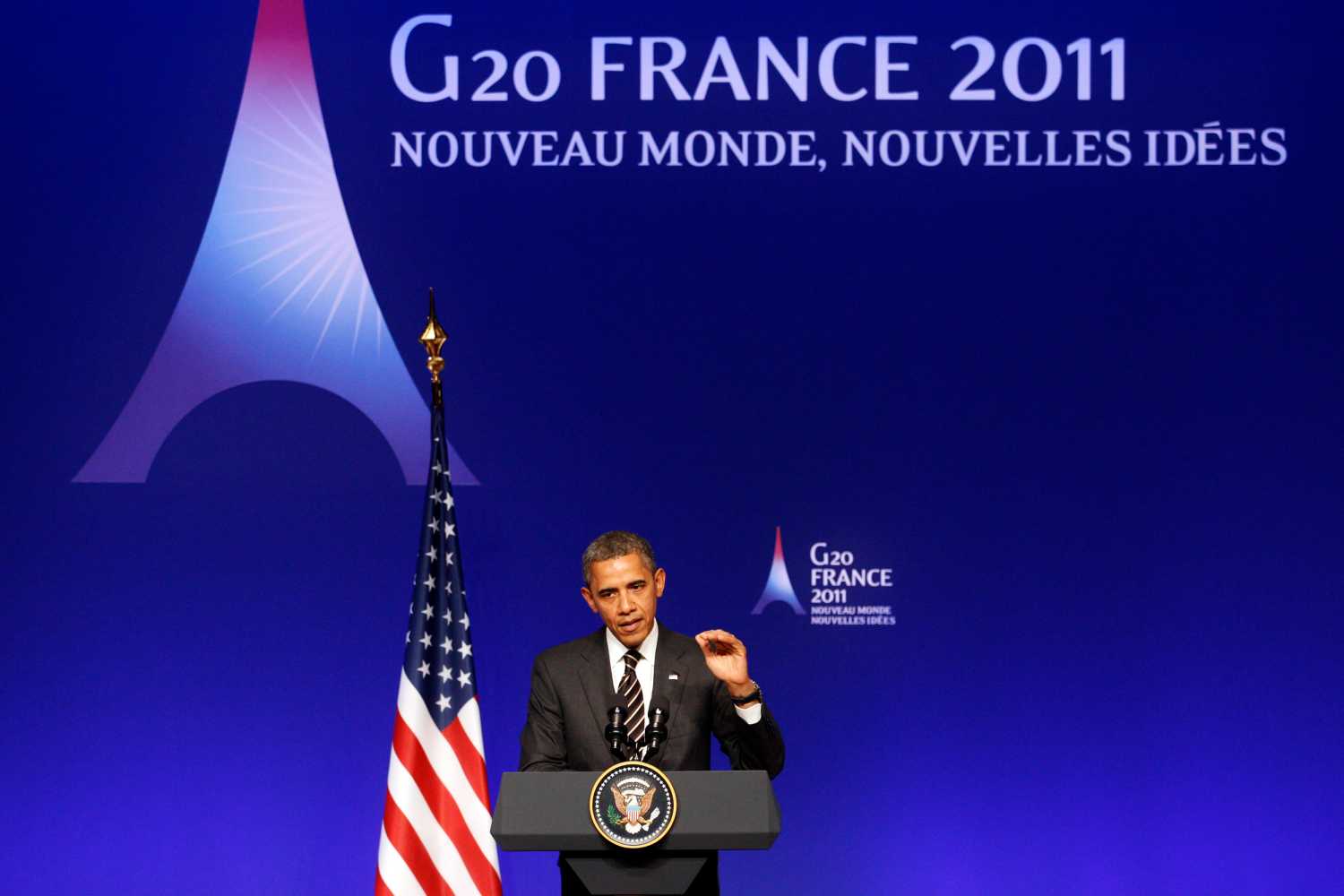
A year ago, many hoped that the November G-20 Leaders’ Summit in Cannes would be an opportunity to state that the worst was over and that the world economy was on a solid growth path again. Leaders were expected to turn to long run issues to implement their vision of “strong, sustainable and balanced” global growth. In April, finance ministers already started a discussion of how to monitor key structural variables as a backdrop to a discussion on rebalancing global growth.
Today, it is clear that a sense of urgency over the short-term prospects of the global economy has returned. In the United States, growth is weak and the fraction of the population employed is at historical lows. The eurozone is facing an existential threat and even the German growth engine is slowing, perhaps even stalling. Japan cannot get out of a now two-decade long stagnation. And the widespread confidence prevailing in emerging markets is giving way to greater anxiety as global trade falters again and advanced country banks are recalling liquidity to their home bases. As has always been the case when anxiety mounts, there is a flight into the U.S. dollar despite America’s fiscal problems. The emerging market country currencies that are basically floating have depreciated sharply against the dollar. Brazil, a country that had been very worried about the appreciation of the real, has intervened to slow down a sudden marked depreciation. Turkey’s central bank is selling reserves. Equity markets have been down worldwide although there is a great deal of volatility and there have been rallies.
The Interdependence of Macroeconomic Policies and Structural Reforms
A year ago, many hoped that the November G-20 Leaders’ Summit in Cannes would be an opportunity to state that the worst was over and that the world economy was on a solid growth path again. Leaders were expected to turn to long run issues to implement their vision of “strong, sustainable and balanced” global growth. In April, finance ministers already started a discussion of how to monitor key structural variables as a backdrop to a discussion on rebalancing global growth.
Downloads:
Argentina's 2001 Economic and Financial Crisis: Lessons for Europe
The 2001 Argentine economic and financial crisis has many parallels with the problems that some European countries are facing today. Prior to the crisis, Argentina was suffering a deep recession, large levels of debt, twin deficits in the fiscal and current accounts, and the country had an overvalued currency but devaluation was not an option.
Downloads:
Can Asia Keep Growing in the Midst of Global Economic Turmoil?
Getting the right fix on the interaction between macroeconomic policy and structural reforms is crucial to navigating the world’s economic woes in the years immediately ahead. The turmoil in industrial Europe and North America today is centrally about plummeting confidence in the ability of political leadership to establish the right balance between stimulating their flagging economies and dealing with the structural problem of future debt. As private sector demand fails to recover quickly because of serious balance sheet effects, it has been difficult for governments to maintain financial market confidence in their ability to deal with spending that is currently needed and future public debt. Fractious politics hamstrings forging majorities for packages designed to lift confidence and get recovery on track. Corrosion of the authority of political leadership feeds back into weak demand for labor and confidence in investing, and deepens the gloom. Restoring confidence will be a slow and painful process in a period of economic and political turmoil.
Downloads:
Brazil in the Current Enviroment: Will the Tropical Social Democracy Sustain the Momentum
In the last decade or so, an unusual commodity boom took place with interest rates decoupling from commodity prices and more recently commodity prices from the economic cycle of advanced economies. If historically interest rates, prices and global output moved together, the rise of China, India and other Asian commodity-dependant economies seem to be responsible for a new type of commodity super cycle taking place despite the difficulties of advanced economies to regain traction and move toward economic recovery. Although commodity prices are not indifferent to the current crisis, and short-term price movements do respond to spikes of risk aversion as observed during September, a combination of supply constraints and rising incomes in emerging and developing economies is putting sustained pressure on prices and it would take a major recession for a “shift down” in this long-term trend. Clearly a lot will depend on the growth prospects of China and other emerging economies. If trend deceleration becomes a fact and China’s long-term growth peters down to 5 percent, the decoupling proposition loses strength. However, the view espoused here is that high commodity prices are here to stay in the foreseeable future.
Downloads:
Responding to Global Economic Challenges: A View from China
The world is again on the brink of a global crisis. Major economies are respectively plagued by different woes: the eurozone is confronted with a free-falling of sovereign debt, leading potentially to a full-fledged financial crisis; the United States is suffering from intractably high unemployment that shows no sign of improvements; and major emerging economies are besieged by unexpected high inflation. Largely due to the economic difficulties, social tensions have increased significantly and unrest has occurred sporadically in many countries.
Downloads:
Wanted: A Strong and Better G-20 For the Global Economy
The resurgence of turbulence in international financial markets—with epicenter not in the U.S. banking system as in 2008 but in the European sovereign sector—potentially brings the G-20 closer to the center of policy action after a phase of relative eclipse. Many questions arise. Are the European risks relevant from a global perspective? Is the G-20 the right forum to avert threats to financial stability? And if so on both counts, what concretely can and should the G-20 do?
Downloads:
Wages and Productivity
For more than two decades, increasing the return on equity has been the supposed recipe for achieving successful growth. During this time, income inequality disappeared from the radar screens of economists. Yet, one of the most unexpected effects of the global financial crisis has been the resurgence of the issue of income inequality not only as a social concern but as a significant cause of the 2008 crisis. This tentative connection is an opportunity to think deeper about: the origins of the crisis; its similarities and differences with the Great Depression; the addition of the European sovereign debt crisis to the American private sector debt problem; and the avenues we should explore to find an exit to the intractable difficulties we continue to face three years after the crisis.
Downloads:
Structural Policies for Sustainable Growth
The 2009 G-20 Pittsburgh Summit declared “strong, sustainable and balanced growth” as the overarching goal of its coordinated efforts to steer the global economy out of the crisis. Two years later, we know that growth in the advanced countries has been sluggish at best and global imbalances persist. Particularly, Europe is probably facing a prolonged period of low growth, since all possible solutions to the European debt crisis will require a downward adjustment of wages, prices and public spending in Southern Europe. For Europe, there is no way of spending itself out of this crisis. The effectiveness of pushing up aggregate spending, as it has been recommended by a wide range of U.S. scholars and policymakers to those European countries which still dispose of some fiscal headroom, can be questioned. If the decline in growth is structural in nature, short-term fiscal stimulus will not have a lasting effect on growth, but will instead drive public debt to an even higher level and thus limit growth potential in the long run for the aging societies in Europe.
Downloads:
Macroeconomic Policy and Structural Reform: The Indian Case
In their introductory chapter, Kemal Derviş and Homi Kharas discuss the limited political and policy space available to the advanced countries in dealing with continued sluggishness in the global recovery. As Martin Wolf has observed, in many ways it is incorrect even to talk of a double-dip recession for the U.S. or Europe. While the mix between overstretched households, undercapitalized banks and over-indebted sovereigns differs across countries, slow growth is both a consequence and a cause of the attempts to repair balance sheets in each sector. The synchronization of these stresses across the major advanced countries has further retarded the global recovery, in a way that was last seen in the 1930s. Even the crisis of the euro can be seen as a manifestation of the relentless interconnection between the overextension of bank credit (in this case to sovereigns), the bursting of a valuation bubble, and the resulting effects on economic growth and bank solvency.
Downloads:
The Risk of Prolonged Stagnation and the Need for International Concerted Action
The prospects for the global economy have been significantly downgraded since the summer of 2011, especially for advanced economies. International organizations such as the International Monetary Fund and Organization for Economic Cooperation and Development now forecast gloomier outlooks for the world economy and anticipate a baseline scenario of renewed slowdown in the U.S. and Europe for the end of 2011 and beginning of 2012. In the best scenario for the global economy, the growth rate is so below potential that there is a significant increase in the unemployment rate. The other scenario, which has a 50 percent probability, is much worse; it is one of recession with an economic contraction in all advanced economies in the next two quarters.
Downloads:
A Needed G-20 Consensus: A New Structural Reform Agenda for Developing Countries
What a wonderful world we lived in before the 2008 collapse of Lehman Brothers and the global financial crisis that followed. Economists and financial market analysts had coined many phrases to describe the period of prosperity before the crisis. Some of these include: the Goldilocks economy, the new economy, the Great Moderation and the second wave of globalization. During this period, the developing world as a whole also enjoyed significant growth acceleration and poverty reduction. Also during this period, international policymakers built up an elegant macroeconomic policy framework, comprised of inflation targeting, the fiscal rules of the Maastricht Treaty for fiscal sustainability and a flexible exchange rate regime. This global economic framework also encouraged regional and international economic integration and private finance initiatives for infrastructure investment. It seemed as if this prevailing global economic framework would ensure the continuation of prosperity in the world economy well into the future.
Downloads:
A Case for Macroeconomic Expansion with Structural Reform
In his preface to The General Theory of Employment, Interest and Money, John Maynard Keynes wrote: “The ideas which are here expressed so laboriously are extremely simple and should be obvious. The difficulty lies, not in the new ideas, but in escaping from the old ones…” Believing in the power of ideas, Keynes thought that rational policy discourse would follow once his new theory was understood. In “Political Aspects of Full Employment,” however, Michael Kalecki pointed out that even if the new principles were understood, business leaders would be opposed to full employment achieved by government spending, for it would weaken their bargaining position by making the threat of an investment downturn or a layoff less credible than otherwise. Thus, adopting Keynesian policy would be a political as well as intellectual challenge.
Downloads:
Mexico - Austerity Measures Without Growth? Greece, Ireland, and Latin America
For several years before the global financial crisis, many advanced economies let government expenditures run well ahead of revenues. Moreover, after the crisis, fiscal policy provided major support in response to the deep downturn. Yet, countercyclical policies were not without a cost. The combination of a slump in economic activity and stimulus measures pushed fiscal deficits in advanced economies to about 10 percent of GDP. And debt-to-GDP ratios in some of these economies are expected to exceed 100 percent in 2011, some 40 percentage points of GDP higher than before the crisis.
Downloads:
The Fiscal Crisis as an Opportunity for Structural Reforms
Politicians, newspapers and commentators have a natural tendency to focus on the current problems. The word “crisis” is probably the most used word in the ongoing economic policy debate. While handling the current crisis is certainly a priority, a longer-term view is ultimately more important for the world economy. After all, a crisis in which a country’s economy falls by 10 percent of GDP—a very large crisis, indeed—is half as important as a “lost decade” of growth, where an economy grows at 2 percent per year less than it could. Japan is one example of this. At the end of the 1980s, Japan was an envied example of an economy with fast growth, a potential challenge to the economic status quo and the dominance of the Western developed economies, and the economic powerhouse. Twenty years of the anemic growth has now made Japan a lackluster heavyweight slugging along.
Downloads:
South Africa - New Opportunities for Structural Policies and Growth
Global economic and financial development since 2008 have forced closer attention on the role of national structural policy intervention, both as potential sources of growth but also as necessary policy initiatives to achieve and maintain macroeconomic stability. The standard fare for stabilization policy has included fiscal, macroeconomic and exchange rate policies. Yet, significantly worsening prospects for global growth and the absence of coordinated global remedies to reverse weakening growth prospects in the advanced economies are now forcing a re-examination of the potential for both national and internationally coordinated structural policy interventions. At the Seoul Summit and more recently, G-20 leaders have increased their emphasis on coordinated short-term and longer-term policies to reverse declining growth. They have also raised attention to the contribution of structural policies in this collective quest. The forthcoming G-20 Cannes Summit is likely to give further momentum to this approach.
Downloads:
The Political Dimension of Global Economic Challenges: Lessons from Turkey
The intense debate surrounding the upcoming G-20 meeting, with the European debt crisis taking center stage, reflects deep historical shifts and dilemmas facing the political process as the 21st century unfolds.
Downloads:
A Structural Agenda for the United States
The global economy is struggling to generate sufficient growth to re-employ capital and labor resources idled in the recent recession in the advanced economies, despite extremely low or even negative real interest rates resulting from highly accommodative monetary policies. The natural resilience of market economies has been restrained by a variety of forces, including the need to work through the overhang of debt and of houses, and consumer durables purchased with that debt in the previous sharp upswing in the credit cycle. Relieving these restraints and overcoming these forces will require a variety of structural as well as cyclical policy initiatives. Businesses and households need to have the incentives, as well as the means, to invest in physical and human capital and to expand their operations and spending. Pessimism about future employment and demand has been the major damper on the expansion, but both the feasibility and effectiveness of countercyclical policies are being impeded by deep structural problems and uncertainties that our political systems seem unable to deal with effectively.
Downloads:
The Brookings Institution is committed to quality, independence, and impact.
We are supported by a diverse array of funders. In line with our values and policies, each Brookings publication represents the sole views of its author(s).